




Category: Reproductive Care
Core Research Direction: Family-centered, health-belief-model-based predictors of fertility preservation uptake and decision quality among adolescent and young adult males newly diagnosed with cancer, and a pilot psychoeducational intervention
Search Intent: Why do so few adolescent and young adult males with cancer bank sperm before treatment, and can family communication and provider or parent recommendations improve fertility preservation uptake and decision quality?
Platform: SANYUN Science Center
Evidence reviewed through: 2026-11-21
Executive Summary
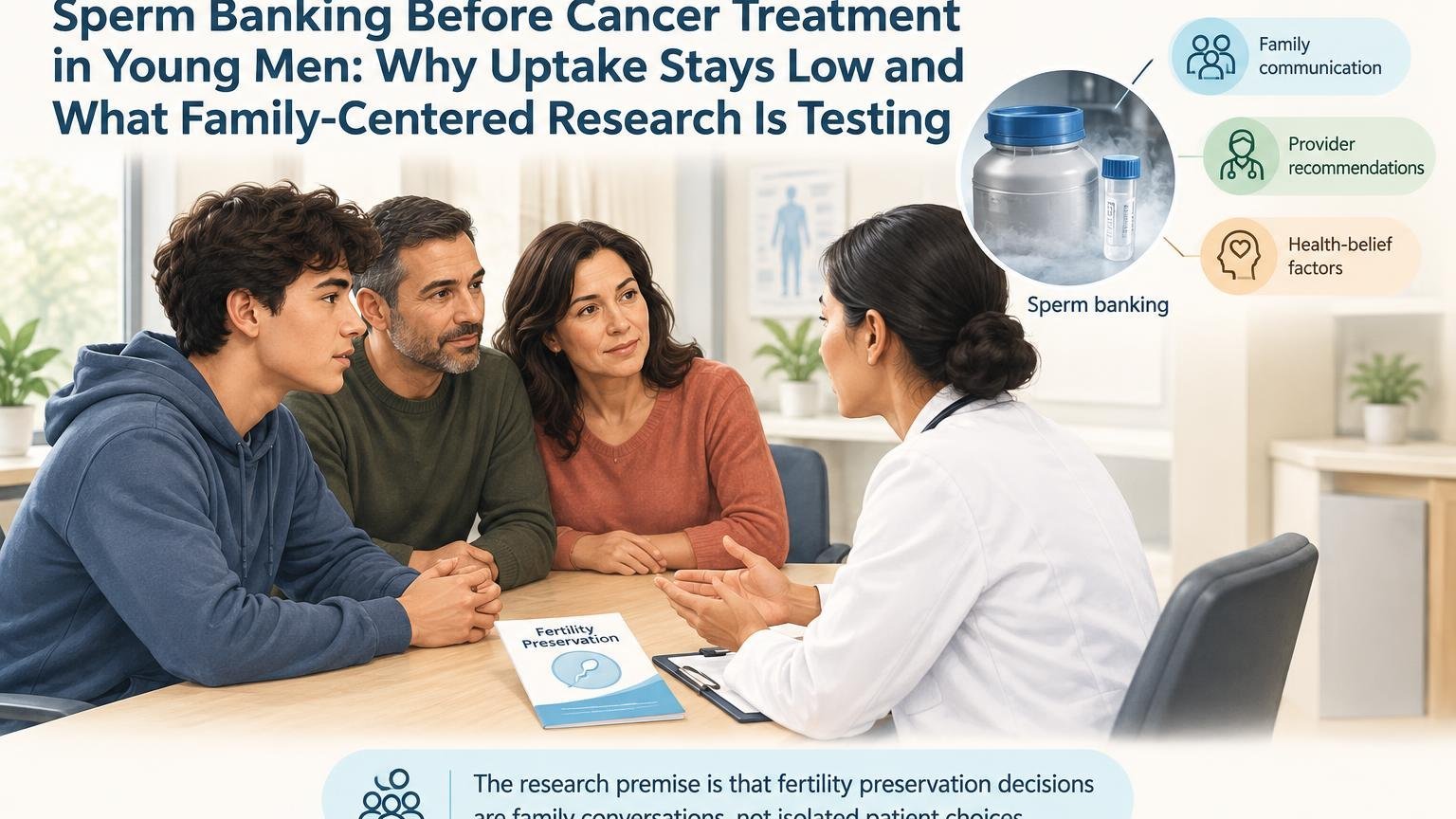
For adolescent and young adult males facing cancer treatment, sperm banking is a well-established way to preserve the option of biological fatherhood later. Yet the behavioral question is why so many eligible young men do not use it. A National Cancer Institute–funded career development project describes a planned, family-centered research program built on two ideas: that parent and provider recommendations strongly shape whether a young man attempts fertility preservation, and that existing interventions have largely skipped over parent–adolescent conversations.[1]
The supplied project description is a grant abstract, not a completed trial report. Its figures — that one in two male childhood cancer survivors has impaired fertility and that only 25% of adolescents opt for fertility preservation before treatment — are asserted without cited primary data in the text available here. The two studies it proposes are described as planned: a prospective mixed-methods study of 40 adolescents and young adults plus their parents, followed by a pilot randomized trial of a psychoeducational intervention in another 40 families.
This matters because fertility regret is a documented psychosocial theme in survivorship narratives, and because the decision window closes once cancer treatment begins. What follows explains the mechanism, weighs the strength of the underlying evidence, and separates what is known from what this research is only trying to find out.
Why This Matters: A Narrow Decision Window
Cancer treatment can damage fertility, and for a pubertal male the practical option is usually to produce and freeze sperm before therapy starts. The project abstract frames this as a rare situation where the preventive step is relatively straightforward yet substantially underused. That combination — low burden, low uptake — is what makes the behavior worth studying rather than assuming that cost, access or technical difficulty explain everything.
The emotional stakes arrive later. According to the abstract, many survivors and their parents come to regret missed fertility preservation opportunities and report distress about possible infertility as the young person approaches reproductive years. That retrospective regret is part of the rationale for studying decisions in real time, at diagnosis, instead of years afterward.
A second reason to focus on adolescents specifically is demographic. The abstract states that the population of childhood cancer survivors in the United States is growing and that one in two male survivors has impaired fertility. Treat that as the project's stated framing rather than as an independently verified prevalence estimate; the supplied text gives no denominator, measurement method or source study for it.
The Mechanism Under Study: Beliefs, Communication and Recommendations
The project borrows a familiar behavioral framework — the Health Belief Model — and applies it to a family situation. In broad terms, such models hold that health behavior depends on how a person perceives susceptibility and severity, weighs benefits against barriers, and feels cued to act. Here the twist is that the decision-maker is not a lone adult: the young man and his parents are treated as a unit, and communication between them is part of the mechanism, not background noise.
The abstract highlights communication in two forms: the quality of communication generally, and specific recommendations from providers or parents that the young man should attempt fertility preservation. It also reports that recent research identified a parent's recommendation as one of the strongest predictors of uptake among adolescent and young adult males. That claim is a useful lead, but in the material supplied here it arrives without a citation, effect size or study design, so it should be read as a hypothesis worth testing rather than a settled quantity.
The intervention logic follows from that. Most prior efforts in this area targeted knowledge and patient–clinician interaction; the argument here is that knowledge alone cannot explain a decision made inside a family. A psychoeducational approach would therefore add structured support for parent–adolescent discussion, on the theory that improving that conversation improves both uptake and the quality of the decision itself.
What the Evidence Shows — and What It Does Not
The honest summary is that this source documents a research plan, not results. Two gaps are named explicitly: most studies are conducted years after therapy, leaving limited information about what predicts fertility preservation among these young men, and little is known about decision quality soon after a decision is made. Decision quality here is a distinct outcome from uptake — it concerns whether the choice was informed and aligned with the family's values, not merely whether sperm were banked.
Study 1 is described as a prospective, mixed-methods design enrolling 40 adolescents and young adults with their parents at the time of diagnosis. Its purpose is to examine individual and family factors drawn from the Health Belief Model alongside communication quality and provider or parent recommendations, in relation to both uptake and decision quality. Mixed methods suggests qualitative interviews will sit beside quantitative questionnaires, which suits a question about how families actually talk.
Study 2 is described as a pilot randomized controlled trial of a family-centered psychoeducational intervention, planned for 40 adolescents and young adults and their parents, informed by what Study 1 finds. Each study is described as having two visits, with participants aged 13 to 21 newly diagnosed with cancer and at risk for infertility. A pilot of this size can test acceptability, feasibility and early signals; it cannot establish effectiveness, and the abstract does not report it as having done so.
| Element | Description in the source | What it can and cannot tell us |
|---|---|---|
| Fertility preservation uptake | 25% of adolescents reported as opting for fertility preservation before cancer treatment | Headline underuse figure, but no source study, sample size or setting is provided in the abstract |
| Survivor fertility impairment | 1 in 2 male childhood cancer survivors stated to have impaired fertility | Framing statistic asserted without a cited primary dataset or measurement definition |
| Key predictor under study | Parent's recommendation described as among the strongest predictors of uptake | Promising but uncited in the supplied text; effect size and design unknown |
| Study 1 design | Prospective mixed-methods study, 40 AYA and parents, at diagnosis | Can describe associations and mechanisms; not designed to prove causation |
| Study 2 design | Planned pilot RCT of a family-centered psychoeducational intervention, 40 AYA and parents | Feasibility and early signals only; too small for effectiveness claims |
| Later stage | Stated plan to support a larger multisite RCT via an R01 | Forward-looking intent; no such trial reported in the supplied text |
Note what is absent. There are no reported baseline characteristics, no measured associations between beliefs and uptake, no decision-quality scores, and no intervention outcomes. Any article or social post asserting that a family intervention has been shown to raise sperm banking rates would be going beyond this source.
Interpretation and Limitations
Several limitations deserve emphasis. First, the entire description comes from a single grant abstract, and abstracts are written to justify funding; they select and frame evidence favorably. Second, the abstract itself notes that no publications are associated with the award in the reporting record, so there is no peer-reviewed results paper in the supplied material to check the claims against.
Third, the numbers carry unstated provenance. A 25% uptake figure and a one-in-two fertility impairment figure can each be true or misleading depending on the population, the era and how fertility preservation and impairment were defined. Fourth, single-site recruitment at a large pediatric oncology program may not generalize to centers with different fertility services, insurance arrangements or cultural norms around family involvement.
Fifth, there is a conceptual caution. Parents' recommendation being a strong predictor is compatible with several explanations: parents may persuade, but parents may also be responding to a young man's own stated wishes, or to a clinician's explicit advice. Observational designs can describe these patterns but struggle to separate them. A small randomized pilot is a step toward causal inference, but at 40 families it is a step, not a verdict.
Finally, the outcome mix needs care. Uptake is countable; decision quality is not. If an intervention raises the proportion of families who discuss fertility preservation and reach a considered decision not to bank, that could be a success on decision quality while leaving uptake unchanged. Readers should resist treating a single percentage as the only meaningful endpoint.
Research Outlook and Practical Reading
The stated trajectory is incremental: complete the prospective study, use its findings to build the intervention, pilot it in a small randomized trial, then seek funding for a larger multisite trial. Each stage is described as planned or future in the source. Anyone following this line of work should look for the peer-reviewed results of the prospective study first, then the pilot's feasibility and acceptability data, before expecting practice guidance.
For families facing a new diagnosis, the useful takeaway is conversational rather than prescriptive. The research premise suggests that a young man's decision is shaped by what the people around him say and how the topic is raised, and that the discussion is worth having early, before treatment forecloses options. What specific words, formats or timing work best remains an open empirical question, not an established protocol.
For clinicians and educators, the project is a reminder that knowledge-focused counseling may be necessary but incomplete. If parent recommendation and communication quality matter as much as the abstract suggests, then the family, not only the patient, is the unit of the conversation. That reframing is the project's central contribution so far — an argument and a design, offered for testing rather than settled fact.
Key Takeaways
- Sperm banking is described as relatively easy yet underused: the abstract reports that only 25% of adolescents opt for fertility preservation before cancer treatment, though the figure's source is not given.
- The project's rationale rests partly on retrospective regret: many survivors and parents reportedly regret missed opportunities and feel distress about potential infertility.
- Parents' recommendation is described as one of the strongest predictors of uptake among adolescent and young adult males, but without a citation or effect size in the supplied text.
- Study 1 is a planned prospective mixed-methods study of 40 adolescents and young adults plus parents at diagnosis, examining health-belief factors and communication in relation to uptake and decision quality.
- Study 2 is a planned pilot randomized trial of a family-centered psychoeducational intervention in another 40 families; no outcomes have been reported in the supplied material.
- Claims that a family intervention improves sperm banking rates are not supported by this source; the described work is a research plan, with a larger multisite trial only envisioned.
Questions and Answers
What is fertility preservation for young men with cancer, and why does timing matter?
Fertility preservation in this context usually means producing and freezing sperm before cancer treatment begins, because treatment can reduce future fertility. The project abstract calls sperm banking relatively easy yet underused, and describes regret among survivors and parents about missed opportunities. The decision window closes once therapy starts, which is why the research focuses on the moment of diagnosis rather than years later.
How many adolescent males with cancer actually bank sperm before treatment?
The grant abstract states that only 25% of adolescents opt for fertility preservation before cancer treatment, despite pubertal males being able to bank sperm. That figure is asserted without a cited study, sample size or setting in the supplied text, so it should be treated as a reported headline number rather than a verified estimate. It is best read as evidence of underuse, not a precise national rate.
Why might a parent's recommendation influence whether a young man banks sperm?
The abstract reports that recent research identified a parent's recommendation as one of the strongest predictors of fertility preservation uptake among adolescent and young adult males. The proposed mechanism is family communication: decisions are made inside a family, not by the patient alone, and prior interventions mostly targeted knowledge and patient–clinician interaction. However, the abstract gives no citation, effect size or study design for this predictor.
Has a family-centered psychoeducational intervention been shown to improve fertility preservation decisions?
Not in the material provided. The abstract describes an intervention that was planned to be piloted in a randomized controlled trial among 40 adolescents and young adults and their parents, informed by a prior prospective study. No results, outcomes or peer-reviewed publication are reported for either study in the supplied text. Readers should look for published feasibility and preliminary data before drawing conclusions about effectiveness.
What are the main limitations of the research described on male adolescent fertility preservation?
The source is a single grant abstract, which is written to justify funding and frames evidence selectively. Key statistics — 25% uptake and one-in-two male survivors with impaired fertility — lack cited primary data in the supplied text. Recruitment is single-site, the studies are small, and a pilot of 40 families can test feasibility but not prove effectiveness. Observational designs also cannot easily separate parental persuasion from shared preferences.
What is decision quality in fertility preservation, and how does it differ from uptake?
Uptake simply counts whether sperm were banked. Decision quality concerns whether the choice was informed, considered and consistent with the family's values — including a well-reasoned decision not to bank. The project treats these as separate outcomes, examining both in a prospective study of 40 adolescents and young adults and their parents at diagnosis. That distinction matters because an intervention could improve deliberation without changing the banking rate.
Sources and References
- NAHATA, LEENA. Optimizing fertility preservation and decision quality in male AYA with cancer: A family-centered intervention.
SANYUN Science Center explains published research on men's reproductive and sexual health, connecting scientific evidence with everyday questions while making sources and limitations clear.
Disclaimer: This article is for scientific education and research communication only. It does not provide medical advice, diagnosis, or individualized treatment recommendations, and does not endorse any medication, supplement, device, penile enlargement procedure, or other intervention. Decisions about sexual and reproductive health should be made in consultation with a qualified healthcare professional. Do not delay seeking professional care because of information in this article.
Original Content & Copyright Notice
- This article is prepared for SANYUN Science Center, drawing on published research and publicly available academic literature on men’s sexual and reproductive health. Its editorial explanations and presentation are developed for this platform.
- Copyright in the original editorial content, selection, and arrangement is reserved by SANYUN Science Center to the extent protected by applicable law. Referenced research, quotations, and third-party materials remain subject to the rights of their respective owners. This notice does not claim ownership of scientific facts or third-party research.
- Except where permitted by applicable law or an applicable license, prior written permission is required to reproduce, republish, translate, adapt, redistribute, or commercially reuse protected content. Attribution alone does not grant permission for such reuse.
- For permitted quotation or authorized reuse, clearly identify the source and retain a link to the original article.
- Source: SANYUN Science Center
- Original URL: Retain the original article URL on science.san-yun.com.
- Copyright Holder: SANYUN Science Center, for its own protected editorial content.
- Quotation, excerpts, or authorized reuse must not distort the scientific meaning, omit material limitations or disclaimers, or imply unverified medical claims, product efficacy, or endorsement by SANYUN Science Center.



