




Category: Clinical Insights
Core Research Direction: Sperm DNA fragmentation (DFI) testing in male infertility: its clinical role and limits relative to routine semen analysis, thresholds, oxidative-stress contributors, and management implications before IVF/ICSI
Search Intent: When is a sperm DNA fragmentation test clinically useful for men in fertility workup, what do the cut-offs and underlying evidence actually support, and what can and cannot be done to lower a high DFI?
Platform: SANYUN Science Center
Evidence reviewed through: 2026-11-15
Executive Summary
Sperm DNA fragmentation (DFI) testing measures the proportion of sperm carrying breaks in their genetic material — information that a standard semen analysis, which counts and characterises sperm, does not provide. The rationale is straightforward: sperm count, motility and shape may all look normal while the DNA inside those sperm is damaged. The clinical value, however, is narrower than marketing often implies.[1]
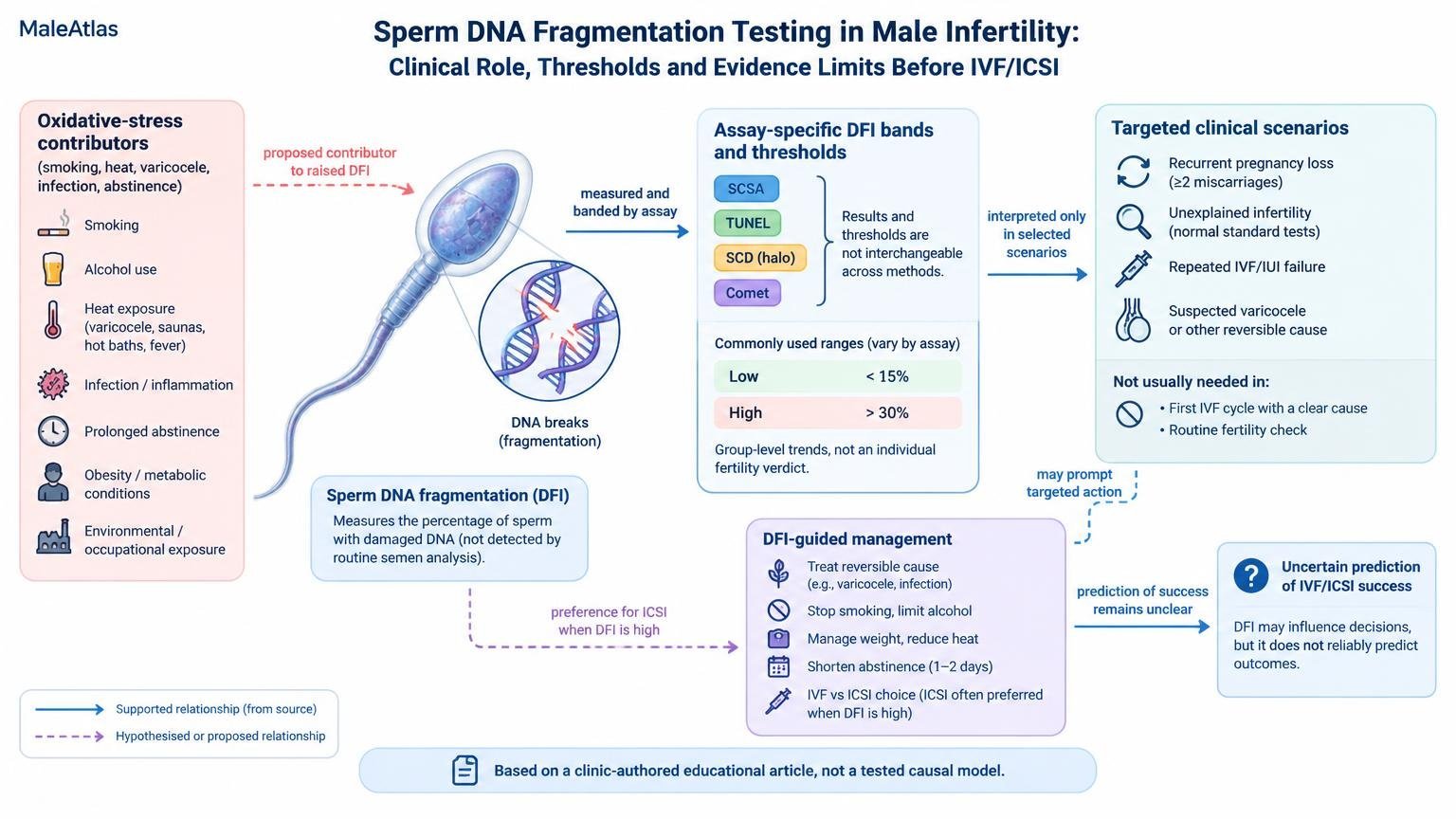
Commonly used bands place a DFI below about 15% as low and above roughly 30% as high, but the exact cut-off depends on the laboratory method, and the main assays — SCSA, TUNEL, SCD and Comet — cannot be used interchangeably. The bands describe group-level trends and cannot predict an individual couple's outcome: a 28% result does not make conception impossible, and a 12% result does not guarantee success.
The practical question is not whether DFI matters but when testing changes a decision. The source material describes testing as most useful in recurrent pregnancy loss, unexplained infertility, repeated IVF or IUI failure, and suspected reversible causes such as varicocele — while stating it is not part of routine IVF workup for most couples with a clear diagnosis and rarely changes the immediate plan. Guideline bodies differ on routine use, and the article notes that it remains unclear how well DFI predicts IVF or ICSI success.
This review interprets a clinic-authored patient education article rather than primary trials. Its statements about oxidative stress, antioxidant failure and abstinence intervals are summarised at a general level without cited effect sizes, so they should be read as orienting evidence signals, not as proof of individual benefit.
Why This Matters
Male fertility assessment has traditionally rested on the semen analysis, a test that answers questions of quantity and movement but is silent on DNA integrity. That gap creates a genuine diagnostic blind spot: a man can receive a reassuring semen report and still carry a high DFI. For couples with unexplained infertility or repeated losses, that blind spot is precisely where additional information might be useful.
At the same time, an additional test carries costs — financial, emotional and logistical — and may generate anxiety without altering management. The source is explicit that DFI testing is not part of routine workup and that, for most couples beginning IVF with a clear diagnosis, a normal-or-not result rarely changes the immediate plan. The value question therefore hinges on whether the result will lead to a different, actionable step.
What DFI Measures and How It Differs From Semen Analysis
A DFI test reports the percentage of sperm whose DNA carries breaks or damage. A standard semen analysis instead counts sperm, assesses how well they swim and describes their shape. These are complementary but non-overlapping domains: normal count, motility and morphology do not exclude damaged sperm DNA, which is the central rationale for the test.
The measurement is assay-dependent. SCSA, TUNEL, SCD (the halo test) and Comet detect damage through different technical routes, so their numerical results and thresholds cannot be used interchangeably. This matters for interpretation: a DFI value is meaningful only alongside the method named on the report and a specialist's reading, not as a fixed pass-or-fail line. Readers comparing results across laboratories or over time should confirm the same assay was used.
| Variable | Source-grounded definition | Interpretation |
|---|---|---|
| DFI (DNA Fragmentation Index) | Percentage of sperm whose DNA carries breaks or damage; not detected by routine semen analysis. | A group-level marker of sperm DNA integrity, not an individual fertility verdict. |
| Low band | Below about 15% in commonly used ranges. | Considered low, but cut-offs shift by laboratory method; a low result does not guarantee success. |
| High band | Above roughly 30% in commonly used ranges. | Considered high; a high result lowers odds but does not preclude fatherhood. |
| Assay method | SCSA, TUNEL, SCD (halo) or Comet. | Results and thresholds are not interchangeable across methods. |
| Spermatogenesis cycle | Roughly 72 to 90 days. | Changes in DFI would be expected to take about three months to appear on a repeat test. |
| Abstinence interval | Shorter gap, often 1–2 days, before sample collection. | Described as frequently associated with lower DFI; an evidence-informed step, not a guarantee. |
Biological and Clinical Mechanism: Why DNA Damage Matters
The source attributes most causes of high DFI to a single dominant process: oxidative stress, in which harmful molecules damage sperm DNA. Contributors listed include smoking and heavy alcohol use, advancing age, heat exposure (varicocele, saunas, hot baths, fever), genital-tract infection or inflammation, prolonged abstinence, obesity and poorly controlled metabolic conditions, and environmental or occupational exposures.
The downstream logic is that the oocyte can repair only limited sperm DNA damage; beyond a point, high damage is linked to lower natural conception chances and, in some couples, higher early miscarriage risk. This is framed as a link rather than a demonstrated causal chain, and the source provides no study-level quantification. Varicocele is highlighted as a recognised and often treatable contributor, which is clinically relevant because it offers a potential point of intervention rather than only a prognostic label.
What the Evidence Shows: Thresholds, Guidelines and Clinical Scenarios
Threshold interpretation is the most commonly misunderstood element. The 15% and 30% bands are commonly used ranges, not a universal standard, and they shift with the assay. The source is careful to state that these bands reflect general trends in groups of men and cannot predict outcomes for an individual couple. A result of 28% does not mean conception is impossible, and a result of 12% does not guarantee success. In practical terms, DFI should be treated as one more piece of information rather than a verdict.
Guideline positions diverge. According to the source, ASRM/AUA guidance does not recommend DFI testing as part of the initial infertility evaluation but suggests considering it in recurrent pregnancy loss; ESHRE's 2023 recurrent pregnancy loss guidance supports considering DNA fragmentation analysis to help explain losses; and EAU guidance goes further, recommending testing in both recurrent pregnancy loss and unexplained infertility. The source does not cite the individual guideline documents or specify versions for all of them, so these should be read as a secondary summary of differing positions rather than a definitive synthesis.
The source identifies the scenarios where testing adds the most value: recurrent pregnancy loss (two or more miscarriages), unexplained infertility with normal standard tests, repeated IVF or IUI failure, and suspected clinical varicocele or another reversible cause. Conversely, a first IVF cycle in a couple with a clear cause, or a routine fertility check without miscarriages or failed cycles, does not usually require the test. Reflexive ordering adds cost and anxiety without changing what would be done next.
Lowering a High DFI: What Has a Rationale and What Does Not
Because spermatogenesis takes roughly 72 to 90 days, any change would be expected to take about three months to appear on a repeat test — a retest after a few weeks is therefore premature. Measures the source associates with a real rationale include stopping smoking and limiting alcohol, treating an underlying cause such as a clinical varicocele or genital-tract infection, managing weight and reducing scrotal heat, and shortening the abstinence interval. A fresh sample after a shorter gap, often 1–2 days, is described as frequently having a lower DFI and as an evidence-based step before IVF.
Antioxidant supplements occupy a different evidentiary position. The source reports that a large, well-designed randomised trial found antioxidants do not significantly improve sperm DNA fragmentation, motility or morphology, and characterises overall evidence for benefit as weak. The trial itself is not cited with a sample size or effect estimates, so the claim should be read as a directional signal against expecting supplements to 'fix' DFI. Where a man chooses to take them, the source frames this as a discussion with a specialist alongside other measures — not a substitute for finding and treating the actual cause, and not self-prescribed at high doses.
DFI and the Choice Between IVF and ICSI
A high DFI rarely means treatment cannot work. The source describes ICSI — injecting a single selected sperm into the egg — as often preferred over conventional IVF when DFI is high, because the embryologist can choose the healthiest-looking sperm. This is a practice preference rather than a demonstrated superiority: visible sperm appearance does not equal DNA integrity, and the source concedes that it is unclear how well DFI predicts IVF or ICSI success. Sperm taken directly from the testicle, where DNA damage tends to be lower than in ejaculated sperm, is mentioned as a consideration in selected cases.
Interpretation and Limitations
The evidence base behind this review is a single clinic-authored patient education article, not a primary study or systematic review. Its statements about mechanisms, lifestyle contributors and supplement failure are summarised without the underlying citations, effect sizes, confidence intervals or sample characteristics that would allow a quantitative appraisal. Where the source reports that a large randomised trial found no significant antioxidant benefit, the trial design and magnitude are not described, so the strength of that specific claim cannot be independently verified from the supplied material.
Several interpretive cautions follow. The 15% and 30% bands are commonly used ranges rather than a validated universal threshold, and assay heterogeneity limits comparability. Guideline disagreement — with ASRM/AUA more conservative, ESHRE supportive in recurrent loss and EAU broader still — reflects genuine uncertainty about whether testing changes outcomes rather than merely adding prognostic information. The predictive value of DFI for IVF or ICSI success remains unclear. And the source's own caution that group-level bands cannot predict individual outcomes applies to every clinical decision derived from a DFI result.
Statistical versus clinical meaning deserves explicit separation here. The source does not provide numerical outcome data linking specific DFI values to live birth or miscarriage rates, so no statistical inference about an individual's probability of success can be drawn from the bands alone. The clinically meaningful question is whether a result will prompt a different, evidence-supported action — treating a varicocele, shortening abstinence, or reconsidering the fertilisation strategy — rather than whether the number itself is above or below a line.
Research Outlook
The gaps identified in the source point to several priorities. Prospective studies are needed to clarify how well DFI predicts IVF and ICSI outcomes, and whether DFI-guided decisions — such as the choice between conventional IVF and ICSI, or the use of testicular sperm in selected cases — actually improve live birth or reduce miscarriage. Standardisation across SCSA, TUNEL, SCD and Comet would improve comparability of thresholds. And pragmatic trials of modifiable contributors, including abstinence interval and treatment of varicocele, would help distinguish interventions that lower the number from interventions that improve outcomes.
Key Takeaways
- DFI measures sperm DNA damage that routine semen analysis cannot detect, which is its core rationale; normal count, motility and morphology do not exclude a high DFI.
- Commonly used bands place DFI below about 15% as low and above roughly 30% as high, but cut-offs depend on the assay, and SCSA, TUNEL, SCD and Comet results are not interchangeable.
- Bands describe group-level trends and cannot predict an individual couple's outcome; a 28% result does not make conception impossible, and a 12% result does not guarantee success.
- Testing is described as most useful in recurrent pregnancy loss, unexplained infertility, repeated IVF/IUI failure and suspected reversible causes such as varicocele — not as routine workup for most couples starting IVF with a clear diagnosis.
- Guideline bodies differ: ASRM/AUA do not recommend routine initial evaluation testing but suggest considering it in recurrent pregnancy loss, ESHRE's 2023 guidance supports considering it in recurrent loss, and EAU recommends it in recurrent loss and unexplained infertility.
- Oxidative stress is the dominant proposed mechanism; contributors include smoking, heavy alcohol use, heat, infection, varicocele, prolonged abstinence and obesity, while a large randomised trial reported no significant antioxidant benefit for DFI, motility or morphology.
- Because spermatogenesis takes roughly 72 to 90 days, retesting should wait about three months; a shorter abstinence interval of often 1–2 days is described as frequently lowering DFI before IVF.
- DFI is one piece of information, not a verdict, and it remains unclear how well it predicts IVF or ICSI success.
Questions and Answers
What does a sperm DNA fragmentation (DFI) test measure that a semen analysis does not?
A DFI test reports the percentage of sperm whose DNA carries breaks or damage. A standard semen analysis instead counts sperm, assesses motility and describes morphology. These domains do not overlap: count, motility and shape can all appear normal while sperm DNA is damaged, so a reassuring semen report does not exclude a high DFI.
What DFI percentage is considered high, and can a single cut-off be applied across laboratories?
Commonly used bands place DFI below about 15% as low and above roughly 30% as high, but no single universally agreed cut-off exists. SCSA, TUNEL, SCD and Comet measure damage differently, so results and thresholds cannot be used interchangeably. A DFI value is interpretable only alongside the assay named on the report and specialist input.
When is sperm DNA fragmentation testing most clinically useful in male infertility?
The source describes testing as adding most value in recurrent pregnancy loss (two or more miscarriages), unexplained infertility with normal standard tests, repeated IVF or IUI failure, and suspected clinical varicocele or another reversible cause. It is not described as routine workup for most couples starting IVF with a clear diagnosis, where a DFI result rarely changes the immediate plan.
Do fertility guidelines agree on routine DFI testing before IVF?
They do not fully agree. According to the source, ASRM/AUA guidance does not recommend DFI testing in the initial infertility evaluation but suggests considering it in recurrent pregnancy loss; ESHRE's 2023 guidance supports considering DNA fragmentation analysis in recurrent loss; and EAU recommends testing in recurrent loss and unexplained infertility. These are secondary summaries without direct citations.
Can antioxidants or lifestyle changes lower a high sperm DNA fragmentation index?
The source associates smoking cessation, limiting alcohol, treating varicocele or infection, weight management, heat reduction and shorter abstinence intervals with a real rationale. By contrast, it reports that a large randomised trial found antioxidants do not significantly improve DFI, motility or morphology, and characterises overall supplement evidence as weak. Changes should be discussed with a specialist, not self-prescribed.
How strong is the evidence that DFI predicts IVF or ICSI success?
It is uncertain. The source states plainly that it is unclear how well DFI predicts IVF or ICSI success, and that the test helps guide decisions without giving a definite answer. The bands reflect group-level trends and cannot predict outcomes for an individual couple. The review is based on a clinic-authored educational article rather than primary trials or a systematic review.
Conceptual framework: Conceptual framework. DFI measures sperm DNA damage undetected by routine semen analysis. Oxidative-stress contributors are proposed to raise DFI; thresholds are assay-specific and interpreted only in selected clinical scenarios. DFI-guided management, including ICSI preference, remains a proposed strategy because prediction of IVF/ICSI success is unclear. Based on a clinic-authored educational article, not a tested causal model.
Academic References & Evidence
SANYUN Science Center explains published research on men's reproductive and sexual health, connecting scientific evidence with everyday questions while making sources and limitations clear.
Disclaimer: This article is for scientific education and research communication only. It does not provide medical advice, diagnosis, or individualized treatment recommendations, and does not endorse any medication, supplement, device, penile enlargement procedure, or other intervention. Decisions about sexual and reproductive health should be made in consultation with a qualified healthcare professional. Do not delay seeking professional care because of information in this article.
Original Content & Copyright Notice
- This article is prepared for SANYUN Science Center, drawing on published research and publicly available academic literature on men’s sexual and reproductive health. Its editorial explanations and presentation are developed for this platform.
- Copyright in the original editorial content, selection, and arrangement is reserved by SANYUN Science Center to the extent protected by applicable law. Referenced research, quotations, and third-party materials remain subject to the rights of their respective owners. This notice does not claim ownership of scientific facts or third-party research.
- Except where permitted by applicable law or an applicable license, prior written permission is required to reproduce, republish, translate, adapt, redistribute, or commercially reuse protected content. Attribution alone does not grant permission for such reuse.
- For permitted quotation or authorized reuse, clearly identify the source and retain a link to the original article.
- Source: SANYUN Science Center
- Original URL: Retain the original article URL on science.san-yun.com.
- Copyright Holder: SANYUN Science Center, for its own protected editorial content.
- Quotation, excerpts, or authorized reuse must not distort the scientific meaning, omit material limitations or disclaimers, or imply unverified medical claims, product efficacy, or endorsement by SANYUN Science Center.



 testing in male infertility: what abnormal thresholds mean, when guidelines support testing, oxidative-stress causes, and what can realistically lower a high DFI before IVF or ICSI.)