


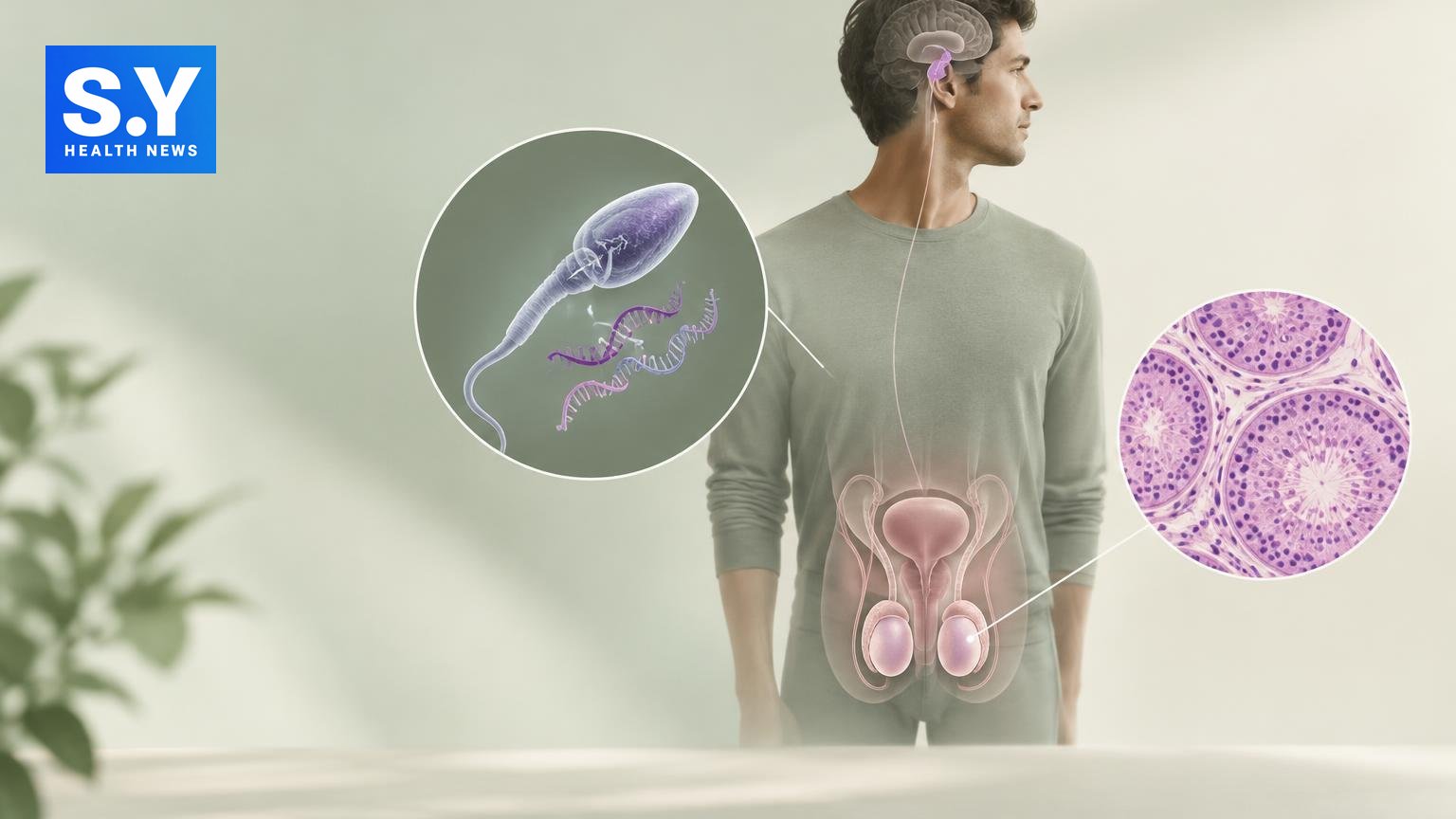


Category: Latest Research
Core Research Direction: Sperm mRNA transcriptome differences and testicular histopathology-hormone-germ-cell relationships as research signals in idiopathic male infertility assessment, with emphasis on what these observational studies can and cannot establish
Search Intent: Does the latest research suggest new ways to understand or assess idiopathic male infertility, and how strong is that evidence?
Platform: SANYUN Science Center
Evidence reviewed through: 2026-11-03
Executive Summary
Two original articles in the November 2026 issue of Andrology look at male infertility from different angles. One compares sperm mRNA profiles between men presenting for infertility assessment and men who had fathered a child; the other describes how specific testicular biopsy patterns line up with germ cell counts, reproductive hormones and semen quality. Neither study introduces a validated clinical test, and both are observational.[1][2][3]
The sperm transcriptome study found 1885 differentially abundant transcripts between groups, with slightly more than half downregulated in the infertility group, and the spermatogenesis gene set was shifted toward downregulation. The histopathology study found that impaired spermatogenesis patterns were associated with higher FSH and LH and lower testosterone, free testosterone and inhibin B, with the heterogeneous arrest pattern showing the most severe profile.
The practical message for readers is about evidence strength. These findings support hypotheses and describe associations in selected clinical populations. They do not establish that sperm mRNA can diagnose idiopathic infertility, nor that biopsy patterns explain hormone values in an individual man. Confirmation in independent cohorts is needed.
Why This Matters
Roughly half of male factor infertility cases are described as idiopathic, meaning standard assessment does not identify a clear cause. That gap is the stated motivation for the sperm RNA work, and it is why molecular and histological studies attract interest even when they are early-stage.
For men and couples going through fertility assessment, it helps to know what the current evidence can and cannot do. Existing hormone tests already have a recognised limitation: FSH and testosterone values overlap substantially between infertile and fertile men and cannot be used to rule out impaired spermatogenesis. New candidate markers inherit a similar burden of proof.
The Sperm mRNA Study: Design and Findings
The transcriptome study used a cross-sectional comparison of two groups. One group was 53 men presenting for infertility assessment; the other was 14 men without a history of infertility who had fathered a child and were presenting for vasectomy. Each participant provided a semen sample for semen analysis and sperm mRNA sequencing.
Among conventional semen parameters, motility best separated the groups, with an area under the ROC curve of 0.746. That is a modest level of discrimination rather than a sharp dividing line, and it comes from a small comparison.
The sequencing analysis found 1885 total differentially abundant transcripts (q < 0.05, fold difference at least 2), and 1004 of these (53.3%) were downregulated in men in the infertility group. The Gene Ontology term for spermatogenesis was enriched, with 40 of 44 differentially abundant genes in that term downregulated in the infertility group.
Known fertility-associated genes PRM1 and PRM2 were downregulated in the infertility samples, along with candidates the authors describe as potentially novel, HOOK1 and SPATA6. A summary score built from 100 upregulated and 100 downregulated genes separated the two groups in this sample.
The Testicular Histopathology Study: Design and Findings
The second study was a retrospective analysis of testicular biopsies from 4245 patients referred for andrological workup at one clinic between 1990 and 2022. Biopsies were grouped into complete spermatogenesis, reduced spermatogenesis, heterogeneous spermatogenic arrest and homogeneous spermatogenic arrest using a published descriptive coding system.
A quantitative subset of 100 biopsies was immunostained to estimate spermatogonia, spermatocytes and spermatids. Relative to complete spermatogenesis, spermatogonia were reduced only in the heterogeneous arrest group, while spermatocytes and spermatids were lower in all impaired groups.
Hormone measurements were available for 1813 patients and semen analyses for 833. Compared with complete spermatogenesis, all impaired groups had significantly higher FSH and LH and lower testosterone, free testosterone and inhibin B, with one exception: inhibin B was not significantly different in the homogeneous arrest group.
The heterogeneous arrest group had the lowest germ cell counts, the most pronounced hormone changes and the lowest sperm counts. Reduced spermatogenesis showed the mildest phenotype. The authors conclude that this heterogeneous pattern is associated with a more severe phenotype than homogeneous arrest.
How the Two Lines of Evidence Fit Together
The two studies share a broad biological logic. Spermatogenesis is regulated through the hypothalamic-pituitary-gonadal axis, so hormones such as FSH, LH, testosterone and inhibin B are treated as biochemical proxies for testicular function. The histopathology study describes how distinct biopsy patterns map onto those proxies.
The RNA study looks downstream, in the ejaculate. Sperm carry residual mRNAs, and differences in their abundance could reflect disrupted spermatogenesis even when routine semen analysis is unremarkable. The enrichment of downregulated spermatogenesis-associated transcripts in the infertility group is consistent with that idea, though it does not prove it.
Read together, the studies suggest candidate markers and phenotype categories worth testing. They do not show that sperm mRNA profiling or detailed biopsy coding improves clinical decisions, because neither study was designed to measure diagnostic accuracy against a clinical reference standard in a prospective population.
Interpretation and Limitations
The main limitation of the RNA study is size and design. With 53 men in the infertility group and 14 proven fertile controls, the comparison is small, and the control group is a particular subset of fertile men attending for vasectomy rather than a general fertile population.
The gene expression summary score was built and tested in the same sample. That is a useful exploratory step but not evidence of diagnostic performance; the authors themselves call for reproducibility testing and for work on whether candidate markers offer mechanistic insight into idiopathic male infertility.
The histopathology study has the strengths and weaknesses of a large retrospective single-centre cohort. Hormone assays changed over the study period, and the time between hormone measurement, semen analysis and biopsy varied; hormones were measured on average 21 days before biopsy and semen analyses on average 145 days before biopsy.
Biopsy-based studies also involve selection. The cohort excluded biopsies with complete atrophy, Sertoli-cell-only patterns or neoplasia, and many patients had biopsies for reasons other than infertility, such as suspicion of germ cell neoplasia in situ or contralateral assessment. Associations may therefore differ in a routine infertility clinic.
Finally, both studies are correlational. Neither can establish that altered sperm mRNA causes infertility or that a specific histopathology produces a given hormone profile. Overlap between groups matters: a hormone or transcript difference that is statistically significant across groups can still be unhelpful for classifying one man.
What the Evidence Does Not Show
| Question | What the studies report | What remains unestablished |
|---|---|---|
| Can sperm mRNA distinguish infertility from proven fertility? | Differentially abundant transcripts and a 200-gene summary score separated groups in a sample of 53 infertility-assessment men and 14 proven fertile controls. | Independent replication, prospective validation, and diagnostic accuracy in an unselected population are not yet shown. |
| Do semen parameters already separate the groups? | Motility best differentiated groups, with an area under the ROC curve of 0.746. | Whether RNA data add information beyond standard semen analysis and hormones has not been tested here. |
| Do biopsy patterns track hormones and semen quality? | Impaired spermatogenesis groups generally had higher FSH and LH, lower testosterone and free testosterone, and lower inhibin B than complete spermatogenesis, with heterogeneous arrest most severe. | Whether these associations improve individual diagnosis or treatment selection is untested. |
| Can hormone values rule out impaired spermatogenesis? | FSH and testosterone overlap substantially between infertile and fertile men. | No single threshold can exclude impaired spermatogenesis on its own. |
Research Outlook
The next steps are practical rather than dramatic. For the RNA work, independent cohorts, larger control groups and pre-specified analyses are needed before any clinical role can be considered. The authors also propose testing whether candidate markers can provide mechanistic information about causes of idiopathic male infertility.
For the histopathology work, the value lies in refining phenotypes. If the heterogeneous arrest pattern consistently marks a more severe clinical profile, that could eventually inform prognostic conversations. Establishing that would require prospective studies linking biopsy patterns to reproductive outcomes, not just to cross-sectional hormone and semen values.
Key Takeaways
- The sperm mRNA study found 1885 differentially abundant transcripts, with 1004 (53.3%) downregulated in men presenting for infertility assessment. It supports a hypothesis, not a diagnostic test.
- The small control group of 14 proven fertile men and the same-sample score development limit how far the RNA findings can be generalised.
- The histopathology cohort of 4245 patients described associations between four biopsy patterns, germ cell counts, hormones and semen quality; heterogeneous arrest showed the most severe profile.
- FSH and testosterone overlap substantially between infertile and fertile men, so a single value cannot rule out impaired spermatogenesis.
- Both studies are observational and should be read as evidence-generating, not as validation of new tests or treatments.
Questions and Answers
What does sperm mRNA transcriptome analysis involve in male infertility research?
Sperm carry residual messenger RNAs that can be sequenced from an ejaculate sample. In the 2026 study, sperm mRNA sequencing was combined with standard semen analysis in 53 men presenting for infertility assessment and 14 proven fertile men. Researchers then compared transcript abundance between groups and tested whether a gene expression summary score could separate them.
Did the sperm mRNA study find differences between infertile and proven fertile men?
Yes. The study identified 1885 differentially abundant transcripts, with 1004 (53.3%) downregulated in the infertility group. The spermatogenesis gene set was enriched, and 40 of 44 genes in that set were downregulated. PRM1 and PRM2 were downregulated, as were HOOK1 and SPATA6. These are group-level differences in a small sample, not validated individual tests.
How strong is the evidence that sperm mRNA could become a diagnostic test?
The evidence is hypothesis-supporting only. The score was developed and tested in the same small sample, with 14 controls, and the authors explicitly call for reproducibility testing. An area under the ROC curve of 0.746 for motility also shows how modest group separation can be. No independent validation or clinical utility study has been reported.
What did the testicular histopathology study show about hormones and semen quality?
In a retrospective cohort of 4245 patients, impaired spermatogenesis patterns were associated with higher FSH and LH and lower testosterone, free testosterone and inhibin B compared with complete spermatogenesis. The heterogeneous arrest group had the lowest germ cell counts, most pronounced hormone changes and lowest sperm counts. Homogeneous arrest did not show a significant inhibin B difference.
What are the main limitations of these male infertility studies?
The RNA study is small and cross-sectional, with a vasectomy-based fertile control group. The histopathology study is retrospective and single-centre, with hormone assays that changed over time and variable intervals between tests and biopsy. Both are associational; neither can establish causation or prove that a marker improves diagnosis or treatment.
Can FSH or testosterone results rule out a sperm production problem?
No. The authors note that FSH and testosterone values overlap substantially between infertile and fertile men and cannot be used to exclude impaired spermatogenesis. Biopsy patterns are associated with average hormone differences, but individual values can fall within overlapping ranges. Hormone results are interpreted alongside semen analysis and clinical context.
Sources and References
- November 2026 – Volume 14 – Issue 8 : Andrology. Andrology. 2026 14(8)
- Xinran Qi; Han Ji; Enrica Bianchi; Susan J. Hall; Gabriella Avellino; William Berg; Priyanka Bearelly; Mark Sigman; Zhijin Wu; Daniel J. Spade. Downregulation of spermatogenesis-associated… : Andrology. Andrology. 2026 14(8):2419-2431 DOI: 10.1111/andr.70060.
- Gülizar Saritas; Nina Mørup; Trine H. Johannsen; Anders Juul; Lise Aksglaede; Sofia B. Winge; Kristian Almstrup. Testicular histopathology and its association… : Andrology. Andrology. 2026 14(8):2388-2400 DOI: 10.1111/andr.13803.
SANYUN Science Center explains published research on men's reproductive and sexual health, connecting scientific evidence with everyday questions while making sources and limitations clear.
Disclaimer: This article is for scientific education and research communication only. It does not provide medical advice, diagnosis, or individualized treatment recommendations, and does not endorse any medication, supplement, device, penile enlargement procedure, or other intervention. Decisions about sexual and reproductive health should be made in consultation with a qualified healthcare professional. Do not delay seeking professional care because of information in this article.
Original Content & Copyright Notice
- This article is prepared for SANYUN Science Center, drawing on published research and publicly available academic literature on men’s sexual and reproductive health. Its editorial explanations and presentation are developed for this platform.
- Copyright in the original editorial content, selection, and arrangement is reserved by SANYUN Science Center to the extent protected by applicable law. Referenced research, quotations, and third-party materials remain subject to the rights of their respective owners. This notice does not claim ownership of scientific facts or third-party research.
- Except where permitted by applicable law or an applicable license, prior written permission is required to reproduce, republish, translate, adapt, redistribute, or commercially reuse protected content. Attribution alone does not grant permission for such reuse.
- For permitted quotation or authorized reuse, clearly identify the source and retain a link to the original article.
- Source: SANYUN Science Center
- Original URL: Retain the original article URL on science.san-yun.com.
- Copyright Holder: SANYUN Science Center, for its own protected editorial content.
- Quotation, excerpts, or authorized reuse must not distort the scientific meaning, omit material limitations or disclaimers, or imply unverified medical claims, product efficacy, or endorsement by SANYUN Science Center.



