




Category: Latest Research
Core Research Direction: An NIH-funded five-year research program testing the hypothesis that sperm centrioles convert tail sliding motion into lateral 'spermatozoa head-kinking' and that this motion matters for egg penetration, as a step toward centriole-based diagnosis of male infertility
Search Intent: What is the 'spermatozoa head-kinking' centriole hypothesis being tested with this new NIH award, and how far is it from clinical use?
Platform: SANYUN Science Center
Evidence reviewed through: 2026-11-21
Executive Summary
The University of Toledo announced on November 19, 2026 that biologist Dr. Tomer Avidor-Reiss received approximately $2.4 million from the NIH's Eunice Kennedy Shriver National Institute of Child Health and Human Development to study sperm centrioles, framed by the university as aiming ultimately at diagnosis and treatment of male infertility. This is a funding announcement, not a report of new experimental results.[1][2]
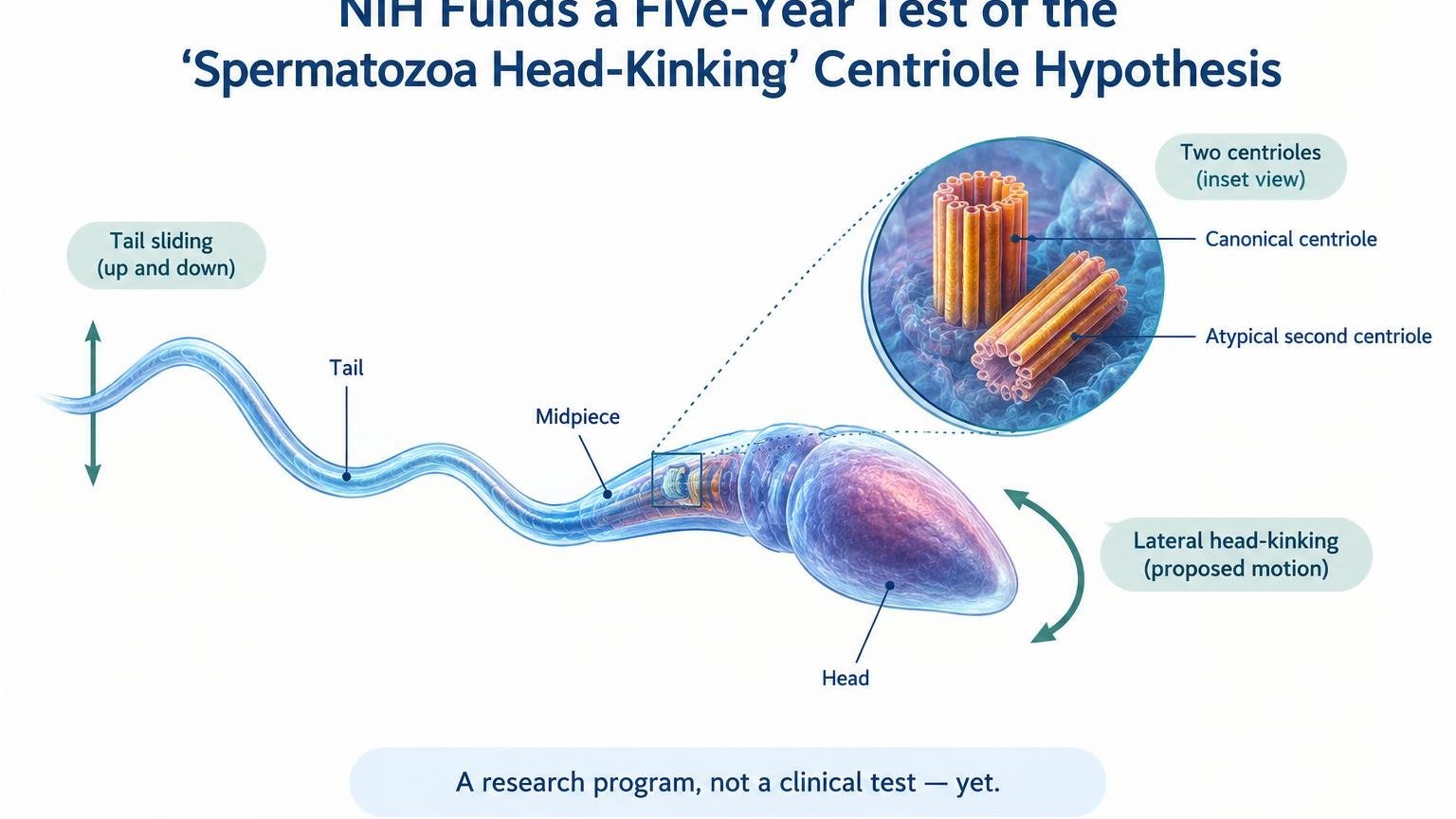
The central idea is a hypothesis the investigator calls 'spermatozoa head-kinking.' In his description, movement begins in the sperm tail, and centrioles act as a transmission system that converts the tail's up-and-down sliding into lateral head-kinking. The planned work also asks how critical that lateral motion is for penetration of the egg.
The hypothesis builds on more than a decade of the team's structural work. The group reported identifying an atypical second centriole in fruit fly sperm in 2009, in additional insects in 2017, and in human and most other mammal sperm in 2018 and 2021. Those findings describe a structure; they do not establish its function or its clinical value.
The award is described as a five-year NIH grant expected to support more than 10 undergraduate students plus four to five graduate students and postdoctoral researchers. No sperm imaging results, egg-penetration experiments, diagnostic accuracy estimates, or patient outcomes are reported in the announcement.
Why This Matters
The release cites estimates that about 15% of couples in the United States struggle to conceive and that roughly half of those cases can be attributed to male infertility. Those figures are presented as estimates without a named data source, denominator, or study design, so they should be read as context rather than as a measured causal share.
Sperm motility is widely regarded as important for fertilization, but the investigator notes that scientists do not fully understand the mechanism behind it. If a specific structural component such as the second centriole proved essential for a particular kind of motion, that could eventually inform how motility is assessed. That is the long-term rationale, not a demonstrated clinical advance.
The investigator has also developed a patent-pending diagnostic test for centriole-based infertility, described as potentially relevant both to men seeking answers about infertility and to the agricultural artificial insemination industry. Patent-pending status indicates an application, not validation: no diagnostic accuracy, reproducibility, or clinical performance data are provided.
The Biological Mechanism Under Investigation
Centrioles are subcellular structures. Most animal cells contain a canonical centriole pair, and sperm typically carry centrioles into the egg. The team's prior work identified a second, atypically shaped centriole in sperm across fruit flies, additional insects, and humans and most other mammals. The existence of this structure raised an obvious question about its purpose.
The head-kinking hypothesis proposes a mechanical role. In the investigator's description, the tail generates an up-and-down sliding movement, and the centrioles act as a transmission system that converts that sliding into lateral head-kinking. The planned research also asks how critical lateral head-kinking is for the sperm to penetrate the egg. Both elements are stated as hypotheses and research aims, not as established mechanisms.[3]
It is worth separating the structural claim from the functional claim. The identification of a second centriole in human and other mammal sperm was reported in a peer-reviewed journal, though the release names it as 'Nature Communication' and supplies no citation identifiers, sample sizes, or methods. The functional claim—that this centriole converts tail sliding into head-kinking and that this motion aids egg penetration—is what the new award is meant to test.
| Element | Status in the announcement | What it means for interpretation |
|---|---|---|
| Second centriole identified in human and other mammal sperm | Previously reported by the team, described as peer-reviewed | A structural finding; does not by itself establish function or clinical utility |
| Centrioles convert tail sliding into lateral head-kinking | Stated hypothesis with 'reason to think' | Proposed mechanism; no measurements reported in the announcement |
| Head-kinking matters for egg penetration | Planned research aim | Not yet tested in the described program; no penetration data reported |
| Centriole-based infertility diagnostic | Patent-pending, described as holding promise | No accuracy, validation, or clinical performance data provided |
| NIH award | Approximately $2.4 million over five years | Funding for planned research; not evidence of results |
What the Evidence Shows
At this stage, the evidence consists of prior structural discoveries and a newly funded research plan. The announcement does not report head-kinking measurements, sperm imaging endpoints, egg-penetration assays, or diagnostic test results. The imaging analysis is described as planned at UToledo with biophysics expertise from Dr. Aniruddha Ray and Dr. Chih-Kuan Tung, but the techniques and analytical endpoints are not specified.
The project includes clinical collaboration. Dr. Samantha Schon of the University of Michigan is described as providing clinical expertise and samples, and IRB compliance will be coordinated at UToledo, indicating that human-subjects components are anticipated. The sample type, source population, and number of samples are not specified, so the scope of any human data cannot be judged from the announcement.
Independent local coverage restates the university's description of the funded aim and the trainee support, but adds no primary data. Multiple outlets repeating the same release should not be mistaken for independent replication of a finding.
Interpretation and Limitations
The strongest part of the story is the team's track record of describing sperm centriole structure across species. The weakest part, from an evidence standpoint, is the functional and clinical inference. A hypothesis that a structure performs a specific mechanical job is a starting point for experiments, not a conclusion. Likewise, a patent-pending diagnostic is a development claim, not a validated test.
The prevalence figures cited in the release are also limited. The statement that about 15% of U.S. couples struggle to conceive and that about half of those cases can be attributed to male infertility is presented as an estimate without a data source. It should not be used to infer that a particular proportion of infertility is caused by centriole abnormalities.
Finally, the translation pathway is explicitly conditional. The investigator states that if the role of centrioles in sperm motility can be definitively established, the team will be well positioned to develop further diagnostic tools or treatment methods. That is a statement about future positioning, not a claim that a test or treatment is available or proven.
Research Outlook
Over the five-year award, the planned work is expected to combine laboratory imaging of spermatozoa with clinical samples and biophysics analysis. The key questions are whether lateral head-kinking can be measured reliably, whether it depends on the second centriole, and whether it predicts or enables egg penetration. Each of those steps would need independent replication before clinical use.
For readers following male fertility research, the appropriate takeaway is that this is an early-stage mechanistic program with a plausible structural foundation and a long path to clinical validation. It does not yet change how infertility is diagnosed or treated, and anyone concerned about fertility should discuss standard evaluation with a qualified clinician rather than rely on a patent-pending or experimental concept.
Key Takeaways
- A University of Toledo biologist received approximately $2.4 million from an NIH institute for a five-year study of sperm centrioles, framed as aiming ultimately at diagnosis and treatment of male infertility.
- The 'spermatozoa head-kinking' hypothesis proposes that centrioles convert tail sliding into lateral head movement and that this motion matters for egg penetration; both are research questions, not established findings.
- Prior work identified an atypical second centriole in fruit fly, insect, and human and other mammal sperm; the human finding was described as peer-reviewed but the announcement gives no citation details.
- A patent-pending centriole-based infertility diagnostic exists, but no accuracy, validation, or clinical performance data are reported, and the investigator frames future tools as conditional on first establishing centriole function.
Questions and Answers
What is the spermatozoa head-kinking centriole hypothesis?
It is the proposal that centrioles inside sperm act as a transmission system, converting the tail's up-and-down sliding motion into a lateral head-kinking movement, and that this movement helps the sperm penetrate the egg. The investigator describes it as a hypothesis under investigation, not a demonstrated mechanism.
What did the NIH award fund in the sperm centriole research?
The NIH's Eunice Kennedy Shriver National Institute of Child Health and Human Development awarded approximately $2.4 million for a five-year program to study sperm centriole function, framed by the university as aiming ultimately at diagnosis and treatment of male infertility. The award supports planned research and trainee support, not completed clinical results.
How strong is the evidence that centrioles cause sperm head-kinking?
The functional link is not yet established. The team has prior peer-reviewed structural findings describing an atypical second centriole in human and other mammal sperm, but the head-kinking mechanism and its role in egg penetration are stated as hypotheses and research aims. The announcement reports no experimental head-kinking measurements.
Could a centriole-based infertility test be available to patients soon?
No timeline or validated test is reported. The investigator has a patent-pending diagnostic for centriole-based infertility, but patent-pending status is not evidence of accuracy or clinical utility. The investigator himself frames further diagnostic or treatment development as conditional on first definitively establishing centrioles' role in sperm motility.
What are the limitations of the male infertility statistics cited in the announcement?
The release cites estimates that about 15% of U.S. couples struggle to conceive and that roughly half of those cases are attributable to male infertility, but it provides no named data source, denominator, or study design. These are unsourced estimates and should not be read as measured causal shares or as evidence about centriole-related infertility specifically.
What should men with fertility concerns take from this sperm centriole research?
It is early-stage laboratory science. It does not change current fertility evaluation or treatment, and no centriole-based clinical test is validated. Men concerned about fertility should seek standard assessment with a qualified clinician rather than rely on experimental or patent-pending concepts described in research announcements.
Sources and References
- Nicki Gorny. Trailblazing UToledo Biologist Receives $2.4M Award to Advance Male Infertility Research | UToledo News.
- Maria Hartman. UToledo Biologist Wins $2.4 Million NIH Award to Study Male Infertility – NewsBreak.
- UToledo Wins $2.4M for Male Infertility Research.
SANYUN Science Center explains published research on men's reproductive and sexual health, connecting scientific evidence with everyday questions while making sources and limitations clear.
Disclaimer: This article is for scientific education and research communication only. It does not provide medical advice, diagnosis, or individualized treatment recommendations, and does not endorse any medication, supplement, device, penile enlargement procedure, or other intervention. Decisions about sexual and reproductive health should be made in consultation with a qualified healthcare professional. Do not delay seeking professional care because of information in this article.
Original Content & Copyright Notice
- This article is prepared for SANYUN Science Center, drawing on published research and publicly available academic literature on men’s sexual and reproductive health. Its editorial explanations and presentation are developed for this platform.
- Copyright in the original editorial content, selection, and arrangement is reserved by SANYUN Science Center to the extent protected by applicable law. Referenced research, quotations, and third-party materials remain subject to the rights of their respective owners. This notice does not claim ownership of scientific facts or third-party research.
- Except where permitted by applicable law or an applicable license, prior written permission is required to reproduce, republish, translate, adapt, redistribute, or commercially reuse protected content. Attribution alone does not grant permission for such reuse.
- For permitted quotation or authorized reuse, clearly identify the source and retain a link to the original article.
- Source: SANYUN Science Center
- Original URL: Retain the original article URL on science.san-yun.com.
- Copyright Holder: SANYUN Science Center, for its own protected editorial content.
- Quotation, excerpts, or authorized reuse must not distort the scientific meaning, omit material limitations or disclaimers, or imply unverified medical claims, product efficacy, or endorsement by SANYUN Science Center.



