




Category: Clinical Insights
Core Research Direction: Management of selective serotonin reuptake inhibitor (SRI/SSRI)-induced sexual dysfunction in adults: substitution, off-label antidote augmentation, and modifiable contributing factors
Search Intent: When an SRI reduces sexual desire, erection, or orgasm, what options exist—switching antidepressants, adding an off-label antidote, or addressing modifiable factors—and how strong is the evidence for each?
Platform: SANYUN Science Center
Evidence reviewed through: 2026-11-08
Executive Summary
Serotonin reuptake inhibitors (SRIs) can disturb sexual desire, erection, and orgasm, and these effects matter for whether people stay on treatment. A continuing medical education activity by Anita H. Clayton, published in 2026 by the Psychopharmacology Institute, sets out a stepwise approach: first address modifiable contributors, then consider switching to an antidepressant with fewer sexual side effects, and reserve off-label add-on agents for people who are doing well on their current SRI after other options have failed.[1][2][3]
The activity is educational synthesis, not a randomized trial, and much of its treatment logic is framed in cautious language. Its strongest quantitative content comes from a cited patient survey on adherence, where sexual adverse effects were named among the reasons for stopping medication and among the hardest side effects to tolerate. Readers should read the strategy sections as expert recommendations that require individualized clinical judgment, not as proven comparative effects.
Why This Matters
Sexual dysfunction is common in depression itself, so it can be difficult to tell whether a symptom reflects the illness, the drug, or both. The activity states that sexual dysfunction as a symptom of major depressive disorder occurs in about 70% of people with a depression diagnosis, and notes that this symptom may improve with effective treatment while also appearing as an antidepressant adverse effect. That ambiguity makes careful attribution a core clinical task rather than an afterthought.
The adherence stakes are not trivial. In a patient survey cited in the activity, the most common reason for stopping an antidepressant was perceived lack of efficacy, reported for 60% of patients, while about 22% were nonadherent, often without telling their physician. Among the reasons patients gave for nonadherence were forgetting doses (43%), substantial weight gain (more than a quarter), inability to reach orgasm (one in five), and loss of libido (20%).
When patients rated which adverse effects were hardest to tolerate and most affected quality of life, weight gain appeared in more than 30%, erectile difficulty in 25%, difficulty reaching orgasm in 24%, and daytime fatigue or low energy in about 20%. Most patients wanted improvement so they could stay on treatment. The activity therefore argues for active screening at every consultation rather than waiting for disclosure.
Biological and Clinical Mechanism
The supplied activity does not offer a detailed neurotransmitter model; its stated learning objectives include identifying neurotransmitter, hormonal, and genetic contributors and separating medication effects from illness-related and non-psychiatric causes. In practical terms, the mechanism it emphasizes is attribution: the same symptom can arise from depression, from other medical conditions or medicines, from alcohol, other drugs, or smoking, and from a partner's sexual difficulties.
That framing shapes the treatment sequence. Because multiple inputs can converge on sexual function, the first move is to treat the underlying condition effectively and to remove or reduce competing contributors, including non-psychiatric medications and psychosocial stressors. Only after that does the activity move to drug-specific strategies such as substitution or adjunctive antidotes.
What the Evidence Shows: A Stepwise Approach
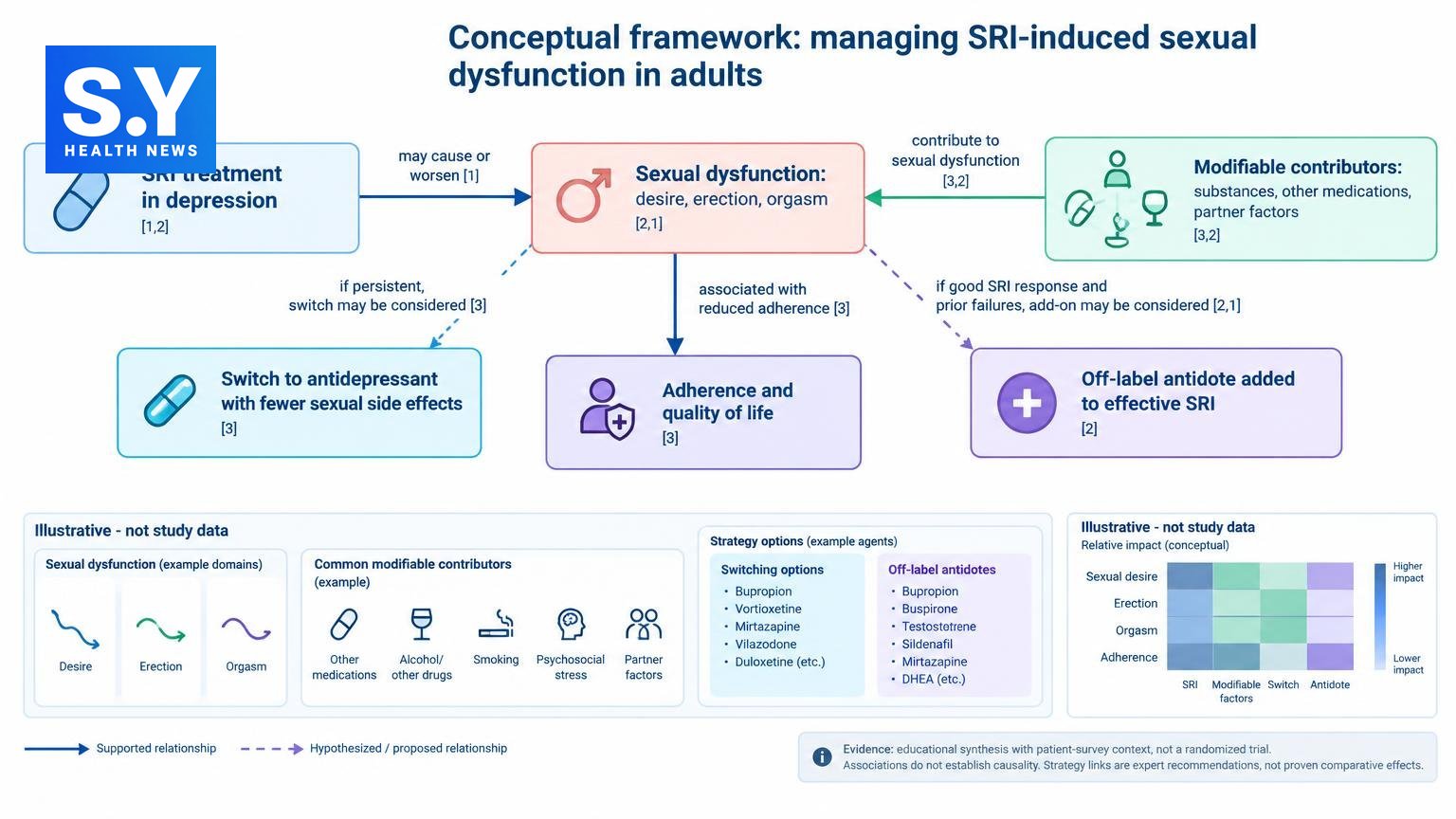
The recommended order is explicit. One of the first steps is to manage modifiable factors: conditions, medications, and psychosocial situations that may contribute to sexual dysfunction. If dysfunction persists, a switch to an agent with fewer sexual side effects may be considered. Examples named include bupropion, vortioxetine, mirtazapine, vilazodone, transdermal selegiline, duloxetine, desvenlafaxine, and gepirone ER. The activity hedges that these agents may be less effective or carry other tolerability problems, but that switching should improve sexual function.
Switching is described as possibly most effective in patients who develop sexual dysfunction during their first antidepressant treatment. Where sexual dysfunction persists and switching is unattractive, off-label antidotes enter the discussion. The activity names bupropion, buspirone, testosterone, sildenafil, mirtazapine, and over-the-counter DHEA, and suggests these might even enhance antidepressant efficacy, while acknowledging risks of drug interactions, additional side effects, and the extra cost of two medications.
Patient selection for antidotes is presented as the deciding issue. Off-label agents such as buspirone, testosterone, sildenafil, or DHEA should be reserved for patients who respond well to their current SRI and in whom earlier antidepressant trials were unsuccessful. A history of multiple failed medication trials combined with a currently effective treatment, plus patient preference, may favor adding an antidote rather than switching.
| Strategy | What the activity proposes | Key caveat in the source |
|---|---|---|
| Address modifiable factors first | Treat contributing conditions, review psychiatric and medical medications, and address psychosocial situations and lifestyle contributors such as alcohol, other drugs, and smoking | Presented as an initial step, not tested against alternatives |
| Switch antidepressant | Move to an agent with fewer sexual side effects, such as bupropion, vortioxetine, mirtazapine, vilazodone, transdermal selegiline, duloxetine, desvenlafaxine, or gepirone ER | May be less effective or carry other tolerability problems; improvement is expected rather than quantified |
| Add an off-label antidote | Bupropion, buspirone, testosterone, sildenafil, mirtazapine, or DHEA alongside a working SRI | All off-label; drug interactions, added side effects, and higher cost; best reserved for prior treatment failures |
| Avoid dose reduction or drug holidays | The activity advises against these as strategies for medication-induced sexual dysfunction | Said to often lead to relapse or full discontinuation; expert opinion, not a controlled comparison |
| Monitor when adding an antidote | Track improvement in sexual function, any change in antidepressant efficacy, and new tolerability problems | Monitoring advice without quantitative outcome data in the source |
Interpretation and Limitations
The central weakness is evidentiary, and it should not be smoothed over. The source is a continuing medical education slide-and-transcript activity, not a systematic review or randomized trial. Many of its most consequential statements are modal—may be considered, possibly most effective, should improve, could even enhance—and the supplied text does not report effect sizes, confidence intervals, or head-to-head trial results for switching versus add-on strategies.
The adherence figures come from a patient survey in which sample size and survey methods are not described in the quoted passages, and percentages are self-reported. The 70% figure for sexual dysfunction in depression is asserted in a teaching slide without a cited denominator in the supplied material. These are useful for context and for motivating screening, but they are not precise prevalence estimates for a defined population.
There is also an attribution problem that the activity acknowledges but cannot resolve with the data provided: sexual dysfunction may improve with effective depression treatment, yet may equally be caused by the drug. Without structured baseline assessment before and after treatment, clinicians cannot reliably separate the two, which limits how confidently any specific intervention can be credited with improvement. The activity's own learning objectives frame this distinction as a skill to be taught rather than a settled method.
Finally, general adherence context is offered: chronic conditions requiring daily medication are associated with partial or complete nonadherence in 25% to 50% of patients, and adverse effects such as sexual dysfunction, weight gain, or low energy can contribute to discontinuation or reduced quality of life. These are broad statements rather than SRI-specific causal estimates.
Research Outlook and Clinical Relevance
For practice, the most defensible reading is procedural rather than prescriptive. Ask about sexual function proactively, including desire, erection, orgasm, and partner factors; review alcohol, other drugs, smoking, and non-psychiatric medications; treat the depression adequately; and then discuss trade-offs with the patient. The choice between switching and adding an agent should weigh prior treatment history, current response, patient preference, interaction risk, invasiveness, and cost—principles the activity explicitly lists.
What the field still needs is transparent comparative data: randomized trials with structured sexual-function endpoints, prespecified baseline measurement, and adequate power to separate drug effects from illness effects. Until then, the activity's framework is best used as a structured conversation guide and a reminder that untreated sexual side effects can quietly undermine adherence, rather than as proof that any single substitution or antidote strategy outperforms another.
Key Takeaways
- Screen actively for sexual side effects at every consultation; one in five patients is described as stopping an antidepressant because of orgasm difficulties or lost libido.
- Start with modifiable contributors—comorbid conditions, other medications, alcohol and other drugs, smoking, psychosocial stress, and partner sexual dysfunction—before changing the antidepressant.
- Switching to an agent with fewer sexual side effects is a reasonable next step and may work best in people whose sexual dysfunction appeared with their first antidepressant.
- Off-label antidotes such as bupropion, buspirone, testosterone, sildenafil, mirtazapine, or DHEA are positioned for patients doing well on their SRI after prior treatment failures, with interaction, side-effect, and cost risks.
- Dose reduction and drug holidays are discouraged in this activity because they are said to lead to relapse or discontinuation; this is expert opinion, not trial evidence.
- The evidence base is educational synthesis with survey context; strategy claims are provisional and should be individualized rather than applied as a fixed algorithm.
Questions and Answers
What is SRI-induced sexual dysfunction and why is it hard to attribute?
SRIs can cause reduced desire, erectile difficulty, or orgasm problems, but depression itself also causes sexual dysfunction—about 70% of people with a depression diagnosis are said to have it as a symptom. Because the same symptom can improve with effective treatment or appear as a drug adverse effect, clinicians must consider illness, medication, other conditions, substances, and partner factors together.
What does the Clayton CME activity recommend first for antidepressant-related sexual dysfunction?
The first step is to address modifiable factors: treat contributing medical and psychiatric conditions, review other medications, and address psychosocial situations, alcohol, other drugs, smoking, and partner sexual dysfunction. Only if dysfunction persists does the activity move to switching antidepressants or adding an off-label antidote, and it advises against dose reduction or drug holidays.
Which antidepressants are suggested when switching for sexual side effects?
The activity names bupropion, vortioxetine, mirtazapine, vilazodone, transdermal selegiline, duloxetine, desvenlafaxine, and gepirone ER as options with potentially fewer sexual side effects. It cautions that these may be less effective or carry other tolerability problems, and that switching is expected—not proven in the supplied text—to improve sexual function. Switching may be most effective when dysfunction appeared with the first antidepressant.
When are off-label antidotes like bupropion, buspirone, or sildenafil considered?
They are positioned for patients who respond well to their current SRI but develop sexual dysfunction, especially when earlier antidepressant trials failed. All are off-label; the activity lists bupropion, buspirone, testosterone, sildenafil, mirtazapine, and DHEA and notes possible interaction, added side-effect, and cost risks. Monitoring should cover sexual function, antidepressant efficacy, and new tolerability problems.
How strong is the evidence behind these management recommendations?
It is expert educational synthesis, not a randomized trial or systematic review. Many claims use cautious wording such as may be considered or possibly most effective, and the supplied text reports no effect sizes or head-to-head comparisons. Supporting figures come largely from a patient survey lacking described methods and denominators, and the 70% depression-related prevalence figure is asserted without a cited source in the material.
Why does asking about sexual side effects matter for antidepressant adherence?
The cited patient survey found that one in five patients stopped an antidepressant because of orgasm difficulties or lost libido, and about 22% were nonadherent, often without telling their physician. Difficulty reaching orgasm and low libido were each reported by 20% as reasons for nonadherence, and most patients wanted improvement so they could continue treatment.
Conceptual framework: Conceptual framework: how SRI treatment and modifiable contributors relate to sexual dysfunction in adults, and where switching antidepressants or adding an off-label antidote fit. Supported links reflect associations described in the educational source; strategy links are proposed recommendations. The framework is not a tested causal model.
Academic References & Evidence
- Anita H. Clayton. Beheer van SRI-geïnduceerde seksuele disfunctie: substitutie, antidota en modificeerbare factoren. 2026
- Anita H. Clayton. Gestione della disfunzione sessuale indotta da SRI: sostituzione, antidoti e fattori modificabili. 2026
- Anita H. Clayton. Management SRI-induzierter sexueller Dysfunktion: Substitution, Antidota und modifizierbare Faktoren. 2026
SANYUN Science Center explains published research on men's reproductive and sexual health, connecting scientific evidence with everyday questions while making sources and limitations clear.
Disclaimer: This article is for scientific education and research communication only. It does not provide medical advice, diagnosis, or individualized treatment recommendations, and does not endorse any medication, supplement, device, penile enlargement procedure, or other intervention. Decisions about sexual and reproductive health should be made in consultation with a qualified healthcare professional. Do not delay seeking professional care because of information in this article.
Original Content & Copyright Notice
- This article is prepared for SANYUN Science Center, drawing on published research and publicly available academic literature on men’s sexual and reproductive health. Its editorial explanations and presentation are developed for this platform.
- Copyright in the original editorial content, selection, and arrangement is reserved by SANYUN Science Center to the extent protected by applicable law. Referenced research, quotations, and third-party materials remain subject to the rights of their respective owners. This notice does not claim ownership of scientific facts or third-party research.
- Except where permitted by applicable law or an applicable license, prior written permission is required to reproduce, republish, translate, adapt, redistribute, or commercially reuse protected content. Attribution alone does not grant permission for such reuse.
- For permitted quotation or authorized reuse, clearly identify the source and retain a link to the original article.
- Source: SANYUN Science Center
- Original URL: Retain the original article URL on science.san-yun.com.
- Copyright Holder: SANYUN Science Center, for its own protected editorial content.
- Quotation, excerpts, or authorized reuse must not distort the scientific meaning, omit material limitations or disclaimers, or imply unverified medical claims, product efficacy, or endorsement by SANYUN Science Center.



