




Category: Penile Size
Core Research Direction: Does stretched flaccid penile length accurately serve as a surrogate for erect penile length in men with erectile dysfunction?
Search Intent: How well does stretched flaccid penile length match erect penile length in men with erectile dysfunction?
Platform: SANYUN Science Center
Evidence reviewed through: 2026-11-09
Executive Summary
Penile length measurement supports several andrology decisions, and clinicians have long been taught that stretched flaccid penile length (SFPL) approximates erect penile length (EPL). A conference abstract from 2021 directly tested that assumption in men with erectile dysfunction (ED) who achieved a rigid erection during penile duplex Doppler ultrasound (DDUS). The study was designed to evaluate whether SFPL accurately reflects EPL, addressing the prior suggestion that it is an excellent surrogate.[1]
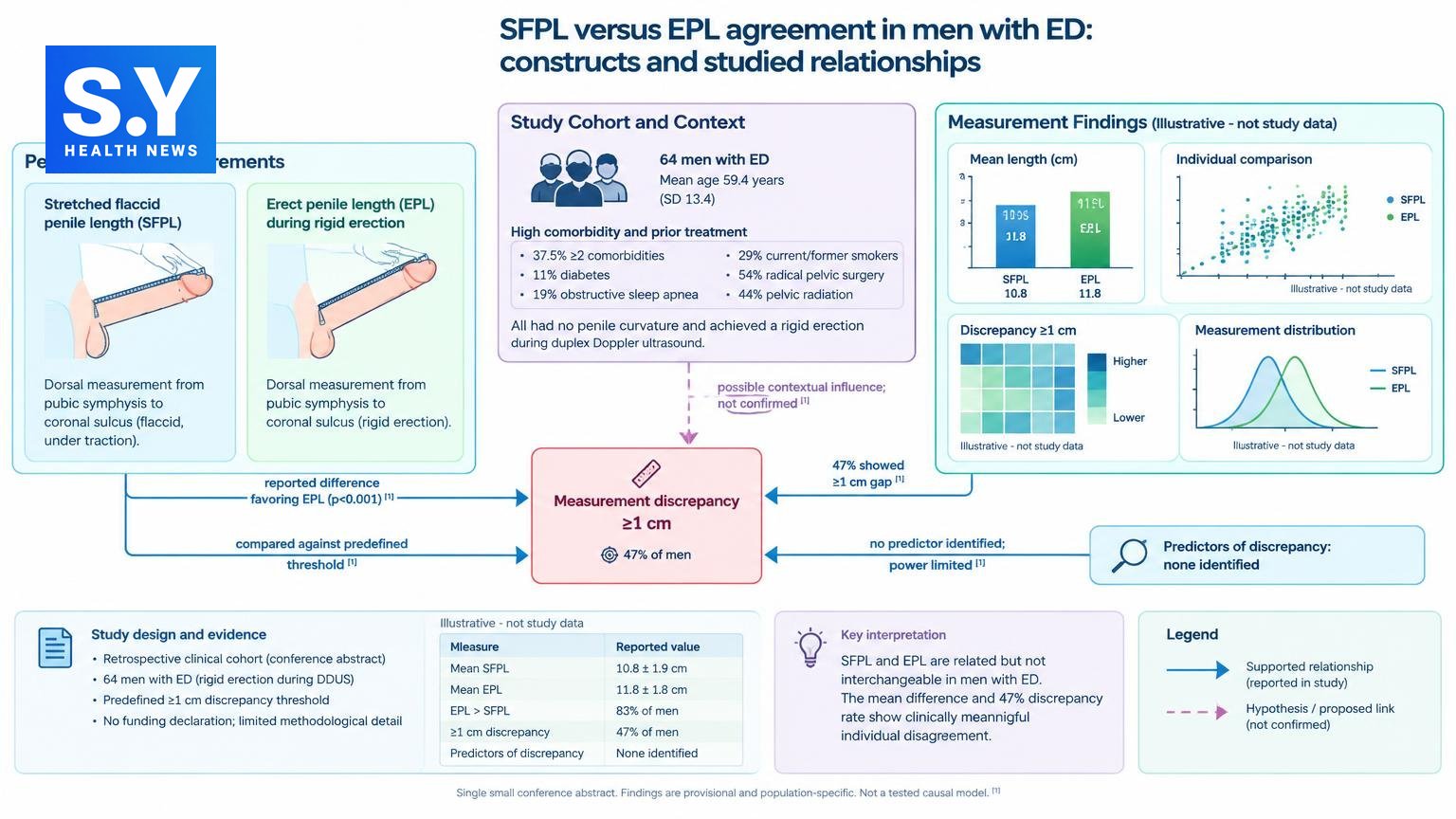
The analysis included 64 men with a mean age of 59.4 years (SD 13.4). Mean SFPL was 10.8 cm (SD 1.9) against a mean EPL of 11.8 cm (SD 1.8), a statistically significant difference (p<0.001). In 83% of men EPL exceeded SFPL, and 47% had a discrepancy of at least 1 cm, the study's predefined threshold for clinical significance. No predictors of discrepancy were identified, and the authors concluded that SFPL is not a reasonable surrogate for erect length in this population.
- SFPL underestimated EPL on average by about 1 cm in this cohort, but the direction was not universal, since 83% rather than all men showed EPL greater than SFPL.
- The surrogate question is about individual-level agreement, not group means; a significant mean difference and a 47% rate of at least 1 cm discrepancy both bear on that distinction.
Why This Matters
Penile length is measured in clinical scenarios that include documenting baseline anatomy before surgery, assessing shortening after pelvic cancer treatment, evaluating curvature or prosthesis candidates, and responding to patient concerns about size. In these settings a flaccid measurement is convenient, non-provocative and does not require pharmacological erection. If SFPL reliably tracked EPL, clinicians could avoid the time, expense and invasiveness of erect measurement.
The cohort studied is exactly the group in which this convenience matters most. Participants were men with ED without penile curvature undergoing DDUS and achieving a rigid erection. The prevalence of comorbidity was high: 37.5% reported two or more comorbidities, 11% had diabetes, 19% obstructive sleep apnea, 29% were current or former smokers, 54% had undergone radical pelvic surgery and 44% had pelvic radiation. These are men whose penile anatomy and vascular function are often altered, making measurement accuracy clinically consequential rather than academic.
Biological and Measurement Mechanisms
The rationale for SFPL as a surrogate rests on the mechanics of the tunica albuginea and cavernosal tissue. Stretching a flaccid penis is thought to approximate the maximal extensibility the organ reaches during erection, so a tape measure under gentle traction has been treated as a proxy for the engorged state. Both measurements in this study were taken dorsally from the pubic symphysis to the coronal sulcus, so the anatomical landmarks were identical and the difference cannot be attributed to landmark selection.
Several factors could break the equivalence in men with ED. Reduced cavernosal compliance or fibrosis, prior pelvic surgery or radiation, and variability in the rigidity achieved during DDUS could all alter how far the erect state exceeds the stretched state. The study did not identify predictors of discrepancy, so these possible contributors remain plausible explanations rather than demonstrated mechanisms. Importantly, the abstract reports no measurement-reproducibility data, so inter-observer or test-retest variability cannot be separated from true anatomical difference.
What the Evidence Shows
The design is a retrospective clinical cohort analysis reported as a conference abstract. Eligibility required ED without penile curvature, DDUS, and a rigid erection; a discrepancy of at least 1 cm between SFPL and EPL was predefined as significant. Because only men who achieved rigidity were analyzed, men with the most severe ED, in whom erect measurement is hardest, may be underrepresented. The abstract carries no funding declaration and provides limited methodological detail.
The central results are consistent in direction. Mean SFPL was 10.8 cm (SD 1.9) and mean EPL 11.8 cm (SD 1.8), a difference that was statistically significant (p<0.001). EPL exceeded SFPL in 83% of men. A discrepancy of at least 1 cm occurred in 47%, meaning that in nearly half the cohort the two measurements would have led to materially different conclusions if used interchangeably. No baseline or clinical variable predicted which men would show this discrepancy.
| Measure | Reported value | What it answers in this cohort |
|---|---|---|
| Sample analyzed | 64 men; mean age 59.4±13.4 years | Describes the size and age structure of the studied group |
| Mean SFPL | 10.8±1.9 cm | Average stretched flaccid measurement |
| Mean EPL | 11.8±1.8 cm | Average erect measurement during rigid erection |
| Mean difference test | p<0.001 | Statistical significance of the group-level difference |
| EPL>SFPL | 83% of men | How often erect length exceeded stretched length |
| ≥1 cm discrepancy | 47% of men | Frequency of the predefined clinically significant gap |
| Predictors of discrepancy | None identified | Whether any collected variable flagged likely mismatch |
Interpretation and Limitations
The authors' conclusion, that SFPL is not a reasonable surrogate for erect penile length in men with ED assessed during DDUS, follows from two observations together. The mean difference shows a systematic bias, and the 47% discrepancy rate shows that the error is large enough to matter in individual patients rather than being a statistical artifact of a large sample. A statistically significant p value alone would not establish clinical inadequacy; the predefined 1 cm threshold and the proportion exceeding it are what give the finding practical weight.
The limitations are substantial and should temper any broad claim. This is a single-center conference abstract with 64 participants, incomplete methods and no reported reproducibility data for either measurement. The cohort is unusually comorbid, with 54% having had radical pelvic surgery and 44% pelvic radiation, so results may not generalize to healthier men or to men without ED. Restricting analysis to men who achieved a rigid erection also excludes the patients for whom erect measurement is most difficult. The failure to identify predictors may reflect limited statistical power rather than a true absence of predictors.
The study also cannot settle whether SFPL might perform acceptably in other groups, such as younger men without ED or men without pelvic treatment. Nor does it address whether a correction factor could improve estimation. Because only one direct comparative dataset is available in this packet, the review cannot quantify typical disagreement across populations or compare measurement protocols. No causal claim is made: the study describes agreement between two measurements, not a biological mechanism.
Clinical and Practical Implications
For clinicians, the practical message is caution rather than abandonment. SFPL remains a reasonable screening or documentation measurement when erect measurement is impractical, but it should not be substituted for EPL when the clinical decision depends on erect dimensions, such as prosthesis sizing or surgical planning. When accuracy matters, direct measurement under adequate rigidity, or documentation of both values, is more defensible than assuming equivalence.
For patients, the finding helps explain why a flaccid or stretched office measurement may not match erect length, and why a single number should not be treated as definitive. Men with a history of pelvic surgery or radiation may be particularly likely to show a gap, though the study could not confirm that as a predictor. Discussion of measurement uncertainty belongs in the clinical conversation rather than being resolved by a surrogate assumption.
Research Outlook
The key next steps are methodological. A full peer-reviewed report with reproducibility data, standardized traction force and documented erection quality would clarify how much of the discrepancy is biology versus measurement noise. Studies in broader ED populations, and in men who cannot achieve rigid erections, would test generalizability. Prospective multivariable analyses with larger samples could properly evaluate whether surgery, radiation, diabetes or vascular disease predict discrepancy, rather than relying on an underpowered negative finding.
Until such data exist, the single available comparative study supports a conservative reading: SFPL and EPL are related but not interchangeable in men with ED, and the magnitude of individual disagreement can be clinically meaningful. That conclusion is population-specific and provisional, not a universal rule.
Key Takeaways
- In 64 men with ED who achieved rigid erections during duplex Doppler ultrasound, mean SFPL was 10.8 cm (SD 1.9) and mean EPL 11.8 cm (SD 1.8), a significant difference (p<0.001).
- EPL exceeded SFPL in 83% of men, and 47% had a discrepancy of at least 1 cm, the predefined threshold for clinical significance.
- No predictors of discrepancy were identified, and the authors concluded SFPL is not a reasonable surrogate for EPL in this population.
- The evidence base is a single small conference abstract in a highly comorbid cohort restricted to men with rigid erections, so findings are provisional and population-specific.
- Clinically, stretched length should not replace erect measurement when decisions depend on erect dimensions; documenting measurement conditions and uncertainty is preferable.
Questions and Answers
What is stretched flaccid penile length and why is it used as a surrogate for erect length?
Stretched flaccid penile length (SFPL) is measured dorsally from the pubic symphysis to the coronal sulcus while the flaccid penis is under traction. It has been suggested as an excellent surrogate for erect penile length because it is convenient and avoids pharmacological erection. The reviewed study tested that suggestion directly and found it did not hold well in men with erectile dysfunction.
Does stretched flaccid penile length accurately reflect erect penile length in men with erectile dysfunction?
In the reviewed cohort it did not. Mean SFPL was 10.8 cm versus 11.8 cm erect (p<0.001), EPL exceeded SFPL in 83% of men, and 47% had a discrepancy of at least 1 cm. The authors concluded SFPL is not a reasonable surrogate for erect length in men with ED assessed during duplex Doppler ultrasound.
How strong is the evidence that SFPL and EPL differ in men with erectile dysfunction?
The evidence is suggestive but limited. It comes from a single 64-man conference abstract with a clear predefined 1 cm discrepancy threshold and a statistically significant mean difference, but without full methods or measurement reproducibility data. The cohort was highly comorbid and restricted to men who achieved rigid erections, so the finding is provisional and population-specific.
Which men were studied in the stretched versus erect penile length comparison?
Participants were men with erectile dysfunction without penile curvature who underwent penile duplex Doppler ultrasound and achieved a rigid erection. Their mean age was 59.4 years, 37.5% had two or more comorbidities, 54% had prior radical pelvic surgery and 44% had pelvic radiation. This profile differs from the general ED population and from healthy men.
What are the limitations of the evidence that stretched flaccid length is not a good surrogate?
Key limitations include a single-center design, only 64 participants, conference-abstract reporting with incomplete methods, and no reported measurement reproducibility. Men unable to achieve a rigid erection were excluded, and the failure to identify predictors may reflect limited sample size. Results may not generalize to healthier men or to other measurement protocols.
How should clinicians interpret penile length measurements in men with erectile dysfunction?
Stretched flaccid length can be documented but should not be assumed to equal erect length when decisions depend on erect dimensions. In the reviewed cohort the mean gap was about 1 cm and nearly half of men showed a discrepancy of at least 1 cm. When accuracy matters, direct measurement under rigidity, with attention to measurement conditions, is more defensible.
Conceptual framework: Conceptual framework: the reviewed study examines agreement between stretched flaccid and erect penile length in 64 men with erectile dysfunction during duplex Doppler ultrasound. Supported links reflect reported group differences and the 47% rate of at least 1 cm discrepancy; the contextual link to comorbidity is proposed, not confirmed. Single small conference abstract; not a tested causal model.
Academic References & Evidence
- MP27-09 ARE THERE DIFFERENCES IN STRETCHED FLACCID PENILE LENGTH VERSUS ERECTILE PENILE LENGTH IN MEN WITH ERECTILE DYSFUNCTION? | Journal of Urology. 2021 DOI: 10.1097/JU.0000000000002024.09.
SANYUN Science Center explains published research on men's reproductive and sexual health, connecting scientific evidence with everyday questions while making sources and limitations clear.
Disclaimer: This article is for scientific education and research communication only. It does not provide medical advice, diagnosis, or individualized treatment recommendations, and does not endorse any medication, supplement, device, penile enlargement procedure, or other intervention. Decisions about sexual and reproductive health should be made in consultation with a qualified healthcare professional. Do not delay seeking professional care because of information in this article.
Original Content & Copyright Notice
- This article is prepared for SANYUN Science Center, drawing on published research and publicly available academic literature on men’s sexual and reproductive health. Its editorial explanations and presentation are developed for this platform.
- Copyright in the original editorial content, selection, and arrangement is reserved by SANYUN Science Center to the extent protected by applicable law. Referenced research, quotations, and third-party materials remain subject to the rights of their respective owners. This notice does not claim ownership of scientific facts or third-party research.
- Except where permitted by applicable law or an applicable license, prior written permission is required to reproduce, republish, translate, adapt, redistribute, or commercially reuse protected content. Attribution alone does not grant permission for such reuse.
- For permitted quotation or authorized reuse, clearly identify the source and retain a link to the original article.
- Source: SANYUN Science Center
- Original URL: Retain the original article URL on science.san-yun.com.
- Copyright Holder: SANYUN Science Center, for its own protected editorial content.
- Quotation, excerpts, or authorized reuse must not distort the scientific meaning, omit material limitations or disclaimers, or imply unverified medical claims, product efficacy, or endorsement by SANYUN Science Center.



