




Category: Penile Size
Core Research Direction: Whether stretched flaccid penile length is a valid surrogate for erect penile length in men with erectile dysfunction, and what reference distributions and intervention evidence exist for penile size
Search Intent: Can stretched flaccid penile length be used to estimate erect penile length, and what do published measurements and reviews say about normal size and the limits of size-enhancement interventions?
Platform: SANYUN Science Center
Evidence reviewed through: 2026-11-07
Executive Summary
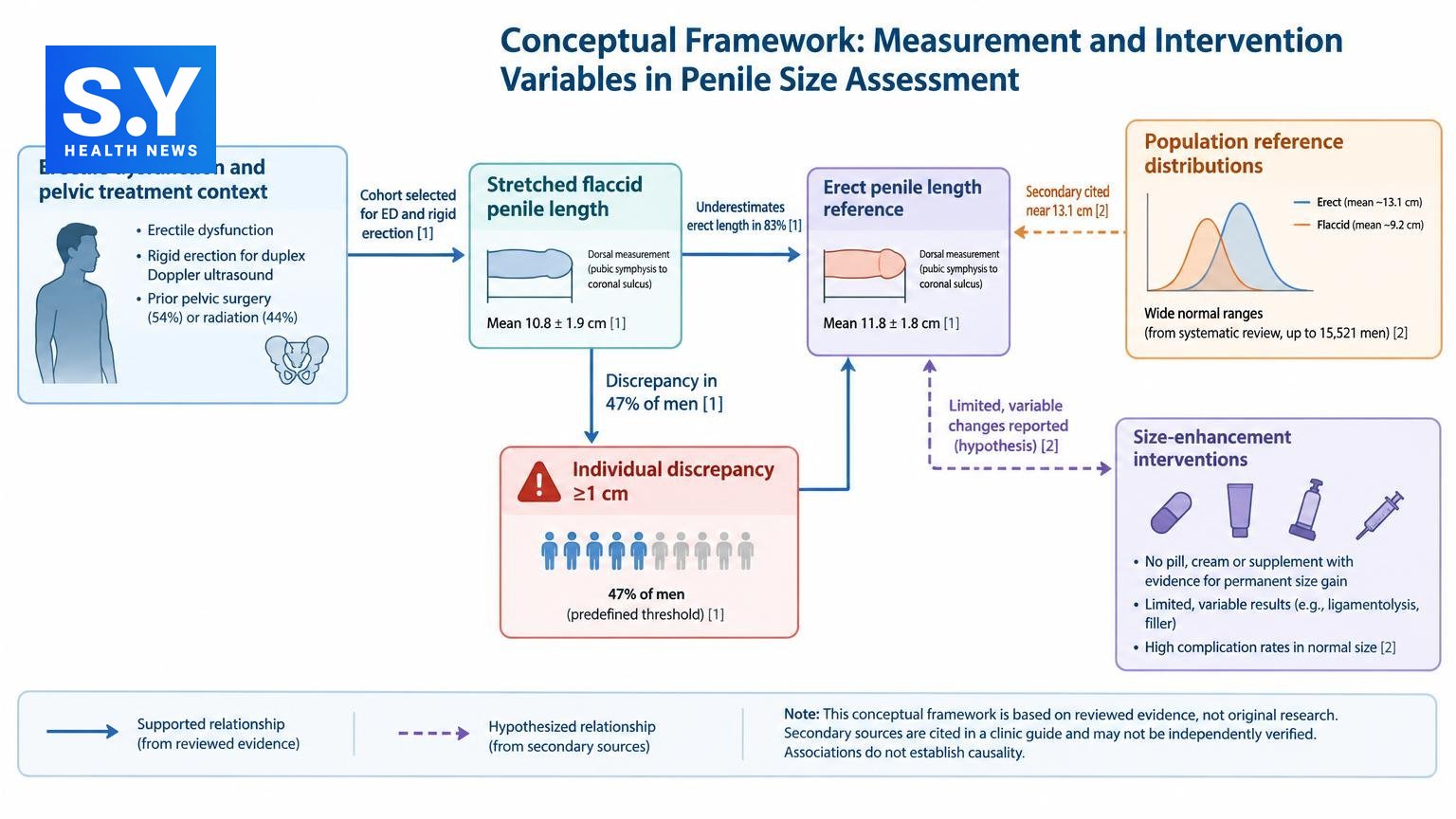
Clinicians in andrology often need a penile length estimate without relying on a full rigid erection. Stretched flaccid penile length has been proposed as an excellent proxy for erect penile length, but a 2021 conference analysis of men with erectile dysfunction who were measured during penile duplex Doppler ultrasound challenges that assumption. Among 64 men with a mean age of 59.4 years, mean stretched flaccid length was 10.8 cm against a mean erect length of 11.8 cm, a statistically significant difference.[1]
The clinical picture matters more than the group mean. Erect length exceeded stretched flaccid length in 83% of men, and 47% had a difference of at least 1 cm, the study's predefined threshold for a significant discrepancy. No predictors of that discrepancy were identified in this small cohort, and the authors concluded that stretched flaccid length is not a reasonable surrogate for erect length in this population.
Broader context comes largely from a commercial clinic educational guide that cites secondary literature rather than reporting new data. It cites a systematic review pooling clinician measurements from up to 15,521 men, with mean erect length of about 13.1 cm and flaccid length of about 9.2 cm and wide normal ranges, and it summarizes intervention evidence as limited, complication-prone and inconsistent in satisfaction. Those secondary claims should be read as background, not as verified primary findings.[2]
- In men with erectile dysfunction measured during duplex Doppler ultrasound, stretched flaccid length averaged about 1 cm shorter than erect length, and nearly half the men crossed the 1 cm discrepancy threshold.
- Population reference values cited for average erect length are around 13.1 cm, but with wide normal ranges, so a single number cannot define abnormality.
- No pill, cream or supplement is presented as having evidence for permanent size gain, and surgical or filler options described carry limited and variable results with real risks.
Why the Surrogate Question Matters
Penile length measurement appears in several clinical situations: documenting baseline anatomy before pelvic surgery or radiation, evaluating a man who reports a short penis, and assessing outcomes after intervention. A reliable flaccid measurement that predicts erect length would simplify these assessments, avoid the need for rigid erection during every examination, and make records more comparable between visits. The surrogate assumption is therefore practical, not merely academic.
The cohort studied here was not a general sample. Men had erectile dysfunction without penile curvature and were assessed during duplex Doppler ultrasound with a rigid erection, and many carried substantial comorbidity or had undergone pelvic cancer treatment: 54% had radical pelvic surgery and 44% had pelvic radiation. That context matters because it describes exactly the men in whom accurate length documentation is often clinically necessary.
A separate practical concern is that men's self-assessment is frequently inaccurate. A clinic guide states that flaccid size varies greatly with temperature and circumstances and cannot predict erect size, and it describes viewing angle and comparison with selected media as sources of distortion. These are educational claims rather than measured findings, but they align with the broader point that measurement technique and setting change what number is recorded.
How Length Was Measured and What Counted as a Discrepancy
Both stretched flaccid and erect lengths were measured dorsally from the pubic symphysis to the coronal sulcus, the standard bone-anchored reference points intended to reduce the influence of body habitus. A difference of 1 cm or more between the two measurements was predefined as a significant discrepancy, which gives the 47% figure a concrete clinical meaning rather than treating any numerical difference as failure of the surrogate.
The distinction between statistical and clinical significance is central here. A mean difference of roughly 1 cm between two measurement techniques is statistically significant with p<0.001, but the more decision-relevant finding is the distribution: 83% of men had erect length greater than stretched length, and nearly half exceeded the discrepancy threshold. A surrogate that is systematically shorter for most men and crosses a 1 cm error threshold in nearly half is not interchangeable with the reference measurement at the individual level.
| Measure or finding | Reported value | Population and context | Interpretation |
|---|---|---|---|
| Sample analyzed | 64 men, mean age 59.4 ± 13.4 years | Men with erectile dysfunction without curvature, rigid erection during duplex Doppler ultrasound | Small single-cohort analysis; precision of subgroup estimates is limited |
| Mean stretched flaccid length | 10.8 ± 1.9 cm | Same cohort, measured dorsally from pubic symphysis to coronal sulcus | Systematically shorter than the erect measurement in this group |
| Mean erect length | 11.8 ± 1.8 cm | Same cohort during rigid erection on duplex Doppler ultrasound | Reference measurement against which the surrogate was judged |
| Proportion with erect length greater than stretched length | 83% | Same cohort | Direction of error is consistent rather than random |
| Discrepancy of 1 cm or more | 47% | Predefined significant discrepancy threshold | Individual-level agreement is poor despite group-level means appearing close |
| Predictors of discrepancy | None identified | Same cohort | Absence in a small sample does not prove no predictor exists |
| Cited reference means for erect and flaccid length | About 13.1 cm erect and 9.2 cm flaccid | Clinician-measured data from up to 15,521 men, per a systematic review cited in a clinic guide | Secondary source; wide normal ranges, not a threshold for abnormality |
What the Evidence Shows About Normal Reference Size
The reference figures most often quoted come from a systematic review of clinician-measured data, cited in the clinic guide as including up to 15,521 men, with mean erect length of about 13.1 cm and mean flaccid length of about 9.2 cm. The guide emphasizes that normal ranges for both values are wide. That emphasis is important: a population mean describes a distribution, not a cutoff, and many men who believe they are unusually small fall within the measured normal range once properly assessed.
The guide also cites a study of men presenting for penile-lengthening surgery in which most measured within the normal range. This is a secondary report without the original sample size in the available text, but the pattern it describes is clinically familiar and shapes how a measured number should be interpreted: the presentation for lengthening does not itself establish abnormal size.
Satisfaction data cited in the guide point in a similar direction. In a survey of more than 50,000 adults, only about half of men were satisfied with their own size, while 85% of women were satisfied with their partner's size. The survey design and sampling are not detailed in the available text, so these proportions should be treated as descriptive context rather than precise estimates of the gap between self-perception and partner perception.
Intervention Evidence: Limited Gains and Documented Risks
The enhancement literature summarized in the guide does not support a simple effective option. No pill, cream or supplement is presented as having evidence for permanent size gains, and the guide flags that some male supplement products have been found adulterated with prescription erectile drugs without label disclosure, a safety issue for men with cardiac disease or nitrate use. That adulteration statement is an editorial assertion in the guide without primary data supplied in the available text.
Device and manual techniques occupy a weak evidence zone. Vacuum pumps are described as producing temporary erection with a legitimate role in erectile dysfunction care but no permanent size increase. Online-shared massage and stretching techniques are described as lacking evidence of benefit while having reported injuries, including capillary rupture, fibrosis and penile curvature. These are educational statements without cited case series or rates in the available text.
Medical options produce modest, variable changes. Ligamentolysis is described as increasing visible flaccid length by a published average of about 1–2 cm, with large individual variation and some men showing almost no change. Hyaluronic acid filler is described as a temporary girth increase, not a length increase, typically lasting about 1–2 years before resorption. A cited systematic review of interventions in men with normal size concluded that many procedures carry high complication rates and uncertain satisfaction, though no quantitative rates appear in the available text.
Interpretation and Limitations
The central finding—that stretched flaccid length is not a reasonable surrogate in this cohort—rests on 64 men in a single center, reported as a conference abstract. Small samples give imprecise subgroup proportions, and the absence of identified predictors of discrepancy should not be read as proof that no predictor exists; a larger sample might reveal factors such as prior pelvic surgery, radiation or comorbidity that modulate the difference. The cohort was also selected for erectile dysfunction, absence of curvature and the ability to achieve a rigid erection during duplex Doppler ultrasound, so the results cannot be generalized to men without erectile dysfunction or to routine clinic settings without pharmacological erection.
A second limitation is the evidence base for the surrounding claims. The reference distributions, satisfaction survey and intervention summaries come from a commercial clinic guide that cites named studies but does not present their data, methods or full results in its body text. These claims are useful for orientation but cannot be independently verified from the available material, and they should not be presented as equivalent in strength to the measured cohort data.
There is also an apparent tension between the two sources. The clinic guide states that flaccid size varies substantially and cannot predict erect size, while the duplex study tested a formalized stretch measurement and found it systematically shorter. These are not contradictory: both point toward flaccid-based estimates being unreliable proxies, but the stretch maneuver is a defined technique that can still be shorter than the erect reference in a substantial minority.
Finally, the intervention material should not be read as a comparison of procedures. The figures for ligamentolysis and filler come from secondary summaries, describe different outcomes—visible flaccid length versus girth—and carry no head-to-head data. They describe what published literature is said to report, not what any individual can expect.
Research Outlook
The most direct next step would be independent confirmation of the stretched-versus-erect discrepancy in larger, multicenter cohorts, including men without erectile dysfunction as a comparison group and men with and without prior pelvic surgery or radiation. Reporting individual-level agreement statistics, not only group means, would clarify whether a correction factor could rescue the surrogate for some subgroups even if it fails overall. The present study found no predictors, which is a question left open rather than answered.
On the intervention side, the priority is transparent reporting of complications, reoperation and satisfaction in men with normal baseline size, with prespecified outcomes and adequate follow-up. The cited review's conclusion of high complications and uncertain satisfaction in this group is a signal for clinicians to counsel carefully and for researchers to design studies that measure what matters to patients, not only centimeters gained.
Key Takeaways
- Stretched flaccid penile length was not a reliable stand-in for erect length in men with erectile dysfunction measured during duplex Doppler ultrasound.
- Mean stretched flaccid length was 10.8 cm and mean erect length 11.8 cm, a statistically significant difference with a consistent direction.
- Erect length exceeded stretched length in 83% of men, and 47% had a discrepancy of at least 1 cm.
- Cited population reference values put average erect length near 13.1 cm with wide normal ranges, so a single figure should not define abnormal size.
- Intervention summaries describe modest, variable and temporary changes, with real risks and no pill or supplement evidence for permanent gain.
- A man with persistent size worry deserves an accurate measured assessment and an honest conversation, not an immediate procedure.
Questions and Answers
What is stretched flaccid penile length and why is it used?
Stretched flaccid penile length is measured dorsally from the pubic symphysis to the coronal sulcus after stretching the flaccid penis. It has been proposed as a proxy for erect length because it avoids needing a rigid erection during examination. A duplex Doppler study in men with erectile dysfunction found it was systematically shorter than erect length in most men, so its use as a surrogate is contested.
Does stretched flaccid penile length accurately predict erect penile length in men with erectile dysfunction?
In the 64 men analyzed, it did not perform well as a surrogate. Mean stretched length was 10.8 cm versus 11.8 cm erect, 83% had erect length greater than stretched length, and 47% had a difference of at least 1 cm, the predefined threshold for significant discrepancy. The authors concluded it is not a reasonable surrogate in this population.
How strong is the evidence that stretched flaccid length is a poor proxy for erect length?
The evidence is suggestive but limited. It comes from a single small cohort of 64 men with erectile dysfunction assessed during duplex Doppler ultrasound, reported as a conference abstract, without independent replication. No predictors of the discrepancy were identified, but a small sample cannot exclude them. It should not be treated as a definitive general-population finding.
What is the average erect penile length, and how wide is the normal range?
A systematic review of clinician-measured data cited in a clinic guide, including up to 15,521 men, reports mean erect length of about 13.1 cm and flaccid length of about 9.2 cm, with wide normal ranges for both. The mean is a population descriptor, not a cutoff, and these figures come from a secondary summary rather than a directly verified dataset.
Do pills, supplements or pumps permanently increase penile size?
The guide states no pill, cream or supplement has evidence for permanent size gain, and warns that some male supplements have been found adulterated with prescription erectile drugs. Vacuum pumps produce temporary erection and have a legitimate role in erectile dysfunction care but do not increase size permanently. These are educational claims from a secondary source, not a systematic appraisal of each product.
What do published summaries say about penile lengthening surgery and fillers?
Ligamentolysis is described as adding about 1–2 cm of visible flaccid length on average, with large individual variation and some men showing little change. Hyaluronic acid filler adds temporary girth, not length, typically lasting about 1–2 years. A cited systematic review concluded that in men with normal size many procedures carry high complication rates and uncertain satisfaction.
Conceptual framework: Conceptual framework. In a single duplex Doppler cohort of 64 men with erectile dysfunction, stretched flaccid length underestimated erect length in most men and crossed a 1 cm discrepancy threshold in 47%. Reference distributions and intervention summaries are secondary, cited in a clinic guide; intervention links are proposed, not tested causal effects, and the framework is not a validated causal model.
Academic References & Evidence
- MP27-09 ARE THERE DIFFERENCES IN STRETCHED FLACCID PENILE LENGTH VERSUS ERECTILE PENILE LENGTH IN MEN WITH ERECTILE DYSFUNCTION? | Journal of Urology. 2021
- Veale D; Miles S; Bramley S; Muir G; Hodsoll J; Mondaini N; Ponchietti R; Gontero P; Marra G; Drury A; Tran L; Veale D; Muir GH; Lever J; Frederick DA; Peplau LA; Vardi Y; Har-Shai Y; Gil T; Gruenwald I; Wylie KR; Eardley I. เพิ่มขนาดน้องชาย: ขนาดปกติ อะไรได้ผลจริง ความเสี่ยง. 2026
SANYUN Science Center explains published research on men's reproductive and sexual health, connecting scientific evidence with everyday questions while making sources and limitations clear.
Disclaimer: This article is for scientific education and research communication only. It does not provide medical advice, diagnosis, or individualized treatment recommendations, and does not endorse any medication, supplement, device, penile enlargement procedure, or other intervention. Decisions about sexual and reproductive health should be made in consultation with a qualified healthcare professional. Do not delay seeking professional care because of information in this article.
Original Content & Copyright Notice
- This article is prepared for SANYUN Science Center, drawing on published research and publicly available academic literature on men’s sexual and reproductive health. Its editorial explanations and presentation are developed for this platform.
- Copyright in the original editorial content, selection, and arrangement is reserved by SANYUN Science Center to the extent protected by applicable law. Referenced research, quotations, and third-party materials remain subject to the rights of their respective owners. This notice does not claim ownership of scientific facts or third-party research.
- Except where permitted by applicable law or an applicable license, prior written permission is required to reproduce, republish, translate, adapt, redistribute, or commercially reuse protected content. Attribution alone does not grant permission for such reuse.
- For permitted quotation or authorized reuse, clearly identify the source and retain a link to the original article.
- Source: SANYUN Science Center
- Original URL: Retain the original article URL on science.san-yun.com.
- Copyright Holder: SANYUN Science Center, for its own protected editorial content.
- Quotation, excerpts, or authorized reuse must not distort the scientific meaning, omit material limitations or disclaimers, or imply unverified medical claims, product efficacy, or endorsement by SANYUN Science Center.



