




Category: Penis Enlargement
Core Research Direction: Penile enlargement with suspensory ligament release (with or without V-Y plasty and silicone girth implants), and the ancillary claims about visible flaccid length gain, permanence, erect-length benefit, and dependence on post-op penile extender use — evaluated for how much is supported by trial/peer-reviewed evidence versus clinic marketing claims.
Search Intent: What does clinical research actually show about the visible length gained from suspensory ligament release with or without V-Y plasty, whether the result is permanent, and whether concurrent penile extender use is required?
Platform: SANYUN Science Center
Evidence reviewed through: 2026-11-09
Executive Summary
Suspensory ligament release is a surgical approach marketed to increase visible penile length by cutting the ligament that tethers the penile shaft to the pubic bone, allowing more of the internal portion to project outward; it is often paired with V-Y skin plasty or, separately, with silicone girth implants. The mechanistic description is plausible as an anatomical explanation, but plausibility is not the same as demonstrated outcome. The evidence retrieved for this review consists of commercial clinic service pages, not peer-reviewed trials or cohort studies.[1][2]
The same clinic offers several different length-gain figures across its pages and languages: up to 2 cm, 2–4 cm, 1.5–4 cm and 1–5 cm on average. These inconsistencies are not reconciled with measurement methods, denominators or follow-up periods. Claims of permanence are also internally inconsistent: one page states results are permanent provided a penile extender is used for the first 3 months, while another describes ligament release as a permanent one-time procedure. Erect-length benefit is hedged in English and explicitly denied in French.[3]
For readers, the practical conclusion is not that the procedure does nothing, but that the public-facing claims are unsupported by the retrieved evidence. There is no basis in this packet for a quantified expectation, a permanence guarantee, or a demonstrated erect-length benefit. Anyone considering such surgery should treat these numbers as marketing assertions and seek independent, peer-reviewed outcome data and a candid discussion of risks, including scar, altered erection angle and the unproven role of postoperative extenders.
Why This Matters
Penile size concerns are common and can drive men toward invasive surgery with permanent anatomical consequences, often in a commercial setting where marketing language substitutes for outcome data. The stakes are high because the procedure is irreversible and touches urinary, sexual and psychological function. When a clinic advertises a range of gains that shifts from page to page, a prospective patient cannot form a realistic expectation from that advertising alone.
The topic also illustrates a broader problem in men's health: the gap between a plausible mechanism and demonstrated clinical benefit. Suspensory ligament release has an intelligible anatomical rationale, and that rationale is often presented as if it were an outcome finding. For readers, learning to separate the two is a transferable skill in evaluating any surgical or cosmetic claim.
The Proposed Mechanism
The suspensory ligament attaches the penile shaft to the pubic bone. In the clinic's description, releasing this ligament allows a greater portion of the internal shaft to extend outward, increasing visible penile length. This is a mechanical explanation of how visible projection might change, and as such it is coherent. It does not, however, establish how much lengthening occurs, in whom, for how long, or with what effect on erection or function.
V-Y skin plasty is described as a cosmetic adjunct used with ligament release for refined results, and a dermal-fat graft variant is offered for added projection. Silicone girth implants are presented as a separate or combined option, with claimed circumference gains of roughly 4–6 cm. The term 'FDA-cleared' in that context refers to device clearance, not to demonstrated efficacy, and the packet provides no trial data for the implants either.
What the Evidence Shows
The retrieved evidence does not include peer-reviewed studies. It includes a Thai clinic's English and French service pages and a city directory listing with no clinical content. The claims therefore describe what a commercial provider asserts, not what controlled research has found. Every quantitative figure below should be read as a marketing claim with no stated measurement protocol, denominator or follow-up window.[4]
| Claim area | What the clinic pages state | Consistency and evidence status |
|---|---|---|
| Visible flaccid length gain | Up to 2 cm on the lengthening page and surgery page; 2–4 cm in the English FAQ; 1.5–4 cm on the French page; 1–5 cm on average elsewhere on the same English page | Four different ranges from one provider; no measurement method, denominator or follow-up; not peer-reviewed |
| Erect length | May improve modestly (English); generally remains unchanged (French) | Direct internal contradiction; unquantified; no erect-length measurements provided |
| Permanence | Results permanent provided a penile extender is used consistently for the first 3 months; elsewhere both ligament release and implants described as permanent one-time procedures | Conditional and unconditional permanence both asserted; no long-term outcome data; the extender requirement implies the surgical result alone may not be stable |
| Erection angle | Not significantly affected, with slight initial change normalising over 2–3 months (English); slight change expected but sexual function unaffected (French) | Contradictory framing; no angle or functional outcome measurements |
| Girth implants | Roughly 4–6 cm of added circumference, described as permanent | Device clearance is not efficacy evidence; no trial data, complication rates or follow-up provided |
The most informative feature of the packet is its internal inconsistency. A single clinic, on pages attributed to two different board-certified urologists, gives at least four different flaccid length-gain ranges, contradicts itself on erect length, and both conditions and denies permanence. Consistency is a minimum requirement for credible outcome claims; these pages do not meet it, and none of the figures can be treated as an established effect size.
Permanence and the Penile Extender Question
The claim that a penile extender must be used consistently for the first 3 months for results to be permanent is particularly important because it reframes the surgery as one component of a longer regimen. If the surgical release alone were sufficient, the extender condition would be unnecessary. The packet offers no trial demonstrating that extender use preserves or augments surgical gains, so the claim remains an unsupported assertion rather than a tested protocol.
The alternative page statement that ligament release is a permanent one-time procedure conflicts with the conditional claim. A reader cannot determine from these sources whether the clinic believes permanence is intrinsic to the surgery or dependent on postoperative traction. That distinction matters clinically: it determines whether the outcome is a property of the operation or of patient adherence to an additional intervention.
Erection Angle and Functional Outcomes
Releasing a ligament that contributes to erection support raises a legitimate question about erection angle. The English page claims angle is not significantly affected and that any slight initial change normalises over 2–3 months. The French page states a slight change in angle is expected while sexual function is unaffected. These are not equivalent statements, and neither is supported by measured angle or functional data in the packet.
The packet also includes a patient testimonial describing no erection problems after surgery, but testimonials are selected anecdotes, not outcome data, and cannot substitute for systematic follow-up of sexual function, sensation or curvature. Readers should regard functional outcomes after ligament release as incompletely characterized in these sources.
Interpretation and Limitations
Several limitations constrain this review. First, the evidence base is commercial service content, not peer-reviewed research; it may be accurate in places, but it cannot establish efficacy. Second, no measurement method is described: it is unclear whether length was measured flaccid, stretched or erect, by whom, with what device, or at what time point. Third, no denominators, complication rates or follow-up durations are reported, so even the direction of average effect is unknown. Fourth, the packet contains no independent source against which to check the clinic's figures.
The internal contradictions are themselves a finding. The same provider gives flaccid gain figures of up to 2 cm, 2–4 cm, 1.5–4 cm and 1–5 cm, and disagrees with itself on erect length, angle and permanence. Whatever the true effect of suspensory ligament release may be, these pages do not measure it, and the variability suggests the numbers are promotional rather than derived from audited outcomes.
This article is an evidence review of published and retrieved material, not a systematic review or an original study. It does not establish that the procedure is ineffective, nor does it establish that it is effective. It establishes that the retrieved public claims are inconsistent and unsupported, and it identifies the specific questions that peer-reviewed research would need to answer: measured gain by erection state, durability, functional outcomes, complication rates and the independent contribution of postoperative extenders.
Research Outlook
A credible evidence base for suspensory ligament release would require prospective cohorts or trials with standardized measurement of flaccid, stretched and erect length, predefined follow-up intervals, validated sexual-function instruments, and reporting of complications such as scar complaints, altered angle, sensory change and dissatisfaction. The independent effect of penile extenders would need a controlled comparison, since the clinic's own permanence claim depends on extender adherence.
Until such data exist, clinical communication should present length change as uncertain in magnitude and durability, distinguish visible flaccid projection from erect length, and avoid implying that device clearance or surgeon certification substitutes for outcome evidence. The packet's directory listing contributes nothing clinical and illustrates how easily commercial visibility can outpace substantive evidence.
Key Takeaways
- Suspensory ligament release has a coherent anatomical rationale for increasing visible projection, but the retrieved sources provide no peer-reviewed outcome data.
- One clinic gives at least four different flaccid length-gain ranges, from up to 2 cm to 1–5 cm on average, without stating measurement methods or follow-up.
- Claims about erect length, erection angle and permanence are internally contradictory across the clinic's English and French pages.
- The assertion that results are permanent only with 3 months of consistent penile extender use is unsupported and conflicts with the description of ligament release as a permanent one-time procedure.
- Prospective patients should seek independent peer-reviewed outcome data and explicit discussion of risks before treating marketing figures as expected results.
Questions and Answers
What is suspensory ligament release for penile lengthening?
It is a surgical procedure that cuts the suspensory ligament attaching the penile shaft to the pubic bone, allowing more of the internal shaft to project outward. The mechanism is anatomically plausible, but the retrieved clinic pages provide no peer-reviewed measurements of how much visible or erect length changes, in whom, or for how long.
How much visible length does suspensory ligament release actually add?
The retrieved sources do not establish a reliable figure. One clinic states up to 2 cm, 2–4 cm, 1.5–4 cm and 1–5 cm on average across its pages and languages, without measurement methods, denominators or follow-up. These are marketing claims, not audited outcomes, so no evidence-based estimate can be given from this packet.
Are penile lengthening surgery results permanent, and is an extender required?
The clinic pages are inconsistent. One states results are permanent provided a penile extender is used consistently for the first 3 months; another describes ligament release as a permanent one-time procedure. No trial in the packet demonstrates that extender use preserves surgical gains, so both permanence claims remain unsupported assertions rather than tested findings.
Does suspensory ligament release improve erect length or change erection angle?
The English page says erect length may improve modestly, while the French page says it generally remains unchanged. On angle, one page claims no significant effect with slight early change normalising over 2–3 months, while the other says a slight change is expected. No measured erect-length or angle data are provided in the retrieved sources.
How strong is the evidence for suspensory ligament release with V-Y plasty?
The retrieved evidence is limited to commercial clinic service pages and a directory listing, with no peer-reviewed trials or cohorts. Claims therefore describe what a provider asserts, not what controlled research shows. Evidence strength is low for all advertised outcomes, and the internal contradictions on length gain, angle and permanence further reduce confidence in the figures.
What should men considering penile enlargement surgery discuss with a clinician?
They should ask for independent peer-reviewed outcome data rather than marketing figures, clarify whether measured gain refers to flaccid, stretched or erect length and at what follow-up, and discuss risks including scar, altered erection angle, sensory change and dissatisfaction. The role of postoperative extenders should be presented as unproven, and a second opinion is reasonable before irreversible surgery.
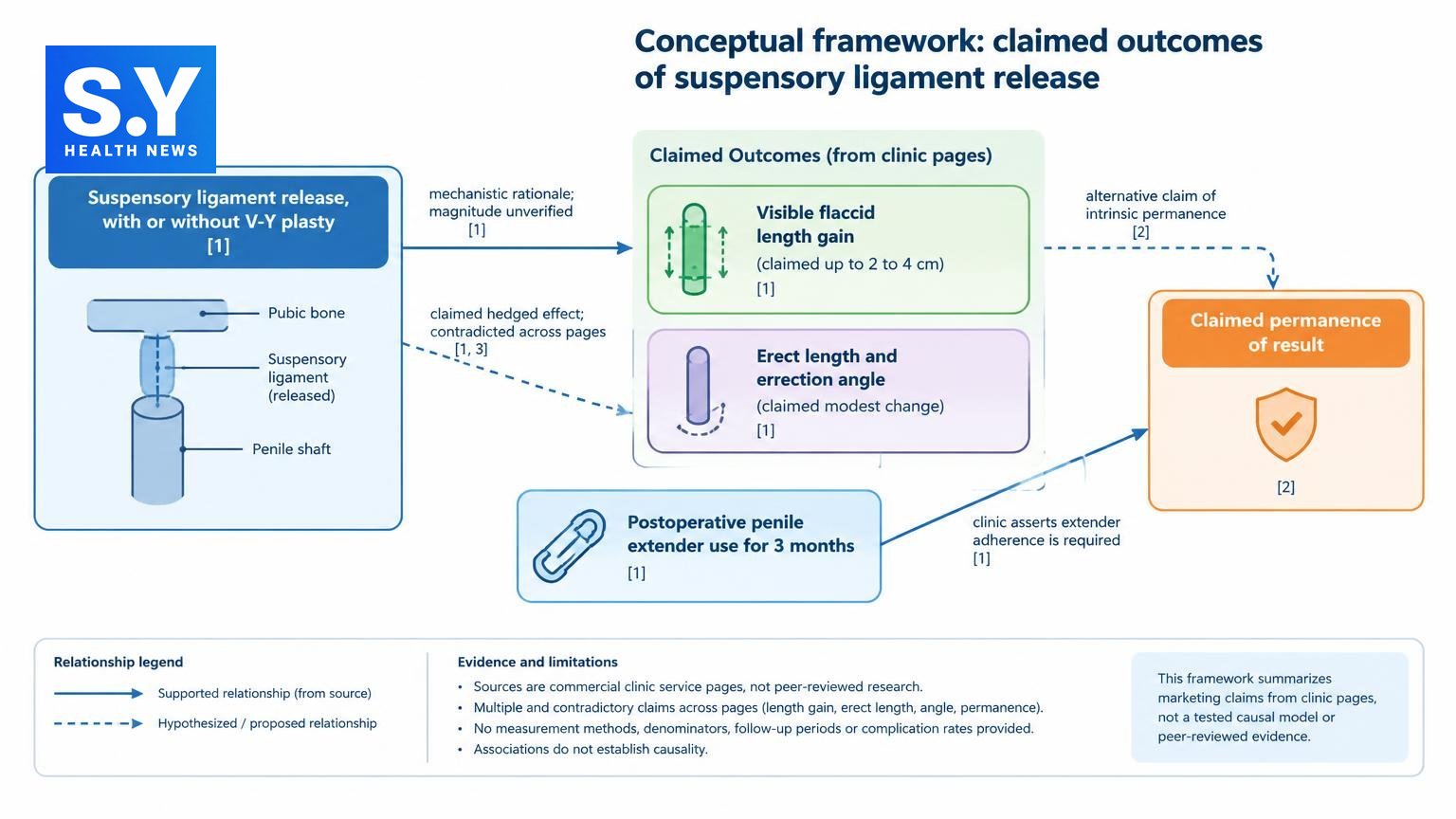
Conceptual framework: Conceptual framework of the claims evaluated in this evidence review. The framework maps the proposed surgical exposure to advertised outcomes and the disputed role of postoperative penile extenders. Relationships are proposed clinic claims, not demonstrated causal effects; the underlying sources are commercial service pages without peer-reviewed outcome data.
Academic References & Evidence
- Noppon Arunkajohnsak (Win). Penile Lengthening Surgery Bangkok – Menscape Clinic.
- Chonlatee Roekmongkolwit (Boss). Penis Enlargement Surgery Bangkok | Length & Girth |….
- Noppon Arunkajohnsak (Win). Chirurgie d'Allongement du Pénis à Bangkok – Menscape Clinic.
- Menscape Clinic – Beauty in Siam, Bangkok.
SANYUN Science Center explains published research on men's reproductive and sexual health, connecting scientific evidence with everyday questions while making sources and limitations clear.
Disclaimer: This article is for scientific education and research communication only. It does not provide medical advice, diagnosis, or individualized treatment recommendations, and does not endorse any medication, supplement, device, penile enlargement procedure, or other intervention. Decisions about sexual and reproductive health should be made in consultation with a qualified healthcare professional. Do not delay seeking professional care because of information in this article.
Original Content & Copyright Notice
- This article is prepared for SANYUN Science Center, drawing on published research and publicly available academic literature on men’s sexual and reproductive health. Its editorial explanations and presentation are developed for this platform.
- Copyright in the original editorial content, selection, and arrangement is reserved by SANYUN Science Center to the extent protected by applicable law. Referenced research, quotations, and third-party materials remain subject to the rights of their respective owners. This notice does not claim ownership of scientific facts or third-party research.
- Except where permitted by applicable law or an applicable license, prior written permission is required to reproduce, republish, translate, adapt, redistribute, or commercially reuse protected content. Attribution alone does not grant permission for such reuse.
- For permitted quotation or authorized reuse, clearly identify the source and retain a link to the original article.
- Source: SANYUN Science Center
- Original URL: Retain the original article URL on science.san-yun.com.
- Copyright Holder: SANYUN Science Center, for its own protected editorial content.
- Quotation, excerpts, or authorized reuse must not distort the scientific meaning, omit material limitations or disclaimers, or imply unverified medical claims, product efficacy, or endorsement by SANYUN Science Center.



