




Category: Penis Enlargement
Core Research Direction: Surgical penile lengthening by suspensory ligament release with adjunct monsplasty/scrotoplasty (or trans-scrotal variant) — what objective stretched-length gains and functional/aesthetic outcomes are reported, in which populations (acquired buried penis vs. penile-size dissatisfaction), and what a small case-level evidence base cannot establish
Search Intent: In men seeking penile lengthening, what objective length changes and satisfaction outcomes have been reported for suspensory ligament release—and how strong is that evidence compared with clinic marketing claims?
Platform: SANYUN Science Center
Evidence reviewed through: 2026-11-02
Executive Summary
Suspensory ligament release is a surgical technique in which the suspensory ligament tethering the penile shaft to the pubic bone is divided, with the stated aim of allowing more of the shaft to project externally. The published record supplied here is thin. The core report is a single-case surgical video describing a 39-year-old man with an acquired buried penis and concern about reduced penile length affecting sexual function, treated with a combined procedure that included suprapubic liposuction, monsplasty, suspensory ligament release and ventral scrotoplasty.[1]
In that one patient, stretched penile length was reported to increase from 5.5 to 8 inches postoperatively, described by the authors as a 45% gain. There were no reported wound complications, the patient was satisfied with cosmetic and functional outcomes, and recovery milestones included catheter removal on postoperative day 1 and discharge on day 2. These are single-patient observations, not an efficacy estimate. A second, 2026 journal article describes a trans-scrotal suspensory ligament release technique, but the supplied record contains only a bibliographic listing and a truncated abstract, so its design, sample size and outcomes are unavailable for appraisal.[2]
The practical conclusion is that suspensory ligament release, particularly within a combined reconstructive approach, has been described as technically feasible in a carefully selected buried-penis case. It has not been shown in this packet to deliver predictable, generalizable length gains in men whose concern is penile size without a concealment problem. Commercial clinic pages quoting flaccid gains in centimetres do not substitute for measured, comparative data, and at least one such page concedes that erect length generally does not change.[3][4]
Why This Matters
Penile size concerns are common and are often bound up with self-esteem and masculinity, which is precisely why surgical claims in this area carry unusual persuasive force. The background of the trans-scrotal technique article situates penile augmentation alongside small penis anxiety and penile dysmorphic disorder as well as pathological conditions, indicating that the men presenting for lengthening are not a single clinical population. That distinction matters because a reconstructive operation for a concealed or buried penis addresses a structural and functional problem, whereas an operation offered for dissatisfaction with an otherwise normal penis is answering a different question.
Acquired buried penis in adult men has been described as capable of significantly impairing erectile and sexual function, and the case authors framed their combined approach around restoring exposure and anatomical definition rather than simply adding length. If concealment and functional impairment are the real problem, then measuring stretched length alone may not capture the outcome that matters most to the patient. Conversely, if the presenting concern is appearance without concealment, the rationale for dividing a stabilizing ligament becomes much less clear.
Mechanism and Clinical Rationale
The anatomical rationale for suspensory ligament release is mechanical. The suspensory ligament anchors the proximal shaft to the pubic bone; dividing it is intended to permit the shaft to sit further forward and thus appear longer externally. In the reported case, the surgical team specifically identified both the fundiform and the true suspensory ligaments and dissected carefully to preserve the dorsal neurovascular bundle, reflecting the proximity of erectile and sensory structures to the operative field. The procedure was combined with targeted suprapubic liposuction, monsplasty and ventral scrotoplasty to redefine the penopubic and penoscrotal junctions.
Two mechanisms are being conflated in much of the public discussion. One is true anatomical release, which may allow more of an existing shaft to become externally visible. The other is visual lengthening produced by removing suprapubic fat and tightening surrounding skin, which makes the penile base more prominent without necessarily changing the shaft itself. A commercial educational page describes pubic fat removal as creating a visual lengthening effect for exactly this reason. When several components are performed together, as in the reported case, the contribution of ligament release alone cannot be separated from the contribution of the surrounding soft-tissue work.
The distinction between stretched and erect length is central. Stretched penile length is a standard clinical proxy used because it correlates reasonably with erect length in many contexts, but it is not the same measurement, and it can be influenced by how firmly the tissue is stretched, by postoperative edema and by the examiner. The reported case provides a postoperative stretched-length figure without stating when it was measured. A commercial clinic page, by contrast, states plainly that erect length generally does not change after its lengthening procedure. If erect length is stable while visible flaccid length increases, then what is being offered is largely a positional and cosmetic change, not a gain in erectile dimensions.
What the Evidence Shows
The strongest source-backed observation in this packet is the single-patient outcome. A 39-year-old man with an acquired buried penis underwent a combined procedure and was reported to achieve a stretched penile length increase from 5.5 inches to 8 inches, described as a 45% gain. The phallus was said to be fully exteriorized with re-established penopubic and penoscrotal angles, the Foley catheter was removed on postoperative day 1, discharge occurred on day 2, partial staple removal occurred on day 14 with complete removal by day 21, no wound complications were observed, and the patient reported satisfaction with cosmetic and functional outcomes.
Those numbers are internally coherent as a case narrative, and the reported course is reassuring for this patient. They say nothing about the distribution of outcomes across a series of men, the durability of the gain beyond an unspecified follow-up, or the complication rate. Follow-up duration is not reported, satisfaction was not captured with a validated instrument, and the measurement time point for stretched length is not stated. A single favorable case is compatible with genuine benefit, with an unusually good result, or with optimistic reporting; the design cannot distinguish among these.
The second research source describes a trans-scrotal suspensory ligament release technique for penile length augmentation, with keywords covering penile augmentation, suspensory ligament release, penile size, satisfaction and penile length. That keyword profile indicates the authors were concerned with both length and satisfaction, which is the right framing. Unfortunately the supplied record is a bibliographic listing only: no study design, sample size, measured outcomes, follow-up or complication data are available. It therefore signals that a technique paper exists without providing evidence that can be weighed.
The commercial sources add claims rather than evidence. One clinic page advertises most patients achieving a 1.5 to 4 cm increase in flaccid length, while elsewhere on the same page an average increase of 1 to 5 cm is quoted, and the page also states that erect length generally does not change and that permanence depends on consistent use of a penile extender during the first three months of recovery. Another clinic page states that cutting the suspensory ligament frees the penis outward with approximately 2-4 cm of extension, without specifying whether this refers to flaccid, stretched or erect length and without citing data. The same page asserts that combined penile aesthetic surgery is extremely safe with appropriate selection and an experienced surgeon, again without complication rates.
| Variable | Source-grounded description | Interpretation |
|---|---|---|
| Stretched penile length change | Reported change from 5.5 inches to 8 inches after combined surgery in a single patient | A large single-case change; not a population estimate, and measurement timing is unstated |
| Recovery milestones | Catheter removed on postoperative day 1; discharged on day 2 | Uneventful early recovery in one case; not a generalizable recovery timeline |
| Complications and satisfaction | No wound complications observed; patient satisfied with cosmetic and functional outcomes | Favorable but unvalidated single-case report with unspecified follow-up duration |
| Trans-scrotal technique record | Bibliographic listing and truncated abstract only | Technique exists in the literature but design and outcomes cannot be appraised from the supplied record |
| Clinic-claimed flaccid gain | Most patients reported to gain 1.5 to 4 cm in flaccid length | Unsourced commercial claim without denominator or measurement method |
| Clinic-claimed average gain | 1 to 5 cm average increase advertised on the same page | Inconsistent with the page's own narrower range, underlining the limits of marketing figures |
| Erect length | Clinic page states erect length generally does not change | If accurate, the offered benefit is positional or cosmetic rather than a gain in erect dimensions |
Interpretation and Limitations
The central limitation is design. A single-case surgical video is a demonstration of technique and an illustrative anecdote; it has no comparison group, no consecutive series and no denominator from which to calculate success or complication rates. The authors' proposal that a comprehensive combined approach may yield superior functional and aesthetic outcomes than ligament release or monsplasty alone is explicitly tentative and was not tested in the case. That distinction should be preserved: a plausible surgical rationale is not the same as a demonstrated comparative advantage, and the packet contains no head-to-head comparison of techniques.
Population transferability is a second limitation. The reported patient had an acquired buried penis with functional concern, a presentation in which restoring exposure can plausibly improve function and appearance. Extending the result to men with normal anatomy who are dissatisfied with penile size is an inferential leap the evidence does not support. The trans-scrotal article's background explicitly names small penis anxiety and penile dysmorphic disorder, which are psychological presentations, not anatomical ones; surgery directed at anatomy may not address the underlying concern in those men.
Measurement is a third limitation. Stretched length is a proxy, and the case reports a single postoperative value without a stated time point or examiner protocol. There is no erect length, no erectile function score, no validated satisfaction instrument and no durability data. The authors' statement that no wound complications were observed is confined to one patient over an unspecified follow-up, so it cannot be read as a safety profile. The mechanism itself carries anatomical risk, since the dissection occurs near the dorsal neurovascular bundle, which the surgical team explicitly took care to preserve.
Finally, the commercial material should be treated as promotional framing rather than as findings. The internal inconsistency across a page that simultaneously advertises 1.5 to 4 cm, 1 to 5 cm, and no change in erect length illustrates why such figures cannot anchor a clinical decision. The claim that results are permanent provided a penile extender is used consistently for three months is an adherence-dependent assertion without outcome data. None of this establishes that the procedure is ineffective; it establishes that the marketing numbers are not evidence.
Research Outlook
What the field needs is not another technique video but prospective cohort data with pre-specified measurement. Consecutive men undergoing suspensory ligament release, stratified at enrollment by acquired buried penis versus size dissatisfaction without concealment, followed with standardized stretched and erect length measurements at defined intervals, validated erectile-function and satisfaction instruments, and systematic complication capture would begin to answer the clinical question. Reporting should distinguish the contribution of ligament release from that of adjunctive monsplasty, liposuction and scrotoplasty, ideally through a design that allows the components to be compared rather than always bundled.
The trans-scrotal technique article, once fully available, may add a further technical description and possibly early outcomes; the supplied record is insufficient to judge it. Until such data exist, the honest position is that suspensory ligament release has been described as feasible in a carefully selected buried-penis case, that objective single-case gains are reported, and that the comparative and long-term picture remains unestablished. That is a statement about the evidence, not a verdict on the operation.
Key Takeaways
- The core report is a single 39-year-old man with an acquired buried penis, treated with a combined suprapubic liposuction, monsplasty, suspensory ligament release and ventral scrotoplasty procedure; it is a technique demonstration, not a cohort or controlled study.
- Stretched penile length was reported to rise from 5.5 to 8 inches, a 45% gain, with no wound complications and patient satisfaction; measurement timing and follow-up duration were not specified.
- The suggestion that a combined approach outperforms ligament release or monsplasty alone is a hypothesis, not a tested comparison, in this evidence base.
- A 2026 journal article describes a trans-scrotal suspensory ligament release technique, but only a bibliographic listing and truncated abstract are available, so its sample, outcomes and safety data cannot be assessed.
- Clinic marketing figures of 1.5 to 4 cm, 1 to 5 cm and 2 to 4 cm are unsourced and internally inconsistent; one such page also concedes that erect length generally does not change.
- Results from a buried-penis reconstruction cannot be assumed to transfer to men with normal anatomy who are dissatisfied with size, a group in which psychological presentations such as small penis anxiety are explicitly recognized.
Questions and Answers
What is suspensory ligament release for penile lengthening and how is it thought to work?
It is a surgical technique that divides the suspensory ligament anchoring the penile shaft to the pubic bone, aiming to let more of the shaft project externally. In the reported case it was combined with suprapubic liposuction, monsplasty and ventral scrotoplasty, with careful dissection to preserve the dorsal neurovascular bundle. Some of the apparent gain may come from surrounding soft-tissue work rather than ligament division alone.
How much stretched penile length gain is reported after suspensory ligament release with monsplasty and scrotoplasty?
The single reported case describes stretched penile length increasing from 5.5 inches to 8 inches postoperatively, which the authors describe as a 45% gain. This is one patient's result, the measurement time point is not stated, and no erect length or validated functional measure is reported. It should not be read as an expected gain for other men.
How strong is the evidence that suspensory ligament release reliably lengthens the penis?
It is very weak in the supplied record. The main source is a single-case surgical video, which cannot estimate success or complication rates. A second 2026 article on a trans-scrotal technique is available only as a bibliographic listing with a truncated abstract, so its design and outcomes cannot be appraised. No comparative or consecutive-cohort data are present.
Does suspensory ligament release work the same way for acquired buried penis and for penile-size dissatisfaction?
They are different clinical problems. In acquired buried penis, the case authors framed surgery around impaired erectile and sexual function and restoring anatomical exposure. In men whose anatomy is normal but who are dissatisfied with size, the trans-scrotal article's background highlights small penis anxiety and penile dysmorphic disorder, which are psychological presentations. Results from buried-penis reconstruction should not be assumed to transfer to that group.
What are the limitations and risks of the published suspensory ligament release evidence?
The evidence is a single patient with unspecified follow-up, no validated satisfaction or erectile-function measure, and no erect length data. The authors' claim of no wound complications applies to that one case only. Anatomically, dissection occurs near the dorsal neurovascular bundle, which the team took care to preserve. Claims that a combined approach outperforms ligament release alone remain an untested hypothesis.
How should clinic claims of 2 to 4 cm penile lengthening after ligament release be interpreted?
Cautiously. Such figures come from commercial pages without cited data, denominators or stated measurement method. One page quotes 1.5 to 4 cm flaccid gain, another section quotes 1 to 5 cm, and the same page states that erect length generally does not change. Another clinic claims 2 to 4 cm without specifying whether this is flaccid, stretched or erect length.
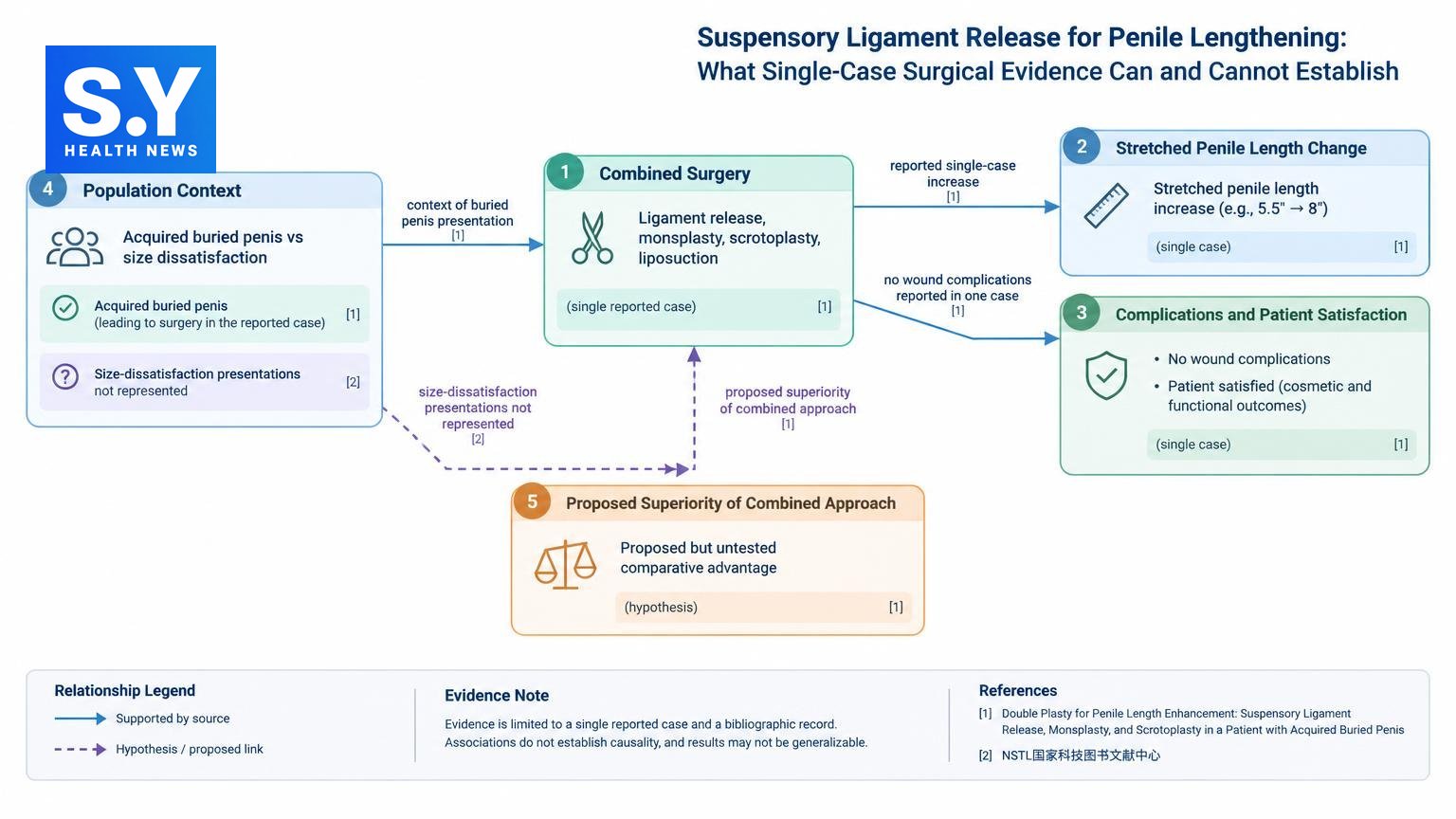
Conceptual framework: Conceptual framework of the variables examined in this evidence review. A single reported case combined suspensory ligament release with monsplasty, scrotoplasty and suprapubic liposuction and described a stretched-length increase, no wound complications and patient satisfaction. The population context distinguishes acquired buried penis from size dissatisfaction, and the proposed superiority of the combined approach is shown as an untested hypothesis. Relations are interpretive, not causal, and derive from one case.
Academic References & Evidence
- Almidani O; Al Homsi A; Rowaiee R; Cherubino M; Raheem O. Double Plasty for Penile Length Enhancement: Suspensory Ligament Release, Monsplasty, and Scrotoplasty in a Patient with Acquired Buried Penis. 2026
- Karimian, Babak; Shamshirgaran, Amirr. NSTL国家科技图书文献中心. Aesthetic plastic surgery. 2026 50(3):1431~1438
- Cirugía de Alargamiento de Pene en Bangkok | Menscape Clinic.
- What is Combined Penis Aesthetics? – Assoc. Dr. Ömer Bayrak.
SANYUN Science Center explains published research on men's reproductive and sexual health, connecting scientific evidence with everyday questions while making sources and limitations clear.
Disclaimer: This article is for scientific education and research communication only. It does not provide medical advice, diagnosis, or individualized treatment recommendations, and does not endorse any medication, supplement, device, penile enlargement procedure, or other intervention. Decisions about sexual and reproductive health should be made in consultation with a qualified healthcare professional. Do not delay seeking professional care because of information in this article.
Original Content & Copyright Notice
- This article is prepared for SANYUN Science Center, drawing on published research and publicly available academic literature on men’s sexual and reproductive health. Its editorial explanations and presentation are developed for this platform.
- Copyright in the original editorial content, selection, and arrangement is reserved by SANYUN Science Center to the extent protected by applicable law. Referenced research, quotations, and third-party materials remain subject to the rights of their respective owners. This notice does not claim ownership of scientific facts or third-party research.
- Except where permitted by applicable law or an applicable license, prior written permission is required to reproduce, republish, translate, adapt, redistribute, or commercially reuse protected content. Attribution alone does not grant permission for such reuse.
- For permitted quotation or authorized reuse, clearly identify the source and retain a link to the original article.
- Source: SANYUN Science Center
- Original URL: Retain the original article URL on science.san-yun.com.
- Copyright Holder: SANYUN Science Center, for its own protected editorial content.
- Quotation, excerpts, or authorized reuse must not distort the scientific meaning, omit material limitations or disclaimers, or imply unverified medical claims, product efficacy, or endorsement by SANYUN Science Center.



