




Category: Health Academy
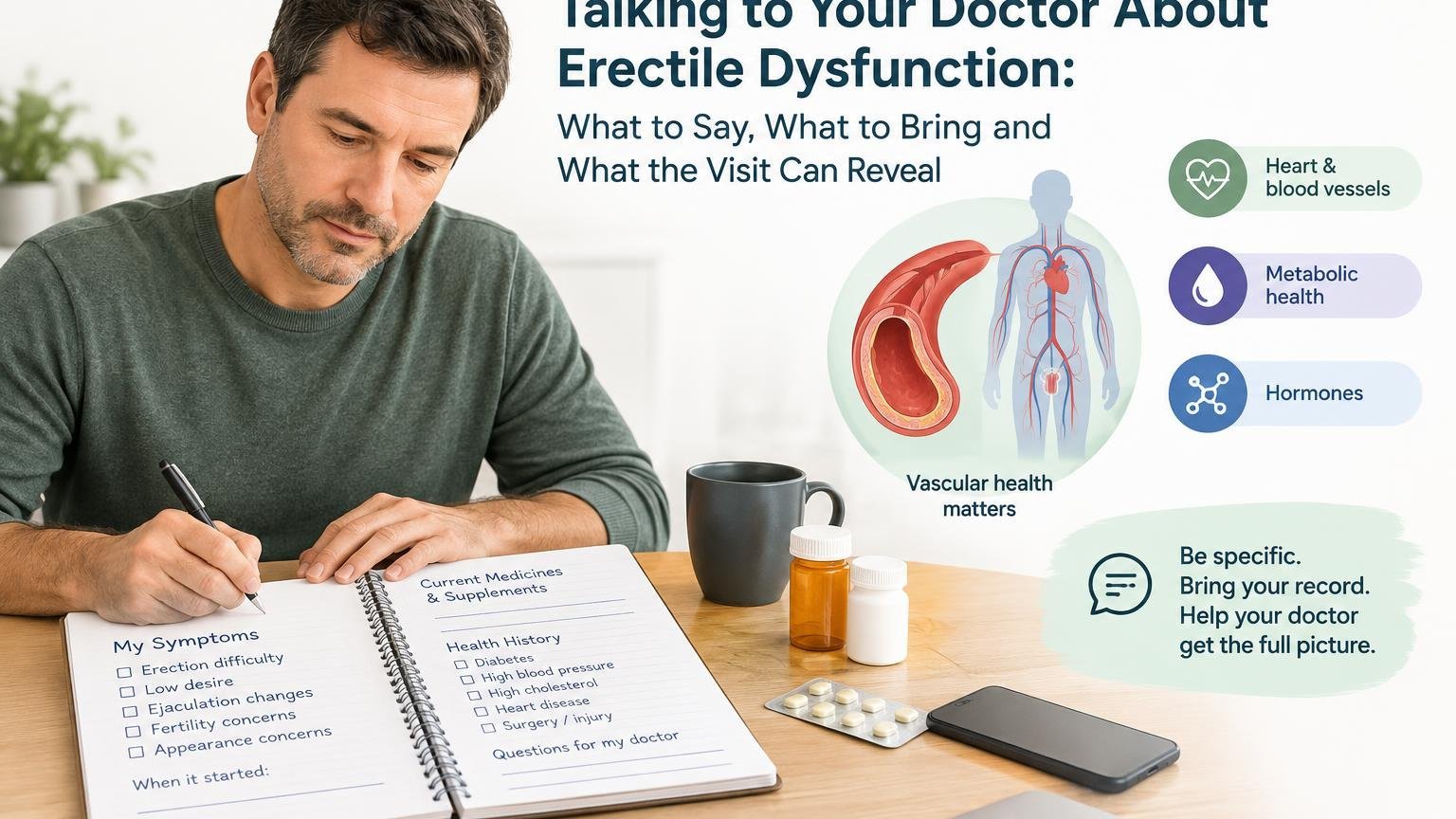
Core Research Direction: Practical, patient-centered preparation for discussing erectile dysfunction with a clinician: how to describe the symptom pattern (erection difficulty vs. desire, ejaculation, fertility or appearance concerns), what history and tests to anticipate, and how ED functions as a potential marker of vascular, metabolic and hormonal disease.
Search Intent: What should I say, and what should I bring, when I talk to my doctor about erectile dysfunction so that the visit leads to the right evaluation?
Platform: SANYUN Science Center
Evidence reviewed through: 2026-11-25
Executive Summary
Erectile dysfunction is often described in patient guides as common, treatable and frequently an early warning sign of heart disease, diabetes or hormonal imbalance, which is why the consultation is framed as a health review rather than a performance confession. The practical difficulty is rarely the medicine; it is the opening sentence. Patient-facing sources converge on the same advice: be direct, describe the specific pattern of what has changed, and bring a written record of symptoms, medicines, substances and relevant health history.[1][2]
The most useful preparation is not a script but a distinction. Erection difficulty, reduced desire, ejaculation changes, fertility questions and appearance concerns are different clinical problems that point toward different causes and different first tests. Lumping all of them under the single word "ED" can send an evaluation in the wrong direction.
This explainer is an interpretation of patient-education sources, not a new study or a systematic review. The supplied material is largely narrative guidance from clinician-written and consumer health pages, with limited primary data and no verified trial results on communication itself. Where numbers appear, they are secondhand estimates. The aim is to help an adult man prepare honestly, understand what a clinician is likely to ask, and recognize which findings deserve prompt attention.[3][4]
Why This Conversation Matters More Than It Feels
Delay is the norm rather than the exception. One guide, citing unspecified studies, estimates that fewer than 25% of men with ED ever discuss it with a healthcare provider despite safe and effective options existing for most causes. That figure should be read cautiously because the underlying studies are not identified in the supplied text, but the direction of the claim matches the tone of every source in this packet: the gap between symptom and consultation is wide, and awkwardness is the main reason.
Avoiding the discussion carries two costs. The obvious one is untreated sexual difficulty. The less obvious one is delayed detection: patient guides argue that avoiding the conversation can prolong stress and may allow underlying health conditions to go undetected. That claim is plausible but unquantified, and it should be treated as a rationale for evaluation rather than a proven outcome of any particular conversation.
Another common assumption deserves correction. Erectile difficulty becomes more common with age, but one guide reports that the Massachusetts Male Aging Study found ED prevalence rises with age while ED is not a normal or untreatable consequence of growing older. That framing matters clinically: age is a risk marker, not a diagnosis, and it does not by itself explain away a new or worsening symptom.
Separate What You Are Actually Experiencing
Before the appointment, sort your experience into categories. A urology appointment guide defines erection difficulty as trouble achieving or maintaining firmness sufficient for intercourse, and treats that as distinct from other sexual concerns. It defines desire change as reduced interest in sexual activity, which can occur with or without erection problems. It notes that fertility questions involve different testing, such as semen analysis and hormone panels, than an ED evaluation.
Another source puts the same distinction more bluntly: erectile dysfunction is difficulty achieving or maintaining an erection, whereas low libido is reduced interest in sex. A man can have a normal sex drive and erection difficulty, or low desire without erection problems, and the two require different lines of inquiry.
The practical warning attached to this is straightforward. If more than one category applies, say so explicitly rather than letting the word "ED" cover everything, because a clinician working from a single vague complaint may order the wrong first test. This is a reasoned caution rather than a tested finding, but it is a sensible one: semen analysis and testosterone panels answer different questions than a vascular workup does.
The Mechanism Behind the Warning Label
Why would a sexual symptom prompt a cardiovascular review? The commonly offered explanation is anatomical. Erections depend on adequate blood flow, so problems in the small penile arteries may reflect vascular disease elsewhere in the body. One guide expands this into a hypothesis: because penile blood vessels are smaller than coronary vessels, they may show signs of narrowing or reduced blood flow before chest pain or other cardiac symptoms appear.
That explanation is intuitive and widely repeated, but none of the supplied sources provides outcome data, imaging comparisons or prospective follow-up to support the timing claim. It should be presented to patients as a plausible mechanism and a reason to check cardiovascular risk factors, not as proof that a given man's erection problem predates or predicts a cardiac event. The broader causal list in these guides is more modest and more defensible: reduced blood flow, nerve damage, hormone imbalance and medication side effects are all listed as possible physical contributors.
Erections, as one source summarizes, rely on healthy blood vessels, proper nerve function, balanced hormones and stable mental health. That multi-system framing is useful in conversation because it explains why a clinician asks about mood and sleep as well as cholesterol, and why treatment may involve more than one approach.
What the Evidence Shows: What a Visit Involves
The sources are consistent on structure. Expect a focused medical history and physical examination, plus laboratory tests that include glucose, cholesterol and testosterone. Another guide lists the typical panel as fasting glucose and HbA1c for diabetes screening, a lipid profile for cardiovascular risk, and total and free testosterone. A fourth source adds thyroid function and notes that blood sugar, cholesterol, testosterone and thyroid testing may all be ordered.
One source attributes to the National Institute of Diabetes and Digestive and Kidney Diseases the position that ED is diagnosed using a combination of medical, sexual and mental health history, a physical examination, and laboratory or other tests. That attribution is secondhand in the supplied packet, and the underlying document is not provided, but it matches the pattern described across all four sources: the conversation is part of the diagnostic process rather than a formality before it.
The table below summarizes the dimensions a clinician is likely to explore and what each one is meant to distinguish. It is a preparation aid drawn from patient-education descriptions of typical practice, not a validated instrument.
| Dimension | What to describe | Why it matters clinically |
|---|---|---|
| Symptom category | Erection difficulty, desire change, ejaculation change, fertility concern or appearance concern, and whether more than one applies | Different categories point to different causes and different first tests; a single vague complaint may misdirect the workup |
| Timeline and pattern | When it began, whether onset was gradual or sudden, whether it is occasional or consistent, and whether it varies by situation or partner | Helps separate situational and psychological contributors from persistent physical ones |
| Morning erections | Whether erections still occur on waking or during sleep | Absence may suggest a physiological rather than psychological cause, though this is a heuristic rather than a diagnostic test |
| Medicines and substances | Prescription drugs with doses if known, over-the-counter products, supplements, alcohol, tobacco and recreational use | More than 25 medication classes, including antidepressants, antihypertensives and antiandrogens, are associated with ED; undeclared ingredients in sexual enhancement products are a separate safety issue |
| Health history | Diabetes, high blood pressure, high cholesterol, heart disease, pelvic or prostate surgery, injury, prior cancer treatment | Identifies conditions that may cause or accompany ED and shapes which tests come first |
| Expected tests | Glucose or HbA1c, lipid profile, total and free testosterone, sometimes thyroid function | Looks for root causes rather than treating the symptom alone |
What to Say, and What to Bring
The sources agree that no special vocabulary is required. One recommends a direct opening such as "I've been having trouble getting or keeping an erection." Another suggests variants like "I think I might have erectile dysfunction" or "my erections aren't as firm as they used to be." The point is not eloquence; it is specificity and honesty.
- Write down the symptom pattern before the visit: what specifically happens, whether it occurs in all situations or only some, whether morning erections persist, and whether desire, ejaculation or fertility are also concerns.
- Bring a complete medication and supplement list, including doses if known, plus honest information about alcohol, smoking and recreational substance use.
- Note relevant history: diabetes, blood pressure, cholesterol, heart disease, pelvic or prostate surgery, injury, and any hormone-related symptoms such as fatigue or low mood.
- Prepare a short list of questions, such as what category of cause seems most likely, which tests are recommended, whether current medicines could contribute, and which cardiovascular risk factors should be addressed regardless of the ED.
A written worksheet is not a sign of over-preparation. The urology guide that provides one notes that it exists so details are not forgotten under time pressure, and that a short focused visit works better than a vague one. If speaking the words aloud feels impossible, one source suggests writing the concern on paper or typing it on a phone and handing it over.
Treatment Talk Without Promises
Patients often arrive expecting a prescription, and the sources are careful here. Options discussed include lifestyle change, oral medications, hormone treatment where testosterone is low, mental health support, and device or injection therapies typically reserved for when first-line approaches are ineffective. PDE5 inhibitors such as sildenafil and tadalafil are described as improving penile blood flow and effective for many men, but requiring a prescription and medical clearance. No efficacy percentages are given in the supplied text.
One commercial guide asserts that most men with ED respond well to first-line treatments when the underlying cause is identified and managed. That claim is unquantified in the supplied material, and the article's commercial context — it promotes a paid telehealth consultation — warrants caution in reading it. The safer framing for a patient is that response depends on the cause and that follow-up matters.
A specific safety point deserves emphasis. One guide notes that the FDA maintains an ongoing list of sexual enhancement products found to contain undeclared prescription drug ingredients, often the same compounds used in approved ED medicines. A complete medication history is what allows a clinician to catch a dangerous interaction or duplication before a patient tries something unregulated.
When to Seek Care Promptly
Most ED evaluation is routine and can be scheduled. Some combinations are not. One source advises prompt medical attention when ED occurs together with chest pain, shortness of breath or leg pain with walking, because these may indicate cardiovascular or peripheral vascular disease. It also lists severe fatigue and sudden changes in sexual function as reasons to speak to a doctor promptly. This is safety guidance rather than a triage protocol, and acute chest pain or breathlessness warrants urgent care on its own merits.
Interpretation and Limitations
The evidence base behind this article is thin in a specific way. Three of the four sources are consumer-facing guides rather than clinical trials, systematic reviews or guideline documents. One is a clinician-reviewed doctor's note, one is a urology practice guide, one is a commercial telehealth blog, and one appears on a non-medical arts organization's website. The last of these is a notable credibility weakness for its mechanistic claims.
Several claims are presented in the sources as established when they are better described as plausible or heuristic. The idea that absent morning erections point to an organic rather than psychological cause is a clinical heuristic, not diagnostic accuracy data. The suggestion that penile vessels show disease earlier than coronary vessels is a hypothesis offered without cited evidence. The thresholds offered for when difficulty is unlikely to resolve — more than half the time, more than a few months, or worsening — are unreferenced practical guidance.
The single numerical estimate on care-seeking, fewer than 25% of men with ED discussing it with a provider, is secondhand and its source studies are not identified in the supplied text. It is useful for framing the problem and should not be quoted as a precise prevalence figure.
Finally, the sources are geographically mixed, with one written for a Singapore context and referencing telehealth regulations specific to that country. Tests and pathways vary by health system. The general structure — history, examination, blood work, discussion of options — is consistent across sources, but local practice will differ.
Research Outlook
None of the supplied sources reports a trial of communication strategies, shared decision-making tools or appointment preparation in ED. The advice in this packet is therefore practical consensus rather than evidence from controlled comparison. The relevant open questions are real: whether structured pre-visit worksheets improve the completeness of history-taking, whether they shorten time to diagnosis, and whether they increase the proportion of men who discuss sexual concerns at all, remain unanswered in this material. The clinical case for evaluation rests on the overlap between erectile and vascular, metabolic and hormonal health, not on proof that any particular conversation script works better than another.
Key Takeaways
- Erection difficulty, reduced desire, ejaculation changes, fertility concerns and appearance concerns are different problems; name all that apply rather than saying only "ED".
- A direct opening sentence is enough; patient guides suggest simple wording such as trouble getting or keeping an erection.
- Expect a focused history, a physical examination and blood tests that commonly include glucose or HbA1c, lipids and testosterone, with thyroid function sometimes added.
- Bring a full medication and supplement list, because many drug classes are associated with ED and unregulated products may contain undeclared prescription ingredients.
- Treat ED as a possible signal of vascular, metabolic or hormonal disease worth checking, while recognizing that the early-warning mechanism is plausible but not proven by the sources here.
- Seek prompt care if ED accompanies chest pain, shortness of breath or leg pain with walking.
Questions and Answers
What is the difference between erectile dysfunction and low libido?
Erectile dysfunction refers to difficulty achieving or maintaining an erection firm enough for intercourse, while low libido refers to reduced interest in sexual activity. A man can have normal desire with erection difficulty, or low desire without erection problems. Patient guides stress this distinction because the two point toward different causes and different first tests.
What should I say to my doctor about erectile dysfunction?
Start with a direct statement such as "I've been having trouble getting or keeping an erection." Then describe the pattern: when it began, whether it is occasional or consistent, whether morning erections persist, and whether desire, ejaculation or fertility are also affected. Mention medicines, supplements, alcohol, smoking and stress. No medical vocabulary is required, and written notes are acceptable.
What tests should I expect at an erectile dysfunction appointment?
Patient guides describe a focused medical history and physical examination plus blood tests that commonly include fasting glucose or HbA1c for diabetes screening, a lipid profile for cardiovascular risk, and total and free testosterone. Thyroid function and a full blood count are sometimes added. These look for underlying causes rather than treating the symptom alone, and the exact panel varies by clinician and country.
Can erectile dysfunction be an early sign of heart disease or diabetes?
Patient-education sources describe ED as often an early warning sign of heart disease, diabetes or hormonal imbalance, and one proposes that smaller penile vessels may show narrowing before coronary symptoms appear. That mechanism is plausible but not proven by the supplied sources, which provide no outcome data. It is a reason to check cardiovascular and metabolic risk, not a diagnosis.
When is erectile dysfunction a reason to seek urgent medical care?
Routine ED evaluation can usually be scheduled, but one source advises prompt attention when ED occurs with chest pain, shortness of breath, leg pain with walking, severe fatigue or sudden changes in sexual function. These combinations may indicate cardiovascular or peripheral vascular disease. Acute chest pain or breathlessness warrants urgent care in its own right.
How common are medication-related causes of erectile dysfunction?
One guide states that more than 25 medication classes are associated with ED, including antidepressants, antihypertensives and antiandrogens, though the underlying review is not supplied. A separate safety concern is that the FDA keeps a list of sexual enhancement products containing undeclared prescription ingredients. A complete medication and supplement list lets a clinician spot reversible contributors and dangerous interactions.
Sources and References
- Don’t Wait: Exactly What to Say to Your Doctor About ED Today | Ubie Doctor's Note. 2026
- Bringing Up ED With Your Doctor: What to Say and What to Bring.
- How to Talk to Your Doctor About ED: A No-Shame Guide | Noah.
- Sana. Breaking the Silence: A Practical Guide to Talking to a Doctor About Erectile Dysfunction – Bennington Area Arts Council, Art, Events & Music, in Southern Vermont.
SANYUN Science Center explains published research on men's reproductive and sexual health, connecting scientific evidence with everyday questions while making sources and limitations clear.
Disclaimer: This article is for scientific education and research communication only. It does not provide medical advice, diagnosis, or individualized treatment recommendations, and does not endorse any medication, supplement, device, penile enlargement procedure, or other intervention. Decisions about sexual and reproductive health should be made in consultation with a qualified healthcare professional. Do not delay seeking professional care because of information in this article.
Original Content & Copyright Notice
- This article is prepared for SANYUN Science Center, drawing on published research and publicly available academic literature on men’s sexual and reproductive health. Its editorial explanations and presentation are developed for this platform.
- Copyright in the original editorial content, selection, and arrangement is reserved by SANYUN Science Center to the extent protected by applicable law. Referenced research, quotations, and third-party materials remain subject to the rights of their respective owners. This notice does not claim ownership of scientific facts or third-party research.
- Except where permitted by applicable law or an applicable license, prior written permission is required to reproduce, republish, translate, adapt, redistribute, or commercially reuse protected content. Attribution alone does not grant permission for such reuse.
- For permitted quotation or authorized reuse, clearly identify the source and retain a link to the original article.
- Source: SANYUN Science Center
- Original URL: Retain the original article URL on science.san-yun.com.
- Copyright Holder: SANYUN Science Center, for its own protected editorial content.
- Quotation, excerpts, or authorized reuse must not distort the scientific meaning, omit material limitations or disclaimers, or imply unverified medical claims, product efficacy, or endorsement by SANYUN Science Center.



