


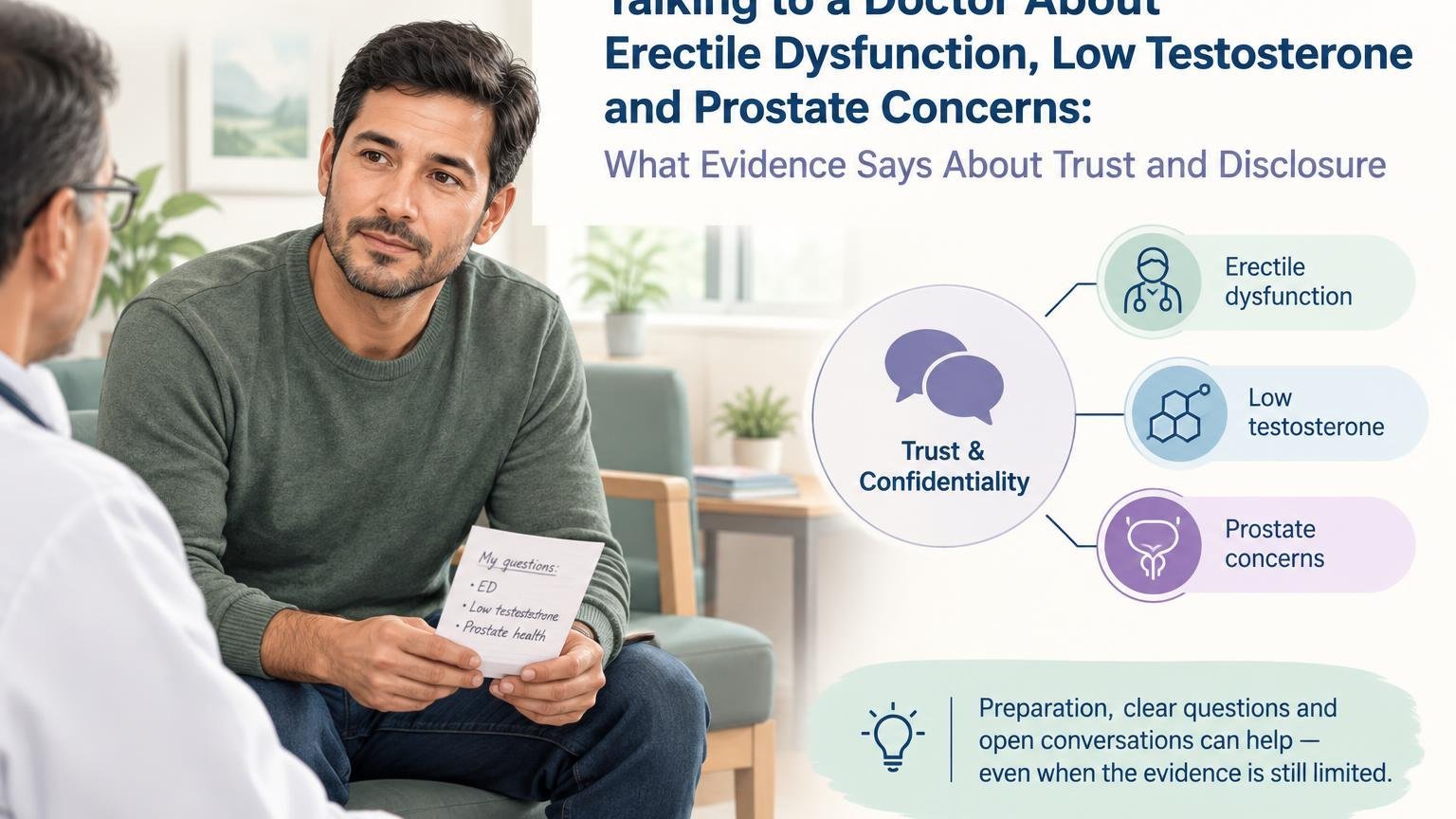


Category: Health Academy
Core Research Direction: Helping adult men raise sensitive reproductive and sexual health concerns (erectile dysfunction, low testosterone, prostate concerns) with a primary care clinician, and what evidence exists on confidentiality/trust and disclosure barriers in clinical encounters
Search Intent: Why do men find it hard to raise sexual and reproductive health concerns with a primary care clinician, and what does the available evidence say about trust, confidentiality and disclosure?
Platform: SANYUN Science Center
Evidence reviewed through: 2026-11-25
Executive Summary
Many adult men delay or avoid raising sexual and reproductive health concerns with a primary care clinician. Health-system patient education acknowledges that topics such as erectile dysfunction, low testosterone, mental health struggles and prostate concerns can feel too personal to say out loud, and recommends building a relationship over regular visits and preparing specific questions before an appointment. That advice is practical but largely unreferenced; it describes a communication problem rather than testing a solution.[1]
Survey evidence supports the broad picture. In a representative German survey reported in 2026, 18% of respondents said they had at some point withheld health problems or symptoms during a consultation, and sexuality, domestic violence and abuse were among the topics commonly left unspoken. Among respondents aged 18–29, 28% reported hiding symptoms or other information from a physician, compared with 13% of those over 60. Yet 92% of respondents said they trust physicians on health matters, a gap suggesting that trusting a clinician and telling them everything are different things.[2]
The most direct experimental-style evidence on confidentiality comes from a cross-sectional survey of 1,509 young people aged 13–26. Only about one third reported a confidentiality agreement with their physician. Those who did discussed 4.4 health topics on average at their most recent visit versus 2.9 among those without such an agreement. For tobacco, drugs and alcohol, and STIs/HIV, a confidential and trusting climate was associated with higher adjusted odds of discussion (aOR 1.85–2.00). This is observational, self-reported and not specific to adult men or to erectile dysfunction, low testosterone or prostate concerns, so it cannot show that a confidentiality agreement causes disclosure.[3]
Taken together, the evidence is thin but consistent: sensitive topics are under-discussed, confidentiality and trust may facilitate discussion, and trust alone does not guarantee full disclosure. For adult men, the practical implication is not that a particular script or clinic policy has been proven to work, but that preparation, explicit clarification of confidentiality, and repeated contact are reasonable ways to reduce the communication barrier while remaining honest about what the evidence can and cannot support.
Why This Matters
Erectile dysfunction, low testosterone and prostate concerns are common reasons men eventually seek care, but they are also topics people describe as embarrassing or too personal. When these concerns are not raised, clinicians cannot assess symptoms, arrange appropriate tests, discuss treatment options or recognize red flags. The consequences are not limited to sexual function: sexual difficulties can accompany cardiovascular, metabolic, psychological and relationship problems, and prostate symptoms can affect urination, sleep and quality of life. The clinical value of disclosure is therefore broader than the specific complaint.
The German survey gives a population-level sense of how often information is withheld. The 18% figure is a lifetime self-report, not a rate per visit, and it does not tell us how many of those withheld concerns were sexual or reproductive. Even so, the fact that sexuality was named among commonly unspoken topics is directly relevant to men's health. The same survey found that women more often reported difficulty talking about domestic violence or abuse and also about weight and eating disorders, which cautions against framing non-disclosure as an exclusively male problem. Men may face particular barriers around sexual performance, masculinity and fear of judgment, but the available packet does not quantify those male-specific barriers.
There is also a distinction between trust in the profession and comfort in a specific encounter. A large majority of survey respondents expressed trust in physicians, yet some had withheld information. This is a useful corrective to the assumption that distrust is the main reason men stay silent. Discomfort, shame, fear of judgment, uncertainty about what is relevant and worry about confidentiality may operate alongside trust. The packet does not test these mechanisms directly, but the co-occurrence of high trust and non-disclosure is an important observation for clinicians who assume that a good relationship automatically resolves the problem.
What Surveys and Studies Actually Show
The adolescent and young-adult survey is the most detailed source in the packet. Researchers interviewed 1,509 people aged 13–26 and asked how many of 11 listed health topics they had discussed with their physician at their most recent visit. Young women discussed 3.7 topics on average and young men 3.6, a small difference. The most frequently discussed topics were mental and emotional health (55%), drug or alcohol use (46%), tobacco use (44%) and school performance (43%). The least discussed were gun safety (14%), sexual orientation (20%) and sexual or physical abuse (21%). This pattern suggests that even in a clinical encounter, topics with higher perceived sensitivity or lower routine screening are less likely to be raised.
| Measure | Reported finding | Population and design | Interpretation |
|---|---|---|---|
| Confidentiality agreement with physician | About one third | US young people aged 13–26; cross-sectional survey (n=1,509) | Minority reported an explicit confidentiality arrangement |
| Mean health topics discussed at most recent visit | 4.4 with confidentiality agreement vs 2.9 without | Same survey; self-reported topic count | Association only; not proof that agreements increase disclosure |
| Adjusted odds of discussing tobacco, drugs/alcohol or STIs/HIV | aOR 1.85–2.00 for confidential and trusting climate | Same survey; adjusted observational estimate | Statistically significant association; causality cannot be inferred |
| Withheld health information during a consultation | 18% of respondents | German representative survey; lifetime self-report | Non-disclosure is common but not quantified specifically for sexual concerns |
| Withheld information by age | 28% aged 18–29 vs 13% over 60 | Same German survey; age-group comparison | Generation difference; survey cannot explain it |
| Trust in physicians on health matters | 92% | Same German survey | High trust coexists with non-disclosure |
The German survey adds a population perspective but is also limited. The 18% figure is a lifetime proportion, so it does not estimate how often information is withheld at a given visit. The age gradient from 28% among 18–29-year-olds to 13% among those over 60 is striking, but the survey alone cannot establish that greater familiarity with the medical system explains it. Other possibilities include cohort differences in attitudes toward medical authority, different health concerns, or different interpretations of what counts as relevant to disclose. The finding that women more often reported difficulty discussing domestic violence, abuse, weight and eating disorders is a reminder that barriers are not uniform across genders or topics.
A separate US survey on mental health in primary care found that 74% of adults said they are or would be generally comfortable raising mental health concerns, including loneliness, depression, anxiety and social isolation, with a primary care provider. Women and men reported similar comfort levels, although men were overall less likely to prefer being asked about mental health. In the same survey, 87% of patients considered it very or somewhat important that primary care providers screen for anxiety or depression. These findings are about mental health rather than sexual health, but they suggest that many patients want primary care clinicians to open sensitive conversations rather than waiting for patients to initiate them. The packet does not provide the survey's sample size or full methodology, so these percentages should be read as reported survey results rather than precise national estimates.[4]
Confidentiality, Trust and the Limits of the Evidence
The confidentiality concept is intuitive: if patients fear that personal information will be shared without their consent, they may withhold it. The young-adult survey provides the clearest packet evidence. Study author Santelli is quoted saying many young patients do not feel safe discussing certain things with their physician or fear the doctor will immediately report discussion content to parents, and that a confidentiality agreement is an important step to reassure them. That quotation is expert interpretation, not a measured outcome. The survey's adjusted associations are consistent with the idea that confidentiality and trust facilitate discussion, but cross-sectional data cannot distinguish cause from consequence. It is equally plausible that patients who already feel comfortable and communicative are more likely to establish confidentiality agreements and to discuss more topics.
For adult men, the confidentiality issue is different from the adolescent case but not absent. Adults generally have legal control over their medical information, yet they may still worry about who will see records, whether a partner or family member will be informed, or how a clinician will judge them. The German survey does not measure these specific fears, and the packet contains no study of confidentiality agreements in adult male primary care. The health-system patient education source addresses the emotional barrier directly, advising that regular visits make conversations less intimidating and that preparation, written questions, a support person and rehearsal can help. These are sensible communication strategies, but they are editorial recommendations without cited outcome data.
It is also worth distinguishing statistical significance from clinical significance. The adjusted odds ratios of 1.85–2.00 for discussing tobacco, drugs and alcohol, or STIs/HIV indicate a meaningful association in the survey, but they do not tell us whether a confidentiality agreement would change behavior in a real clinic, how large the effect would be, or whether it would extend to erectile dysfunction or prostate concerns. The difference between 4.4 and 2.9 topics discussed is substantial in absolute terms, but it reflects an unadjusted comparison that may be confounded by patient age, health status, clinic type, clinician communication style and willingness to discuss sensitive topics. Without a randomized or longitudinal design, causal claims are not justified.
What This Means for a Primary Care Conversation
The evidence does not support a single proven script for raising erectile dysfunction, low testosterone or prostate concerns. It does support a few reasonable principles. First, continuity may help: the patient-education source recommends regular visits so that trust has time to develop. Second, preparation can reduce the burden of initiation: writing down concerns, bringing a trusted person and practicing the conversation are practical steps the source recommends, even though their effectiveness has not been tested in the cited material. Third, patients who are unsure about confidentiality can ask directly what will be shared and with whom. That question is not a sign of distrust; the German survey suggests that trust and full disclosure are not the same thing.
Clinicians can also reduce the initiation burden. The US mental health survey found that most adults were comfortable raising mental health concerns and that 87% considered screening for anxiety or depression important, yet men were less likely to prefer being asked about mental health. One interpretation is that men may welcome a clinician opening the topic even if they do not want to be singled out. The packet does not test this interpretation for sexual health, but it is consistent with the broader idea that normalizing sensitive questions can help. A clinician who asks routinely about sexual function, urinary symptoms and testosterone-related concerns may make it easier for a man to respond than one who waits for the patient to volunteer a complaint.
It is important not to overstate what a conversation can achieve. Raising a concern does not establish a diagnosis. Erectile dysfunction can have vascular, neurological, hormonal, psychological, relationship and medication-related contributors; low testosterone requires appropriate testing and interpretation; prostate concerns require symptom assessment and, where indicated, examination or referral. The packet does not provide clinical guidance on these conditions, and this article does not either. The evidence here is about communication, not about the comparative effectiveness of treatments. A useful conversation is a starting point for appropriate evaluation, not a substitute for it.
Research Outlook
The packet reveals clear evidence gaps. There is no adult male-specific study of confidentiality agreements and disclosure of sexual or reproductive concerns. The largest relevant survey is cross-sectional and self-reported, and the German survey does not report topic-specific frequencies for sexual concerns. The mental health survey provides useful context but is not about erectile dysfunction, testosterone or prostate symptoms. Future research could test whether routine, non-judgmental opening questions increase disclosure among adult men, whether explicit confidentiality statements change comfort or behavior, and whether continuity of care with the same primary care clinician is associated with earlier presentation of sexual health concerns. Until such studies exist, recommendations should be framed as reasonable communication strategies rather than proven interventions.
The current evidence also does not support claims that a particular clinic, health system or communication training program has been shown to improve disclosure or clinical outcomes. The Endeavor Health source is patient education and editorial content, not a study, and it provides no data or citation. The news reports summarize surveys and a published study but do not provide full methodological detail. Readers should treat percentages and associations as descriptive signals, not as precise effect sizes or causal findings. The most defensible conclusion is that sensitive topics are often under-discussed, that trust and confidentiality are plausible facilitators, and that both patients and clinicians can take practical steps to make the conversation easier without pretending the evidence is stronger than it is.
Key Takeaways
- Health-system patient education acknowledges that erectile dysfunction, low testosterone, mental health and prostate concerns can feel too personal to raise, and recommends regular visits and preparation to make conversations easier; these are practical recommendations, not tested interventions.
- In a German representative survey reported in 2026, 18% of respondents had at some point withheld health problems or symptoms during a consultation, and sexuality was among the topics commonly left unspoken; 28% of 18–29-year-olds versus 13% of those over 60 reported hiding information.
- Despite that non-disclosure, 92% of the same German survey respondents said they trust physicians on health matters, suggesting that trust and full disclosure are different phenomena.
- In a cross-sectional survey of 1,509 young people aged 13–26, only about one third reported a confidentiality agreement with their physician; those who did discussed 4.4 topics on average versus 2.9 among those without, and confidential climate was associated with higher adjusted odds (aOR 1.85–2.00) of discussing tobacco, drugs/alcohol or STIs/HIV.
- A US survey found 74% of adults comfortable raising mental health concerns with a primary care provider and 87% considered anxiety or depression screening important; men were less likely than women to prefer being asked about mental health, despite similar reported comfort.
- No packet source proves that a confidentiality agreement, a specific script or a clinic policy increases disclosure of erectile dysfunction, low testosterone or prostate concerns in adult men; the relevant evidence is observational, self-reported and often from younger or non-male-specific populations.
Questions and Answers
Why do men find it hard to talk to a doctor about erectile dysfunction, low testosterone or prostate concerns?
Health-system patient education notes that these topics can feel too personal to say out loud, and survey data show that sexuality is among the topics people commonly leave unspoken in medical consultations. Shame, fear of judgment, uncertainty about confidentiality and not knowing how to start are plausible barriers, but the packet does not quantify male-specific causes or prove which barrier matters most.
What does the survey evidence show about confidentiality agreements and patient disclosure?
In a cross-sectional survey of 1,509 young people aged 13–26, only about one third reported a confidentiality agreement with their physician. Those with an agreement discussed 4.4 topics on average versus 2.9 without one, and a confidential climate was associated with higher adjusted odds of discussing tobacco, drugs/alcohol or STIs/HIV (aOR 1.85–2.00). The design is observational, so causation is not established.
How common is it for patients to hide health information from their doctor?
A representative German survey reported in 2026 found that 18% of respondents had at some point withheld health problems or symptoms during a consultation. The proportion was 28% among 18–29-year-olds and 13% among those over 60. This is a lifetime self-report, not a per-visit rate, and it does not give topic-specific frequencies for sexual concerns.
Can a patient trust their doctor and still not disclose sensitive health concerns?
Yes. In the German survey, 92% of respondents said they trust physicians on health matters, yet 18% had withheld information at some point. The report interprets this as evidence that trusting a clinician and telling them everything are different things. Trust may be necessary but is not sufficient for disclosure, and the survey cannot establish causal direction.
How strong is the evidence that improving confidentiality will help adult men discuss sexual health?
The evidence is weak for this specific question. The main confidentiality study is a cross-sectional survey of young people aged 13–26, not adult men, and it measures association rather than causation. It does not focus on erectile dysfunction, low testosterone or prostate concerns. The adult survey data on withheld information are descriptive. No packet source tests whether a confidentiality intervention changes disclosure in adult male primary care.
What practical steps might make it easier to raise a sensitive health concern with a primary care clinician?
Patient education suggests preparing written questions, bringing a trusted support person, practicing the conversation and using regular visits to build familiarity over time. Clinicians can help by asking routine, non-judgmental questions about sexual function, urinary symptoms and related concerns. These are reasonable communication strategies, but the packet does not provide outcome data proving that any specific approach increases disclosure or improves clinical outcomes.
Sources and References
- Discussing sensitive topics with your primary care physician.
- En consultation, un patient sur cinq tait ce qui le gêne. Medinside. 2026
- Anne Harding. Ragazzi: il “patto sulla riservatezza” con il medico è fondamentale. Pediatrics. 2019
- 70% of Americans want primary care providers to address mental health | Medical Economics. Medical Economics. 2024
SANYUN Science Center explains published research on men's reproductive and sexual health, connecting scientific evidence with everyday questions while making sources and limitations clear.
Disclaimer: This article is for scientific education and research communication only. It does not provide medical advice, diagnosis, or individualized treatment recommendations, and does not endorse any medication, supplement, device, penile enlargement procedure, or other intervention. Decisions about sexual and reproductive health should be made in consultation with a qualified healthcare professional. Do not delay seeking professional care because of information in this article.
Original Content & Copyright Notice
- This article is prepared for SANYUN Science Center, drawing on published research and publicly available academic literature on men’s sexual and reproductive health. Its editorial explanations and presentation are developed for this platform.
- Copyright in the original editorial content, selection, and arrangement is reserved by SANYUN Science Center to the extent protected by applicable law. Referenced research, quotations, and third-party materials remain subject to the rights of their respective owners. This notice does not claim ownership of scientific facts or third-party research.
- Except where permitted by applicable law or an applicable license, prior written permission is required to reproduce, republish, translate, adapt, redistribute, or commercially reuse protected content. Attribution alone does not grant permission for such reuse.
- For permitted quotation or authorized reuse, clearly identify the source and retain a link to the original article.
- Source: SANYUN Science Center
- Original URL: Retain the original article URL on science.san-yun.com.
- Copyright Holder: SANYUN Science Center, for its own protected editorial content.
- Quotation, excerpts, or authorized reuse must not distort the scientific meaning, omit material limitations or disclaimers, or imply unverified medical claims, product efficacy, or endorsement by SANYUN Science Center.



