




Category: Health Academy
Core Research Direction: Testicular cancer awareness and testicular self-examination among young men: what campaign-based sources report about early detection, symptoms, incidence and survival, and the limits of their evidence
Search Intent: Why is testicular cancer in young men still diagnosed late in some countries, and what do awareness campaigns claim about self-examination and early detection?
Platform: SANYUN Science Center
Evidence reviewed through: 2026-11-20
Executive Summary
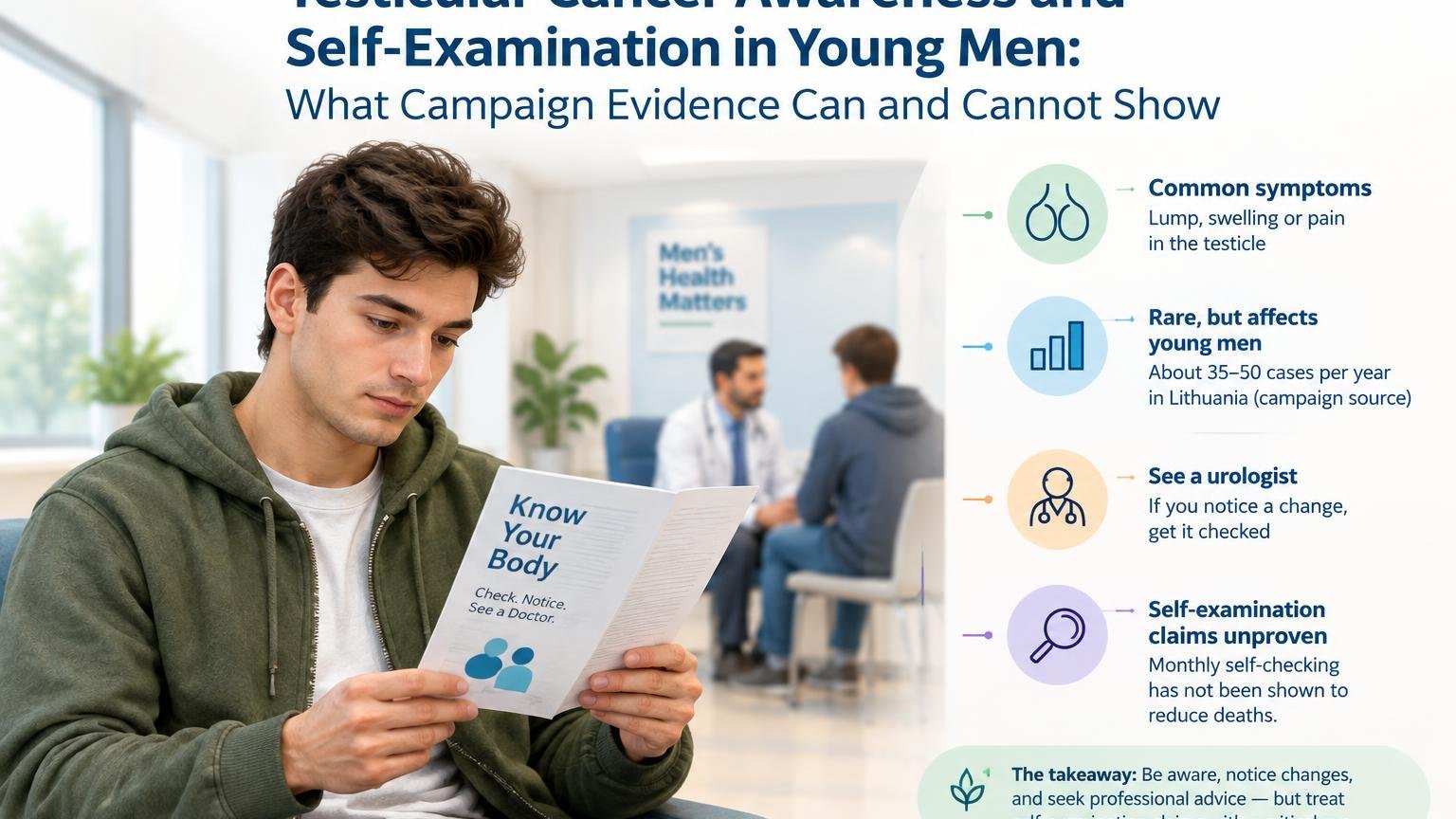
Public campaigns aimed at young men increasingly promote testicular self-examination as a low-cost habit. The Lithuanian Urological Society's "Check Your Balls" initiative is a prominent example: it encourages young men to notice unusual body changes and visit a urologist, and it frames masculinity stereotypes as a barrier to timely help-seeking. The materials describe testicular cancer as a disease of young men and argue that delayed diagnosis still occurs.[1]
The campaign's central clinical claims are striking but largely unsourced. Its president states that global five-year survival is 98–99% but that the figure in Lithuania is 88%, and that testicular cancer is still sometimes diagnosed at very late stages when curative help may no longer be possible. The same materials give annual Lithuanian case numbers of 35–50, a lifetime risk of about 1 in 250 (or 300) men, and global figures of about 7,200 cases and 9,100 deaths in 2023. No registry, year range or statistical method is cited for any of these numbers.
The strongest evidence problem concerns self-examination itself. The campaign asserts that 1–2 minutes of monthly self-checking "can save young people's lives," but it reports no trial, no comparison group and no outcome data. That does not make self-awareness useless; it means the mortality benefit is a plausible hypothesis rather than a demonstrated result. Readers should treat the campaign as health communication, not as proof of screening effectiveness.
- What campaigns report: late-stage diagnosis still occurs, survival varies by country, and men often delay care.[2]
- What remains unproven: that monthly self-examination reduces deaths from testicular cancer.
- What to do with a change: campaign materials consistently direct men to a urologist rather than to self-treatment.[3]
Why This Matters
Testicular cancer is rare relative to prostate cancer, but it matters because it affects young men during decades when health is rarely a priority. The campaign's comparison is stark: annual Lithuanian prostate cancer detections are stated as up to 3,000, while testicular cancer detections are up to 50. A lifetime risk of about 1 in 250 (or 300) men is far lower than the 1 in 5–8 figure the society gives for prostate cancer. Rarity is precisely why awareness messaging has to be careful: a low-prevalence condition can generate anxiety disproportionate to risk if campaigns overstate the protective value of self-checking.
The help-seeking argument is more defensible than the screening argument. Campaign sources repeatedly claim that more than half of men visit a urologist only when disease is strongly advanced, because they believe health matters only when pain begins. That claim is uncited and appears identically in a society news listing and on the campaign website, so it should not be treated as a measured statistic. Yet the underlying concern — that men wait for pain before acting — is consistent with the campaign's framing of masculinity as a barrier, and it points to a practical message that does not depend on unproven screening claims.
Biological and Clinical Context
The packet does not describe testicular cancer biology in detail, and this article will not supply unsourced mechanism claims. What the campaign materials do provide is a symptom-oriented message. They list pain, swelling, changes in the genital area, urinary problems, and changes in urine or sperm colour as the most common symptoms bringing men to urologists. That list is a general statement about presentations, not a testicular-cancer-specific symptom profile, and several listed items are more typical of other urological conditions. The practical implication is that a change in the scrotum or testicle warrants assessment, while the presence of urinary symptoms does not by itself indicate testicular cancer.
The campaign also links self-examination to broader sexual-health advice, recommending safe sexual practices and a regular sex life alongside regular self-checking. The source does not establish a causal link between casual sexual encounters and testicular cancer, and readers should not infer one. The advice is best read as general sexual-health guidance attached to a cancer-awareness message, not as a testicular cancer prevention strategy.
What the Evidence Shows
The packet contains no primary studies, systematic reviews or registry analyses of testicular cancer awareness, self-examination or stage at diagnosis. Its sources are a society news report built around an interview, a society news listing, and a campaign website whose text is duplicated across two URLs. This matters for interpretation: the numbers and claims should be attributed to campaign advocates, not to peer-reviewed epidemiology.[4]
| Reported item | Campaign figure or statement | What the source does not provide |
|---|---|---|
| Lithuanian annual testicular cancer cases | 35–50 per year | Registry source, reference years, citation |
| Lifetime risk in men | About 1 in 250 (or 300) | Population, geography, registry basis |
| Five-year survival | 98–99% globally; 88% in Lithuania | Data source, period, definitions |
| Global burden, 2023 | About 7,200 cases and 9,100 deaths | Registry or model citation; explanation for deaths exceeding cases |
| Men presenting with advanced disease | More than half, according to campaign messaging | Survey design, sample, reference population |
| Self-examination benefit | 1–2 minutes monthly "can save lives" | Trial evidence, comparator, outcome data |
The survival contrast deserves particular caution. A gap between 98–99% and 88% is clinically meaningful if real, but the packet gives no indication of whether the two figures cover the same period, use the same definition of five-year survival, or come from comparable registry systems. Lithuania is a smaller country with 35–50 annual cases, so year-to-year variation and small-number effects can be substantial. The figure is best treated as a signal worth investigating, not as a settled national performance measure.
Global figures of about 7,200 cases and 9,100 deaths in 2023 are internally puzzling because deaths exceed reported cases. The packet does not explain the discrepancy, which could reflect differences in how cases are counted, modelled estimates, or a transcription issue. Readers should not repeat these numbers as established global epidemiology without checking a primary source.
Interpretation and Limitations
The campaign's logic is straightforward: testicular cancer can present silently, late diagnosis is harder to treat, self-examination is cheap, and men should act on changes. Each step is plausible, but the packet supports only the general claim that early detection often allows shorter, easier and less costly treatment. That statement is not specific to testicular cancer and is not quantified. The leap from "early detection is generally better" to "monthly self-examination saves lives" is the weakest link in the chain.
A second limitation is the evidence base itself. A campaign news report and a promotional website are designed to persuade, not to measure. The society president's clinical impression that late-stage diagnoses still occur is valuable context, but it is not stage-distribution data. The award recognition the campaign received is not evidence of health impact. None of this invalidates the campaign as communication; it simply limits what can be concluded from it.
There is also a risk of conflating self-awareness with screening. Organized screening programmes require evidence that the test detects disease earlier, that earlier treatment improves outcomes, and that harms such as false positives and anxiety are acceptable. The packet contains none of that evidence for testicular self-examination. What it does contain is a clear instruction to see a urologist when something changes, and that instruction does not depend on the screening debate.
Health-system context matters too. The campaign describes a "green corridor" principle ensuring rapid access to oncology treatment once cancer is suspected or diagnosed in Lithuania. That is an advocate's description without waiting-time or outcome metrics, but it illustrates why awareness campaigns often pair self-checking messages with reassurance that the referral pathway works. In settings without such a pathway, the same message could place more burden on individuals.
Research Outlook
What would strengthen this area is not another awareness slogan but evaluation. Useful questions include whether campaign exposure increases appropriate urologist visits, whether it shifts stage at diagnosis, and whether it causes harm through anxiety or unnecessary investigation. The packet reports a planned Movember step challenge scheduled for 16–30 November 2026, but no participation or outcome data. That is a planned activity, not a result.
Registry-linked studies comparing stage at diagnosis across countries with different awareness campaigns would help clarify whether the 88% versus 98–99% survival gap is real and what drives it. Qualitative work on masculinity and help-seeking could test the campaign's framing hypothesis. Until such evidence exists, the honest position is that awareness messaging is reasonable, self-examination is low-cost and low-risk for most men, and the mortality benefit remains unproven.
Key Takeaways
- Testicular cancer is rare but affects young men; campaign sources give annual Lithuanian case numbers of 35–50 and a lifetime risk of about 1 in 250 (or 300) men, without citing a registry.
- The reported survival gap (98–99% globally versus 88% in Lithuania) is worth investigating but cannot be verified from this packet.
- The claim that monthly self-examination saves lives is a hypothesis, not a demonstrated outcome in the available sources.
- A new lump, swelling or pain in the testicle should prompt a urologist visit; the campaign consistently directs men to clinical assessment rather than self-management.
- Men who delay care until pain begins are a legitimate public-health target, but the "more than half present late" figure is uncited and should be repeated cautiously.
Questions and Answers
What is testicular self-examination and what does the Check Your Balls campaign recommend?
Testicular self-examination is a self-check in which a man feels his testicles for lumps, swelling or other changes. The Check Your Balls campaign prompts readers to perform it and to see a urologist if they find changes. The packet does not describe a specific technique or schedule beyond a promotional claim of 1–2 minutes monthly, and it provides no evidence that the practice reduces deaths.
Does monthly testicular self-examination actually save lives?
The available campaign sources assert that 1–2 minutes of monthly self-examination can save young lives, but they report no trial, comparison group or outcome data. That makes the mortality benefit a plausible hypothesis rather than a demonstrated result. Self-awareness and prompt assessment of changes are reasonable; organized screening claims for self-examination are not supported by this packet.
How common is testicular cancer in Lithuania and worldwide according to campaign sources?
The campaign states that 35–50 testicular cancer cases are diagnosed annually in Lithuania, with a lifetime risk of about 1 in 250 (or 300) men. It also reports about 7,200 global cases and 9,100 deaths in 2023, a figure that is internally puzzling because deaths exceed cases. None of these numbers is accompanied by a registry citation, period or method, so they should be treated as campaign assertions.
Why do campaign materials say Lithuanian men are diagnosed with testicular cancer late?
The Lithuanian Urological Society president states that testicular cancer is still sometimes diagnosed at very late stages, when curative help may no longer be possible. Campaign news items add that more than half of men visit a urologist only when disease is strongly advanced, attributing this to the belief that health matters only when pain begins. These are clinical impressions and uncited claims, not measured stage-distribution data.
How strong is the evidence behind testicular cancer awareness campaigns?
The packet contains no primary studies or systematic reviews of awareness campaigns or self-examination. Its sources are a society news report, a news listing and a campaign website, all designed to communicate rather than to measure. The reported survival figures, case numbers and late-presentation claims lack cited methodology. Campaign messaging can be reasonable public health communication, but it is not proof that self-examination reduces mortality.
What should a young man do if he notices a lump or change in his testicle?
Campaign materials consistently advise seeing a urologist when unusual changes are noticed, rather than waiting for pain. They list pain, swelling, genital-area changes and urinary symptoms among presentations that bring men to care, though these are general statements not specific to testicular cancer. This article cannot provide personal diagnosis or treatment advice; a persistent lump, swelling or pain warrants clinical assessment.
Sources and References
- Marius Kinčius; Irma Markevičienė; Indrė Ereminė. Lithuanian Urological Society: “Check your balls: Hard isn’t always good” – Uroweb.
- Naujienos.
- Check your balls.
- Check your balls.
SANYUN Science Center explains published research on men's reproductive and sexual health, connecting scientific evidence with everyday questions while making sources and limitations clear.
Disclaimer: This article is for scientific education and research communication only. It does not provide medical advice, diagnosis, or individualized treatment recommendations, and does not endorse any medication, supplement, device, penile enlargement procedure, or other intervention. Decisions about sexual and reproductive health should be made in consultation with a qualified healthcare professional. Do not delay seeking professional care because of information in this article.
Original Content & Copyright Notice
- This article is prepared for SANYUN Science Center, drawing on published research and publicly available academic literature on men’s sexual and reproductive health. Its editorial explanations and presentation are developed for this platform.
- Copyright in the original editorial content, selection, and arrangement is reserved by SANYUN Science Center to the extent protected by applicable law. Referenced research, quotations, and third-party materials remain subject to the rights of their respective owners. This notice does not claim ownership of scientific facts or third-party research.
- Except where permitted by applicable law or an applicable license, prior written permission is required to reproduce, republish, translate, adapt, redistribute, or commercially reuse protected content. Attribution alone does not grant permission for such reuse.
- For permitted quotation or authorized reuse, clearly identify the source and retain a link to the original article.
- Source: SANYUN Science Center
- Original URL: Retain the original article URL on science.san-yun.com.
- Copyright Holder: SANYUN Science Center, for its own protected editorial content.
- Quotation, excerpts, or authorized reuse must not distort the scientific meaning, omit material limitations or disclaimers, or imply unverified medical claims, product efficacy, or endorsement by SANYUN Science Center.



