




Category: Health Academy
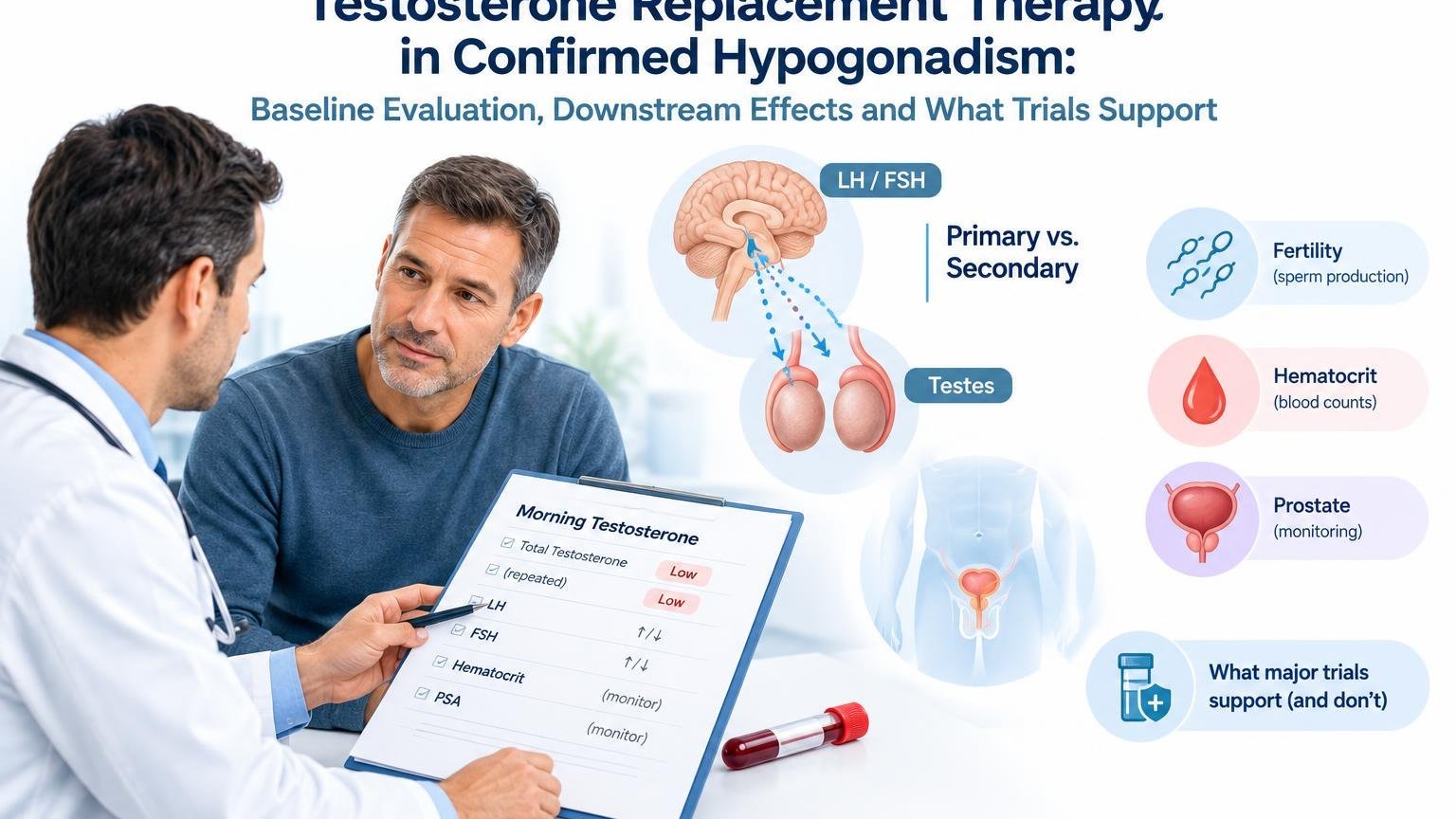
Core Research Direction: TRT in men with confirmed hypogonadism: defining the baseline defect, distinguishing primary versus secondary failure, tracing downstream consequences (HPG suppression, fertility, hematocrit, prostate), and interpreting the strength and limits of key trial evidence before committing to long-term therapy
Search Intent: In men with confirmed low testosterone, what should a baseline evaluation establish, which downstream effects and risks do different formulations carry, and what do the major trials actually support?
Platform: SANYUN Science Center
Evidence reviewed through: 2026-11-21
Executive Summary
Testosterone replacement therapy (TRT) is a treatment for confirmed hypogonadism, not a general intervention for fatigue, low mood or athletic performance. The diagnosis depends on compatible symptoms plus consistently low morning testosterone measured on more than one occasion, interpreted alongside medical history and other laboratory results. Consumer and clinic-authored guidance agree that neither a symptom list nor a single blood draw establishes the diagnosis.[1][2]
Before committing to long-term therapy, the baseline evaluation should establish whether the defect lies in the testes (primary hypogonadism) or upstream in the hypothalamus or pituitary (secondary hypogonadism), since the two differ in reversibility and in the treatment options worth discussing. The evaluation should also document factors that can be addressed without replacing testosterone, such as untreated sleep apnea, substantial excess body fat, opioid or heavy alcohol use, undernutrition or prior anabolic-steroid use, and should record baseline prostate, hematocrit, cardiovascular and fertility status because each is directly affected by exogenous testosterone.[3][4]
The downstream consequences are predictable from the mechanism. Exogenous testosterone suppresses pituitary LH and FSH, reducing intratesticular testosterone, sperm production and testicular volume; it can raise hematocrit; and it acts on prostate biology, which is why prostate checks accompany treatment. The strongest trial evidence in this packet, the TRAVERSE trial, found testosterone gel noninferior to placebo on its primary major cardiovascular endpoint in a narrowly defined population of middle-aged and older men with confirmed hypogonadism and existing or elevated cardiovascular risk. The earlier Testosterone Trials in men aged 65 and older improved sexual function but did not significantly improve the primary vitality outcome. These findings support specific uses in specific populations; they do not establish universal benefit or lifelong safety.
Why This Matters
The boundary between treating hypogonadism and optimizing testosterone numbers has become blurred in consumer-facing material. One commercial guide in this packet describes a therapeutic target of roughly 400-1,000 ng/dL total testosterone while acknowledging that optimal ranges vary by individual, and it also describes men pursuing upper-normal levels for body composition and recovery. That framing can make replacement therapy sound like a general performance intervention rather than a treatment for a defined deficiency. The clinical consequence is that men may start long-term therapy without a confirmed baseline defect, without investigation of reversible causes and without a fertility plan.
The stakes are practical. Exogenous testosterone generally suppresses endogenous production while it is used, and after discontinuation symptoms may return with variable recovery of natural production. Sperm production can fall substantially, sometimes to zero, and recovery can take months without being guaranteed. Hematocrit can rise enough to require evaluation and possibly a dose, schedule or formulation change, or a pause. Decisions made at the start therefore shape fertility, monitoring burden and the difficulty of stopping.
A careful baseline also protects against treating the wrong problem. Fatigue, low libido, reduced strength, irritability and poor concentration overlap with sleep apnea, thyroid disease, depression, anemia, medication effects and inadequate sleep. A consultation that ends with a different explanation can still be a successful evaluation, provided the alternative is actually pursued.
Defining the Baseline Defect
The first question is whether testosterone is consistently low. Guidance summarized in this packet recommends two separate morning testosterone measurements showing consistently low levels, and states that diagnosis requires compatible symptoms plus consistently low morning values generally confirmed on a separate day and interpreted with history and other laboratory results. A commonly cited threshold is total testosterone below 300 ng/dL, which the American Urological Association is described as identifying as a reasonable cutoff supporting the diagnosis, while noting that the number alone is not a diagnosis. Laboratory methods and reference ranges vary, and free testosterone with sex hormone-binding globulin may add context when total testosterone and symptoms do not align.
The second question is why testosterone is low. The differential includes testicular problems, reduced pituitary or hypothalamic signaling, and potentially reversible factors such as acute illness, substantial excess body fat, untreated sleep apnea, opioid use, heavy alcohol use, undernutrition or previous anabolic-steroid use. Pituitary disease, medication effects, thyroid dysfunction and elevated prolactin are additional possibilities worth considering when the history suggests them. Replacement can be appropriate while this investigation continues, but replacing a number without asking why it is low can leave a treatable cause unaddressed.
Primary Versus Secondary Hypogonadism
LH and FSH testing helps separate primary from secondary failure. In primary hypogonadism the testes themselves do not produce adequate testosterone, so LH and FSH are typically elevated because the pituitary is signaling strongly without a testicular response; causes include prior injury, infection and genetic conditions such as Klinefelter syndrome. In secondary hypogonadism the hypothalamus or pituitary does not send adequate LH and FSH signals, so the testes never receive the instruction to produce testosterone; this pattern is described as more common in men with obesity, sleep apnea, chronic stress or prior anabolic-steroid use.
The distinction matters because secondary hypogonadism is sometimes reversible, and medications such as clomiphene or enclomiphene can stimulate the hypothalamic-pituitary-gonadal axis rather than directly replacing testosterone. That does not make these agents universally preferable, and this packet supplies no efficacy data for them. It does mean that a man with secondary failure and near-term fertility goals has a treatment conversation that differs from that of a man with irreversible testicular failure. TRT can be appropriate for either type, but the protocol discussion changes.
Biological and Clinical Mechanism
Exogenous testosterone raises circulating androgen and, through negative feedback, signals the pituitary to reduce LH and FSH. The testes lose the gonadotropin stimulation needed for intratesticular testosterone production and spermatogenesis. The clinical consequences include reduced sperm production, which can fall substantially and often to zero, reduced testicular volume and testicular atrophy over time. Because intratesticular testosterone is needed for sperm production, peripheral blood testosterone levels during TRT do not indicate that fertility is preserved.
Testosterone also drives erythropoiesis, so hematocrit can rise during treatment. A significant elevation requires clinical evaluation and may prompt a change in dose, schedule or formulation, or a pause in treatment. Separately, the prostate responds to testosterone and to DHT, which the body makes from testosterone, and these hormones support normal prostate growth and function. That biology is why prostate history, urinary symptoms and PSA are reviewed before and during therapy rather than being treated as unrelated.
Aromatization of testosterone to estradiol is part of the same pharmacology. Estradiol is not simply an adverse byproduct; bone density, libido and cardiovascular health are described as depending partly on it, while excess can cause fluid retention, mood instability and gynecomastia. Monitoring estradiol is presented as part of protocol management, although this packet provides no target range or outcome data from which to judge how aggressively it should be modified.
What the Evidence Shows
The two trials discussed in this packet answer different questions and should not be merged. The Testosterone Trials studied men aged 65 and older with low testosterone and found that treatment improved sexual function but did not significantly improve the primary vitality outcome. That is a specific result in an older population with a prespecified primary endpoint; it argues for realistic expectations about energy and vitality, not for or against benefit in younger men or in other symptom domains.
TRAVERSE addressed cardiovascular safety rather than symptom benefit. In middle-aged and older men with confirmed hypogonadism and existing or elevated cardiovascular risk, testosterone gel was noninferior to placebo for the primary major adverse cardiovascular endpoint. Prostate cancer and other major prostate problems were uncommon and did not differ significantly between groups, in a population screened to exclude men at high prostate-cancer risk. The noninferiority finding is population-specific; it does not establish cardiovascular safety in younger men, in men without elevated cardiovascular risk, or over periods longer than the trial.
Regulatory context has shifted with the evidence. In 2025, the FDA is reported to have removed class-wide boxed-warning language about increased cardiovascular outcomes while requiring broader warnings about increased blood pressure. This is a labeling decision, not proof that blood pressure or cardiovascular risk can be ignored; blood pressure monitoring remains part of follow-up.
For prostate safety, the practical evidence is organized around screening and follow-up rather than a claim of zero risk. The Endocrine Society guideline is described as calling for urology review before TRT when PSA is above 4.0 ng/mL, or above 3.0 ng/mL in a man at higher cancer risk, and during the first year of TRT for a confirmed PSA rise of more than 1.4 ng/mL above the starting value, a confirmed PSA above 4.0 ng/mL, or an abnormal prostate exam. These are triggers for further testing, not cancer diagnoses. Studies in screened men have not shown clear worsening of mild to moderate urinary symptoms with TRT, while evidence for severe symptoms is more limited.
Interpreting the Evidence: Strengths and Limits
The packet's evidence is a mixture of primary trial summaries reported secondhand, guideline statements summarized by clinic-authored sources, and commercial educational material. None of the sources is a primary trial report, and none supplies effect sizes, confidence intervals, event counts or sample sizes. Statements that TRAVERSE was noninferior, or that the Testosterone Trials did not significantly improve vitality, are therefore directional rather than quantitative. They should not be converted into expected probabilities of benefit or harm for an individual patient.
Generalizability is limited in both directions. TRAVERSE enrolled men with existing or elevated cardiovascular risk and screened out high prostate-cancer risk, so its reassuring cardiovascular and prostate findings apply most directly to that screened, higher-risk population. The Testosterone Trials enrolled men aged 65 and older, so its vitality result does not establish the same null finding in younger men. Conversely, benefits observed in older men with confirmed deficiency cannot be assumed for men with borderline or normal testosterone or for symptoms with another cause.
Several claims in the packet are mechanistic or practice-based rather than trial-derived. The 400-1,000 ng/dL target range, the 100-150 mg per week starting injection dose and the 6-8 week then 3-6 month laboratory schedule are descriptions of common practice from a commercial source, not outcomes of randomized comparisons. The statements that secondary hypogonadism is more common with obesity, sleep apnea or prior steroid use, and that clomiphene or enclomiphene can stimulate the axis, are plausible mechanisms without quantification here. They should be presented as concepts for discussion, not as established effect sizes.
Fertility, Formulations and Monitoring
Fertility planning belongs at the baseline visit, before the first dose. Because exogenous testosterone suppresses LH and FSH and can reduce or stop sperm production, men who may want children should discuss options such as hCG co-administration, a protocol pause before attempting conception, sperm banking or specialist evaluation. No medication can guarantee sperm preservation or conception, and recovery after suppression can take months and is not guaranteed in every case. For a man actively trying to conceive, standard TRT is generally not described as the appropriate first treatment.
Formulation choice is a trade-off rather than a ranking. Injections, topical gels and creams, patches, pellets, oral and nasal products differ in pharmacokinetics, transfer risk, adjustability and cost. A commercial guide notes that twice-weekly injections produce more stable levels than less frequent dosing, that topical gels carry transfer risk to partners and children, and that pellets cannot be adjusted once implanted. The packet does not provide head-to-head outcome data, so formulation should be selected on diagnosis, laboratory response, adherence, household considerations and medication-specific risks.
Monitoring is the safety plan. A commercial source describes most providers checking laboratories 6-8 weeks after starting or adjusting a protocol and every 3-6 months once stable, covering testosterone, estradiol, hematocrit and hemoglobin, PSA, and metabolic and lipid markers. Clinic guidance emphasizes that follow-up includes symptoms, blood pressure, hematocrit, treatment response, adverse effects and prostate evaluation when appropriate. These schedules are practice conventions, and timing should be set by the prescribing clinician rather than treated as a fixed standard.
Research Outlook
Three gaps stand out. First, long-term safety beyond the duration of TRAVERSE and the Testosterone Trials is not established, and the packet explicitly notes that prostate results do not settle long-term risk for every patient. Second, fertility recovery after prolonged suppression lacks quantified rates and predictors in these sources, leaving men and clinicians to plan around uncertainty. Third, comparative effectiveness between TRT and alternatives such as clomiphene or enclomiphene in secondary hypogonadism, and between formulations, is not addressed with outcome data here. These are questions for future trials rather than settled clinical facts.
Key Takeaways
- TRT is for confirmed hypogonadism: compatible symptoms plus consistently low morning testosterone, generally confirmed on a separate day, not a single test or a symptom list alone.
- Baseline LH and FSH help distinguish primary from secondary failure, and secondary failure is sometimes reversible, which changes the treatment conversation.
- Exogenous testosterone suppresses LH and FSH, can reduce sperm production and testicular volume, and can raise hematocrit; fertility planning and hematocrit monitoring belong before and during therapy.
- TRAVERSE found testosterone gel noninferior to placebo on its primary cardiovascular endpoint in a specific higher-risk, prostate-screened population, and the Testosterone Trials improved sexual function without improving the primary vitality outcome in men 65 and older.
- The packet reports trial findings secondhand without effect sizes, so benefits and risks should be discussed as population-level evidence rather than individualized predictions.
Questions and Answers
How is hypogonadism confirmed before starting testosterone replacement therapy?
Diagnosis requires compatible symptoms plus consistently low morning testosterone, generally confirmed on a separate day and interpreted with history and other labs. Guidance in this packet recommends two separate morning measurements and notes that total testosterone below 300 ng/dL is a reasonable supporting cutoff, though the number alone is not a diagnosis. A single test or symptom list is not sufficient.
What is the difference between primary and secondary hypogonadism on baseline testing?
LH and FSH help separate the two. In primary hypogonadism the testes fail, so LH and FSH are typically elevated because the pituitary is signaling strongly. In secondary hypogonadism the hypothalamus or pituitary does not send adequate LH and FSH signals, so the testes are not stimulated. The distinction matters because secondary failure is sometimes reversible and may allow alternatives to direct replacement.
What do the Testosterone Trials and TRAVERSE actually show about testosterone therapy?
They answer different questions. In men aged 65 and older with low testosterone, the Testosterone Trials improved sexual function but did not significantly improve the primary vitality outcome. TRAVERSE found testosterone gel noninferior to placebo on its primary major cardiovascular endpoint in middle-aged and older men with confirmed hypogonadism and existing or elevated cardiovascular risk. Neither establishes universal benefit or lifelong safety.
Does testosterone replacement therapy affect sperm production and fertility?
Yes. Exogenous testosterone suppresses LH and FSH, reducing intratesticular testosterone and sperm production, which can fall substantially and often to zero. Testicular volume can also decrease. Recovery may take months and is not guaranteed in every case. Men who may want children should discuss hCG co-administration, a protocol pause, sperm banking or specialist evaluation before starting, since standard TRT is generally not appropriate first-line when actively trying to conceive.
What are the main safety concerns and monitoring needs during testosterone replacement therapy?
Hematocrit can rise, and significant elevation requires evaluation and may prompt a dose, schedule or formulation change or a pause. Prostate history, urinary symptoms and PSA are reviewed because the prostate responds to testosterone and DHT; guideline triggers for urology review include PSA above 4.0 ng/mL, or above 3.0 ng/mL in higher-risk men, and a confirmed rise of more than 1.4 ng/mL above baseline in the first year. Blood pressure and cardiovascular history also matter.
What are the limitations of the evidence on testosterone replacement therapy?
The packet reports trial findings secondhand without effect sizes, confidence intervals, event counts or sample sizes, so results are directional rather than quantitative. TRAVERSE enrolled higher-cardiovascular-risk men and screened out high prostate-cancer risk, and the Testosterone Trials enrolled men 65 and older; neither generalizes to all men. Long-term safety, fertility recovery rates and comparative effectiveness against alternatives remain uncertain.
Sources and References
- TRT Monitor Team. What to Know Before Starting TRT: Key Questions Answered. 2025
- NovaGenix Editorial Team; Timothy W. Mackey. Is TRT Worth It? 15 Questions to Ask Before Starting. 2026
- Anabolic Insights. What Is Testosterone Replacement Therapy (TRT)? A 2026 Guide for Men.
- Malek Haver. TRT and Prostate Health: PSA Testing and Safety. 2026
SANYUN Science Center explains published research on men's reproductive and sexual health, connecting scientific evidence with everyday questions while making sources and limitations clear.
Disclaimer: This article is for scientific education and research communication only. It does not provide medical advice, diagnosis, or individualized treatment recommendations, and does not endorse any medication, supplement, device, penile enlargement procedure, or other intervention. Decisions about sexual and reproductive health should be made in consultation with a qualified healthcare professional. Do not delay seeking professional care because of information in this article.
Original Content & Copyright Notice
- This article is prepared for SANYUN Science Center, drawing on published research and publicly available academic literature on men’s sexual and reproductive health. Its editorial explanations and presentation are developed for this platform.
- Copyright in the original editorial content, selection, and arrangement is reserved by SANYUN Science Center to the extent protected by applicable law. Referenced research, quotations, and third-party materials remain subject to the rights of their respective owners. This notice does not claim ownership of scientific facts or third-party research.
- Except where permitted by applicable law or an applicable license, prior written permission is required to reproduce, republish, translate, adapt, redistribute, or commercially reuse protected content. Attribution alone does not grant permission for such reuse.
- For permitted quotation or authorized reuse, clearly identify the source and retain a link to the original article.
- Source: SANYUN Science Center
- Original URL: Retain the original article URL on science.san-yun.com.
- Copyright Holder: SANYUN Science Center, for its own protected editorial content.
- Quotation, excerpts, or authorized reuse must not distort the scientific meaning, omit material limitations or disclaimers, or imply unverified medical claims, product efficacy, or endorsement by SANYUN Science Center.



