




Category: Clinical Insights
Core Research Direction: Evidence-anchored questions about testosterone replacement therapy monitoring: when to repeat diagnostic testosterone testing, how often to monitor hematocrit and PSA once TRT begins, and how to interpret formulation-specific blood-draw timing and safety thresholds, while separating guideline claims from trial evidence
Search Intent: For adult men being evaluated or treated for low testosterone, what monitoring schedule do major guidelines and trial evidence support for confirming the diagnosis and tracking hematocrit, PSA and cardiovascular safety, and what remains uncertain?
Platform: SANYUN Science Center
Evidence reviewed through: 2026-11-05
Executive Summary
Testosterone replacement therapy (TRT) requires structured laboratory monitoring because several changes on treatment, including rising hematocrit and small PSA increases, are often asymptomatic. The sources supplied for this review are patient-education and commercial laboratory-guide web articles rather than primary trials or guideline documents. They describe a broadly consistent monitoring architecture: two fasting morning total testosterone tests before treatment to confirm deficiency, a check at roughly 3–6 months after starting, and then annual or six-monthly review of testosterone, hematocrit and, in appropriate age groups, PSA.[1][2]
The same sources place two thresholds at the center of safety monitoring. A hematocrit above 54% is described as a level at which therapy is paused or dose reduced. A PSA rise of more than 1.4 ng/mL in the first year, or a confirmed PSA above 4 ng/mL at any time, is described as prompting urology referral. Formulation determines when blood is drawn: midway between injections for short-acting esters, and 2–8 hours after application for gels. These are guideline-derived statements reproduced secondhand; the sources do not provide the underlying guideline documents, and only limited trial-level data are summarized.[3]
Why This Matters
Low testosterone is common in the populations presenting for evaluation, but a single low reading can reflect transient factors. The supplied patient-education source states that if a second test returns within the normal range, the initial low result was likely due to causes such as viral infection, significant stress, or poor sleep. Testing at the wrong time of day or without fasting can also mislead. Requiring confirmation before committing a man to long-term therapy is therefore a patient-safety issue, not merely a laboratory formality.
Once treatment begins, monitoring serves two different goals. The first is dose optimization: checking whether testosterone is in an appropriate range at the correct point in the dose cycle. The second is detection of adverse effects that may be silent, particularly erythrocytosis and prostate-related changes. The supplied materials note that many side effects, such as a rise in red blood cells or PSA, do not have immediate symptoms, and that monitoring is designed to catch these before they become health problems. That framing supports regular scheduled testing but does not by itself establish how frequently testing must occur.
Biological and Clinical Mechanism
Testosterone influences red blood cell production. The commercial laboratory guide notes that testosterone tells the body to make more red blood cells, with hepcidin, iron handling and erythropoietin all reportedly playing a part, and describes the rise in hematocrit as the most common laboratory change on TRT. This provides a biologically plausible pathway linking testosterone exposure to a measurable safety parameter. The review presents this mechanism at a general conceptual level; the supplied sources do not reproduce the underlying experimental evidence in detail.
Prostate tissue is also responsive to testosterone, which is why PSA is monitored. The supplied sources describe modest PSA rises on testosterone gel in the large cardiovascular safety trial summarized in the commercial guide, and they emphasize that most of the PSA rise occurs in the first year. The same source reports that high-grade prostate cancer was rare in that trial, but the supplied text does not reproduce the statistical details, so cancer-risk conclusions cannot be drawn from this review.
Formulation matters because blood testosterone concentrations fluctuate differently with each product. A short-acting injection produces a peak and a trough, which is why the commercial guide describes drawing blood midway between injections for weekly or biweekly schedules. A gel produces absorption over hours, which is why the guide describes drawing blood 2–8 hours after application. The patient-education source similarly recommends morning sampling 2–4 hours after gel application. These statements are mechanistically coherent but are reproduced from secondary sources.
What the Evidence Shows
On diagnosis, the supplied sources agree that more than one measurement is required. The patient-education source states that guidelines require at least two separate blood tests to confirm a permanent deficiency, and its table specifies two tests 2 to 4 weeks apart measuring total testosterone, free testosterone, LH, FSH and SHBG. The commercial laboratory guide states that TRT blood work begins with two fasting morning total testosterone tests plus LH/FSH, hematocrit and, for many men over 40, PSA. The precise numerical cut-off for low testosterone is not consistently reproduced across the supplied texts, and this review does not adopt one.
On monitoring after treatment starts, the commercial guide states that guidelines recheck testosterone and hematocrit 3–6 months after starting and again annually. The patient-education source describes a 3-month check as the most important initial follow-up, used to assess early symptom response and side effects and likely to prompt dose adjustment. Another patient-education source states that the first follow-up test is usually at week 6 to 12, allowing peak and trough levels to be reviewed. These schedules overlap but are not identical, and none of the supplied sources presents the underlying guideline text.
On long-term monitoring, the patient-education source states that once the first year is complete and the dose is stable, monitoring usually falls to every 12 months. Its table lists long-term stability monitoring every 6 to 12 months measuring testosterone, hematocrit, PSA and liver function. The commercial guide states that hematocrit is checked every year after the first year and testosterone every 6–12 months. These are consistent enough to support a general annual rhythm, but the sources do not establish that annual testing is superior to six-monthly testing or vice versa.
On hematocrit thresholds, the commercial guide states that a hematocrit above 54% means therapy is paused. The patient-education source states that if hematocrit exceeds 54%, a doctor may recommend donating blood, reducing the testosterone dose, or switching from injections to a daily gel. These are broadly aligned in identifying 54% as an action threshold, although the recommended actions differ in emphasis. The sources do not provide the primary evidence base for the 54% threshold.
On PSA, the commercial guide lists a PSA rise of more than 1.4 ng/mL in the first year, or a confirmed PSA above 4 ng/mL, as red flags leading to a pause or urology referral. The same guide summarizes a large placebo-controlled cardiovascular safety trial in men aged 45 to 80 with heart disease or high cardiovascular risk, in which PSA on testosterone gel rose more than placebo but only by about 0.11 ng/mL at 3 months and 0.15 ng/mL at 12 months. That trial summary, reproduced secondhand, provides context for how small the average PSA change can be, but individual variation is not captured by an average.
On cardiovascular safety, the commercial guide reports that the same large trial enrolled 5,246 men aged 45 to 80 with heart disease or high cardiovascular risk, each with two fasting testosterone levels under 300 ng/dL, and adjusted gel dose to keep testosterone between 350 and 750 ng/dL. Over a mean follow-up of 33.0 months, heart attack, stroke or heart death occurred in 7.0% on testosterone versus 7.3% on placebo, which the guide describes as meeting the test for no added risk. The guide also reports more atrial fibrillation, acute kidney injury and pulmonary blood clots in the testosterone arm. These are secondhand trial summaries, not primary analyses, and the absolute event rates and statistical details are not reproduced in the supplied text.
On formulation-specific hematocrit effects, the commercial guide summarizes a network meta-analysis of 29 placebo-controlled trials with 3,393 men in which mean hematocrit rose about 4.0 percentage points with cypionate or enanthate injections, 3.0 with gels and 1.4 with patches. This is a secondhand summary of a meta-analysis not supplied in full, and it describes average changes rather than individual risk. It supports the general principle that injectable esters may carry a greater average hematocrit effect than transdermal products, which is relevant to monitoring intensity but does not by itself dictate a specific schedule.
| Monitoring question | Supplied guidance | Source basis and caveat |
|---|---|---|
| Confirming low testosterone before treatment | At least two separate blood tests; the table specifies 2 to 4 weeks apart with total T, free T, LH, FSH and SHBG | Patient-education web article; guideline documents not supplied |
| First follow-up after starting TRT | 3-month check described as most important initial follow-up; another source says week 6 to 12 | Patient-education web articles; schedules overlap but are not identical |
| Routine monitoring after starting | Testosterone and hematocrit at 3–6 months, then annually per one guide; 3, 6 and 12 months per another source | Commercial laboratory guide and patient-education article; guideline citation markers but no reproduced guideline text |
| Long-term stable monitoring | Every 12 months per one source; every 6 to 12 months measuring testosterone, hematocrit, PSA and liver function per another | Patient-education web articles; no primary data supplied |
| Hematocrit action threshold | Above 54%: pause therapy per one guide; donate blood, reduce dose or switch from injections to gel per another source | Patient-education and commercial laboratory-guide articles; threshold without primary citation |
| PSA red flags | Rise more than 1.4 ng/mL in first year, or confirmed PSA above 4 ng/mL, leading to pause or urology referral | Commercial laboratory guide; threshold attributed to a citation not reproduced |
| Blood-draw timing for gels | 2–8 hours after application per one guide; morning 2–4 hours after application per another source | Commercial and patient-education articles; ranges differ, no primary data supplied |
| Blood-draw timing for short-acting injections | Midway between injections for weekly or biweekly schedules | Commercial laboratory guide; no primary data supplied |
Interpretation and Limitations
The principal limitation of this review is source quality. Every supplied source is either a patient-education web article or a commercial laboratory guide. Neither category is a primary guideline document, a randomized trial report, or a systematic review. The commercial guide includes bracketed citation markers, but the underlying references are not reproduced in the supplied text. The patient-education articles describe what guidelines recommend without consistently naming or quoting them. Readers should therefore treat the schedules and thresholds described here as secondary descriptions whose primary sources could not be independently verified within this review.
A second limitation is the absence of direct trial evidence on monitoring frequency itself. None of the supplied sources reports a randomized comparison of, for example, three-monthly versus six-monthly hematocrit testing, or annual versus biannual PSA testing. The schedules described are guideline-derived standards of care rather than findings from trials designed to test monitoring intervals. This distinction matters: a schedule can be reasonable and widely recommended without having been shown in a trial to improve outcomes compared with a different schedule.
A third limitation concerns the secondhand trial summaries. The large cardiovascular safety trial is described in the commercial guide with specific enrollment, follow-up and event figures, and these are reproduced here as reported by that guide. However, the original trial publication is not among the supplied sources, and the review cannot verify the statistical methods, the prespecified noninferiority margin, or the adverse-event definitions. The reported finding of no increase in major adverse cardiovascular events should therefore be attributed to the guide's summary rather than treated as a primary analysis.
A fourth limitation concerns the hematocrit meta-analysis summary. The commercial guide reports average hematocrit increases of about 4.0, 3.0 and 1.4 percentage points for injectable esters, gels and patches respectively, based on 29 placebo-controlled trials and 3,393 men. These are average effects in trial populations, not predictions for an individual patient. The original meta-analysis is not supplied, and the review cannot confirm the pooling methods, heterogeneity or the precision of these estimates.
Finally, the sources differ on some specifics. Gel blood-draw timing is described as 2–8 hours after application in one source and 2–4 hours in another. The first post-treatment check is described as at 3 months in one source and at week 6 to 12 in another. Long-term monitoring is described as every 12 months in one source and every 6 to 12 months in another. These differences may reflect different underlying guidelines, different product labels, or editorial simplification. They should not be resolved by assuming one source is correct; instead, they indicate that the precise schedule should be set by the treating clinician with reference to the product label and current guideline.
Research Outlook
The most important evidence gap is the absence of randomized comparisons of monitoring strategies. Trials could test whether more intensive hematocrit surveillance reduces clinically significant erythrocytosis or thrombotic events, and whether different PSA trigger thresholds improve prostate cancer detection without excessive biopsy. Such trials would need to be large and long-term, because the events of interest are uncommon. In the meantime, the schedules described in the supplied sources are best understood as consensus-based standards rather than trial-proven protocols.
A second gap concerns formulation-specific monitoring. The average hematocrit differences reported for injections versus gels versus patches suggest that monitoring intensity might reasonably differ by formulation, but no supplied source reports a trial of formulation-tailored monitoring schedules. Similarly, the differing gel blood-draw windows in the sources highlight the need for product-specific pharmacokinetic data and clear labeling, rather than generic class-wide recommendations.
A third gap concerns long-term safety beyond the first year. The large cardiovascular trial summarized in the commercial guide had a mean follow-up of 33.0 months, which is informative but not indefinite. The patient-education source emphasizes that annual monitoring is mandatory and that many clinicians will not issue further prescriptions without completed annual blood work and a physical check. Whether such enforcement improves outcomes has not been tested in the supplied sources.
Key Takeaways
- Before starting TRT, the supplied sources describe a requirement for at least two separate blood tests to confirm low testosterone, with one table specifying tests 2 to 4 weeks apart including total and free testosterone, LH, FSH and SHBG.
- After starting TRT, the commercial guide states that testosterone and hematocrit are rechecked 3–6 months after starting and again annually, while the patient-education source describes follow-up at 3, 6 and 12 months during the first year.
- Once stable after the first year, monitoring usually falls to every 12 months according to one source, or every 6 to 12 months measuring testosterone, hematocrit, PSA and liver function according to another.
- A hematocrit above 54% is described as an action threshold, prompting either a pause in therapy or measures such as blood donation, dose reduction or a switch from injections to gel.
- A PSA rise of more than 1.4 ng/mL in the first year, or a confirmed PSA above 4 ng/mL at any time, is described as a red flag prompting a pause or urology referral.
- Blood-draw timing depends on formulation: midway between injections for short-acting esters; 2–8 hours after gel application in one source and 2–4 hours in another.
- These monitoring recommendations are drawn from secondary sources, not primary guideline documents or trials of monitoring frequency, so the precise schedule should be individualized by the treating clinician.
Questions and Answers
How many testosterone tests are needed to confirm low testosterone before starting TRT?
The supplied sources describe a requirement for at least two separate blood tests to confirm a permanent deficiency before treatment. One patient-education table specifies two tests 2 to 4 weeks apart, measuring total testosterone, free testosterone, LH, FSH and SHBG. A single low reading can reflect temporary factors such as viral infection, stress or poor sleep, so confirmation helps avoid treating a transient dip. The underlying guideline documents are not supplied, so this is a secondary description.
How often should hematocrit and PSA be checked after starting testosterone replacement therapy?
The commercial laboratory guide states that guidelines recheck testosterone and hematocrit 3–6 months after starting and then annually, with hematocrit checked every year after the first year. PSA is checked at 3–12 months for men in screening age groups and then according to standard screening rules. A patient-education source describes follow-up at 3, 6 and 12 months during the first year. These are secondary descriptions; no supplied source reports a trial comparing monitoring intervals.
What hematocrit level on TRT requires action?
The sources identify a hematocrit above 54% as an action threshold. The commercial guide states that therapy is paused at this level. The patient-education source states that a doctor may recommend donating blood, reducing the testosterone dose, or switching from injections to a daily gel. Values below 54% are not uniformly defined as safe, and the sources do not provide the primary evidence base for the 54% threshold. Clinical decisions should be individualized.
When should blood be drawn for testosterone testing on gels versus injections?
Timing depends on formulation. For gels, the commercial guide states blood is drawn 2–8 hours after application, while the patient-education source states morning sampling 2 to 4 hours after application. For weekly or biweekly short-acting injections, the commercial guide states blood is drawn midway between doses. The discrepancy in gel timing between sources is unresolved in the supplied material, and product-specific labeling should guide practice.
What PSA change on testosterone therapy should prompt a urology referral?
The commercial guide lists a PSA rise of more than 1.4 ng/mL within the first 12 months, or a confirmed PSA above 4 ng/mL at any time, as red flags leading to a pause or urology referral. The same guide reports that in a large cardiovascular safety trial, average PSA on testosterone gel rose only about 0.11 ng/mL at 3 months and 0.15 ng/mL at 12 months compared with placebo. These thresholds are secondary descriptions, not primary guideline text.
What does the evidence say about cardiovascular risk and hematocrit changes with TRT?
The commercial guide summarizes a large placebo-controlled trial in 5,246 men aged 45 to 80 with heart disease or high cardiovascular risk, in which major adverse cardiovascular events occurred in 7.0% on testosterone versus 7.3% on placebo over a mean follow-up of 33.0 months. The same summary reports more atrial fibrillation, acute kidney injury and pulmonary blood clots on testosterone. A separate secondhand meta-analysis summary reports average hematocrit rises of about 4.0, 3.0 and 1.4 percentage points for injectable esters, gels and patches. These are secondary summaries; primary trial reports are not supplied.
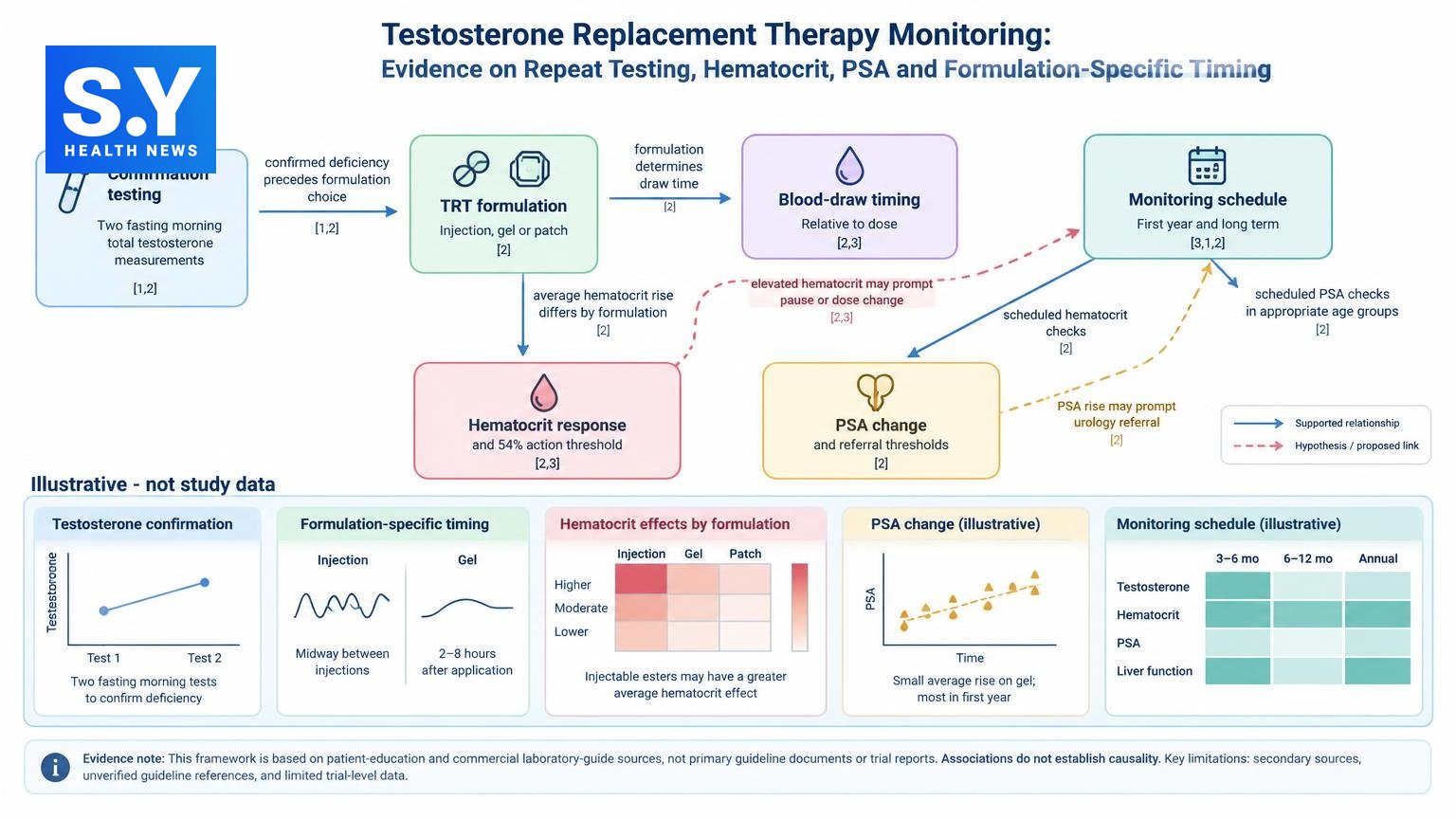
Conceptual framework: Conceptual framework. This figure organizes the monitoring variables discussed in this evidence review: confirmation testing, TRT formulation, blood-draw timing, hematocrit and PSA thresholds, and the monitoring schedule. Supported arrows reflect relationships described in the supplied patient-education and commercial laboratory-guide sources; hypothesis arrows indicate clinical actions the sources propose without trial-level proof. The framework is not a tested causal model and does not represent primary guideline documents, which were not supplied.
Academic References & Evidence
- How Often to Test Testosterone Levels | Diagnosis and Monitoring 2026.
- TRT Blood Work: Monitoring Labs & Schedule | JustLabs.
- Follow-up and Monitoring for Low Testosterone | TRT Blood Tests 2026.
SANYUN Science Center explains published research on men's reproductive and sexual health, connecting scientific evidence with everyday questions while making sources and limitations clear.
Disclaimer: This article is for scientific education and research communication only. It does not provide medical advice, diagnosis, or individualized treatment recommendations, and does not endorse any medication, supplement, device, penile enlargement procedure, or other intervention. Decisions about sexual and reproductive health should be made in consultation with a qualified healthcare professional. Do not delay seeking professional care because of information in this article.
Original Content & Copyright Notice
- This article is prepared for SANYUN Science Center, drawing on published research and publicly available academic literature on men’s sexual and reproductive health. Its editorial explanations and presentation are developed for this platform.
- Copyright in the original editorial content, selection, and arrangement is reserved by SANYUN Science Center to the extent protected by applicable law. Referenced research, quotations, and third-party materials remain subject to the rights of their respective owners. This notice does not claim ownership of scientific facts or third-party research.
- Except where permitted by applicable law or an applicable license, prior written permission is required to reproduce, republish, translate, adapt, redistribute, or commercially reuse protected content. Attribution alone does not grant permission for such reuse.
- For permitted quotation or authorized reuse, clearly identify the source and retain a link to the original article.
- Source: SANYUN Science Center
- Original URL: Retain the original article URL on science.san-yun.com.
- Copyright Holder: SANYUN Science Center, for its own protected editorial content.
- Quotation, excerpts, or authorized reuse must not distort the scientific meaning, omit material limitations or disclaimers, or imply unverified medical claims, product efficacy, or endorsement by SANYUN Science Center.



