




Category: Erectile Dysfunction
Core Research Direction: Hormonal evaluation and testosterone replacement in erectile dysfunction: what the evidence supports in men with versus without confirmed biochemical hypogonadism, and how the quality of the broader ED treatment evidence base shapes interpretation
Search Intent: In men with erectile dysfunction, when does testosterone testing and testosterone therapy actually change outcomes — and how strong is the evidence behind the treatments we recommend?
Platform: SANYUN Science Center
Evidence reviewed through: 2026-11-11
Executive Summary
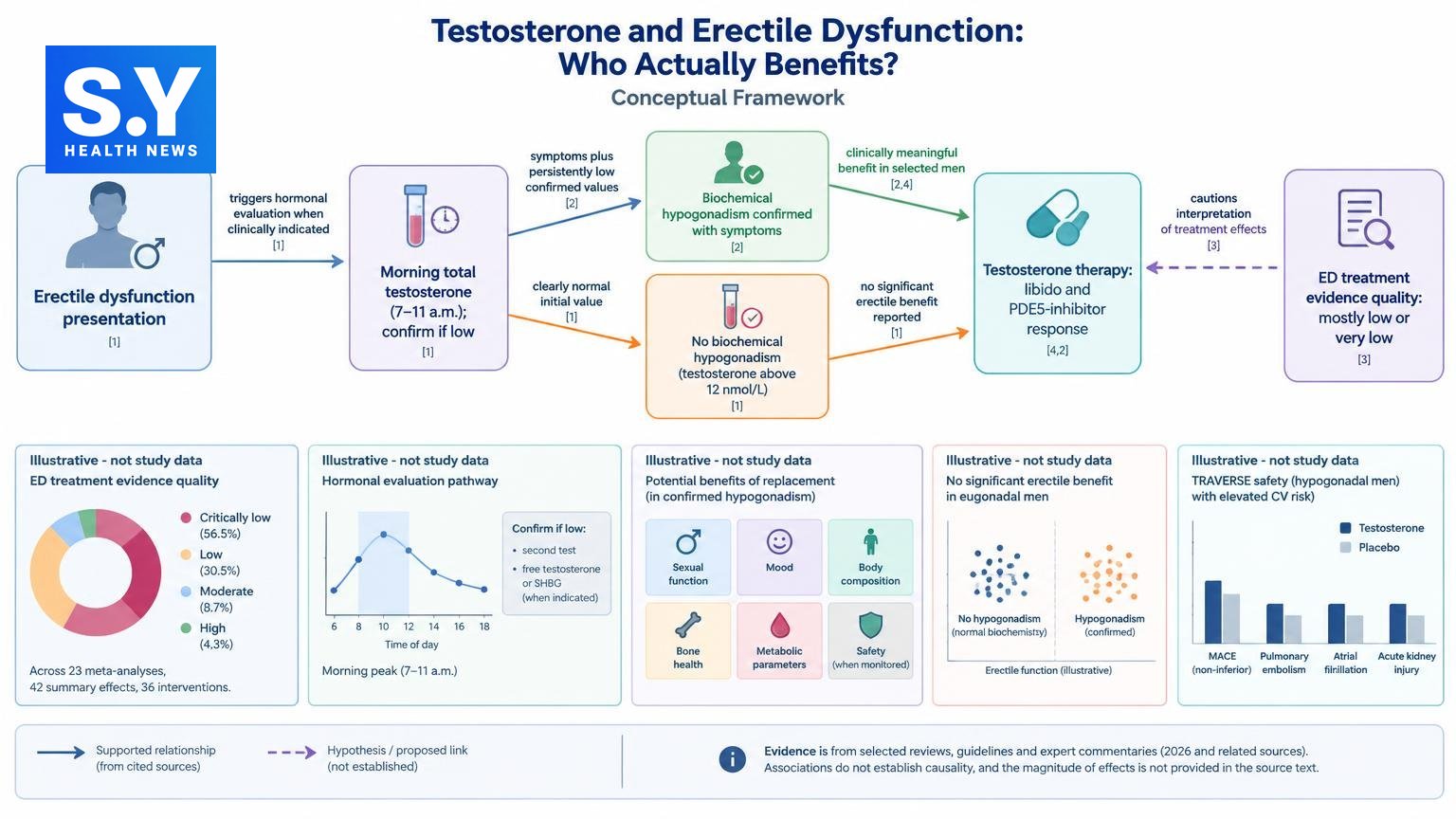
The clinical question is narrower than the marketing. In men with erectile dysfunction (ED) but no biochemical androgen deficiency, a widely cited Cochrane meta-analysis, described in a 2026 clinical commentary, found no significant benefit of testosterone supplementation on erectile function and minimal to absent impact on overall sexual quality of life and satisfaction. The picture changes when hypogonadism is confirmed by symptoms plus persistently low morning testosterone: a 2026 narrative review reports clinically meaningful benefits of replacement in appropriately selected men, spanning sexual function, mood, body composition, bone and metabolic parameters.[1][2]
Two separate evidence problems shape interpretation. First, diagnostic procedure: guidelines anchor the evaluation on fasting morning total testosterone drawn ideally between 7 and 11 a.m., with a confirmatory second test when values are borderline or low, and free testosterone or SHBG added when symptoms and total testosterone disagree. Second, evidence quality: a 2026 umbrella review of 23 meta-analyses covering 36 interventions found that most meta-analyses were rated critically low or low quality, and that only two of 42 summary effects reached high or moderate quality. Statistically significant improvements appeared across pharmacological and non-pharmacological interventions, but the authors urge caution because of limited patient numbers and subjective outcomes.[3]
Why This Matters
ED is rarely an isolated sexual complaint. The same determinants that damage penile vasculature — diabetes, obesity, dyslipidemia, smoking and sedentary lifestyle — flag cardiovascular risk, so a systematic search for them also identifies men who need preventive cardiovascular management. Morning testosterone sampling is one part of a multifactorial workup, not a reflex add-on. Over-testing and over-treating carry their own costs: unnecessary injections, gels or pellets, monitoring burdens, and the risk of attributing a vascular or psychological problem to a hormone that is not deficient.
The stakes are also pharmacological. PDE5 inhibitors remain the gold standard for ED management, and the practical question for many patients is not whether testosterone replaces them but whether it can restore their effectiveness. That framing has clinical plausibility but weaker direct support than the headline evidence on either side.
Biological and Clinical Mechanism
Male hypogonadism is a clinical syndrome requiring clinical features together with persistently low serum testosterone, not a laboratory number alone. It is classified as primary (testicular), secondary (hypothalamic-pituitary) or functional, the last commonly associated with ageing, obesity and chronic systemic disease. Functional hypogonadism matters for ED because it overlaps heavily with the metabolic profile that already drives endothelial dysfunction — which is why the same man may have low-normal testosterone readings and vascular erectile failure at once.
Testosterone is not the primary driver of erection mechanics; it modulates libido and contributes to nitric oxide signalling, according to a physician-authored clinical explainer. This distinction explains the split evidence: men with genuine deficiency may gain libido and PDE5-inhibitor responsiveness, while men with normal androgen levels have little androgen-dependent erectile function left to restore.[4]
Beyond sexual function, hypogonadism is linked to metabolic disturbance and osteoporosis. In target populations, particularly men with metabolic syndrome, replacement may be relevant for improving insulin sensitivity, increasing lean and bone mass, and improving the lipid profile. These are potential systemic benefits, not demonstrated standalone ED effects, and they justify treatment only when deficiency itself is established.
What the Evidence Shows
The most cited efficacy evidence concerns men without biochemical hypogonadism. The Cochrane review summarized in the commentary found no significant benefit on erectile function and minimal to absent impact on sexual quality of life and satisfaction in that population. Because the commentary gives no effect sizes, trial counts, confidence intervals or denominators, the direction is clear but the magnitude is not verifiable from the supplied text; readers should treat the summary as a strong directional signal rather than a precise estimate.
The same meta-analysis reportedly showed no efficacy for improving cardiovascular health, but its population was men with ED — a different question from cardiovascular safety in hypogonadal men. The TRAVERSE trial was designed to answer the safety question and, as summarized in the clinical guide, randomized 5,246 hypogonadal men with elevated cardiovascular risk to transdermal testosterone or placebo: major adverse cardiac events were non-inferior over a mean 21.7 months (HR 0.96, 95% CI 0.78–1.17). Adverse-event rates were higher in the testosterone arm for pulmonary embolism (0.9% vs 0.5%), atrial fibrillation (3.5% vs 2.4%) and acute kidney injury (2.3% vs 1.5%).
In confirmed hypogonadism with symptoms, replacement can improve libido and augment the response to PDE5 inhibitors but is not effective as standalone ED therapy, per the clinical guide's summary of guidance. The diagnostic threshold it cites is total testosterone consistently below 300 ng/dL on two early-morning draws. The source supplies no trial-level figures for the augmentation claim, so it should be read as guideline-level practice rather than a quantified effect.
The 2026 narrative review frames replacement more broadly: clinically meaningful benefits in appropriately selected men with confirmed deficiency, with reported improvements in sexual function, mood, anaemia, body composition, bone mineral density and metabolic parameters, and contemporary data not supporting increased prostate cancer or major adverse cardiovascular event risk when therapy is appropriately monitored. That safety reassurance is conditional — it depends on selection and monitoring, and it does not extend to men without confirmed deficiency.
| Question | Population | Reported finding | Evidence caveats |
|---|---|---|---|
| Does testosterone improve erectile function when biochemistry is normal? | Men with ED without biochemical androgen deficiency | No significant benefit on erectile function; minimal to absent effect on sexual quality of life and satisfaction | Summarized second-hand from a 2024 Cochrane review; no effect sizes, trial counts or confidence intervals given |
| Is testosterone safe for the heart in hypogonadal men? | 5,246 hypogonadal men with elevated cardiovascular risk over a mean 21.7 months | MACE non-inferior to placebo (HR 0.96, 95% CI 0.78–1.17); higher pulmonary embolism, atrial fibrillation and acute kidney injury rates in the testosterone arm | Reported via a commercial explainer; does not address ED outcomes or non-hypogonadal men |
| Does testosterone help ED in confirmed hypogonadism? | Men with confirmed hypogonadism and deficiency symptoms | Can improve libido and augment PDE5 inhibitor response; not effective as standalone ED therapy | Guideline-level assertion; no trial-level figures supplied for the augmentation claim |
| How reliable is the wider ED treatment literature? | 23 meta-analyses, 42 summary effects, 36 interventions, studies to October 2025 | 56.5% of meta-analyses critically low quality, 30.5% low, 8.7% moderate, 4.3% high; only two summary effects rated high or moderate | Review-level methodology appraisal; pooled interventions heterogeneous and outcomes partly subjective |
How Hormonal Evaluation Should Be Done
European and French urology guidelines emphasize fasting morning total testosterone, ideally between 7 and 11 a.m., reflecting the circadian peak of androgen secretion. When a value is borderline or low, a confirmatory second measurement — with free or bioavailable testosterone where relevant — limits false positives from within-person biological variability and sampling conditions. When the initial value is clearly normal, above 12 nmol/L, the benefit of further hormonal workup becomes questionable.
The narrative review adds a complementary rule: diagnosis requires both clinical symptoms and biochemical confirmation, and free testosterone with SHBG can add diagnostic clarity when values are borderline or when symptoms and total testosterone disagree. Neither source provides diagnostic accuracy statistics in the supplied text, so these are procedural standards rather than validated prediction rules.
Interpretation and Limitations
Several boundaries limit what can be concluded. The Cochrane findings are reported second-hand in an expert commentary, without the numerical detail needed to judge precision or heterogeneity. The TRAVERSE results likewise reach this review through a commercial explainer; they concern hypogonadal men with elevated cardiovascular risk and say nothing about ED symptom scores. The 300 ng/dL threshold and the 12 nmol/L ceiling come from different sources and different framing — one a treatment threshold, the other a stop-testing threshold — and are not interchangeable.
The proposal that testosterone restores PDE5-inhibitor sensitivity in non-responders via direct effects on cavernous tissue is explicitly a hypothesis offered by one commentator, not a finding from the cited data. It is biologically plausible and clinically familiar, but it should not be presented to patients as established. Similarly, the claim that ED independently predicts cardiovascular disease — an umbrella review reported relative risks of 1.45 for cardiovascular disease and 1.50 for coronary heart disease — is observational association, not proof that treating ED modifies cardiovascular outcomes.
The umbrella review adds a broader caution. Of 1,191 studies screened, 23 meta-analyses yielded 42 summary effects across IIEF, IIEF-5, IIEF-EF and EHS endpoints for 36 interventions, and quality was predominantly low or very low. The authors note statistically significant improvements with both pharmacological and non-pharmacological interventions but emphasize limited patient numbers and subjective outcome indicators, and they urgently recommend better single-treatment studies and high-quality head-to-head meta-analyses. In other words, the confidence clinicians place in any single ED intervention should be calibrated to a literature that is, in aggregate, methodologically fragile.
Research Outlook
Three gaps stand out. First, PDE5-inhibitor non-responders with confirmed hypogonadism remain an under-studied subgroup; the augmentation hypothesis needs trials with erectile-function endpoints rather than inference from mechanism. Second, functional hypogonadism tied to obesity and metabolic disease raises the question of whether weight-focused or hormone-focused strategies — or sequencing of both — produce better durable sexual outcomes; the supplied sources do not resolve this. Third, the umbrella review's call for intertreatment comparisons implies that the field still lacks the head-to-head evidence needed to rank options confidently.
Key Takeaways
- In men with ED but normal biochemistry, testosterone supplementation showed no significant erectile benefit and minimal to absent effect on sexual quality of life in a Cochrane review described in a 2026 commentary.
- In confirmed hypogonadism with symptoms, replacement can improve libido and augment PDE5-inhibitor response but is not standalone ED therapy; PDE5 inhibitors remain the gold standard.
- Test with fasting morning total testosterone, ideally 7 to 11 a.m., confirm borderline or low values, and question further workup when initial values exceed 12 nmol/L.
- Cardiovascular safety data in hypogonadal men are reassuring for major adverse cardiac events over a mean 21.7 months, with small absolute increases in pulmonary embolism, atrial fibrillation and acute kidney injury worth counselling.
- The wider ED treatment literature is mostly low or very low quality, so statistically significant trial results should not be read as robust clinical certainties.
Questions and Answers
Does testosterone therapy improve erectile dysfunction in men with normal testosterone levels?
Evidence summarized in a 2026 clinical commentary indicates it does not. A 2024 Cochrane meta-analysis found no significant benefit of testosterone supplementation on erectile function in men with ED but no biochemical androgen deficiency, and minimal to absent impact on sexual quality of life and satisfaction. The commentary gives no effect sizes or confidence intervals, so the direction is clearer than the magnitude.
How is hypogonadism diagnosed before considering testosterone for erectile dysfunction?
Diagnosis requires symptoms plus persistently low serum testosterone. Guidelines emphasize fasting morning total testosterone, ideally between 7 and 11 a.m., with a confirmatory second measurement when values are borderline or low, adding free testosterone or SHBG when symptoms and total testosterone disagree. When initial values are clearly normal — above 12 nmol/L — further hormonal workup has questionable value.
Can testosterone replacement help men whose erectile dysfunction does not respond to PDE5 inhibitors?
A 2026 clinical commentary proposes that in PDE5-inhibitor non-responders, testosterone may restore sensitivity to these drugs through direct effects on cavernous tissue, while PDE5 inhibitors remain the gold standard. This is a hypothesis offered by one commentator rather than a demonstrated trial finding. In confirmed hypogonadism, guidance cited in a clinical explainer does support improving libido and augmenting PDE5-inhibitor response.
Is testosterone replacement safe for the heart in hypogonadal men with erectile dysfunction?
In hypogonadal men with elevated cardiovascular risk, the TRAVERSE trial reported transdermal testosterone was non-inferior to placebo for major adverse cardiac events (HR 0.96, 95% CI 0.78–1.17) over a mean 21.7 months. However, pulmonary embolism (0.9% vs 0.5%), atrial fibrillation (3.5% vs 2.4%) and acute kidney injury (2.3% vs 1.5%) were more frequent in the testosterone arm. These data come via a commercial explainer and do not address ED outcomes.
How strong is the evidence base for erectile dysfunction treatments overall?
Fragile. A 2026 umbrella review of 23 meta-analyses found 56.5% were critically low quality and 30.5% low; only one of 42 summary effects was high quality and one moderate, with 47.6% low and 47.6% very low. Statistically significant improvements appeared across pharmacological and non-pharmacological interventions, but the authors urge caution because of limited patient numbers and subjective outcomes.
What should men with erectile dysfunction understand about hormonal testing and cardiovascular risk?
Hormonal testing is one part of a multifactorial workup, not a routine reflex. Men with ED often carry diabetes, obesity, dyslipidemia, smoking or sedentary lifestyle — major determinants that also flag cardiovascular risk needing preventive management. ED is associated with higher cardiovascular relative risks in observational meta-analyses (for example 1.45 for cardiovascular disease), but association does not prove that treating ED changes cardiac outcomes.
Conceptual framework: Conceptual framework (illustrative, not a tested causal model). Men presenting with ED may undergo morning total testosterone testing with confirmation of low values; confirmed hypogonadism with symptoms is linked to reported benefits of replacement, while normal biochemistry is linked to no significant erectile benefit. Evidence quality across ED treatments is mostly low or very low, so relationships should be read as reported associations and guideline-based proposals rather than proven causal effects.
Academic References & Evidence
- Charlotte Methorst; Pierre Derrouch. Dysfonction sexuelle masculine : évaluation hormonale et indications du traitement substitutif – Urofrance. Urofrance (AFU)
- Thomas Thompson. Update on testosterone deficiency and therapeutic options for testosterone replacement therapy. Nature Reviews. Urology. 2026
- Current treatment for erectile dysfunction: an umbrella review of systematic reviews and meta-analyses. 2026 DOI: 10.6084/m9.figshare.31562993.v1.
- Parth Bhavsar. Erectile Dysfunction. TeledirectMD (commercial health guide)
SANYUN Science Center explains published research on men's reproductive and sexual health, connecting scientific evidence with everyday questions while making sources and limitations clear.
Disclaimer: This article is for scientific education and research communication only. It does not provide medical advice, diagnosis, or individualized treatment recommendations, and does not endorse any medication, supplement, device, penile enlargement procedure, or other intervention. Decisions about sexual and reproductive health should be made in consultation with a qualified healthcare professional. Do not delay seeking professional care because of information in this article.
Original Content & Copyright Notice
- This article is prepared for SANYUN Science Center, drawing on published research and publicly available academic literature on men’s sexual and reproductive health. Its editorial explanations and presentation are developed for this platform.
- Copyright in the original editorial content, selection, and arrangement is reserved by SANYUN Science Center to the extent protected by applicable law. Referenced research, quotations, and third-party materials remain subject to the rights of their respective owners. This notice does not claim ownership of scientific facts or third-party research.
- Except where permitted by applicable law or an applicable license, prior written permission is required to reproduce, republish, translate, adapt, redistribute, or commercially reuse protected content. Attribution alone does not grant permission for such reuse.
- For permitted quotation or authorized reuse, clearly identify the source and retain a link to the original article.
- Source: SANYUN Science Center
- Original URL: Retain the original article URL on science.san-yun.com.
- Copyright Holder: SANYUN Science Center, for its own protected editorial content.
- Quotation, excerpts, or authorized reuse must not distort the scientific meaning, omit material limitations or disclaimers, or imply unverified medical claims, product efficacy, or endorsement by SANYUN Science Center.



