




Category: Premature Ejaculation
Core Research Direction: Topical anaesthetic delay sprays and creams for premature ejaculation: reported efficacy versus placebo, mechanism and limits via glans desensitisation, adverse effects and partner transfer, and the weak evidence base for long-term outcomes and unlicensed 'herbal' products
Search Intent: Do topical anaesthetic delay sprays and creams actually prolong time to ejaculation in premature ejaculation, and what do they not fix?
Platform: SANYUN Science Center
Evidence reviewed through: 2026-11-08
Executive Summary
Topical anaesthetic sprays and creams are consumer and clinical products intended to reduce sensitivity of the glans, or head of the penis, temporarily. According to secondary clinical summaries, controlled studies of these products have reported a clear increase in time to ejaculation compared with placebo in men with premature ejaculation. That directional finding is the strongest part of the evidence base described in the available sources.[1][2]
The same summaries are explicit about what cannot be said. The absolute prolongation varies by study and product, with marked gains in some men and limited gains in others, so no single numerical estimate is supported. Evidence is characterised as stronger for short-term latency gain and limited for long-term outcomes, couple satisfaction and differences between individual products.
Practical and safety considerations are substantial. Reported problems include genital numbness, reduced pleasure, weakened erection quality, local burning and irritation, allergic skin reactions, and transfer of residue to a partner's genital mucosa. Products described as 'herbal' or 'natural' and sold online are often unlicensed, may contain undeclared active substances, and have unpredictable safety profiles.[3]
This article interprets published summaries and consensus-topic material; it is not a new trial, a systematic review or an independent clinical assessment. Where the sources give no numbers, none are supplied here.[4]
Why This Matters
Ejaculatory disorders, including premature ejaculation, are described in consensus-review material as common conditions with a substantial impact on men's quality of life and their relationships. That framing matters because the topic attracts self-treatment: men often encounter delay-spray advertising in pharmacies or online and try a product before consulting a clinician, sometimes buying from an unregulated source.
Definitional clarity is part of the issue. International definitions of lifelong premature ejaculation use ejaculation within about one minute of penetration as one criterion, but time alone does not establish the diagnosis; loss of control and distress are also required. A product that changes a stopwatch reading is therefore not automatically addressing the clinical problem as defined.
A second concern is masking. The available clinical commentary argues that topical products reduce sensitivity only and are not treatments for anxiety, relationship problems, prostatic inflammation, thyroid disorder, or premature ejaculation that is secondary to erectile problems. If one of those factors is driving the presentation, a desensitising product may delay an appropriate assessment.
The Proposed Mechanism: Glans Desensitisation
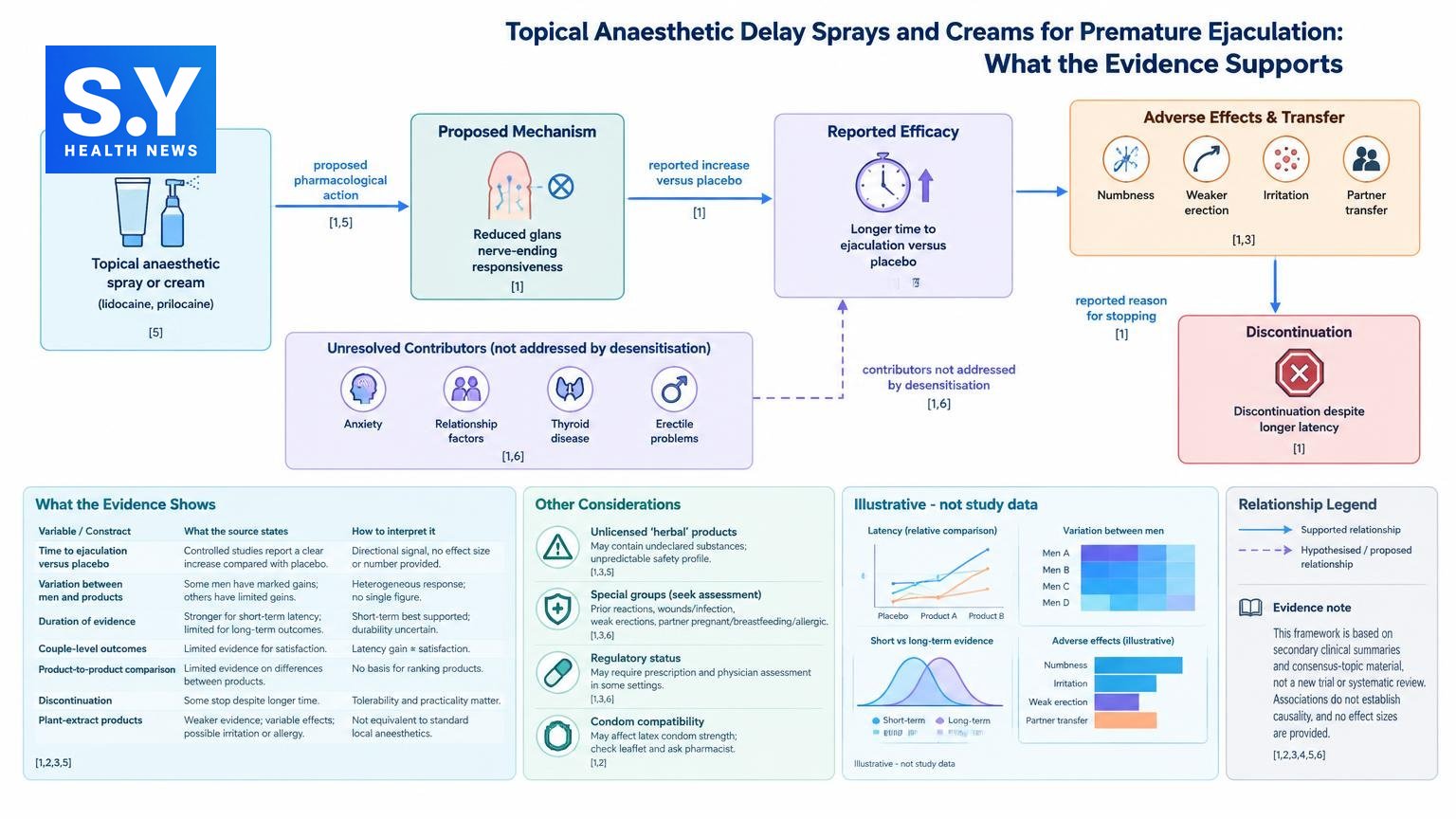
The mechanistic account in the sources is straightforward and pharmacological rather than psychological. Topical anaesthetics applied to glans skin are said to temporarily reduce the response of nerve endings on the skin surface to stimulation. When sensitivity falls, it may take longer to reach the level of stimulation that triggers the ejaculatory reflex.
Consumer-facing explanations add that the common active ingredients are local anaesthetics such as lidocaine and prilocaine, described as temporarily blocking conduction at nerve endings to blunt local sensation. This is a plausible and widely used pharmacological principle, but the supplied sources present it as explanation rather than as a directly tested causal pathway with dose-response data.[5]
The mechanism also predicts the adverse effects. Sensitivity is reduced indiscriminately, not selectively for the trigger of ejaculation, so pleasure can fall alongside latency gain. Excessive reduction is linked to weakened erections and, in one summary, to difficulty ejaculating. These are mechanistically coherent side effects, not idiosyncratic ones.
One important qualification is that glans hypersensitivity is not the whole story of premature ejaculation. One source argues that ejaculation latency is influenced by psychological state, partner relationship, fatigue and hormonal factors, so attributing the problem solely to excessive sensitivity is often inaccurate. The desensitisation model therefore explains a plausible route to longer latency without explaining the condition.[6]
What the Evidence Shows
The central efficacy claim available here is comparative and directional: in controlled studies, sprays and creams containing topical anaesthetics have produced a clear increase in time to ejaculation versus placebo. The Turkish-language version of the same clinical explainer repeats the statement, which adds consistency across languages but not independent corroboration, since it is the same secondary source.
Critically, no effect size is available in the supplied material. The sources state that absolute time varies with the study and the product, with marked increases in some men and limited increases in others, and that quoting a single figure would be inaccurate. Readers should therefore treat 'longer than placebo' as a qualitative finding rather than a quantified promise.
| Variable or construct | What the source states | How to interpret it |
|---|---|---|
| Time to ejaculation versus placebo | Controlled studies of topical anaesthetic sprays and creams report a clear increase compared with placebo | Directional efficacy signal; no effect size, sample size or trial citation is provided, so the magnitude is unknown |
| Variation between men and products | Absolute prolongation differs by study and product; some gains are marked, others limited | A single headline number would misrepresent the evidence; response appears heterogeneous |
| Duration of evidence | Stronger for short-term latency gain; limited for long-term outcomes | Short-term use is the best-supported scenario; durability and maintenance are uncertain |
| Couple-level outcomes | Limited evidence for couple satisfaction | Latency gain and satisfaction are not interchangeable endpoints |
| Product-to-product comparison | Limited evidence on differences between products | No basis in these sources for ranking specific formulations |
| Discontinuation | Some men and couples stop despite longer time, citing numbness, loss of spontaneity or application burden | Tolerability and practicality affect real-world persistence, not just efficacy |
| Plant-extract and combination products | Weaker evidence than classic local anaesthetics; variable effects; possible irritation or allergy | Should not be assumed equivalent to standard local anaesthetics |
Satisfaction and persistence diverge from the latency endpoint. The sources note that even when time lengthens, some men and couples stop the product because of genital numbness, loss of spontaneity or the effort involved in use. A statistically longer intercourse interval in a trial does not guarantee that a couple will find the trade-off acceptable.
On who might benefit most, one consumer explainer positions topical products as better suited to lifelong premature ejaculation or a glans-hypersensitivity pattern, and as usually insufficient alone when anxiety, relationship difficulties, erectile dysfunction or thyroid disease are involved. This is a clinical position rather than a trial-tested stratification rule, and it should be read accordingly.
Placement among other options is also a matter of individual assessment rather than fixed sequencing. The sources describe topical products as one option among behavioural and sex-therapy techniques, pelvic floor work, certain antidepressant-class medicines, and combinations, with choice depending on the person, accompanying problems and preference. The consensus-review record lists penile hypersensitivity, latency time, dapoxetine, SSRIs and psychotherapy among the domains it covers, but its abstract does not report findings for any of them.
Adverse Effects and Partner Transfer
Adverse effects in the sources cluster at the application site. Genital numbness beyond the intended level can reduce pleasure during intercourse. Erections may weaken, particularly with excessive application. Burning, redness or itching may occur on the glans and mucosa, and a contact allergy can develop with redness, blisters or swelling.
Frequency data are absent. The sources describe these events as possible rather than quantifying how often they occur, so a reader cannot convert these warnings into a personal risk percentage. That is a limitation of the underlying summaries, not a reason to dismiss the concerns.
Partner transfer is a distinctive and underappreciated issue. If product residue reaches a partner's genital mucosa through contact, the partner may experience numbness, burning, irritation or an allergic reaction. Residual product may also affect the experience of both partners, and washing per instructions is advised. Oral contact can cause numbness in the mouth, so leaflet guidance on this point matters.
Condom compatibility introduces another practical layer. One source notes that some products may affect the strength of latex condoms, with compatibility stated in the leaflet and pharmacists available to advise when it is not. This is presented as a possibility rather than as tested compatibility data, and it interacts directly with condom-based strategies for reducing partner exposure.
A further safety concern is systemic exposure. One consumer explainer states that topical anaesthetics absorbed through mucosa may enter the circulation, and that large or frequent use may pose potential cardiac and neurological effects. No dose-response or case data are supplied, so this should be read as a precautionary warning rather than a quantified risk.
Several groups are advised to seek assessment before starting rather than self-treating: people with prior reactions to local anaesthetics or other product components; those with open wounds, cracks, infection, balanitis or marked irritation; men whose erections are already weak; and couples where the partner is pregnant, breastfeeding or allergic. Regulatory status also varies, and one source describes topical local anaesthetics as falling under prescription management in at least some settings, requiring physician assessment before use.
The Unlicensed 'Herbal' Market
A recurring theme across the sources is that many delay sprays, creams and pills marketed as 'natural', 'herbal' or 'instant-acting' on social media and websites are unlicensed. Such products may contain active substances not written on the label, and because contents and amounts are unknown, side effects cannot be predicted.
Plant-extract and traditional-medicine ointments are described as compositionally complex, with largely unclear mechanisms, variable effects and a lack of high-quality clinical research support. Combination products containing plant extracts are characterised as milder but with weaker evidence than classic local anaesthetics, with possible local irritation or allergy. These are evidence-gap statements, not proof that such products are inert or universally harmful.
The practical implication drawn by the clinical sources is sourcing discipline: obtaining a licensed product through a pharmacy or physician means contents and instructions have been checked. Products without an ingredient list, warnings or leaflet, or with exaggerated claims, are best avoided. After a reaction to an unlicensed product, users are advised to stop and seek care with the packaging.
Interpretation and Limitations
The evidence base available for this review is indirect. The two principal clinical explainers are secondary summaries in English and Turkish by the same author; the three consumer health articles are explainers rather than primary studies; and the consensus-review record is an abstract only. No trial names, sample sizes, effect sizes, confidence intervals or follow-up durations are provided. Claims that controlled studies show benefit versus placebo rest on these secondary characterisations.
Several statements are explicitly provisional. The idea that the effect is confined to the intercourse in which the product is applied, and that the earlier pattern may return after stopping, is presented as clinical reasoning rather than as follow-up data. The same applies to the caution that long-term frequent use is discouraged because of possible local tolerance or sensory abnormality. These are plausible but untested in the supplied material.
Application guidance is likewise general. One source describes typical timing of 10 to 20 minutes before intercourse for fast-acting local anaesthetics, but the clinical explainers deliberately avoid giving a universal time or amount, instead directing readers to the product leaflet and physician advice. The absence of a standard protocol across products is itself a finding about the field.
Finally, outcome selection matters. Trials described in these sources appear to centre on latency time, whereas the concerns raised here are about satisfaction, discontinuation, erection quality and partner experience. Whether topical products improve the outcomes couples actually care about, over periods that matter to them, remains the key unanswered question.
Research Outlook
The consensus-review record signals where formal guidance is heading. Its stated aim is to present evidence-based recommendations for the definition, classification and treatment of premature and delayed ejaculation under the guidance of the Fifth International Consultation on Sexual Medicine. Because only the abstract is available here, specific recommendations and the strength of their supporting evidence cannot be assessed from the supplied text.
For topical products specifically, the gaps identified by the sources point to what would strengthen the field: adequately powered comparisons against placebo with reported effect sizes and variability; head-to-head comparisons between formulations; longer follow-up capturing discontinuation and couple satisfaction; and clearer safety reporting on transfer, mucosal absorption and condom compatibility. None of these are reported in the material reviewed here.
Broader management research is also relevant. Behavioural techniques such as the stop-start and squeeze methods, practised under clinician or sex-therapist guidance, are described as effective for many men, and combination approaches are discussed alongside medication. How topical anaesthetics compare or combine with these strategies is not resolved by the available summaries.
Key Takeaways
- Secondary clinical summaries report that controlled studies of topical anaesthetic sprays and creams show a clear increase in time to ejaculation versus placebo, but no effect size is available and the gain varies by person and product.
- The proposed mechanism is temporary desensitisation of glans nerve endings, which plausibly delays the stimulation threshold for the ejaculatory reflex but does not address psychological, relational, prostatic, thyroid or erectile contributors.
- Evidence is characterised as stronger for short-term latency gain and limited for long-term outcomes, couple satisfaction and differences between products, and some couples discontinue despite longer time because of numbness, lost spontaneity or application burden.
- Reported adverse effects include reduced pleasure, weakened erections, burning, irritation and contact allergy, with possible transfer of residue to a partner causing numbness, burning or irritation; some products may also affect latex condom strength.
- Unlicensed 'herbal' delay products sold online may contain undeclared active substances, making side effects unpredictable, and plant-extract formulations have weaker supporting evidence than classic local anaesthetics.
Questions and Answers
How do topical anaesthetic delay sprays and creams work for premature ejaculation?
They contain local anaesthetics such as lidocaine or prilocaine that temporarily blunt conduction at nerve endings on the glans, reducing sensitivity to stimulation. The proposed consequence is that longer stimulation is needed to reach the threshold that triggers the ejaculatory reflex. This mechanism explains a route to longer latency, but it does not address psychological, relational, thyroid or erectile contributors, and the sources present it as explanation rather than a directly tested pathway.
Do delay sprays and creams actually prolong time to ejaculation compared with placebo?
According to secondary clinical summaries, controlled studies report a clear increase in time to ejaculation versus placebo. However, no effect size, sample size or trial citation is provided, and the absolute prolongation varies by study and product, with marked gains in some men and limited gains in others. The supported claim is therefore directional benefit, not a specific number of minutes.
How strong is the evidence for delay sprays and creams in premature ejaculation?
Moderate at best and indirect. The available sources are secondary clinical explainers and consumer articles rather than primary trials, and the consensus record is abstract-only. The sources themselves describe evidence as stronger for short-term latency gain and limited for long-term outcomes, couple satisfaction and differences between products. No trial-level effect sizes, confidence intervals or follow-up durations are reported in the material reviewed.
Who might benefit most from topical delay products, and who should be cautious?
One consumer explainer positions topical products as better suited to lifelong premature ejaculation or a glans-hypersensitivity pattern, and usually insufficient alone when anxiety, relationship problems, erectile dysfunction or thyroid disease are involved. Caution is advised with prior local-anaesthetic allergy, open or irritated genital skin, already weak erections, and partners who are pregnant, breastfeeding or allergic. These are clinical positions, not trial-tested rules.
Can delay creams and sprays transfer to a partner or cause other side effects?
Yes, transfer is described as possible: residue reaching a partner's genital mucosa may cause numbness, burning, irritation or allergic reaction, and oral contact can numb the mouth. User-side effects include excess numbness reducing pleasure, weakened erections, burning, redness, itching and contact allergy. Some products may affect latex condom strength. The sources do not quantify how often these events occur.
Are 'herbal' or online delay sprays for premature ejaculation safe?
They carry avoidable uncertainty. Many products marketed as natural, herbal or instant-acting online are unlicensed and may contain active substances not listed on the label, so contents and amounts are unknown and side effects cannot be predicted. Plant-extract formulations have weaker supporting evidence than classic local anaesthetics. A licensed product obtained through a pharmacy or physician provides checked contents and instructions, and reactions to unlicensed products warrant stopping and seeking care with the packaging.
Conceptual framework: Conceptual framework, not a tested causal model. The diagram shows the relationships described in secondary clinical summaries: a proposed desensitisation route to reported longer latency versus placebo, reported adverse effects including partner transfer, discontinuation despite latency gain, and contributors such as anxiety or erectile problems that topical products are not positioned to treat. Evidence is stronger for short-term latency than for long-term or couple outcomes; no effect sizes are available.
Academic References & Evidence
- Zülfü Sertkaya. Delay Sprays and Creams for Premature Ejaculation: How They Work, Side Effects and Risks | Assoc. Prof. Zülfü Sertkaya, MD.
- Zülfü Sertkaya. Erken Boşalmada Geciktirici Sprey ve Kremler: Nasıl Çalışır, Yan Etkileri ve Riskleri Nelerdir? | Doç. Dr. Zülfü Sertkaya.
- 治疗早泄的外用药膏有哪些?使用前需了解这些要点. 2026
- Contemporary consensus and emerging directions in premature and delayed ejaculation: recommendations from the 5th International Consultation on Sexual Medicine.. Sexual medicine reviews PMID: 42855438.
- 治疗早泄的外用药是什么?常见类型和适用情况要分清. 2026
- 有降低龟头敏感度药吗?医生提醒:这类药物别乱用. 2026
SANYUN Science Center explains published research on men's reproductive and sexual health, connecting scientific evidence with everyday questions while making sources and limitations clear.
Disclaimer: This article is for scientific education and research communication only. It does not provide medical advice, diagnosis, or individualized treatment recommendations, and does not endorse any medication, supplement, device, penile enlargement procedure, or other intervention. Decisions about sexual and reproductive health should be made in consultation with a qualified healthcare professional. Do not delay seeking professional care because of information in this article.
Original Content & Copyright Notice
- This article is prepared for SANYUN Science Center, drawing on published research and publicly available academic literature on men’s sexual and reproductive health. Its editorial explanations and presentation are developed for this platform.
- Copyright in the original editorial content, selection, and arrangement is reserved by SANYUN Science Center to the extent protected by applicable law. Referenced research, quotations, and third-party materials remain subject to the rights of their respective owners. This notice does not claim ownership of scientific facts or third-party research.
- Except where permitted by applicable law or an applicable license, prior written permission is required to reproduce, republish, translate, adapt, redistribute, or commercially reuse protected content. Attribution alone does not grant permission for such reuse.
- For permitted quotation or authorized reuse, clearly identify the source and retain a link to the original article.
- Source: SANYUN Science Center
- Original URL: Retain the original article URL on science.san-yun.com.
- Copyright Holder: SANYUN Science Center, for its own protected editorial content.
- Quotation, excerpts, or authorized reuse must not distort the scientific meaning, omit material limitations or disclaimers, or imply unverified medical claims, product efficacy, or endorsement by SANYUN Science Center.



