




Category: Latest Research
Core Research Direction: Efficacy and limitations of topical local anesthetics (lidocaine, lidocaine-prilocaine sprays) for premature ejaculation, including comparator trial design and generalizability to clinical PE populations
Search Intent: How strong is the evidence that topical numbing sprays delay ejaculation in men with premature ejaculation, and what can this evidence not tell us?
Platform: SANYUN Science Center
Evidence reviewed through: 2026-11-22
Executive Summary
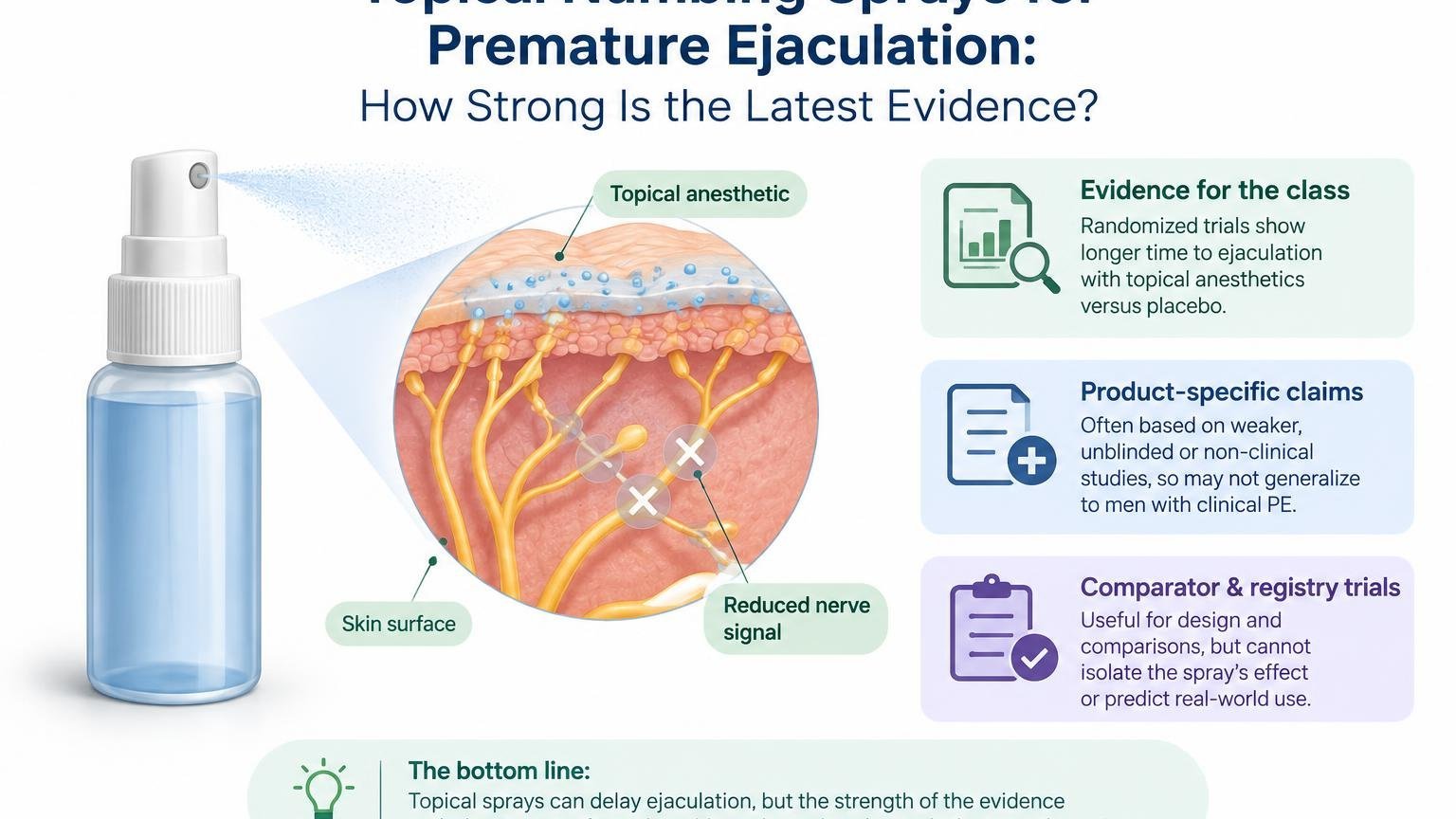
Topical local anesthetics are not a fringe option for premature ejaculation (PE). A 2013 meta-analysis of eight randomized trials reported that numbing agents added a mean of 5.82 minutes to time to ejaculation compared with placebo, and European urology guidelines recommend an EU-approved lidocaine-prilocaine spray as a first-line treatment for lifelong PE alongside the pill dapoxetine.[1]
The strength of that recommendation varies by question. In a phase III placebo-controlled trial of 256 men who usually ejaculated within a minute, the lidocaine-prilocaine spray raised average time to ejaculation from 0.56 to 2.60 minutes over three months, against 0.53 to 0.80 minutes with placebo. That is a randomized, blinded, clinically relevant comparison in a population that actually meets the definition of lifelong PE.
The weakest link is product-specific marketing evidence. The one published study of a widely sold over-the-counter lidocaine spray enrolled men online, had no placebo group, was not blinded, and relied on men's own time estimates. The authors themselves cautioned that the findings should not be generalized to men with clinical PE, because the participants averaged about 6.5 minutes before the study.
A recently completed trial in Istanbul compared a lidocaine-prilocaine spray plus behavioral therapy with a frenular silicone band plus behavioral therapy in men with lifelong PE. The registry record describes the design and primary endpoints, including patient-estimated intravaginal ejaculatory latency time at baseline, month 1 and month 2, but no results are posted in the packet. Until results appear, the trial is a design signal, not evidence of comparative efficacy.[2]
Why This Matters
Premature ejaculation is common enough that many men encounter delay sprays before they encounter a specialist. Over-the-counter status makes the products easy to buy, and the regulatory category is broad: US rules for male genital desensitizers allow benzocaine at 3 to 7.5% in a water-soluble base, or lidocaine in a metered spray at about 10 mg per spray. Products sold under those rules did not need product-specific trial review before marketing.
That creates a gap between class-level evidence and product-level claims. A man reading that a particular spray is "clinically proven" may reasonably assume a strong trial of that spray exists. Often what exists is a strong evidence base for the active ingredient plus a weaker, often unblinded study of the branded product. Understanding that distinction is the difference between informed use and marketing-driven use.
How Topical Anesthetics Are Thought to Work
Lidocaine blocks nerve signals in the skin it touches. Applied to the glans, it reduces local sensitivity, so less sensory input reaches the reflex that triggers ejaculation, which can delay ejaculation. The effect is local and temporary, which is why a spray has to be reapplied for each encounter and why too much can blunt sensation and erections rather than simply extend time.
This mechanism explains both the appeal and the side-effect profile. Trials of the EU-approved lidocaine-prilocaine spray reported genital numbness in 4.5% of men and erection problems in 4.4%, with 1.0% of partners reporting numbness and 3.9% a burning sensation. Across pooled trials, side effects were about four times as common with numbing agents as with placebo, though nearly all were mild and short-lived.
Erection effects deserve separate attention. In a crossover trial in Egypt, erection scores fell while men used a 10% lidocaine spray but not while they took dapoxetine. That does not mean every man will notice softening, but it is a plausible consequence of reduced penile sensation and a reason to test a low dose first rather than assume the product is inert.
What the Evidence Shows
| Study or source | Design and population | Main finding | What it cannot establish |
|---|---|---|---|
| 2013 meta-analysis of numbing agents | Eight randomized trials; men treated with topical numbing agents versus placebo | Mean added time to ejaculation of 5.82 minutes versus placebo | Individual trial quality and product differences are not detailed in the reported summary |
| Phase III lidocaine-prilocaine spray trial | Placebo-controlled; 256 men who usually ejaculated within a minute; three months | Average time rose from 0.56 to 2.60 minutes with the spray versus 0.53 to 0.80 minutes with placebo | Absolute gain is modest in minutes even when statistically clear; per-arm group sizes not stated in the summary |
| Single-blind 5% lidocaine trial in Egypt | 150 men with lifelong PE; eight weeks; alcohol spray comparator | Improved time to ejaculation and symptom scores versus alcohol spray | Single-blind; active comparator rather than placebo |
| Crossover trial in Egypt | 55 men; 10% lidocaine spray versus dapoxetine | 43 of 55 men rated the lidocaine spray effective versus 16 for dapoxetine | Subjective patient ratings; small sample |
| 2025 Turkish comparative study | 273 men with lifelong PE; lidocaine spray, lidocaine-prilocaine cream and benzocaine condoms | Largest increase in time to ejaculation with lidocaine spray, then cream, then benzocaine condoms | Ranking only; absolute values not given in the available summary |
| 2016 online study of a consumer lidocaine spray | 91 analyzed men recruited online; 14-day diary; with versus without spray | Self-estimated time 11.16 minutes with spray versus 6.81 minutes without | No placebo, no blinding, self-estimated times, non-clinical sample |
| Completed Istanbul trial registry record | Lidocaine-prilocaine spray plus behavioral therapy versus frenular silicone band plus behavioral therapy; lifelong PE; one site | Primary endpoints include change in PEDT score and patient-estimated IELT at month 1 and month 2 | No results are posted in this record; comparator trial design cannot by itself establish efficacy |
The randomized data are consistent enough to support a class effect. The phase III trial used a population defined by ejaculation within roughly a minute, and the spray more than quadrupled average time to ejaculation relative to placebo at three months. That is the kind of design clinicians want: a defined population, a placebo arm, and a latency measure repeated over time.
The 2025 Turkish study adds a useful practical comparison. Among 273 men with lifelong PE, time to ejaculation rose most with a lidocaine spray, followed by a lidocaine-prilocaine cream and benzocaine condoms. The ranking is informative for shared decision-making, but the available summary gives no absolute values, so it cannot quantify how much better one option was than another.
Patient-rated comparisons are softer but still relevant. In an Egyptian crossover trial, 43 of 55 men rated a 10% lidocaine spray effective, against 16 who said the same of dapoxetine. This suggests many men prefer a topical option to an oral one, even though the trial is small and the endpoint is a subjective rating rather than a stopwatch measure.
Real-world persistence tells a different story. In a Milan clinic study of 198 men, 93% had tried the lidocaine-prilocaine spray and 66% were using it regularly at six months, but only 27% were still using it regularly after a year. Efficacy in a trial and continued use in daily life are not the same outcome, and discontinuation may reflect cost, inconvenience, side effects or simply that the problem resolved.
Interpretation and Limitations
The most important limitation is quality, not direction. A 2025 review of reviews found only 6 of 65 drug trials for PE at low risk of bias, although numbing agents were one of only two treatments rated as having moderate to high certainty of evidence. Reviewers of earlier trials likewise rated many as small or of unclear quality. The evidence leans consistently toward benefit, but the individual studies behind that lean are often modest in size and design.
The 2016 consumer-spray study illustrates why product-level claims should be read carefully. It had no placebo group and was not blinded, so men knew what they were using and what it was supposed to do. Times were self-estimated rather than stopwatch-measured, and one author had received funding from the manufacturer while the other had consulted for a company founded by that author. None of those facts proves the spray does not work; they mean the study cannot separate the product's effect from expectation.
Generalizability is a second limitation. In that study, participants averaged about 6.5 minutes before treatment and did not meet the time limits doctors use to diagnose PE, despite screening scores that pointed toward it. A man who ejaculates within a minute and a man who ejaculates at six to seven minutes occupy different clinical categories, and results from the latter should not be transferred to the former without caution.
A planned placebo-controlled trial of the same consumer spray never reported results: the announcement targeted 120 men, but the registry record was last updated in 2014 with unknown status, no results posted, and no published results found. The absence of results is not evidence of harm or futility, but it leaves the product-specific evidence base where it was.
Safety limitations are part of the evidence picture. In a laboratory study, adding a lidocaine spray to normal semen samples reduced sperm movement and survival without increasing DNA damage, but in vitro findings do not establish an in vivo fertility effect. Guidelines advise couples trying to conceive to avoid lidocaine-prilocaine products, and partner transfer of numbness is a recognized practical concern.
What the Completed Comparator Trial Can and Cannot Tell Us
The Istanbul registry record describes a completed trial with two active arms. In the experimental arm, participants used a frenular silicone band during each intercourse encounter for one month with behavioral counselling, then continued behavioral techniques for a second month without the band. In the active comparator arm, participants used topical lidocaine-prilocaine spray before each encounter for one month with behavioral counselling, then behavioral techniques alone for a second month.
Both arms changed two things at once: the device or spray, and the timing of behavioral support. That design can answer whether a device-plus-behavior strategy differs from a spray-plus-behavior strategy in the short term, but it cannot isolate the effect of the spray itself against no spray, nor separate spray effects from behavioral effects during the first month. The primary endpoints include change from baseline in PEDT score and in patient-estimated IELT at baseline, month 1 and month 2, and the IELT endpoint is patient-estimated rather than stopwatch-measured.
Single-site trials also carry generalizability limits: one center in one country means the population, operator technique and behavioral counselling may not represent other settings. None of these points is a criticism of the trial; they are simply what a reader should hold in mind before treating a registry record as a result.
Research Outlook
Several questions remain open. First, which men benefit most? The strongest efficacy data come from lifelong PE populations with very short baseline latency, while the weakest product-specific study enrolled men with near-normal times. Second, how do topical agents compare with behavioral and device strategies over months rather than single encounters? The Istanbul trial design speaks to that question once results are available.
Third, adherence matters as much as initial response. The Milan data show that regular use fell from 66% at six months to 27% at one year, which is a reminder that a treatment's real-world value depends on whether men keep using it. Future studies that report reasons for discontinuation and pair latency outcomes with patient-reported satisfaction would add information that latency alone cannot provide.
Finally, fertility and partner outcomes deserve explicit measurement rather than inference. The in vitro sperm findings, the guideline caution for couples trying to conceive, and partner numbness rates all point to safety questions that are best answered in studies designed to measure them, not in convenience samples or marketing reviews.
Key Takeaways
- Class-level evidence supports topical numbing agents for delaying ejaculation, with a pooled mean gain of 5.82 minutes versus placebo and a guideline first-line recommendation for an EU-approved lidocaine-prilocaine spray in lifelong PE.
- The strongest single trial was placebo-controlled and enrolled 256 men who usually ejaculated within a minute; average time rose from 0.56 to 2.60 minutes over three months versus 0.53 to 0.80 minutes with placebo.
- Product-specific evidence for at least one widely sold consumer spray is weak: one unblinded, uncontrolled study of 91 analyzed men relying on self-estimated times, with authors cautioning against generalization to clinical PE.
- A completed Istanbul trial comparing lidocaine-prilocaine spray with a frenular silicone band has a registry record and defined endpoints but no posted results in the available packet.
- Safety considerations include local numbness and erection effects, partner transfer, and in vitro sperm findings that do not establish in vivo fertility harm but warrant caution for couples trying to conceive.
Questions and Answers
How do topical lidocaine sprays delay ejaculation in premature ejaculation?
Lidocaine blocks nerve signals in the skin it touches. Applied to the glans, it reduces local sensitivity so less sensory input reaches the ejaculation reflex, which can delay ejaculation. The effect is local and temporary, so the spray must be reapplied for each encounter and can blunt sensation or erections if too much is used.
What does the strongest trial evidence show about lidocaine-prilocaine spray for lifelong premature ejaculation?
In a phase III placebo-controlled trial of 256 men who usually ejaculated within a minute, average time to ejaculation rose from 0.56 to 2.60 minutes over three months with the lidocaine-prilocaine spray, versus 0.53 to 0.80 minutes with placebo. A pooled analysis of eight randomized trials found numbing agents added 5.82 minutes on average versus placebo.
How strong is the evidence for a specific over-the-counter lidocaine delay spray?
Weaker than class-level evidence. The only published study of one popular spray enrolled men online, had no placebo group, was not blinded, and relied on self-estimated times. Of 195 men screened, 162 were eligible and 91 were analyzed. One author had manufacturer funding. The authors cautioned that findings should not be generalized to men with clinical premature ejaculation.
Does the lidocaine-prilocaine spray evidence apply to all men with premature ejaculation?
Not directly. The strongest trial enrolled men who usually ejaculated within a minute, consistent with lifelong PE. The weaker 2016 product study enrolled men averaging about 6.5 minutes before treatment who did not meet time-based diagnostic criteria, and its authors warned against generalizing to clinical PE. Acquired PE and PE with other conditions may respond differently and require clinical assessment.
What are the main risks and limitations of topical numbing sprays for premature ejaculation?
Local numbness affected 4.5% of men and erection problems 4.4% in trials of the EU-approved lidocaine-prilocaine spray, while 1.0% of partners reported numbness and 3.9% burning. Pooled data show side effects about four times as common as with placebo, mostly mild. In vitro sperm effects, guideline caution for couples trying to conceive, and partner transfer are practical concerns.
What can the completed trial comparing a silicone band with lidocaine-prilocaine spray tell us so far?
Only its design. The registry record describes two active arms with one month of device or spray use plus behavioral counselling, followed by a second month of behavioral techniques alone. Primary endpoints include change in PEDT score and patient-estimated IELT at baseline, month 1 and month 2. No results are posted in the available record, so it cannot yet show which approach works better.
Sources and References
- Promescent review: does it work and is it safe? | Adaging.
- lidocaine-prilocaine spray — 1 site, updated Nov 2026 | DataLookout.
SANYUN Science Center explains published research on men's reproductive and sexual health, connecting scientific evidence with everyday questions while making sources and limitations clear.
Disclaimer: This article is for scientific education and research communication only. It does not provide medical advice, diagnosis, or individualized treatment recommendations, and does not endorse any medication, supplement, device, penile enlargement procedure, or other intervention. Decisions about sexual and reproductive health should be made in consultation with a qualified healthcare professional. Do not delay seeking professional care because of information in this article.
Original Content & Copyright Notice
- This article is prepared for SANYUN Science Center, drawing on published research and publicly available academic literature on men’s sexual and reproductive health. Its editorial explanations and presentation are developed for this platform.
- Copyright in the original editorial content, selection, and arrangement is reserved by SANYUN Science Center to the extent protected by applicable law. Referenced research, quotations, and third-party materials remain subject to the rights of their respective owners. This notice does not claim ownership of scientific facts or third-party research.
- Except where permitted by applicable law or an applicable license, prior written permission is required to reproduce, republish, translate, adapt, redistribute, or commercially reuse protected content. Attribution alone does not grant permission for such reuse.
- For permitted quotation or authorized reuse, clearly identify the source and retain a link to the original article.
- Source: SANYUN Science Center
- Original URL: Retain the original article URL on science.san-yun.com.
- Copyright Holder: SANYUN Science Center, for its own protected editorial content.
- Quotation, excerpts, or authorized reuse must not distort the scientific meaning, omit material limitations or disclaimers, or imply unverified medical claims, product efficacy, or endorsement by SANYUN Science Center.



