




Category: Premature Ejaculation
Core Research Direction: Comparative efficacy and mechanisms of topical local anesthetics (lidocaine-prilocaine cream, lidocaine spray, benzocaine condoms) for premature ejaculation, with attention to IELT outcomes, partner transfer, and short- versus long-term evidence limits
Search Intent: How well do topical numbing agents actually extend ejaculatory latency in premature ejaculation, and what are their limits and trade-offs compared with placebos and condoms?
Platform: SANYUN Science Center
Evidence reviewed through: 2026-11-06
Executive Summary
Topical local anesthetics are an established on-demand strategy for premature ejaculation (PE). A prospective comparative study enrolled 273 men with lifelong PE between November 2020 and December 2022 and followed them for two months of treatment. Baseline intravaginal ejaculatory latency time (IELT) was roughly 30 seconds in all groups, and every group improved significantly. Lidocaine spray and lidocaine-prilocaine cream (EMLA) produced larger increases than benzocaine condoms.[1]
Placebo-controlled phase 3 evidence, summarized in clinical guidance, supports the lidocaine-prilocaine spray more strongly: mean time to ejaculation moved from about 0.6 minutes at baseline to 2.6–3.8 minutes, against 0.8–1.1 minutes with placebo. A 2016 systematic review reached similar conclusions while flagging that the effect is strictly on-demand, that reduced sensation and transfer to a partner are the leading complaints, and that topical therapy does not address anxiety or relationship contributors.[2]
- All three topical approaches raised mean IELT at two months in a single-center, non-randomized cohort of men with lifelong PE.
- In that cohort, lidocaine spray and lidocaine-prilocaine cream significantly outperformed benzocaine condoms on IELT gain.
- Randomized placebo-controlled trials of lidocaine-prilocaine formulations provide stronger, but still formulation-specific, efficacy evidence.
- Partner transfer and dose-dependent numbness are the principal practical drawbacks; wiping off or covering with a condom is recommended.
- Long-term efficacy beyond short follow-up has not been demonstrated, per the authors of the comparative study and the meta-analytic summary.
Why This Matters
Ejaculatory disorders, including PE, are common and carry a substantial impact on quality of life and relationships. A consensus review prepared for the 5th International Consultation on Sexual Medicine frames PE as a condition requiring structured definition, classification and treatment recommendations rather than an isolated complaint.[3]
Topical anesthetics occupy a particular niche in that landscape. They act locally, are applied only when needed, and require no daily dosing. For men who prefer to avoid systemic medication, or whose main triggered problem appears to be penile sensitivity, they are a plausible first step. The clinical question is not whether they reduce sensation — that is predictable — but how much latency they actually add, how that compares across formats and against placebo or condoms, and what the user gives up in return.
How Topical Anesthetics Are Thought to Delay Ejaculation
The proposed mechanism is sensory rather than motor. Topical anesthetics are applied to the glans and frenulum to reduce hypersensitivity, one of the pathways implicated in triggering early ejaculation. Lidocaine, a local anesthetic, blocks sodium channels in cutaneous nerve endings, dampening the afferent signals thought to drive the ejaculatory reflex. Sensation is reduced, not abolished, and the effect is confined to treated skin.
This is an important conceptual boundary. Topicals manage the symptom while the drug is present on the skin; they do not reset the underlying reflex and exert no effect on nights they are not used. That framing matters for counselling: a topical is a tool within a plan, not a cure, and its benefit ends when the product is removed or wears off.
What the Evidence Shows
The strongest format-specific randomized evidence concerns the lidocaine-prilocaine metered spray. In phase 3, double-blind, placebo-controlled trials, the spray was applied five minutes before intercourse. Mean time to ejaculation rose from about 0.6 minutes at baseline to 2.6–3.8 minutes, compared with 0.8–1.1 minutes on placebo, alongside improved ejaculatory control and satisfaction scores. A separate double-blind randomized trial of lidocaine-prilocaine cream reported several-fold increases in time to ejaculation versus placebo.
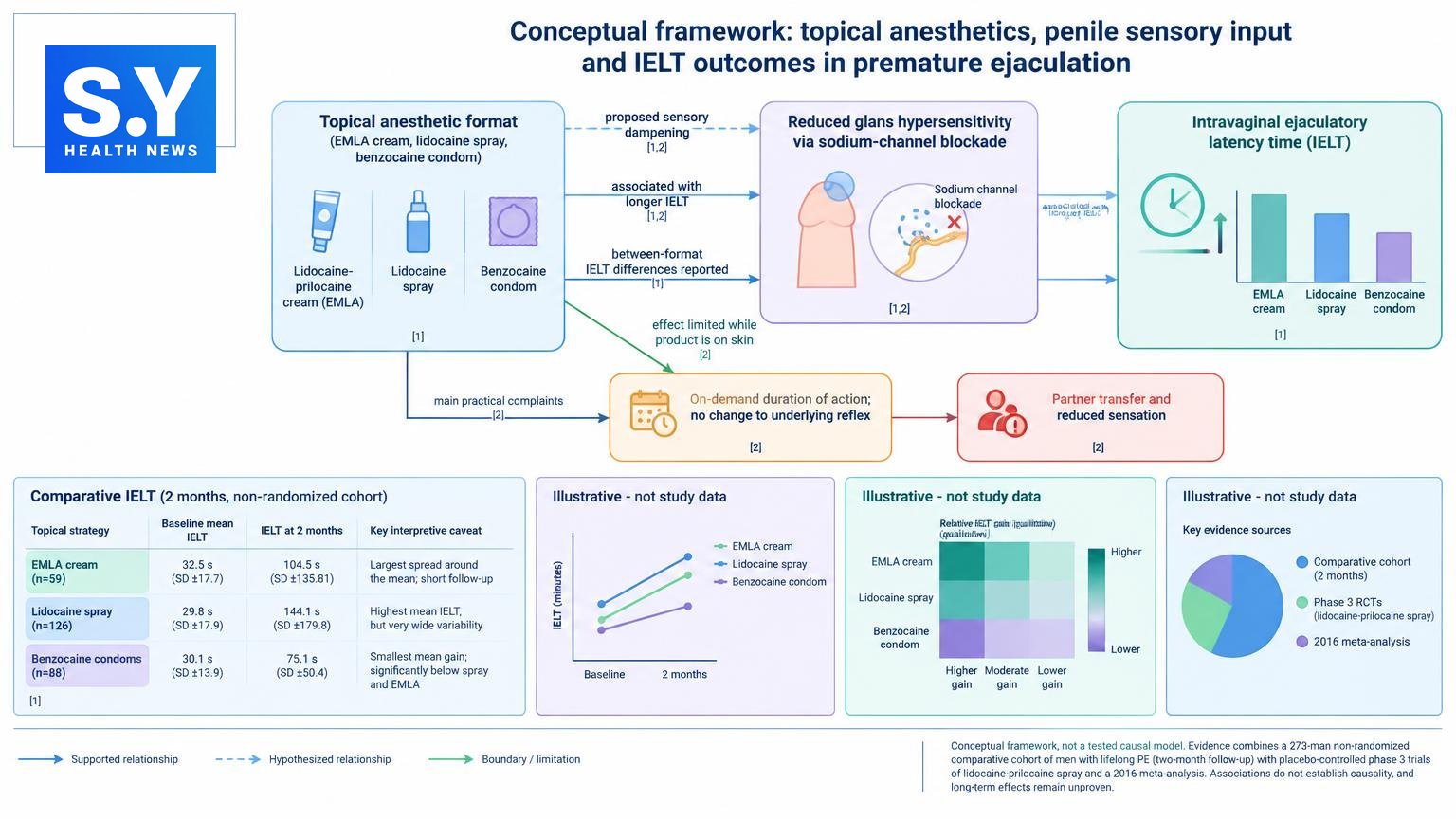
The 2020–2022 comparative cohort adds head-to-head information that placebo trials cannot provide, though at a lower evidentiary tier. Among 273 men with lifelong PE, the EMLA cream group (n=59), lidocaine spray group (n=126) and benzocaine condom group (n=88) all had baseline mean IELT near 30 seconds: 32.5, 29.8 and 30.1 seconds respectively. Two months later, mean IELT was 104.5 seconds with EMLA, 144.1 seconds with lidocaine spray, and 75.1 seconds with benzocaine condoms. Every group improved significantly from baseline, and the authors reported that both the spray and EMLA cream significantly increased IELT compared with condoms.
| Topical strategy | Baseline mean IELT | IELT at 2 months | Key interpretive caveat |
|---|---|---|---|
| Lidocaine-prilocaine cream (EMLA), n=59 | 32.5 s (SD ±17.7) | 104.5 s (SD ±135.81) | Largest spread around the mean; short follow-up |
| Lidocaine spray, n=126 | 29.8 s (SD ±17.9) | 144.1 s (SD ±179.8) | Highest mean IELT, but very wide variability |
| Benzocaine condoms, n=88 | 30.1 s (SD ±13.9) | 75.1 s (SD ±50.4) | Smallest mean gain; significantly below spray and EMLA |
Three interpretations follow. First, the within-group improvements are statistically significant but clinically modest in absolute terms: even the best mean latency, about 144 seconds, remains under three minutes, and individual responses vary enormously. Second, the benzocaine condom result must be read carefully, because condoms may reduce sensation intrinsically; whether benzocaine adds anything beyond the condom itself cannot be determined from this design. Third, the comparative ranking of spray over cream is a between-group difference in a non-randomized cohort, so allocation by clinician or patient preference may have influenced it.
Partner Transfer, Safety and Practical Trade-Offs
Partner transfer is the central practical limitation. A 2016 systematic review and meta-analysis concluded that topical anesthetics are effective but on-demand only, with reduced sensation and transfer to the partner as the main complaints. Clinical guidance therefore recommends wiping the product off before penetration or covering it with a condom, and having a clinician set the format and dose rather than relying on trial and error.
Safety concerns are mostly local and dose-related. Methemoglobinemia, a rare blood-oxygen disorder, is associated mainly with prilocaine, large treated areas or prolonged occlusion, which is relevant to lidocaine-prilocaine products in particular. This is a clinical safety summary rather than a quantified trial outcome, so the absolute risk for small genital applications is not established by the supplied evidence; men with G6PD deficiency or congenital methemoglobinemia are conventionally regarded as unsuitable for prilocaine-containing mixes.
The broader trade-off is therapeutic scope. Because topicals do not address the anxiety or relationship factors that often accompany PE, they are best understood as symptom control layered onto assessment, behavioural strategies, or treatment of coexisting erectile difficulties. The consensus literature on PE reinforces that management is multidimensional.
Interpretation and Limitations
The evidence base has an asymmetric architecture. Efficacy against placebo is reasonably established for lidocaine-prilocaine formulations, but comparator data between formats come from a single prospective cohort with unequal, non-randomized groups, no placebo arm, and only two months of follow-up. The very large standard deviations relative to the means indicate that some men gained a great deal and others gained little or nothing; group averages conceal that heterogeneity.
Several conclusions should be held with appropriate caution. The superiority of lidocaine spray and EMLA cream over benzocaine condoms is a reported association in an observational design, not a randomized causal estimate. The mechanism of glans hypersensitivity is described in the literature but was not directly tested in the supplied studies. The phase 3 spray figures are drawn from a secondary clinical summary rather than the primary trial reports, so exact sample sizes and statistical details were not available for this review.
Finally, the absence of long-term data is a genuine gap rather than a minor caveat. The comparative study's authors state that local treatments are effective in the short term and that further studies of long-term efficacy are needed. Questions about tolerance, skin effects with frequent use, and whether latency gains persist over months remain unanswered by the supplied evidence.
Research Outlook
What the field needs is not more small single-center cohorts but randomized, adequately powered comparisons between formats, with placebo or condom-only arms and follow-up measured in months rather than weeks. Standardized IELT measurement, transparent reporting of partner-reported outcomes, and prespecified handling of the wide inter-individual variability would make results more interpretable.
The consensus process behind the 5th International Consultation on Sexual Medicine is intended to supply evidence-based recommendations for definition, classification and treatment. How explicitly that guidance positions topical anesthetics relative to oral dapoxetine, behavioural therapy and combined approaches is not detailed in the supplied text, and the full recommendations were not available for this review.
Key Takeaways
- Topical anesthetics reliably reduce penile sensation and increase IELT in the short term, with the strongest randomized support for lidocaine-prilocaine formulations.
- In a 273-man cohort, all three strategies improved IELT at two months, and lidocaine spray and EMLA cream outperformed benzocaine condoms.
- Absolute latency gains are modest and highly variable, and group means should not be read as individual expectations.
- Partner transfer and reduced sensation are the main drawbacks; wiping off or using a condom is advised, with clinician-guided dosing.
- Long-term efficacy and the effect on anxiety or relationship contributors remain unproven.
Questions and Answers
How do topical anesthetics delay ejaculation in premature ejaculation?
They are applied to the glans and frenulum to reduce hypersensitivity, one proposed trigger for early ejaculation. Lidocaine blocks sodium channels in skin nerve endings, dampening the sensory signals thought to drive the ejaculatory reflex. Sensation is reduced rather than eliminated, and the effect exists only while product remains on the skin; the underlying reflex is not changed.
How much do lidocaine sprays and creams increase IELT compared with placebo in premature ejaculation?
In phase 3 trials of lidocaine-prilocaine spray applied five minutes before intercourse, mean time to ejaculation rose from about 0.6 minutes to 2.6–3.8 minutes, versus 0.8–1.1 minutes with placebo. A double-blind randomized trial of lidocaine-prilocaine cream reported several-fold increases versus placebo. These figures come from a secondary clinical summary, so primary trial details were not independently verified here.
Are lidocaine spray and EMLA cream more effective than benzocaine condoms for premature ejaculation?
In a prospective cohort of 273 men with lifelong PE, lidocaine spray and EMLA cream significantly increased IELT compared with benzocaine condoms after two months, and all groups improved from baseline. This was a non-randomized, single-center comparison with unequal groups, so the ranking is an observed association rather than a randomized causal finding.
Can topical numbing products for premature ejaculation transfer to a partner?
Yes, partner transfer is one of the main practical complaints in meta-analytic evidence, alongside reduced sensation. Clinical guidance recommends wiping the product off before penetration or covering it with a condom, both approaches used in trials. Format and dose should be set by a clinician, and oral contact should be avoided while the product is active.
What are the safety concerns with prilocaine-containing numbing creams?
Methemoglobinemia, a rare blood-oxygen disorder, is associated mainly with prilocaine, large treated areas or prolonged occlusion. This is a clinical safety summary rather than a quantified trial risk, so absolute risk for small genital applications is not established. People with G6PD deficiency or congenital methemoglobinemia are conventionally considered unsuitable for prilocaine mixes and should raise this with a clinician.
Is there long-term evidence that topical anesthetics keep working for premature ejaculation?
No. The comparative cohort followed men for only two months, and its authors concluded that local treatments are effective short term but that further studies of long-term efficacy are needed. The meta-analytic summary likewise describes the effect as on-demand only. Tolerance, skin effects with frequent use and persistence of benefit over months are not answered by the supplied evidence.
Conceptual framework: Conceptual framework, not a tested causal model. Evidence combines a 273-man non-randomized comparative cohort of men with lifelong PE (two-month follow-up) with placebo-controlled phase 3 trials of lidocaine-prilocaine spray and a 2016 meta-analysis. Arrows show reported associations and proposed mechanisms; format-to-IELT differences are observational, and long-term effects remain unproven.
Academic References & Evidence
- Efficacy of Local Agents Used in Premature Ejaculation Treatment.
- Busato W; Galindo CC; Dinsmore WW; Wyllie MG; Carson C; Wyllie M; Althof SE; Martyn-St James M. Lidocaine Numbing & Delay Products in Thailand (2026). 2026
- Contemporary consensus and emerging directions in premature and delayed ejaculation: recommendations from the 5th International Consultation on Sexual Medicine.. Sexual medicine reviews PMID: 42855438.
SANYUN Science Center explains published research on men's reproductive and sexual health, connecting scientific evidence with everyday questions while making sources and limitations clear.
Disclaimer: This article is for scientific education and research communication only. It does not provide medical advice, diagnosis, or individualized treatment recommendations, and does not endorse any medication, supplement, device, penile enlargement procedure, or other intervention. Decisions about sexual and reproductive health should be made in consultation with a qualified healthcare professional. Do not delay seeking professional care because of information in this article.
Original Content & Copyright Notice
- This article is prepared for SANYUN Science Center, drawing on published research and publicly available academic literature on men’s sexual and reproductive health. Its editorial explanations and presentation are developed for this platform.
- Copyright in the original editorial content, selection, and arrangement is reserved by SANYUN Science Center to the extent protected by applicable law. Referenced research, quotations, and third-party materials remain subject to the rights of their respective owners. This notice does not claim ownership of scientific facts or third-party research.
- Except where permitted by applicable law or an applicable license, prior written permission is required to reproduce, republish, translate, adapt, redistribute, or commercially reuse protected content. Attribution alone does not grant permission for such reuse.
- For permitted quotation or authorized reuse, clearly identify the source and retain a link to the original article.
- Source: SANYUN Science Center
- Original URL: Retain the original article URL on science.san-yun.com.
- Copyright Holder: SANYUN Science Center, for its own protected editorial content.
- Quotation, excerpts, or authorized reuse must not distort the scientific meaning, omit material limitations or disclaimers, or imply unverified medical claims, product efficacy, or endorsement by SANYUN Science Center.



