




Category: Premature Ejaculation
Core Research Direction: Topical local anaesthetics (lidocaine/prilocaine sprays and creams), including the approved lidocaine–prilocaine metered spray, for slowing premature ejaculation in adult men: how they work, their effect on intravaginal ejaculatory latency time (IELT) versus placebo, tolerability and partner transfer, limits of the evidence, and how they sit among other first-line PE options on clinical guidance.
Search Intent: In randomized placebo-controlled trials, how much do topical lidocaine–prilocaine sprays and creams actually increase time to ejaculation in men with premature ejaculation, and what tolerability, dosing, and partner-transfer considerations limit that benefit?
Platform: SANYUN Science Center
Evidence reviewed through: 2026-11-11
Executive Summary
Topical anaesthetic products—lidocaine, prilocaine and their combinations—are among the oldest medical approaches to premature ejaculation (PE) and remain a recognised first-line option in major guidance. The premise is straightforward: applying an anaesthetic to the glans and frenulum reduces the sensory input that triggers the ejaculatory reflex, so that ejaculation takes longer. This review interprets the published evidence base as reported in clinical reviews, a systematic review summary and a narrative review abstract; it is not a new trial or a pooled analysis.[1][2]
The most concrete numbers available concern a metered lidocaine–prilocaine spray applied five minutes before intercourse in phase 3 trials. In that summary, average time to ejaculation rose from about 0.6 minutes at baseline to 2.6–3.8 minutes, compared with 0.8–1.1 minutes on placebo, and control and satisfaction scores improved. A separate double-blind randomised trial of lidocaine–prilocaine cream reported several-fold increases in time to ejaculation versus placebo. These figures are encouraging but should be read with caution: they come from secondary reporting, individual responses vary, and the evidence is stronger for short-term than long-term benefit.[3]
The practical trade-offs are meaningful. Genital numbness, brief burning or stinging, redness or blanching, and partner transfer are the main complaints, and product efficacy is strictly on-demand rather than restorative. A topical does not address anxiety, relationship problems or coexisting erectile dysfunction, which often accompany PE. Partner transfer can be reduced by wiping off the product before penetration or using a compatible condom, but neither routine is a guaranteed safeguard, and dosing ceilings exist to limit systemic toxicity risk.
Why This Matters
Premature ejaculation is the most common male sexual complaint, and affected men and couples frequently seek help first through commercially marketed delay sprays rather than through clinical assessment. Those products sit in a confusing landscape: some are approved, regulated medicines, while many are unregistered or “herbal” preparations with unknown contents and unpredictable effects. A clear reading of the evidence helps separate a legitimate, guideline-supported on-demand treatment from an unlicensed consumer product.[4]
The stakes are not only about efficacy. Topical anaesthetics are drugs with contra-indications and dose ceilings; they can cause local irritation and, rarely, systemic effects with overuse. They also involve a partner, who may inadvertently be exposed. Understanding how much the medicines actually change time to ejaculation—and where they sit among behavioural techniques, dapoxetine and other options—supports more informed, safer conversations with clinicians.[5]
Biological and Clinical Mechanism
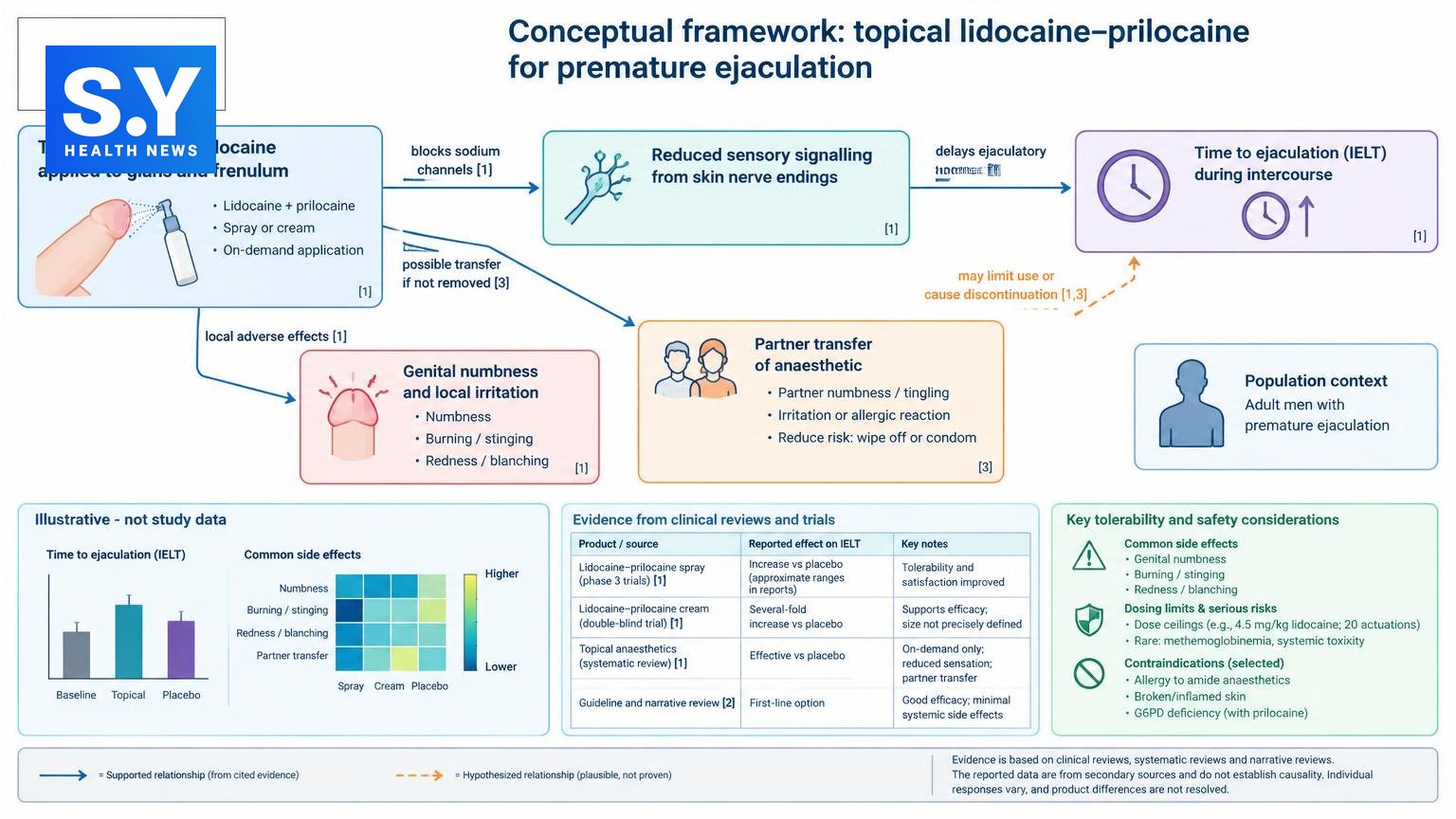
Lidocaine is a local anaesthetic that, applied to the glans and frenulum before intercourse, blocks sodium channels in skin nerve endings. This dampens the sensory signals that trigger the ejaculatory reflex. Prilocaine is added in some formulations; the combination is the one with the most direct regulatory and trial attention. Sensation is reduced rather than eliminated, which is important: the therapeutic aim is to delay the reflex, not to abolish feeling.
The effect is temporary and local. The anaesthetic manages the symptom only while on the skin; it does not change the underlying reflex, and it has no effect on intercourse when not applied. This distinguishes it from daily oral SSRIs, which act centrally and are described as providing control while taken rather than a permanent cure. Descriptions vary on onset and duration—one clinic guide states numbing begins within 2–5 minutes and lasts roughly 15–30 minutes, and phase 3 spray trials applied the product five minutes before intercourse—but these timings are product- and format-dependent.
Many men with PE have heightened sensory signalling, but PE is usually multifactorial. Clinicians describe contributors including sensitivity, anxiety, performance concerns and sometimes an erection problem. A topical treats one contributor and leaves the others untouched; this is why most contemporary guidance places it within a broader plan rather than as monotherapy.
What the Evidence Shows
The most frequently cited trial summary for a dedicated PE product describes phase 3, double-blind, placebo-controlled studies of a metered lidocaine–prilocaine spray applied five minutes before intercourse. Across those studies, average time to ejaculation rose from about 0.6 minutes at baseline to 2.6–3.8 minutes with the spray, versus 0.8–1.1 minutes with placebo. The same summary reports improved control and satisfaction scores. A dedicated lidocaine–prilocaine spray for PE has been approved in the EU since 2013, and another review identifies a eutectic lidocaine–prilocaine spray as an approved medicine for PE.
| Product format / formulation | Reported evidence | Key interpretation |
|---|---|---|
| Metered lidocaine–prilocaine spray, applied 5 minutes before intercourse | Phase 3 placebo-controlled trials summarized in a clinic guide: average time to ejaculation from about 0.6 min at baseline to 2.6–3.8 min vs 0.8–1.1 min on placebo; control and satisfaction improved. | The most directly relevant trial data for a dedicated PE product; absolute times are short and individual variation is reported. |
| Lidocaine–prilocaine cream, applied before sex | One double-blind randomised placebo-controlled trial reported several-fold increases in time to ejaculation versus placebo. | Supports efficacy but the single-trial, qualitative effect size cannot establish a precise average gain. |
| Topical anaesthetics as a class (systematic review) | A 2016 systematic review and meta-analysis supported effectiveness while noting on-demand-only action, reduced sensation and partner transfer as the main complaints. | Class-level support with explicit trade-offs; does not resolve differences between individual products. |
| Narrative review perspective | Topical anaesthetics described as having good efficacy, minimal systemic side effects, and suitability for on-demand use, making them a first-choice option. | Consistent with guideline positioning but the abstract provides no quantitative data and is truncated. |
A 2016 systematic review and meta-analysis reached a concordant conclusion: topical anaesthetics are effective for PE. Importantly, the review also framed the limits—the effect is on-demand only, and reduced sensation and transfer to the partner are the principal complaints. The International Society for Sexual Medicine lists topical anaesthetics as an effective first-line option alongside oral dapoxetine, a position echoed in a review whose abstract describes a eutectic lidocaine–prilocaine spray as an approved PE medicine.[6]
Head-to-head comparisons between spray and cream are not supplied in the available sources, and absolute times vary by study and product. The numbers above should therefore be read as what the cited summaries report, not as a universal expected result. The Fifth International Consultation on Sexual Medicine review, for example, is described only in an abstract that promises evidence-based recommendations but does not provide the specific recommendations or effect sizes in the supplied text.
Tolerability, Partner Transfer and Safety Boundaries
Common side effects are local and usually mild: a brief burning or stinging on application, temporary redness or blanching of the skin (more with lidocaine–prilocaine), and numbness that outlasts the useful window if the dose is too high. Partner tingling or numbness can occur if the product is not removed before sex. Discontinuation is not rare even when time to ejaculation lengthens; some men and couples stop because of genital numbness, loss of spontaneity or the effort involved.
Partner transfer is described as a possible event rather than a theoretical one. If the product reaches the partner's genital mucosa through contact, the partner may experience numbness, burning, irritation or an allergic reaction. Two mitigation strategies appear in the literature and in trial practice: wiping the product off thoroughly before penetration, or using a condom after application. Neither is absolute, and oral contact while the anaesthetic is active should be avoided. If a partner is pregnant or breastfeeding, a clinician should be consulted before use.
Rare but serious risks are associated with heavy overuse. Systemic toxicity can produce dizziness, ringing in the ears and irregular heartbeat. Dose ceilings exist for this reason: about 4.5 mg/kg for the lidocaine jelly, and the 10% spray is capped at 20 actuations in clinical use. Methemoglobinemia, a rare blood-oxygen disorder, is associated mainly with prilocaine, large treated areas or prolonged occlusion. The 10% spray is described as a procedure-strength product for clinical use rather than a self-applied delay product.
Topical anaesthetics are unsuitable for men with allergy to amide anaesthetics or with broken or inflamed genital skin, and prilocaine-containing mixtures are unsuitable for those with G6PD deficiency or congenital methemoglobinemia. Significant heart-rhythm or liver disease should be flagged before use. These are boundaries for clinical assessment, not reasons for self-experimentation, and they explain why a clinician or pharmacist should set format and dose rather than a user titrating by trial and error.
Interpretation and Limitations
Several limitations temper enthusiasm. First, the most specific numerical evidence is drawn from secondary summaries of phase 3 trials rather than from primary trial reports with full sample sizes, confidence intervals and pre-specified analyses. The reported average times are very short in absolute terms—minutes, not tens of minutes—and the ranges indicate meaningful between-study and between-person variation. A statistically clear difference from placebo does not guarantee a clinically satisfying difference for every couple.
Second, the durability of benefit is uncertain. Evidence is stronger for short-term gain in time to ejaculation and limited for long-term outcomes, couple satisfaction and differences between products. The effect is on-demand only, so the underlying pattern can return when the product is not used. Third, the sources do not provide pooled effect sizes for cream versus spray, nor head-to-head trials, so claims that one format is superior would be unsupported.
Fourth, the evidence base is complicated by the product landscape. A narrative review identifies an approved eutectic lidocaine–prilocaine spray but also lists off-label topical formats such as lidocaine–prilocaine cream, Stud-100 spray, Promescent spray and SS cream. Many commercially marketed delay sprays are unregistered, and “herbal” products have unproven effectiveness and uncertain contents. The effectiveness of most herbal products has not been scientifically proven and their safety may be uncertain, which is a separate problem from the regulated medicine evidence summarized above.
Clinical Positioning and Research Outlook
In current guidance, topical anaesthetics are first-line alongside dapoxetine. A topical acts only where applied with few systemic effects, while dapoxetine is an on-demand tablet with its own precautions; a doctor may choose between or combine them based on health history and preference. Behavioural techniques such as stop-start and pelvic-floor training have modest standalone evidence but no drug side effects and can build lasting control; they are often combined with medication. When erectile dysfunction coexists, treating the erection problem first may improve the PE pattern.
Dapoxetine is described as the only licensed medicine specifically for PE in one clinician source, taken on demand 1–3 hours before intercourse with temporary side effects such as nausea and dizziness. Daily off-label SSRIs are effective while taken but the complaint often returns after stopping. These comparisons are not head-to-head trials and should not be read as a ranking. They simply describe the distinct mechanisms and practical profiles that inform shared decision-making.
The research outlook is shaped by what the current evidence cannot answer. The Fifth International Consultation on Sexual Medicine review is intended to present evidence-based recommendations for definition, classification and treatment of PE and delayed ejaculation, but the supplied abstract does not state specific recommendations. Future work would need adequately powered head-to-head trials of formats, longer follow-up including couple-reported outcomes, and clearer data on partner transfer rates under real-world wiping and condom practices.
Key Takeaways
- Topical lidocaine–prilocaine reduces glans sensation by blocking sodium channels in skin nerve endings; it delays ejaculation only while applied and does not change the underlying reflex.
- In phase 3 trials of a metered lidocaine–prilocaine spray applied 5 minutes before intercourse, average time to ejaculation rose from about 0.6 minutes at baseline to 2.6–3.8 minutes, versus 0.8–1.1 minutes on placebo, with improved control and satisfaction scores.
- A single double-blind randomised trial of lidocaine–prilocaine cream reported several-fold increases in time to ejaculation versus placebo; a 2016 systematic review supported the class while flagging reduced sensation and partner transfer.
- Common side effects include brief burning or stinging, redness or blanching, excessive numbness, and partner tingling or numbness; wiping off excess product or using a compatible condom reduces transfer, and dose ceilings exist for safety.
- Evidence is stronger for short-term time gains than for long-term outcomes, couple satisfaction or differences between products, and many marketed unlicensed or “herbal” delay products lack proven effectiveness and safety.
Questions and Answers
How do lidocaine–prilocaine delay sprays and creams work for premature ejaculation?
They are topical anaesthetics applied to the glans and frenulum. Lidocaine blocks sodium channels in skin nerve endings, dampening the sensory signals that trigger the ejaculatory reflex. Sensation is reduced rather than eliminated, and the effect is temporary and local. They manage the symptom only while on the skin and do not change the underlying reflex, so they have no effect when not used.
How much does lidocaine–prilocaine spray increase time to ejaculation in premature ejaculation trials?
In phase 3 trials of a metered lidocaine–prilocaine spray applied 5 minutes before intercourse, average time to ejaculation rose from about 0.6 minutes at baseline to 2.6–3.8 minutes, compared with 0.8–1.1 minutes on placebo. Control and satisfaction scores also improved. These are secondary summaries; individual results vary, absolute times remain short, and the evidence is strongest for short-term rather than long-term benefit.
What is the evidence that topical anaesthetics are a first-line treatment for premature ejaculation?
The International Society for Sexual Medicine lists topical anaesthetics as an effective first-line option alongside oral dapoxetine. A 2016 systematic review and meta-analysis supported their effectiveness, while noting reduced sensation and partner transfer as main complaints. A narrative review also describes topical anaesthetics as a first-choice option with good efficacy and minimal systemic side effects. However, the primary guideline text and full quantitative data are not included in the supplied sources.
Can lidocaine–prilocaine delay products transfer to a partner during sex?
Yes, transfer is possible. If the product reaches the partner's genital mucosa through contact, the partner may experience numbness, burning, irritation or an allergic reaction. Wiping the product off thoroughly before penetration or using a condom after application can reduce the risk, and oral contact while the anaesthetic is active should be avoided. Neither method is guaranteed to eliminate transfer entirely.
What are the safety limits and side effects of topical lidocaine for premature ejaculation?
Common effects include brief burning or stinging on application, temporary redness or blanching, excessive numbness with too-high doses, and partner tingling or numbness if not removed. Heavy overuse carries systemic toxicity risk such as dizziness, tinnitus and irregular heartbeat. Dose ceilings include about 4.5 mg/kg for lidocaine jelly, and the 10% spray is capped at 20 actuations in clinical use. These products are unsuitable for men with amide anaesthetic allergy, broken or inflamed genital skin, or—for prilocaine mixtures—G6PD deficiency or congenital methemoglobinemia.
How do lidocaine–prilocaine delay products compare with dapoxetine for premature ejaculation?
Both are described as first-line options. A topical acts only where applied with few systemic effects, while dapoxetine is an on-demand tablet with its own precautions. A doctor may choose between or combine them based on health history and preference. Dapoxetine is described as the only licensed medicine specifically for PE, but the available sources do not provide head-to-head trials, so no ranking of overall effectiveness can be made.
Conceptual framework: Conceptual framework, not a tested causal model. In men with premature ejaculation, topical lidocaine–prilocaine is proposed to act by reducing sensory signalling from the glans and frenulum, with reported associations between use and longer time to ejaculation in controlled trials. Local numbness and partner transfer are practical moderators of tolerability. Axes and grouped panels are illustrative; no study data are invented.
Academic References & Evidence
- Dr. Sirirat Nakdang (Pong). Lidocaine Numbing & Delay Products in Thailand (2026). Menscape Clinic (clinic medication guide). 2026
- 冯虹; 谭道鹏; 徐瑶青; 成龙. 治疗早泄的表面麻醉剂的研究进展. 现代药物与临床 37(4)
- Zülfü Sertkaya. Delay Sprays and Creams for Premature Ejaculation: How They Work, Side Effects and Risks | Assoc. Prof. Zülfü Sertkaya, MD. zulfusertkaya.com (clinician education article)
- Ahmet Semih Güleser. Medication for Premature Ejaculation | Dapoxetine & SSRIs. semihguleser.com (clinician information page)
- Dr. Sirirat Nakdang (Pong). 泰国的利多卡因 (Lidocaine) 麻醉延时产品(2026) – Menscape Clinic. Menscape Clinic (clinic medication guide). 2026
- Contemporary consensus and emerging directions in premature and delayed ejaculation: recommendations from the 5th International Consultation on Sexual Medicine.. Sexual medicine reviews PMID: 42855438.
SANYUN Science Center explains published research on men's reproductive and sexual health, connecting scientific evidence with everyday questions while making sources and limitations clear.
Disclaimer: This article is for scientific education and research communication only. It does not provide medical advice, diagnosis, or individualized treatment recommendations, and does not endorse any medication, supplement, device, penile enlargement procedure, or other intervention. Decisions about sexual and reproductive health should be made in consultation with a qualified healthcare professional. Do not delay seeking professional care because of information in this article.
Original Content & Copyright Notice
- This article is prepared for SANYUN Science Center, drawing on published research and publicly available academic literature on men’s sexual and reproductive health. Its editorial explanations and presentation are developed for this platform.
- Copyright in the original editorial content, selection, and arrangement is reserved by SANYUN Science Center to the extent protected by applicable law. Referenced research, quotations, and third-party materials remain subject to the rights of their respective owners. This notice does not claim ownership of scientific facts or third-party research.
- Except where permitted by applicable law or an applicable license, prior written permission is required to reproduce, republish, translate, adapt, redistribute, or commercially reuse protected content. Attribution alone does not grant permission for such reuse.
- For permitted quotation or authorized reuse, clearly identify the source and retain a link to the original article.
- Source: SANYUN Science Center
- Original URL: Retain the original article URL on science.san-yun.com.
- Copyright Holder: SANYUN Science Center, for its own protected editorial content.
- Quotation, excerpts, or authorized reuse must not distort the scientific meaning, omit material limitations or disclaimers, or imply unverified medical claims, product efficacy, or endorsement by SANYUN Science Center.



