




Category: Clinical Insights
Core Research Direction: Whether total sperm count (concentration × ejaculate volume) rather than per-milliliter concentration alone should anchor the interpretation of semen analysis when hypospermia coexists with normal density, and how this reclassification changes clinical reasoning
Search Intent: If a man's sperm concentration looks normal but his ejaculate volume is low, does his total sperm count still fall into an oligozoospermic range, and why would that matter for diagnosis and treatment planning?
Platform: SANYUN Science Center
Evidence reviewed through: 2026-11-20
Executive Summary
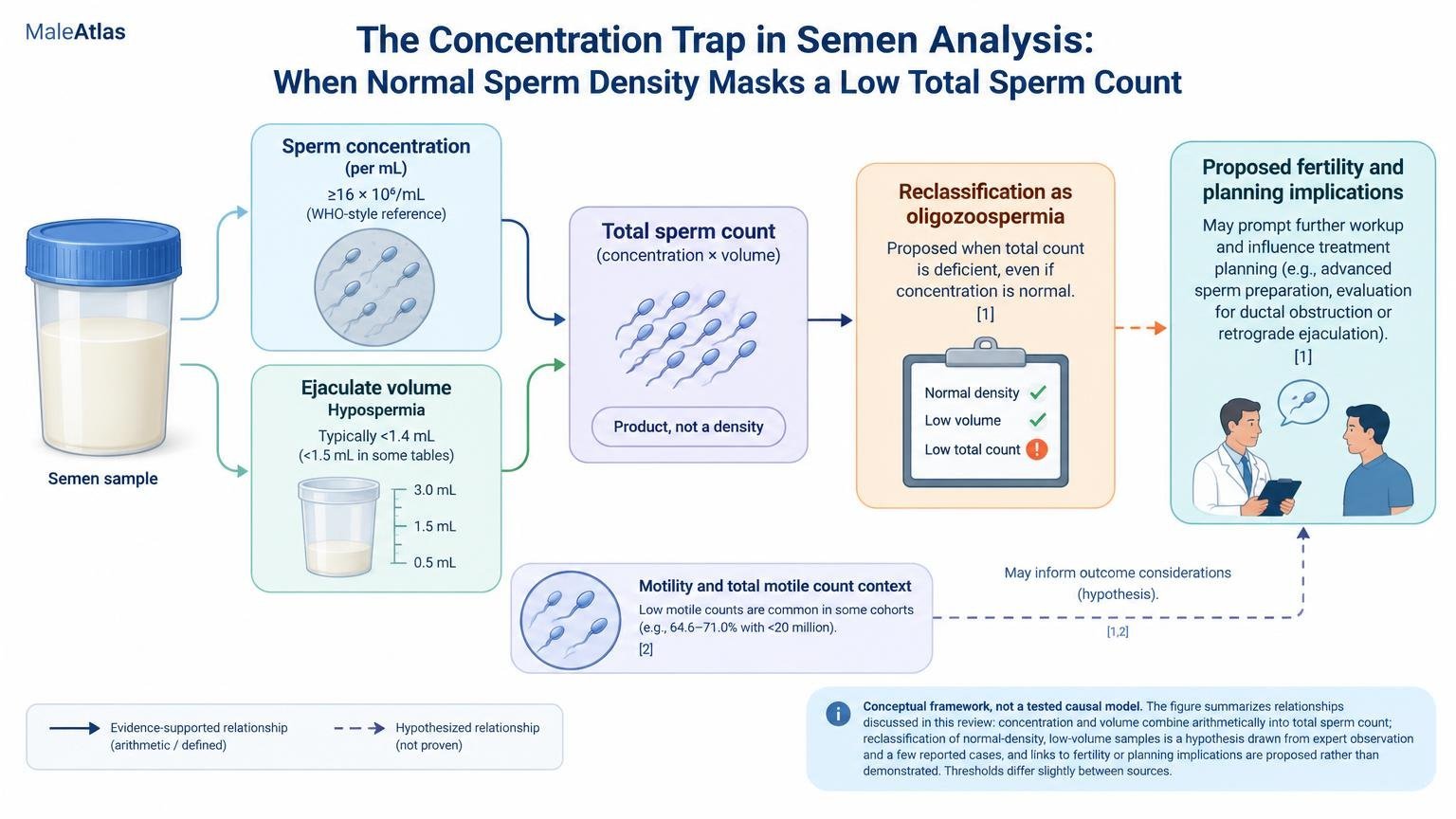
Semen analysis is usually reported as a panel, but in everyday reading the per-milliliter sperm concentration tends to dominate attention. An andrologist writing in a fertility-news commentary argues that this habit creates a "concentration trap": a sample can show a density inside the reference range while the total number of spermatozoa delivered in the ejaculate is low, because the ejaculate volume is unusually small.[1]
The arithmetic is simple and is not itself a research finding. Total sperm count in a single ejaculate is described as sperm concentration multiplied by total ejaculate volume. Hypospermia is described as an abnormally low ejaculate volume, typically less than 1.4 mL in the commentary's account, although another data table in this packet uses a <1.5 mL threshold for the same label.[2]
The clinical claim built on that arithmetic — that a normal-density, low-volume sample should be reclassified as oligozoospermic because the total count is deficient — is asserted from routine laboratory observation and a small number of described patient cases, not from a comparative study. A separate cohort table shows that low volume and low total motile sperm counts are common in a young post-diagnosis population, but the supplied text does not report a total sperm count variable or test whether reclassification changes outcomes.
Read cautiously, the argument is a useful prompt to calculate and report total count rather than to anchor a verdict on density alone. It is not, on this evidence, proof that total count is a superior predictor of conception or that reclassification should drive treatment decisions.
Why This Matters
For a man receiving results, the phrase "normal sperm concentration" can sound like a clean bill of health for the sperm-producing pathway. If the same report shows a small ejaculate volume, that reassurance may be incomplete: the absolute number of sperm available to reach the cervix, survive, and be recovered for intrauterine insemination or in vitro fertilization preparation is a product, not a density. A density figure describes how crowded the sample is per milliliter; it does not describe how much sample there was.
The stakes the commentary raises are diagnostic and logistical rather than a promise of treatment benefit. The author proposes that overlooking a total-count deficit could lead clinicians to underestimate the need for advanced sperm preparation, or to under-investigate causes such as partial ductal obstruction or retrograde ejaculation. That is a plausible clinical hypothesis, but the supplied text presents no outcome data showing that reclassification changes pregnancy rates, live birth, or treatment selection.
There is also a patient-education problem. One consumer-facing account frames low volume as usually accompanied by low concentration, then concedes that concentration may remain normal and that natural pregnancy would be possible if motility and morphology are unaffected. Those two statements sit awkwardly together: the first implies low volume usually drags density down, the second treats normal density plus low volume as compatible with spontaneous conception. Neither is supported by cited data in the supplied text.[3]
Definitions: Concentration, Volume, Total Count and Hypospermia
Sperm concentration is the number of spermatozoa per milliliter of ejaculate. The commentary attributes to World Health Organization laboratory manual frameworks, cited second-hand to Cooper and colleagues, a lower reference limit of ≥16 × 10⁶ spermatozoa per mL. Total sperm count, by contrast, is the absolute number in the whole ejaculate, obtained by multiplying concentration by volume. Hypospermia is described as abnormally low ejaculate volume, typically below 1.4 mL.
Thresholds in this area are not perfectly uniform across documents. The cohort table in this packet labels volumes below 1.5 mL as hypospermia, whereas the commentary says typically less than 1.4 mL. It also uses a normozoospermia threshold of ≥15 million/mL, while the commentary quotes ≥16 × 10⁶/mL. These small differences matter for counting how many men fall on which side of a line, and they illustrate why a single number should not be treated as a verdict.
| Measure or label | Definition as supplied | Threshold or value reported | Interpretive note |
|---|---|---|---|
| Sperm concentration | Spermatozoa per milliliter of ejaculate | Lower reference limit ≥16 × 10⁶/mL in the commentary; normozoospermia ≥15 million/mL in the cohort table | Density alone does not describe how much ejaculate was produced |
| Total sperm count | Concentration multiplied by total ejaculate volume | No numeric threshold given in the supplied text | Arithmetic definition; the commentary does not present measured counts |
| Hypospermia | Abnormally low ejaculate volume | Typically <1.4 mL in the commentary; <1.5 mL in the cohort table | Threshold definitions differ slightly between documents |
| Total motile sperm count | Motile sperm count in the whole sample | Median 7.8 million at diagnosis and 12.3 million at 2 years in one cohort; low (<20 million) in 64.6% and 71.0% | Measured outcome in a young cohort, not a test of the reclassification claim |
| Oligozoospermia | Low sperm count category | 5–15 million/mL in one table row; described as a reclassification consequence when total count is deficient | Category boundaries in the supplied table are inconsistent and unexplained |
The Biological and Mathematical Basis
The mechanism behind the concentration trap is not a cellular pathway but a dilution and delivery problem. Seminal fluid volume is contributed largely by the accessory glands, and the spermatozoa are suspended within it. If the glands produce less fluid while the testes continue to output a similar number of sperm, the same cells are packed into a smaller volume — density rises. If output and volume both fall, density may remain unremarkable while the absolute number drops. The commentary's framing captures the second scenario: a sample that looks adequately dense per milliliter but delivers few gametes in total.
This is why the product matters for anything that depends on absolute gamete availability. The commentary argues that a severely reduced volume multiplied by an acceptable concentration can yield a total count below the lower reference limit, leaving an insufficient absolute number of sperm for the reproductive tract or a laboratory preparation vial. That reasoning is arithmetically coherent; whether the resulting total falls below a limit depends on the specific concentration, volume and the reference limit applied, none of which the commentary quantifies in the supplied text.
Two further qualifications belong here. First, low volume can have its own causes — the commentary names partial ductal obstruction and retrograde ejaculation as possibilities worth investigating — so a low-volume sample is not merely a mathematical inconvenience. Second, the arithmetic assumes the concentration measurement and the volume measurement are accurate and come from the same properly collected sample; short abstinence, spillage or collection error can distort both.
What the Evidence Shows — and Does Not
The core evidence for the concentration trap is an expert commentary. Its author, an andrologist and medical laboratory technologist, describes observing the pattern in routine andrology work at a single fertility center and reports that in several patient cases an apparently normal density nonetheless warranted a clinical classification of oligozoospermia because total count was deficient. The number of cases, the selection process, the measured values and any verification are not described. This is anecdotal observation, useful for generating a hypothesis and for teaching the arithmetic, but not for estimating how often the pattern occurs or what it means for outcomes.
The commentary's stronger claims are predictive and consequential. It asserts that total count is a far more reliable and critical predictor of clinical success in natural conception, intrauterine insemination and in vitro fertilization than concentration alone, and that overlooking a total-count deficit can misguide treatment planning. Neither claim is accompanied in the supplied text by comparative data, effect sizes, outcome rates or follow-up. They should be treated as hypotheses with clinical plausibility, not as established comparative evidence.
The cohort table offers a different kind of evidence: descriptive semen data from a young population, with 48 samples at diagnosis and 31 at two years post-diagnosis. Median semen volume was 1.4 mL (IQR 0.6–2.0) at diagnosis and 1.9 mL (IQR 1.3–3.4) at follow-up. Hypospermia, defined there as <1.5 mL, was present in 26 of 48 samples (54.2%) at diagnosis and 9 of 31 (29.0%) at two years.
In the same table, median sperm concentration was 17.0 million/mL (IQR 2.9–38.9) at diagnosis and 13.0 million/mL (IQR 2.2–35.7) at follow-up, and 25 of 48 samples (52.1%) were normozoospermic at diagnosis versus 15 of 31 (48.4%) at follow-up. Total motile sperm count was low (<20 million) in 31 of 48 (64.6%) at diagnosis and 22 of 31 (71.0%) at two years, with medians of 7.8 million and 12.3 million respectively.
This table is informative about the coexistence of low volume and low motile counts in one young cohort, but it does not test the concentration trap. It reports no total sperm count variable, no comparison between normal-density low-volume samples and other samples, and no reproductive outcomes. It also uses overlapping category boundaries that the supplied text does not explain, so the proportions should not be over-read. The table is best treated as context showing that volume and absolute-count deficits are common enough to deserve routine reporting, not as confirmation of the reclassification argument.
One consumer-education source adds a contrasting view. It states that hypospermia is usually accompanied by oligozoospermia, reasoning that less ejaculate lowers concentration, but then allows that concentration may be normal despite lower volume and that natural pregnancy would be possible if motility and morphology are unaffected. Both statements are presented without cited data, population or pregnancy rates, so they illustrate the range of lay framing rather than resolve the question.
Interpretation and Limitations
The most defensible reading is procedural. When a report shows normal concentration alongside low volume, the total count should be calculated and reported explicitly rather than left implicit, and the volume finding should be interpreted as a finding in its own right. This is arithmetic and good laboratory practice; it does not require accepting the stronger claim that total count outperforms concentration as a predictor of conception.
Several limitations constrain how far the reclassification argument can be pushed. The evidence base is a commentary and an educational page, not a study with a comparison group; the patient cases described are few, from one center and unverified in the supplied text; the key predictive claim is asserted rather than demonstrated; and the reference thresholds differ between documents. The cohort table is descriptive, with unequal sample sizes at the two time points, no tests of significance in the supplied text, and no total count variable.
There is also a conceptual caution. Reclassifying a normal-density, low-volume sample as oligozoospermic could be clinically sensible if total count is the operative limiting factor, but it could also obscure the distinct cause of the low volume. A label that names only the count may direct attention away from the ductal, ejaculatory or collection issues that a low-volume finding raises. Reclassification is therefore best understood as a communication and reasoning aid, not a diagnosis in itself.
Finally, the natural-conception statement in the consumer page should not be read as reassurance that low-volume, normal-density samples carry no fertility implications. It is conditional and unsupported by outcome data. Conversely, the commentary's assertion that such samples are undertreated should not be read as proof that more intervention improves results. The honest position is that the direction of clinical significance is plausible but unquantified.
Research Outlook
The questions worth answering are specific. How often does a normal-density sample fall below an accepted total-count limit purely because of low volume, and does that frequency vary with the cause of hypospermia? Do total-count-defined categories predict intrauterine insemination or in vitro fertilization outcomes better than density-defined categories after adjustment for motility, morphology and female factors? Does flagging the total-count deficit change which investigations or preparation techniques are chosen, and does that change matter to patients?
The cohort data in this packet point to a related descriptive question: whether volume and absolute-count deficits track over time in young populations and which clinical features predict persistence. The supplied table shows that low total motile sperm count was already common at diagnosis and remained so at two years, with unequal denominators, but it does not report the statistical comparison. Prospective cohorts with paired samples and reported total sperm count would be needed to address either question properly.
Key Takeaways
- Total sperm count is concentration multiplied by ejaculate volume; density alone does not describe how many spermatozoa were delivered in the sample.
- Hypospermia is described as abnormally low ejaculate volume, typically below 1.4 mL in the commentary, while a cohort table in this packet uses <1.5 mL.
- The claim that a normal-density, low-volume sample should be reclassified as oligozoospermic rests on expert observation and a few described cases, not on comparative outcome data.
- In one young cohort, hypospermia affected 26 of 48 samples at diagnosis and 9 of 31 at follow-up, and low total motile sperm count affected 31 of 48 and 22 of 31, but total sperm count was not analyzed.
- A reasonable practical response is to calculate and report total count explicitly when volume is low, and to investigate the low volume on its own terms, without treating reclassification as proven to improve outcomes.
Questions and Answers
What is the difference between sperm concentration and total sperm count in a semen analysis?
Sperm concentration is the number of spermatozoa per milliliter, whereas total sperm count is the absolute number in the whole ejaculate, described as concentration multiplied by total ejaculate volume. A sample can therefore be dense per milliliter while containing relatively few spermatozoa overall if the volume is small. Concentration alone does not describe how many gametes were delivered.
Can a man have normal sperm concentration but a low total sperm count because of hypospermia?
Arithmetically, yes. If concentration is acceptable but ejaculate volume is abnormally low, the product can fall below a total-count reference limit. An andrologist commentator reports seeing this pattern in several cases and describes it as the concentration trap. However, the supplied text provides no measured counts or frequency data, so this remains an illustrative claim rather than a quantified finding.
How strong is the evidence that total sperm count should replace concentration in clinical interpretation?
Weak in this packet. The supporting material is an expert commentary and an educational web page, with no comparative study, effect sizes or outcome rates. The claim that total count is a far more reliable predictor of natural conception, intrauterine insemination and IVF success is asserted rather than demonstrated. It is a plausible hypothesis that deserves testing, not established comparative evidence.
How common are low semen volume and low total motile sperm count in the cohort data described here?
In one table, hypospermia (<1.5 mL) was present in 26 of 48 samples (54.2%) at diagnosis and 9 of 31 (29.0%) at two years post-diagnosis. Low total motile sperm count (<20 million) was recorded in 31 of 48 (64.6%) and 22 of 31 (71.0%). The denominators differ between time points, and the supplied table reports no significance testing or total sperm count analysis.
What are the limitations of the concentration trap argument and its risks for patients?
The argument rests on anecdotal case observation, a single center and an unquantified predictive claim. Thresholds for hypospermia and normal concentration differ slightly between documents, and no data show that reclassification improves pregnancy or treatment outcomes. A related risk is that a count-based label may distract from investigating why the volume is low, including ductal obstruction or retrograde ejaculation.
What should a man or clinician do when sperm concentration looks normal but the ejaculate volume is low?
A practical approach is to have the total sperm count calculated and reported explicitly, to confirm sample collection and abstinence conditions, and to evaluate the low volume as its own finding rather than assuming the report is reassuring. Any decisions about further investigation or assisted reproduction belong with a qualified clinician; this evidence base does not show that reclassification alone changes outcomes.
Conceptual framework: Conceptual framework, not a tested causal model. The figure summarizes relationships discussed in this review: concentration and volume combine arithmetically into total sperm count; reclassification of normal-density, low-volume samples is a hypothesis drawn from expert observation and a few reported cases, and links to fertility or planning implications are proposed rather than demonstrated. Thresholds differ slightly between sources.
Academic References & Evidence
- Alzubair Ahmed. The Concentration Trap In Semen Analysis: Why Total Sperm Count Defines The Real Diagnosis • Fertility News.
- Table 2..
- Hypospermia associated with oligozoospermia.
SANYUN Science Center explains published research on men's reproductive and sexual health, connecting scientific evidence with everyday questions while making sources and limitations clear.
Disclaimer: This article is for scientific education and research communication only. It does not provide medical advice, diagnosis, or individualized treatment recommendations, and does not endorse any medication, supplement, device, penile enlargement procedure, or other intervention. Decisions about sexual and reproductive health should be made in consultation with a qualified healthcare professional. Do not delay seeking professional care because of information in this article.
Original Content & Copyright Notice
- This article is prepared for SANYUN Science Center, drawing on published research and publicly available academic literature on men’s sexual and reproductive health. Its editorial explanations and presentation are developed for this platform.
- Copyright in the original editorial content, selection, and arrangement is reserved by SANYUN Science Center to the extent protected by applicable law. Referenced research, quotations, and third-party materials remain subject to the rights of their respective owners. This notice does not claim ownership of scientific facts or third-party research.
- Except where permitted by applicable law or an applicable license, prior written permission is required to reproduce, republish, translate, adapt, redistribute, or commercially reuse protected content. Attribution alone does not grant permission for such reuse.
- For permitted quotation or authorized reuse, clearly identify the source and retain a link to the original article.
- Source: SANYUN Science Center
- Original URL: Retain the original article URL on science.san-yun.com.
- Copyright Holder: SANYUN Science Center, for its own protected editorial content.
- Quotation, excerpts, or authorized reuse must not distort the scientific meaning, omit material limitations or disclaimers, or imply unverified medical claims, product efficacy, or endorsement by SANYUN Science Center.



