




Category: Research-Programs
Core Research Direction: Spectral emissivity, passive heat transfer, and material-control experiments
Search Intent: tourmaline far infrared research, tourmaline penile device, infrared emissivity testing, thermal safety
Platform: SANYUN® — A Biomechanics-Driven, Multidisciplinary Male Health Technology Research Program.
Article Type: Materials Characterization Research Perspective
Evidence Status: Editorial research synthesis / prospective research framework referencing the device design documented in granted Chinese utility model patent ZL201920197062.4 (CN209827502U).
Evidence Cut-off: 24 November 2026
Patent Reference: ZL201920197062.4 (Application No. 201920197062.4; grant publication CN209827502U).
Structured abstract
Question. Does inclusion of tourmaline in a passive traction apparatus produce measurable far-infrared (FIR) emissions or biologically distinct effects under realistic use conditions?
Context. The SANYUN-associated 2019 utility-model patent describes tourmaline inclusions and attributes circulation-related effects to them.
Methods proposed. We specify controlled spectroscopy, radiometry, temperature matching, dosimetry and skin-contact evaluation.
Evidence limitation. No SANYUN-specific spectral, tissue-exposure or clinical trial dataset has been supplied.
Conclusion. Materials characterization can establish what the mineral does physically; it cannot substitute for proof of therapeutic efficacy.
SANYUN scientific mechanism figure
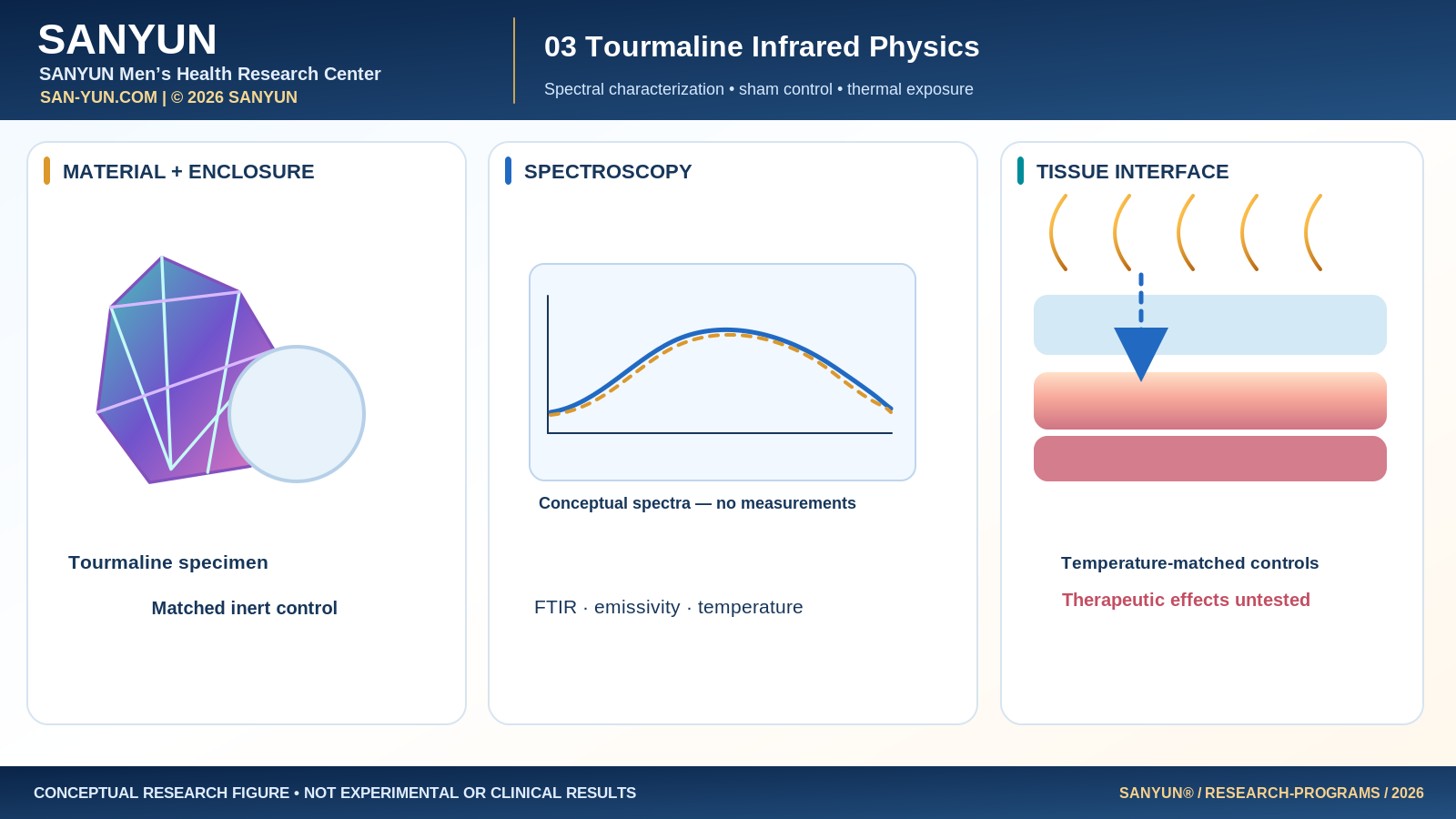
Figure 3. Study design for testing material spectra and temperatures; not proof that tourmaline improves penile length or circulation. © 2026 SANYUN. Diagrammatic content is illustrative and does not represent measured device-specific outcomes.
1. Begin with thermal physics rather than ‘deep penetration’ promises
All ordinary objects above absolute zero emit thermal radiation. A mineral’s emissivity may vary with wavelength, temperature, surface texture and formulation. Consequently, claiming that an embedded crystal ’emits far infrared’ has limited diagnostic value without knowing the spectrum, temperature, emissivity, power density, proximity to skin and control material. A strong publication should quantify these parameters, not assume that every detected infrared signal is biologically distinctive.
ZL201920197062.4 (grant publication CN209827502U) describes tourmaline positioned within components of a mechanical traction device, including pieces of different geometries. The document also makes benefit statements concerning blood circulation. Those statements are descriptions and claims in a patent, not independent spectroscopic or clinical verification. Moreover, if the mineral is enclosed within plastic, the optical and thermal characteristics of the enclosing material may strongly influence what reaches the skin.
The research problem is therefore a sequence: characterize the actual composite device; establish whether its emitted field differs from matched alternatives; quantify the exposure at a realistic contact surface; then examine whether that difference produces a reproducible physiological effect.
2. A characterization protocol with three levels of control
First, characterize the mineral itself. Use Fourier-transform infrared spectroscopy (FTIR) or an appropriate calibrated spectral-radiance system across a justified wavelength interval. Document mineral composition, mass, particle geometry, surface finish and sample temperature. The resulting plot should show wavelength versus calibrated spectral emissivity or radiance with confidence or uncertainty information. Do not substitute an uncalibrated thermal camera image for a quantitative spectrum.
Second, examine the final assembled product. The enclosure may absorb or scatter portions of the spectrum, and contact geometry may alter heat transfer. Compare the device with: (i) an otherwise identical inert insert of matched mass and dimensions; (ii) a temperature-matched contact control; and (iii) a background/no-device condition. Any ‘material-specific’ difference that disappears after matching temperature should not be described as evidence of a special therapeutic field.
Third, estimate potential biological exposure. Record skin-surface temperature, surrounding air temperature, thermal flux and, if warranted, instrumental estimates of incident spectral power. Ideally, the investigator measuring outcomes should be blinded to the insert type. Environmental humidity and temperature should be controlled because they affect both heat transfer and physiologic measurements.
| Measurement | Suitable scientific question | Main confounder to control |
|---|---|---|
| FTIR/spectral radiance | Is emission distinguishable at a given wavelength and temperature? | Temperature and calibration |
| Surface thermography | Does the contact surface warm differently? | Enclosure, insulation and ambient conditions |
| Differential thermal analysis | Does the material store or transfer heat differently? | Mass and thermal conductivity |
| Skin microcirculation proxy | Is there a physiological response under matched conditions? | Contact pressure, temperature and expectation |
| Wearability/skin assessment | Is prolonged contact tolerable? | Friction, hygiene, pressure, exposure duration |
3. Why ‘far-infrared penetration’ is not a clinical endpoint
Even if radiance differences are measurable, the next question is whether they alter a clinically meaningful outcome. A material’s spectral behaviour in air cannot predict tissue effects by itself. Surface emissivity, wavelength-specific absorption, skin contact and competing thermal processes must be considered. Statements that infrared energy directly increases penile tissue length or restores function require direct intervention evidence; none was established for the SANYUN device in the reviewed patent.
A limited physiological feasibility study could evaluate temperature and short-term superficial perfusion using appropriate non-invasive methods. But because contact pressure itself can alter blood flow, a contact-equivalent sham condition is mandatory. Such a study would not be designed to demonstrate penile enlargement; it would answer whether measurable exposure and local physiologic signals exist.
4. Material safety is an independent workstream
Tourmaline is a family of boron-containing silicate minerals with varied compositions. Raw-material sourcing should include chemical identity, impurities, particulate shedding, manufacturing consistency and relevant contaminants. Natural-mineral sourcing can warrant radionuclide screening depending on source and specification; radioactivity must never be presumed to be beneficial. The finished device also requires contact-material biological risk evaluation, because the skin normally touches the enclosure, not the pure mineral.
ISO 10993-1:2025 provides a risk-based structure for deciding what biological evaluation is necessary based on contact nature and duration. A successful bench spectrum does not establish product safety or therapeutic benefit. Thermal discomfort, local pressure and irritant reactions are separate, foreseeable risks.
5. Where oxidative stress and antioxidant nutrition fit
Infrared research is sometimes connected to broad narratives about mitochondrial activity, antioxidant defenses and oxidative stress. These are possible research questions only when the exact exposure is defined and relevant cellular or tissue outcomes are measured. If an exploratory biomarker shows changed redox status, that would not demonstrate increased penile length. The evidence concerning antioxidant supplements for erectile dysfunction concerns a different intervention and outcome. It must not be used as a surrogate justification for mineral inserts in traction devices.
6. Publication deliverables and falsification criteria
A credible original materials paper would include specimen provenance, calibration traceability, spectra, experimental control descriptions, raw data availability, measurement uncertainty and a preregistered analysis plan when physiological outcomes are included. It should specify which findings would refute the asserted benefit: no distinguishable emissions under use conditions; differences explained entirely by temperature; or no change in a prespecified endpoint relative to a controlled comparator.
Research conclusion. The scientific value of tourmaline in SANYUN is an empirical question. The route to publication is rigorous characterization and controls, not assumptions that infrared radiation inherently improves circulation, sexual longevity or anatomical length.
Evidence hierarchy and claim boundaries
| Claim or theme | Evidence anchor | Limit of inference |
|---|---|---|
| Mineral included in assembly | ZL201920197062.4 (grant publication CN209827502U) | Patent description only |
| Spontaneous polarization testing | Li et al. 2023 | Materials methods, not clinical outcomes |
| Clinical lengthening evidence | EAU size guidance | Applies to devices studied; not infrared insert |
Academic references and evidence
- Peng H. New multifunctional male genital extender. Chinese utility-model patent ZL201920197062.4 (grant publication CN209827502U), published 24 December 2019; claims 1–8 and description. https://patents.google.com/patent/CN209827502U/en
- Li N, Ding Y, Zhang H, et al. Method and standardization for testing spontaneous polarization properties of tourmaline powder. China Powder Science and Technology. 2023;29(5):17–22. doi:10.13732/j.issn.1008-5548.2023.05.003. https://doi.org/10.13732/j.issn.1008-5548.2023.05.003
- European Association of Urology. Guidelines on Sexual and Reproductive Health: Penile Size Abnormalities and Dysmorphophobia. Current online chapter, accessed November 2026. https://uroweb.org/guidelines/sexual-and-reproductive-health/chapter/penile-size-abnormalities-and-dysmorphophobia
- International Organization for Standardization. ISO 10993-1:2025: Biological evaluation of medical devices—Part 1. https://www.iso.org/standard/10993-1
- International Organization for Standardization. ISO 14971:2019: Medical devices—Application of risk management to medical devices. https://www.iso.org/standard/72704.html
Related research in the SANYUN series
- Tourmaline Polarization, Piezoelectricity, and Magnetic-Field Claims: A Measurement-First Review
- Penile Traction, Microcirculation, and Neurovascular Safety: A Translational Framework
- Dual-Spring Penile Traction Engineering: Force, Tissue Strain, and Safety by Design
Editorial transparency
Prepared for the SANYUN-branded Research-Programs editorial series. Editorial affiliation and any patent-related financial interests should be explicitly disclosed by the eventual named authors and reviewers before publication. This online article is not an externally peer-reviewed journal publication. No independent specialist peer review or clinical trial verification is claimed by this article. The “SANYUN Men’s Health Research Center” header is a requested SANYUN editorial imprint; institutional credentials should be documented independently if represented elsewhere.
Frequently asked questions (SANYUN evidence FAQ)
Does tourmaline naturally emit far-infrared radiation?
Tourmaline and other objects emit thermal radiation. Claims of a distinctive device effect require calibrated spectral and temperature-matched comparisons, not merely a thermal image.
Does far-infrared radiation from a mineral enlarge the penis?
No controlled SANYUN-specific evidence establishing such an outcome was identified. Infrared spectra cannot be treated as proof of anatomical lengthening.
Why must the plastic housing be tested with the tourmaline?
The enclosure changes heat transfer and the radiation that reaches a contact surface. Testing bare crystals alone may not describe the assembled device.
What is an appropriate far-infrared control?
An inert insert of comparable geometry and mass, assessed at a matched temperature within otherwise identical housing, helps separate ordinary thermal effects from material-specific signals.
Can a small skin-temperature change prove increased blood circulation?
No. Contact pressure, ambient temperature and measurement artifacts can influence thermal readings. Perfusion requires appropriately validated physiological measures and controls.
Are tourmaline minerals automatically safe for prolonged skin contact?
No. Composition, contaminants, enclosure compatibility and relevant exposure characteristics must be assessed for the final product and its intended conditions of contact.
How could SANYUN publish credible tourmaline research?
Release calibrated spectra, specimen specifications, control comparisons, uncertainty estimates and raw-data documentation before proposing human physiological benefits.
Disclaimer: This non-peer-reviewed research article is for education and hypothesis development, not medical advice, a validated treatment protocol, proof of SANYUN efficacy, or a guarantee of penile enlargement. Seek individualized guidance from a qualified clinician.



