




Category: Premature Ejaculation
Core Research Direction: Turkish validation of the five-item Premature Ejaculation Diagnostic Tool (PEDT) and its association with intravaginal ejaculatory latency time (IELT) in men with and without self-reported PE
Search Intent: Does a validated five-item PEDT screen for premature ejaculation in Turkish men, and how well does it correlate with measured intravaginal ejaculatory latency time?
Platform: SANYUN Science Center
Evidence reviewed through: 2026-11-08
Executive Summary
Premature ejaculation is a common ejaculatory disorder with meaningful effects on quality of life and relationships, and clinicians have long needed a structured, practical way to apply diagnostic criteria beyond a single latency measurement. A Turkish diagnostic validation study tested a translated version of the Premature Ejaculation Diagnostic Tool (PEDT), a questionnaire developed to operationalize DSM-IV criteria for PE, and examined how its scores related to self-measured intravaginal ejaculatory latency time (IELT).[1][2]
The study enrolled 94 men with a self-reported complaint of PE and 88 men without PE who completed a Turkish translation of the nine-item PEDT. Factor analysis supported a five-item combination drawn from the original tool, which explained 74.4% of the variance. That five-item set showed a Cronbach's alpha of 0.77, indicating adequate internal consistency, and test-retest correlations above 0.80 per item with a total-score correlation of 0.90.
Critically, the correlation between PEDT score and IELT was ρ=0.44, described by the authors as adequate. That is a moderate association, not a replacement for latency measurement in every context, and it rested on IELT data from only 35 patients. The authors concluded the five-item Turkish PEDT is a reliable screening questionnaire and suggested it may be more practical than measuring IELT in their population.
Why This Matters
Diagnosing PE has historically depended on clinical interview, sometimes supplemented by stopwatch-measured IELT, a metric that is burdensome outside research and difficult to standardize in routine care. A short, validated questionnaire that maps onto recognized diagnostic criteria could make case-finding more consistent in busy clinics, support documentation of symptom severity, and offer a structured way to track change over time.
The Turkish validation matters because screening instruments do not automatically travel across languages and cultures. Translating items about control, distress and timing requires that the underlying constructs remain intelligible and that the psychometric structure holds in the new population. This study is one of the steps needed before such a tool can be used with confidence in Turkish-speaking men.
The Instrument and the Biological Anchor
The PEDT was designed as a systematic application of DSM-IV criteria for PE, capturing elements such as perceived lack of control, short latency, and distress or interpersonal difficulty rather than relying on a single number. In this Turkish study, participants completed a nine-item translated version, and psychometric analysis identified a five-item subset (questions 1, 2, 3, 4 and 8) that performed best.
IELT serves as the closest thing to an objective biological anchor for ejaculatory timing: the interval between vaginal penetration and ejaculation. It is continuous, quantifiable and clinically recognizable, but it is also influenced by situational factors, measurement practice and self-report. In the PE group with available data, geometric mean IELT was reported as 59.7±46.2 seconds (range 6.5–197.7 s), and most of those men reported latencies under one minute.
A useful screening questionnaire should not merely classify men; it should track something real about the underlying condition. If PEDT scores correlate with measured latency, that supports the instrument's construct validity as a proxy for ejaculatory timing, while the imperfect size of that correlation signals that the questionnaire captures additional dimensions, such as distress and perceived control.
What the Evidence Shows
The design was a cross-sectional diagnostic validation with a test-retest component. Ninety-four men with a self-reported PE complaint and 88 men without PE were enrolled and completed the translated nine-item PEDT; participants were asked to return for a second visit to assess retest reliability, and retest data were collected from 78 men in the PE group and 69 in the control group.
Within the PE group, 24 men (68.5%) reported lifelong PE and 11 (31.5%) reported acquired PE. The mean ages were 39.4±9.7 years (range 24–65) in the PE group and 30.1±5.7 years (range 20–56) in the control group; the paper reports a P value of 0.068 for this comparison. The control group was therefore noticeably younger, a point relevant to interpretation and discussed below.
The factor analysis supported the five-item combination, which explained 74.4% of the variance, with no alternative combination explaining more. Internal consistency for that five-item set was Cronbach's alpha 0.77, and the overall alpha did not improve by deleting any further item. Test-retest coefficients exceeded 0.80 for each item, and the total-score correlation was 0.90, indicating that scores were stable across repeat administration in those who returned.
The central construct-validity finding was the correlation of ρ=0.44 between PEDT score and IELT. IELT data were recorded for only 35 patients, and the geometric mean for the PE group was 59.7±46.2 seconds. Among those with IELT data, 20 men (57.1%) reported under one minute, 11 (31.5%) reported between one and under two minutes, and 4 (11.4%) reported more than two minutes.
| Variable | Reported result | Interpretation |
|---|---|---|
| Enrollment | 94 men with self-reported PE; 88 men without PE | Moderate single-center sample; comparison group is not a general-population sample |
| Age | PE group 39.4±9.7 years; control 30.1±5.7 years (P=0.068 reported) | Substantial age difference between groups complicates direct comparison |
| PE subtype | 24 lifelong (68.5%); 11 acquired (31.5%) | Most PE-group responders reported lifelong PE; small counts |
| Factor structure | Five items (1, 2, 3, 4, 8) explained 74.4% of variance | Supports a shortened five-item version in this sample |
| Internal consistency | Cronbach's alpha 0.77 | Adequate but not high; one-sample estimate |
| Test-retest reliability | Item coefficients >0.80; total score 0.90 | Stable scores among the 78 PE and 69 control men retested |
| PEDT–IELT association | ρ=0.44 | Moderate correlation; IELT available for 35 patients only |
| IELT distribution (PE group) | 20 (57.1%) <1 min; 11 (31.5%) 1–<2 min; 4 (11.4%) >2 min | Self-measured latency skewed toward very short times |
Interpretation and Limitations
The psychometric results are internally coherent: a five-item factor with acceptable internal consistency and strong temporal stability is a plausible brief screening instrument, and a moderate correlation with IELT supports the idea that PEDT scores carry meaningful information about ejaculatory timing. The authors' conclusion that the five-item Turkish PEDT is reliable for screening Turkish patients is consistent with these data.
Several limitations temper that conclusion. The sample came from a single center, and the control group was considerably younger than the PE group, so age-related differences in sexual function cannot be easily separated from group differences in ejaculatory complaints. The reported P value for the age comparison is difficult to reconcile with the presented group statistics, which is a reason for caution in interpreting that specific comparison rather than a reason to dismiss the overall findings.
The correlation between PEDT and IELT is moderate rather than strong, and it was derived from a small IELT subsample of 35 patients using self-measured latency rather than stopwatch measurement in a controlled setting. A ρ=0.44 value means the questionnaire and measured latency share only part of their variance; they are related but not interchangeable. Treating the PEDT as a stand-in for IELT in research or clinical decision-making would overstate what the data show.
The suggestion that the PEDT is more applicable than measuring IELT in this population is a reasonable practical inference from the burden of latency measurement, but it was not directly tested as a comparative outcome in the study. Similarly, the claim that the PEDT may help measure treatment response is a hypothesis that requires longitudinal treatment studies, not something established by a cross-sectional validation. The tool is a screening aid, not a diagnostic substitute for clinical assessment.
Research Outlook
The natural next steps are independent replication in larger and more diverse Turkish samples, confirmation of the five-item structure with confirmatory factor analysis, and formal evaluation of sensitivity and specificity against a clinician-administered reference standard. Studies that include stopwatch-measured IELT in a larger proportion of participants would clarify how much of the PEDT signal is timing and how much reflects distress and perceived control.
Treatment-response research is also needed: a tool can be reliable without being responsive, and demonstrating that PEDT scores change meaningfully when ejaculatory latency improves would support its use in follow-up. Broader consensus guidance continues to emphasize careful definition, classification and evaluation of ejaculatory disorders, and brief validated instruments fit naturally into that clinical framework if their limits are respected.
Key Takeaways
- A Turkish five-item version of the PEDT, derived from the nine-item tool, explained 74.4% of variance in factor analysis and showed adequate internal consistency (Cronbach's alpha 0.77).
- Test-retest reliability was strong, with item correlations above 0.80 and a total-score correlation of 0.90 among 78 PE-group and 69 control men who returned for a second visit.
- PEDT score and self-measured IELT correlated at ρ=0.44, a moderate association based on IELT data from only 35 patients.
- The PE group's geometric mean IELT was 59.7±46.2 seconds, and 57.1% of those with IELT data reported under one minute.
- The authors propose the PEDT as a reliable screening tool and a practical alternative to latency measurement, but its use for treatment monitoring and its performance outside this single-center sample remain to be established.
Questions and Answers
What is the five-item Premature Ejaculation Diagnostic Tool (PEDT)?
The PEDT is a questionnaire developed to apply DSM-IV criteria for premature ejaculation in a structured way. In this Turkish validation, factor analysis supported a five-item subset (questions 1, 2, 3, 4 and 8) of the nine-item tool, which explained 74.4% of variance and showed adequate internal consistency with Cronbach's alpha 0.77. It is a screening aid, not a stand-alone diagnosis.
How strongly does the Turkish PEDT correlate with intravaginal ejaculatory latency time (IELT)?
The study reported a correlation of ρ=0.44 between PEDT score and self-measured IELT, which the authors described as adequate. This is a moderate association, meaning the questionnaire and measured latency are related but not interchangeable. The correlation rested on IELT data from only 35 patients, so the estimate is imprecise and should be interpreted cautiously.
How reliable was the Turkish five-item PEDT in test-retest analysis?
Test-retest reliability was strong among the 78 PE-group and 69 control men who returned for a second visit: item correlation coefficients exceeded 0.80 and the total-score correlation was 0.90. This suggests scores were stable across repeat administration. However, retest data came from a subset of the enrolled sample, so some selection effects cannot be excluded.
What were the IELT values in the Turkish premature ejaculation validation study?
In the PE group, geometric mean IELT was reported as 59.7±46.2 seconds (range 6.5–197.7 s). Among the men with IELT data, 20 (57.1%) reported under one minute, 11 (31.5%) reported one to under two minutes, and 4 (11.4%) reported more than two minutes. These were self-measured values from a small subsample.
What are the main limitations of the Turkish PEDT validation study?
Key limitations include a single-center sample, a control group that was substantially younger than the PE group (mean 30.1 versus 39.4 years), and IELT available for only 35 patients using self-measurement. The reported P value for the age comparison is also difficult to reconcile with the presented means. These factors limit generalizability and precision.
Should the PEDT replace IELT measurement when assessing premature ejaculation?
Not on the basis of this study. The moderate PEDT–IELT correlation of ρ=0.44 and the small IELT subsample mean the questionnaire cannot be treated as equivalent to measured latency. The authors suggest the PEDT may be more practical than IELT measurement, but that is an interpretive recommendation, and the tool is best used as a structured screening aid alongside clinical assessment.
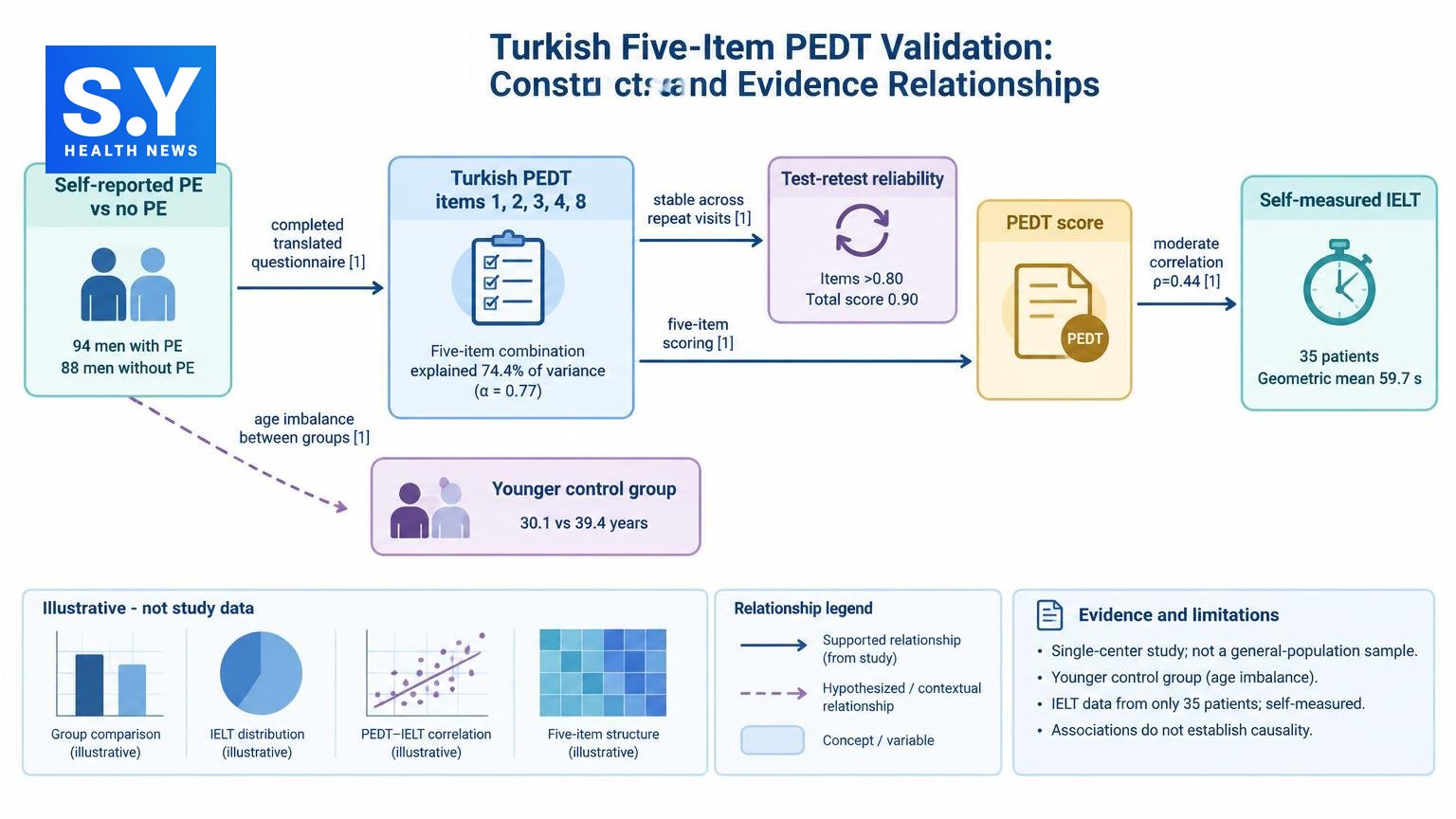
Conceptual framework: Conceptual framework of the Turkish five-item PEDT validation. Nodes show the constructs studied: self-reported PE versus no PE, the five-item questionnaire, retest reliability, PEDT score, self-measured IELT and a younger control group. Edges show supported relationships, including the moderate PEDT–IELT correlation (ρ=0.44) and the age imbalance. The framework reflects one single-center validation and is not a tested causal model.
Academic References & Evidence
- E C Serefoglu; H I Cimen; A T Ozdemir; M D Balbay; T Symonds; M Berktas. Turkish validation of the premature ejaculation diagnostic tool and its association with intravaginal ejaculatory latency time. Int J Impot Res. 2009 21:139–144 DOI: 10.1038/ijir.2008.58.
- Contemporary consensus and emerging directions in premature and delayed ejaculation: recommendations from the 5th International Consultation on Sexual Medicine.. Sexual medicine reviews PMID: 42855438.
SANYUN Science Center explains published research on men's reproductive and sexual health, connecting scientific evidence with everyday questions while making sources and limitations clear.
Disclaimer: This article is for scientific education and research communication only. It does not provide medical advice, diagnosis, or individualized treatment recommendations, and does not endorse any medication, supplement, device, penile enlargement procedure, or other intervention. Decisions about sexual and reproductive health should be made in consultation with a qualified healthcare professional. Do not delay seeking professional care because of information in this article.
Original Content & Copyright Notice
- This article is prepared for SANYUN Science Center, drawing on published research and publicly available academic literature on men’s sexual and reproductive health. Its editorial explanations and presentation are developed for this platform.
- Copyright in the original editorial content, selection, and arrangement is reserved by SANYUN Science Center to the extent protected by applicable law. Referenced research, quotations, and third-party materials remain subject to the rights of their respective owners. This notice does not claim ownership of scientific facts or third-party research.
- Except where permitted by applicable law or an applicable license, prior written permission is required to reproduce, republish, translate, adapt, redistribute, or commercially reuse protected content. Attribution alone does not grant permission for such reuse.
- For permitted quotation or authorized reuse, clearly identify the source and retain a link to the original article.
- Source: SANYUN Science Center
- Original URL: Retain the original article URL on science.san-yun.com.
- Copyright Holder: SANYUN Science Center, for its own protected editorial content.
- Quotation, excerpts, or authorized reuse must not distort the scientific meaning, omit material limitations or disclaimers, or imply unverified medical claims, product efficacy, or endorsement by SANYUN Science Center.



 and its moderate correlation with intravaginal ejaculatory latency time (IELT).)