




Category: Health Academy
Core Research Direction: How reliable, understandable and actionable is the most-viewed YouTube content about varicocele for patients seeking information online, and does popularity track educational quality?
Search Intent: If I watch the most popular varicocele videos on YouTube, am I getting accurate, actionable information about causes, treatment options and fertility, or just popular but mediocre content?
Platform: SANYUN Science Center
Evidence reviewed through: 2026-11-13
Executive Summary
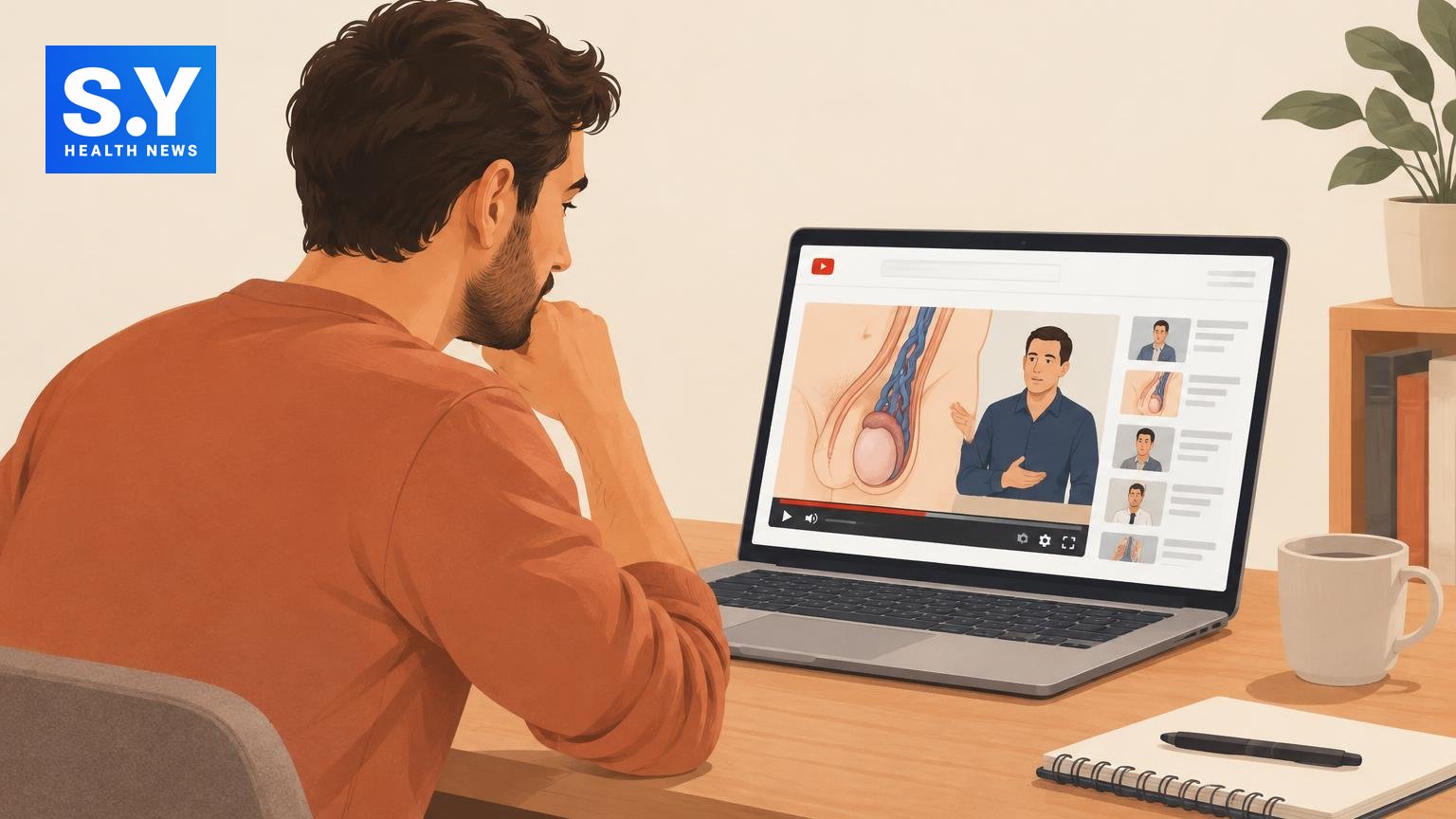
Men looking up varicocele online often land on YouTube, a platform where popularity is easy to see and quality is not. A 2025 cross-sectional study examined the 50 most-viewed English-language varicocele videos and scored them with four validated instruments covering reliability, understandability, actionability and source transparency, plus a content-accuracy rating benchmarked against European Association of Urology patient information.[1]
The headline result is a mismatch between reach and rigor. The 50 videos drew 15,706,250 views, with the top 10 accounting for roughly 73% of that total, yet the average information level was only intermediate (Likert 2 ± 1.19). The authors concluded that popularity does not equate to educational value.
The study is a snapshot of content, not a test of patient outcomes. It cannot tell us whether viewers made better or worse decisions after watching, and it is limited to English-language videos at one point in time. Its practical value is as a warning label: view counts are an engagement signal, not a quality certificate.
Why This Matters
Varicocele is a common and clinically relevant condition, described in the paper as abnormal dilatation of the pampiniform venous plexus within the spermatic cord. The authors note it affects approximately 15% of the general male population and up to 35% of men presenting with primary infertility. Those figures come from earlier literature cited in the introduction rather than from the video study itself, but they explain why so many men search for information.
Because varicocele touches fertility and genital health, the stakes of misleading content are not abstract. The authors observed videos claiming that varicocele resolves spontaneously without any intervention, or that surgical treatment inevitably leads to infertility, among other statements they considered misleading or potentially harmful. Such framing could delay appropriate care or create unnecessary fear.
How the Study Was Built
The search was run on YouTube in February 2025 using the keyword "varicocele," in incognito mode with the cache cleared and the platform's default relevance sorting, after which the 50 most-viewed eligible videos were selected. Videos had to be primarily English-language, specifically about varicocele, not dependent on subtitles or dubbing, and free of major technical problems.
Two urologists with more than a decade of clinical experience each scored the videos independently, resolving discrepancies by consensus with a third evaluator available when needed. Four instruments were used: DISCERN, a validated 16-item questionnaire on the quality and reliability of health information, particularly treatment options; PEMAT A/V, which measures understandability and actionability as percentages; the Global Quality Score, a 5-point overall quality and educational-value rating where 1 is poor and 5 is excellent for patients; and the JAMA benchmark criteria covering authorship, attribution, disclosure and currency. Content accuracy was additionally rated on a 5-point Likert scale against the European Association of Urology patient booklet.
| Variable | What it measures | How to read it here |
|---|---|---|
| DISCERN | Validated 16-item questionnaire on quality and reliability of health information, especially treatment options | Mean scores were modest, pointing to limited reliability across most videos |
| PEMAT-Understandability | Percentage of items met for how understandable audiovisual material is | Most strongly correlated with rated information quality (r2 = 0.687, p < 0.001) |
| PEMAT-Actionability | Percentage of items met for whether viewers are told what they can do | Higher in the top 10 videos than the rest (p = 0.024); the only quality difference found |
| Global Quality Score (GQS) | 5-point overall rating of quality and educational value for patients (1 poor, 5 excellent) | No significant difference between top 10 and remaining videos (p = 0.944) |
| JAMA benchmark criteria | Authorship, attribution, disclosure and currency, each worth one point | Mean scores were modest, indicating limited source transparency in most videos |
| Content-accuracy Likert | 5-point rating of medical content against EAU patient guidance | Average intermediate: 2 ± 1.19 across the 50 videos |
What the Evidence Shows
Reach was extremely concentrated. Of 15,706,250 total views, the top 10 videos alone accounted for about 73%, meaning most of the audience attention sat with a small handful of clips. That concentration is exactly the setting in which quality problems would matter most, since a small number of creators shape most of what viewers see.
Treatment framing leaned heavily surgical. Surgery was presented as the primary option in 76% of videos, while traditional medicine approaches appeared in 18%. Medical (non-surgical) management was the stated recommendation in only 2%, and 4% made no recommendation. The paper does not report whether these proportions were judged accurate or incomplete; it reports only what the videos recommended.
Higher-information videos were significantly longer (p = 0.049) and scored higher on DISCERN, GQS, JAMA and PEMAT (p < 0.05). The strongest correlation with rated information quality was understandability (r2 = 0.687, p < 0.001). These are associations within the sample, not proof that longer or clearer videos cause better understanding.
The central question, whether popularity tracks quality, was essentially answered no. Median view counts did not differ significantly by information level (p = 0.327), and the top 10 videos did not differ from the remaining 40 in overall information level (p = 0.154) or on DISCERN, GQS or JAMA scores. The one exception was actionability, where top 10 videos scored higher (p = 0.024), with mean PEMAT-Actionability of 66.67 ± 30.62% versus 47.34 ± 20.52% for the rest. In plain terms: the most-watched videos were not better informed, though they may have been slightly more likely to tell viewers what to do.
The authors also examined who uploaded traditional-medicine content. Among the 18% of videos promoting traditional medicine, 64.3% came from individual or health-channel accounts and 33.3% from institutional or physician-affiliated sources. They noted this pattern but did not document the country of origin for each video, so it cannot be read as a geographic finding.
Interpreting the Scores Carefully
An intermediate accuracy score and modest reliability scores are meaningful but blunt. The study counted and rated videos; it did not test whether a viewer who watched a low-scoring clip was less likely to see a clinician or more likely to pursue an unproven remedy. Statements about downstream behavior would be inference, not observation.
The actionability result deserves restraint. A higher actionability score means a video told viewers what they could do, not that the recommended action was correct or evidence-based. The authors point out that actionable content does not always equal evidence-based or transparent communication, and the top 10 advantage did not extend to other metrics.
Statistical significance also needs clinical framing. A p-value below 0.05 in a 50-video sample establishes that a difference is unlikely to be pure chance under the tested model, not that it is large or important for a patient. With 50 videos and one urology department's reviewers, findings are a description of a particular slice of the platform.
Limitations and Conflicts in the Evidence
The authors list the key limits themselves. YouTube search results are dynamic and influenced by algorithms, user behavior and geographic location, and incognito mode only partly removes personalization. Only English-language videos were included, limiting applicability to non-English-speaking populations, and the results may not reproduce if the same search is repeated later.
Even with validated instruments, subjective scales such as GQS and DISCERN can introduce inter-observer variability. The authors tried to limit this with dual-reviewer consensus, but residual variability remains. There is also no numeric reporting here of exact mean DISCERN or JAMA values; the paper characterizes them as modest, so readers should not treat secondary summaries as precise means.
A further gap is the absence of viewer-level data. The study cannot say whether the videos changed knowledge, anxiety, consultation behavior or treatment choices. Nor does it assess whether the platform's ranking rewarded clarity, sensationalism or something else. The authors' observation that some widely viewed videos drifted toward comedy or sensationalism is a qualitative impression, not a quantified finding.
What This Means for Patients and Clinicians
For patients, the practical lesson is that view count is not a proxy for trustworthiness. The paper supports a simple triage habit: look for identifiable authorship and disclosure, and treat confident claims that varicocele always resolves on its own or that surgery always destroys fertility as red flags rather than facts.
For clinicians and health communicators, the authors' conclusion points toward producing and promoting accurate, actionable educational material. Their data suggest a specific opening: longer, clearer videos scored higher on information quality, and actionability was the one dimension where top videos already did slightly better, so combining evidence-based content with clear next steps is a plausible, though untested, improvement strategy.
None of this replaces individualized medical advice. Varicocele decisions depend on symptoms, fertility goals, examination findings and other clinical factors that a video cannot assess, and the study offers no evidence for or against any particular treatment in any particular person.
Research Outlook
The most useful next steps follow directly from the gaps above: studies that connect video exposure to patient knowledge or decisions, audits that include non-English content and test whether results reproduce over time, and clarity on which platform signals, if any, predict higher-quality content. Until then, the honest summary is that a large share of highly viewed varicocele content is plausible but mediocre, and popularity remains a poor guide to educational value.
Key Takeaways
- In a 2025 audit of the 50 most-viewed English-language varicocele videos, average content accuracy was intermediate (Likert 2 ± 1.19) despite 15,706,250 combined views.
- The top 10 videos took about 73% of all views but were not significantly more informative than the remaining 40; only actionability was higher (p = 0.024).
- Reliability and transparency scores were modest, meaning many videos gave limited sourcing, authorship or disclosure cues.
- Longer and more understandable videos tended to score better on information quality, though these are associations, not causal effects.
- The findings apply to a single English-language snapshot in February 2025 and should not be generalized to all languages, platforms or time periods.
Questions and Answers
What is a varicocele, and why do patients search for information about it online?
A varicocele is abnormal dilatation of the pampiniform venous plexus within the spermatic cord, and the study authors describe it as a leading cause of male infertility. Their introduction cites prevalence of about 15% in the general male population and up to 35% among men presenting with primary infertility. Fertility and genital-health concerns make many men seek explanations online, where YouTube is a widely used source.
Did the most-viewed varicocele YouTube videos offer better information than less-viewed ones?
No consistent advantage was found. The top 10 videos did not differ significantly from the remaining 40 in information level (p = 0.154) or on DISCERN, GQS or JAMA scores. The only significant difference was higher PEMAT-Actionability in the top 10 (p = 0.024), and the authors concluded that popularity does not equate to educational value.
How strong is the evidence from this varicocele YouTube quality study?
It is a cross-sectional content audit of 50 English-language videos rated by two urologists using validated instruments, which supports statements about those videos but not about patient outcomes. The authors acknowledge dynamic, algorithm-dependent search results, limited generalizability beyond English, and residual subjectivity in rating scales despite dual-reviewer consensus.
How much of the total viewership went to the top 10 varicocele videos?
The 50 videos accumulated 15,706,250 views, and the top 10 accounted for roughly 73% of that total. This concentration matters because a small number of creators effectively shape most of what viewers see, even though the study found no clear quality advantage for the most popular clips.
What misleading claims did reviewers find in varicocele YouTube videos?
The authors describe a small number of videos, mostly from non-professional sources, containing statements such as claims that varicocele resolves spontaneously without any intervention or that surgical treatment inevitably leads to infertility. Several videos also promoted herbal remedies, scrotal cooling or yoga without supporting evidence or clinical context. These are qualitative observations rather than counted proportions.
What should I check before trusting a varicocele video on YouTube?
Look for identifiable authorship, cited sources and disclosures, since transparency scores were modest across most videos. Be cautious with absolute claims in either direction, such as guaranteed spontaneous resolution or certain infertility after surgery. Remember that the study found view counts unrelated to information quality, and that no video can substitute for an individualized clinical assessment.
Sources and References
- Atilla Satir; Oguzhan Akpinar; Anil Erkan; Metin Kilic. Revista Internacional de Andrología (RIA). Revista Internacional de Andrología. 2025 23(3):72-78 DOI: 10.22514/j.androl.2025.032.
SANYUN Science Center explains published research on men's reproductive and sexual health, connecting scientific evidence with everyday questions while making sources and limitations clear.
Disclaimer: This article is for scientific education and research communication only. It does not provide medical advice, diagnosis, or individualized treatment recommendations, and does not endorse any medication, supplement, device, penile enlargement procedure, or other intervention. Decisions about sexual and reproductive health should be made in consultation with a qualified healthcare professional. Do not delay seeking professional care because of information in this article.
Original Content & Copyright Notice
- This article is prepared for SANYUN Science Center, drawing on published research and publicly available academic literature on men’s sexual and reproductive health. Its editorial explanations and presentation are developed for this platform.
- Copyright in the original editorial content, selection, and arrangement is reserved by SANYUN Science Center to the extent protected by applicable law. Referenced research, quotations, and third-party materials remain subject to the rights of their respective owners. This notice does not claim ownership of scientific facts or third-party research.
- Except where permitted by applicable law or an applicable license, prior written permission is required to reproduce, republish, translate, adapt, redistribute, or commercially reuse protected content. Attribution alone does not grant permission for such reuse.
- For permitted quotation or authorized reuse, clearly identify the source and retain a link to the original article.
- Source: SANYUN Science Center
- Original URL: Retain the original article URL on science.san-yun.com.
- Copyright Holder: SANYUN Science Center, for its own protected editorial content.
- Quotation, excerpts, or authorized reuse must not distort the scientific meaning, omit material limitations or disclaimers, or imply unverified medical claims, product efficacy, or endorsement by SANYUN Science Center.



