




Category: Reproductive Care
Core Research Direction: Patient-facing education on vasectomy: expected effectiveness, the necessity and timing of post-vasectomy semen analysis before stopping contraception, recovery and complication counseling, permanence and fertility-restoration caveats, and what the 2026 AUA guideline and other sources do (and do not) establish
Search Intent: If I have a vasectomy, how effective is it, when can I stop using other contraception, and what should I understand about recovery, complications, and permanence?
Platform: SANYUN Science Center
Evidence reviewed through: 2026-11-13
Executive Summary
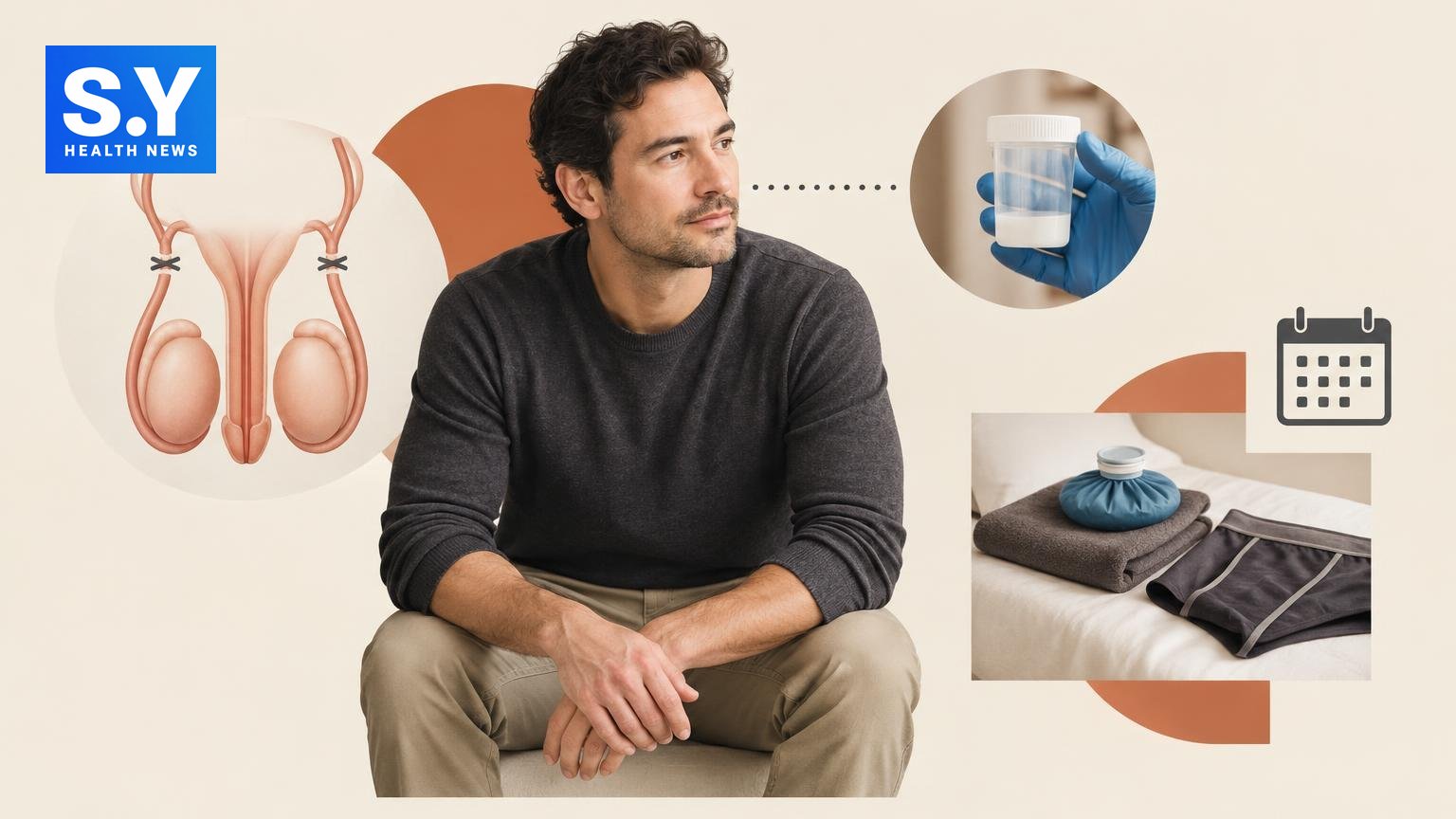
A vasectomy is a minor clinic procedure that interrupts each vas deferens, the tube that carries sperm from the testicle. It is intended as permanent contraception, and it is not immediately effective. Sperm already stored beyond the blocked point must be cleared, which is why a confirmatory semen test matters before a couple relies on the procedure alone.[1][2]
The headline effectiveness figure is high but not absolute. NHS patient information describes a success rate of over 99%. Clinicians quoted in an American Medical Association feature put pregnancy risk at roughly one in 2,000 after a semen test shows no sperm, and stress that this is not zero. Those two framings measure different things and should not be treated as interchangeable.[3]
The 2026 American Urological Association guideline, as summarized in secondary reporting, reinforces three practical messages: vasectomy is safe and effective permanent contraception; it is not causally linked to prostate cancer, cardiovascular disease or kidney stones; and follow-up should rely on post-vasectomy semen analysis, which may be done as early as 8 weeks and is often targeted at around 8 to 10 weeks.[4]
Why This Matters
Vasectomy is common in some countries and uncommon relative to eligible demand. A clinical brief for the American Association for Men in Nursing states that up to 500,000 are performed each year in the U.S., that 8 to 11 million men may be eligible annually, and that less than 1% proceed. CDC figures cited in the AMA feature place prevalence at about 6.8% among U.S. men aged 18 to 49, rising to over 14% among men aged 45 to 49.
Those figures also expose inequity. The same AMA feature cites prevalence of 10.1% among white men, 3.3% among Hispanic men and 2.8% among Black men. The AAMN brief adds a policy dimension: the Affordable Care Act requires coverage of female contraceptive methods and sterilization but does not require plans to cover services for male reproductive capacity, including vasectomies; actual coverage depends on plan, Medicaid program, employer and state law.
How a Vasectomy Works and Why Sterility Is Delayed
The vas deferens drains sperm from each testicle. Vasectomy cuts, ties or seals these tubes, usually through one or two small scrotal openings, often with a no-scalpel instrument. The testicles continue to produce sperm and testosterone, but sperm can no longer travel into the ejaculate. Semen volume is largely unaffected; one foundation statement cited by a urologist says volume does not fall by more than 5%.
The delay is the key counseling point. At the moment of surgery, sperm already sit beyond the blocked segment. They must be washed out through normal ejaculation before the ejaculate becomes sperm-free. A urologist interviewed by the AMA describes checking semen about three months after the procedure, with some men taking up to about six months to clear old sperm. The 2026 guideline summary allows testing from 8 weeks, with many clinicians targeting roughly 8 to 10 weeks.
What the Evidence Shows on Effectiveness
The most quoted patient-facing number is the NHS statement of a success rate over 99%. This is a broad consumer framing rather than a defined outcome. It does not specify whether success means absence of sperm on testing, avoidance of pregnancy, or both, and it gives no study basis.
A more clinically specific figure is the roughly one-in-2,000 pregnancy risk after a negative post-vasectomy semen test, reported by a urologist summarizing multiple studies and repeated in the AAMN brief. That number describes couples who have completed confirmatory testing. It does not describe men who skip testing or who have unprotected intercourse too early.
The consequences of early unprotected intercourse are stark in expert framing. The same AMA feature quotes a urologist warning that pregnancy chances could be close to 100% if intercourse occurs before any confirmatory semen test. That statement is an expert estimate, not a measured trial result, but it captures why the testing step is not optional paperwork.
Post-Vasectomy Semen Analysis: What Counts as Success
| Variable | Guideline summary position | What it means for patients |
|---|---|---|
| Earliest testing | Post-vasectomy semen analysis may be performed as early as 8 weeks; many clinicians target about 8–10 weeks | Do not assume a fixed three-month rule; follow your own clinic's schedule |
| Threshold to stop contraception | Complete azoospermia, or ≤100,000 rare non-motile sperm per mL in an uncentrifuged sample evaluated within 2 hours | A small number of non-motile sperm can still count as success under these conditions |
| Samples evaluated later | If the sample is evaluated more than 2 hours after collection, complete azoospermia is needed | Timing of laboratory processing affects the criterion |
| Repeat testing | One sample is enough if criteria are met; persistent motile sperm at 6 months warrants discussion of repeat vasectomy | Ongoing motile sperm means the man is not sterile |
| Mail-in testing | Acceptable option that may improve adherence, but requires azoospermia because any detected sperm counts as failure | Convenience must be weighed against stricter interpretation |
The wording matters. The guideline summary distinguishes complete absence of sperm from a very low count of rare non-motile sperm, and only the latter under specified processing conditions. It also notes that for samples evaluated more than two hours after collection, complete azoospermia is required. Mail-in kits are described as acceptable and potentially adherence-improving, but with a stricter pass criterion: any detected sperm is treated as a failed result because of assay limitations.
Recovery, Discomfort and Complications
Most vasectomies are done in a clinic under local anesthesia; the AMA feature reports a typical duration of about 20 to 30 minutes, while the AAMN brief says 10 to 15 minutes. These are different clinician descriptions rather than a contradiction to resolve. Many men drive themselves home, though sedation for anxiety requires a driver.
Recovery advice centers on support, cold and restraint. Scrotal swelling and minor pain are common for a few days. Snug underwear or a jockstrap and intermittent icing for the first 48 hours are commonly recommended. Most doctors advise waiting one to two weeks before sex or ejaculation, and heavy lifting and gym activity should be avoided for about a week, longer for men whose jobs involve heavy work.
Serious complications are uncommon but real. The AAMN brief puts hematoma or infection at 1 to 2% and chronic scrotal pain at 1 to 2%. The AMA feature, citing the American Urological Association, gives the same 1 to 2% range for ongoing pain or discomfort. Bleeding is usually internal into the scrotal sac and generally managed conservatively; the AMA feature notes that bleeding risk rises with uncontrolled blood pressure.
Two misconceptions are worth correcting. A vasectomy does not change sexual function and does not protect against sexually transmitted infections. It also does not cause erectile dysfunction; orgasm and ejaculation should feel the same, minus sperm. Separately, most but not all men develop anti-sperm antibodies after vasectomy. This is not described as a general health concern, but it may coat sperm and impair function if fertility is later sought.
Permanence, Reversal and Fertility Restoration
Vasectomy should be chosen as permanent contraception. Reversal is possible but should not be treated as a reliable backup plan. The NHS notes that reversal is not usually available on the NHS and does not always work. The AMA feature describes reversal as major operating-room surgery that is expensive if not covered and does not always succeed even in expert hands.
The 2026 guideline summary adds structure to this counseling. Fertility restoration is possible but not guaranteed. Options include vasectomy reversal and sperm retrieval with intracytoplasmic sperm injection, both involving additional cost, time and complexity. The best preoperative predictors of reversal success are the duration of the obstructive interval, patient age and female partner age. Surgeons offering reversal should have microsurgical expertise in both vasovasostomy and vasoepididymostomy.
A urologist quoted in the AMA feature offers a practical timeline: the closer reversal is to the original vasectomy, the better the success rates, with a good chance of sperm returning to the ejaculate if reversal is done within 10 years. He adds an important qualifier: sperm in the ejaculate does not necessarily translate into pregnancy.
What the 2026 AUA Guideline Does and Does Not Establish
The 2026 AUA Vasectomy Guideline is reported as a comprehensive update reflecting about a decade of new evidence. Key counseling points include that vasectomy is intended to be permanent, sterility is not immediate, another contraceptive method is needed until testing confirms no sperm, and permanent and non-permanent alternatives should be discussed. Consultation may be in person or by telehealth, and partner presence is not required.
On long-term safety, the guideline summary states no causal association has been established between vasectomy and prostate cancer, high-grade prostate cancer, prostate cancer mortality, cardiovascular disease or kidney stones. The AAMN brief adds no causal link with erectile dysfunction or sexual dysfunction. This is a statement about absence of established causation, not mathematical proof of zero risk; it also does not mean men should skip routine prostate or cardiovascular care.
On technique, the guideline strongly recommends combining mucosal cautery with fascial interposition and discourages ligation and excision of a short vas segment alone because of higher failure rates. Routine antibiotic prophylaxis is not recommended for uncomplicated vasectomy. These are surgical-quality points rather than patient-choice points, but they matter because technique influences failure risk.
It is equally important to be clear about limits. This explainer relies on secondary summaries of the guideline in a urology news feature and a nursing association brief, plus NHS and AMA patient-facing material. The full guideline documents were not reproduced in these sources. Specific absolute failure rates by technique, long-term pregnancy rates in contemporary cohorts, and head-to-head comparisons of testing schedules are not established by the material available here.
Research Outlook
Two areas are moving. First, adherence to post-vasectomy testing remains a weak link. Mail-in analysis is described as an acceptable option that may improve adherence for men facing distance, work, transport or scheduling barriers, but its stricter pass criterion and assay limitations need clearer patient communication. Second, the guideline's inclusion of fertility restoration is a meaningful shift, putting reversal outcomes and sperm retrieval alongside the original contraceptive decision.
Key Takeaways
- Vasectomy is highly effective but not immediately effective; sperm already beyond the blockage must clear before the ejaculate is sperm-free.
- A post-vasectomy semen analysis is required before stopping other contraception; the 2026 guideline summary allows testing from 8 weeks, with many clinicians targeting about 8–10 weeks.
- NHS patient information cites a success rate over 99%, while clinician estimates put pregnancy risk at roughly one in 2,000 after a no-sperm test; neither figure is zero risk.
- Recovery usually involves a few days of swelling and discomfort, supportive underwear, icing and one to two weeks without sex or ejaculation.
- Hematoma or infection and chronic scrotal pain are each reported at 1 to 2%; chronic pain can persist and may require treatment larger than the original procedure.
- Treat vasectomy as permanent. Reversal and sperm retrieval are possible but not guaranteed, costly and more complex than the original procedure.
Questions and Answers
How does a vasectomy prevent pregnancy if it does not remove the testicles?
A vasectomy interrupts each vas deferens, the tube that carries sperm from the testicle into the ejaculate. The testicles keep producing sperm and testosterone, but sperm can no longer travel out. Semen volume is largely unchanged; one foundation statement cited by a urologist says it does not fall by more than 5%.
What pregnancy risk remains after a vasectomy when a semen test shows no sperm?
Clinicians quoted in an AMA feature estimate pregnancy risk at about one in 2,000 after a post-vasectomy semen test shows no sperm, and the AAMN brief gives the same approximate figure. That is a low but nonzero risk. It applies to couples who have completed confirmatory testing, not to men who skip it.
When can a couple stop using other contraception after a vasectomy?
Only after a post-vasectomy semen analysis confirms success. The 2026 guideline summary allows testing from 8 weeks, with many clinicians targeting roughly 8 to 10 weeks, and defines success as complete azoospermia or no more than 100,000 rare non-motile sperm per mL in a sample evaluated within 2 hours. Until then, use another method.
What are the chances of chronic pain or infection after a vasectomy?
The AAMN brief puts hematoma or infection at 1 to 2% and chronic scrotal pain at 1 to 2%. The AMA feature, citing the American Urological Association, gives the same 1 to 2% range for ongoing pain or discomfort. Chronic pain can last months or longer and may need treatment more extensive than the original procedure.
Can a vasectomy be reversed if a man later wants children?
Reversal is sometimes possible but is not a reliable backup. The NHS says it is not usually available on the NHS and does not always work. The 2026 guideline summary says fertility restoration is possible but not guaranteed, and that the best predictors of reversal success are the obstructive interval, patient age and female partner age.
Does a vasectomy increase the risk of prostate cancer or heart disease?
The 2026 AUA guideline summary states no causal association has been established between vasectomy and prostate cancer, high-grade prostate cancer, prostate cancer mortality, cardiovascular disease or kidney stones. This is a conclusion about absence of established causation, not proof of zero risk, and it does not replace routine age-appropriate health checks.
Sources and References
- Sara Berg, MS. What doctors want patients to know about getting a vasectomy.
- Susanne A. Quallich, PhD, ANP-BC, NP-C, CMHE, CUNP, FAUNA, FAANP. Mens Health | AAMN. American Association for Men in Nursing (web article). 2026
- How to get a vasectomy.
- 2026 AUA Vasectomy Guideline: Key updates and clinical FAQs | Urology Times. Urology Times. 2026
SANYUN Science Center explains published research on men's reproductive and sexual health, connecting scientific evidence with everyday questions while making sources and limitations clear.
Disclaimer: This article is for scientific education and research communication only. It does not provide medical advice, diagnosis, or individualized treatment recommendations, and does not endorse any medication, supplement, device, penile enlargement procedure, or other intervention. Decisions about sexual and reproductive health should be made in consultation with a qualified healthcare professional. Do not delay seeking professional care because of information in this article.
Original Content & Copyright Notice
- This article is prepared for SANYUN Science Center, drawing on published research and publicly available academic literature on men’s sexual and reproductive health. Its editorial explanations and presentation are developed for this platform.
- Copyright in the original editorial content, selection, and arrangement is reserved by SANYUN Science Center to the extent protected by applicable law. Referenced research, quotations, and third-party materials remain subject to the rights of their respective owners. This notice does not claim ownership of scientific facts or third-party research.
- Except where permitted by applicable law or an applicable license, prior written permission is required to reproduce, republish, translate, adapt, redistribute, or commercially reuse protected content. Attribution alone does not grant permission for such reuse.
- For permitted quotation or authorized reuse, clearly identify the source and retain a link to the original article.
- Source: SANYUN Science Center
- Original URL: Retain the original article URL on science.san-yun.com.
- Copyright Holder: SANYUN Science Center, for its own protected editorial content.
- Quotation, excerpts, or authorized reuse must not distort the scientific meaning, omit material limitations or disclaimers, or imply unverified medical claims, product efficacy, or endorsement by SANYUN Science Center.



