




Category: Reproductive Care
Core Research Direction: How men's characteristics, attitudes, and masculinity beliefs relate to vasectomy utilization and what this means for interpreting vasectomy as a permanent contraception method in U.S. men aged 30–49.
Search Intent: What factors are associated with whether men undergo a vasectomy, and what does available evidence say about how effective vasectomy is at preventing pregnancy?
Platform: SANYUN Science Center
Evidence reviewed through: 2026-11-20
Executive Summary
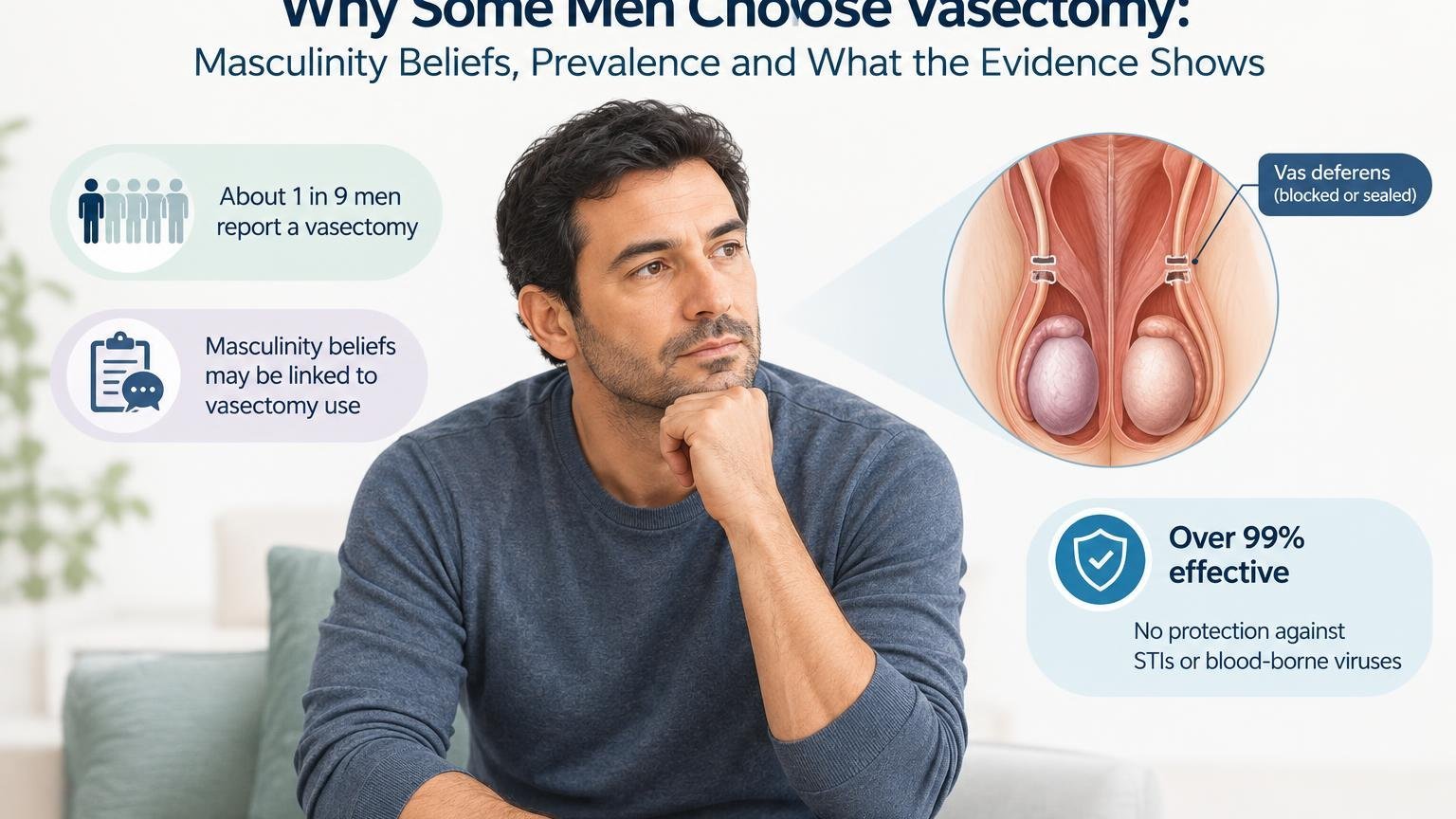
A 2026 study in the American Journal of Public Health examined whether men's characteristics and traditional masculine attitudes are associated with vasectomy utilization in the United States. Using 2022–2023 National Survey of Family Growth data on 2,278 men aged 30 to 49 years, the authors found that approximately 1 in 9 men (11.9%) reported having undergone a vasectomy.[1]
One attitude stood out: men who agreed that men have greater sexual needs than women were more likely to report ever having had a vasectomy (adjusted odds ratio 1.86; 95% confidence interval 1.24 to 2.80). Other measured masculine attitudes were not significantly associated with vasectomy utilization. The authors frame gender beliefs as an important and overlooked part of male contraceptive behavior, but the cross-sectional survey design cannot establish that the belief causes vasectomy use.
For readers weighing vasectomy, the parallel clinical message is simpler: patient education material describes vasectomy as a permanent form of male contraception that blocks the tubes carrying sperm from the testicles to the penis, and states that vasectomy is over 99% effective in preventing pregnancy. It offers no protection against sexually transmitted infections or blood-borne viruses.[2]
Why This Matters
Vasectomy sits at the intersection of reproductive decision-making and gendered expectations about who is responsible for contraception. The 2026 analysis is notable because it treats men's beliefs about masculinity as a measurable factor in contraceptive behavior rather than a background assumption. That framing matters for public health messaging: if some men view vasectomy as a way to maintain sexual continuity while reducing reliance on female-controlled contraception, as the authors suggest, then campaigns that present vasectomy only as a surgical procedure may miss the beliefs that shape uptake.
At the same time, prevalence estimates and attitude associations are not effectiveness data. A man considering vasectomy needs two separate bodies of evidence: what the procedure does to fertility and how reliably it does it, and what social and personal factors shape how people think about it. The 2026 study addresses the second; the patient education source addresses the first. Keeping them distinct avoids a common error—treating an association between a belief and a procedure as evidence about the procedure's medical performance.
What Vasectomy Does: The Mechanism
Vasectomy is described as a permanent form of male contraception that blocks the tubes that carry sperm from the testicles to the penis. During the procedure, the tubes that carry sperm from the testicles to the penis—the vas deferens—are cut, blocked, or sealed to prevent sperm from reaching the semen ejaculated from the penis.
That mechanism is why the procedure is framed as permanent contraception for individuals or couples who have decided not to have any children or no more children. Importantly, the supplied educational material does not describe reversal outcomes, regret rates, or the time required for sperm to clear from the ejaculate after the procedure. Those are real questions for anyone considering vasectomy, but they are not answered by the sources in this packet, and this article does not fill the gap with outside claims.
How Effective Is Vasectomy at Preventing Pregnancy?
The patient education source states that vasectomy is over 99% effective in preventing pregnancy and characterizes it as one of the most effective forms of contraception with a very low failure rate. Those are patient-facing statements, not results from a specified study in the supplied text; no definition of effectiveness, follow-up period, or comparison group accompanies them. Readers should therefore interpret “over 99%” as a summary effectiveness figure used in educational material, not as a newly reported trial result.
The same source is explicit about what vasectomy does not do: it offers no protection from sexually transmitted infections or blood-borne viruses. This is a substantive limitation of the method, not a minor footnote. A man choosing vasectomy as his only contraceptive method still needs a separate plan for infection prevention, and the educational material does not elaborate further on that point.
| Question | What the packet source states | How to interpret it |
|---|---|---|
| What does vasectomy do? | Blocks the tubes that carry sperm from the testicles to the penis; the vas deferens is cut, blocked, or sealed so sperm cannot reach ejaculated semen. | A mechanical barrier to sperm transport; described as permanent male contraception. |
| How well does it prevent pregnancy? | Over 99% effective; one of the most effective forms of contraception with a very low failure rate. | An educational effectiveness statement without a specified study, timeframe, or comparison group in the supplied text. |
| Does it protect against infections? | No protection from sexually transmitted infections or blood-borne viruses. | A separate infection-prevention method is still needed. |
| Who is it for? | Individuals or couples who have decided not to have any or any more children. | Framed as permanent contraception; the supplied text gives no reversal or regret data. |
| Prevalence in U.S. men aged 30–49 (2022–2023) | 11.9% reported ever having had a vasectomy (approximately 1 in 9). | Self-reported survey estimate for this age group and survey period. |
| Association with masculine attitudes | Agreement that men have greater sexual needs than women: adjusted odds ratio 1.86 (95% CI 1.24, 2.80). Other masculine attitudes were not significantly associated. | A statistical association from cross-sectional data; not evidence of causation. |
What the 2026 Study Found
The study's stated objective was to examine how men's characteristics and traditional masculine attitudes are associated with vasectomy utilization in the United States. The authors used 2022–2023 National Survey of Family Growth data on 2,278 men aged 30 to 49 years and conducted descriptive statistics and multivariable logistic regression to assess associations between sociodemographic characteristics, traditional masculine attitudes, and having undergone vasectomy.
Prevalence was substantial: approximately 1 in 9 men (11.9%) reported undergoing vasectomy. In the multivariable analysis, men who agreed that men have greater sexual needs than women were more likely to report ever having had a vasectomy, with an adjusted odds ratio of 1.86 and a 95% confidence interval of 1.24 to 2.80. Other masculine attitudes measured in the study were not significantly associated with vasectomy utilization.
The authors concluded that gender beliefs are an important and overlooked component of male contraceptive behavior. They further suggest that men may view vasectomies as a means to maintain sexual continuity by reducing reliance on female-controlled contraception, and that this interpretation could inform public health messaging. That suggestion is explicitly framed as a possible interpretation rather than a tested mechanism.
Interpreting the Numbers: Statistical vs. Clinical Meaning
An adjusted odds ratio of 1.86 describes the odds of reporting a past vasectomy among men who agreed with a particular statement compared with men who did not, after adjustment for other variables in the model. The confidence interval of 1.24 to 2.80 excludes 1.0, which indicates a statistically significant association in this sample. It does not tell us the size of the effect in absolute terms, how many additional men would choose vasectomy because of this belief, or whether changing the belief would change the behavior.
Statistical significance also differs from clinical or public health importance. A single significant attitude among several measured ones can arise from a combination of true association and chance, and the study reports that the other masculine attitudes were not significantly associated. The authors' own conclusion that gender beliefs matter is a reasonable interpretation of their data, but it should not be read as showing that traditional masculinity uniformly promotes or uniformly discourages vasectomy.
Limitations and What Remains Unknown
The central limitation is design. The analysis uses cross-sectional survey data, meaning attitudes and vasectomy history were measured together in time. Such data can show that a belief and a behavior co-occur more often than expected, but they cannot show that the belief led to the behavior, or that the behavior shaped the belief. A man might adopt the attitude after his vasectomy as a way of explaining his decision, or both might reflect an unmeasured third factor.
The population is another boundary. The prevalence estimate and the association apply to U.S. men aged 30 to 49 years surveyed in 2022–2023; they should not be generalized without qualification to younger men, older men, men in other countries, or men outside the survey frame. The vasectomy data are self-reported, which introduces the possibility of recall or reporting differences.
Finally, the packet does not provide the full questionnaire, the number of attitude items, the exact wording of the sexual-needs question beyond the quoted claim, or the adjusted variables. Null findings for other attitudes indicate lack of statistical significance in this sample, not proof that those attitudes are unrelated to vasectomy in all contexts. And the effectiveness figure of over 99% comes from a patient education page without an underlying study citation in the supplied text, so it should be presented as an educational statement rather than as a verified trial outcome.
Research and Practical Outlook
The most useful next step would be longitudinal data that follow men's attitudes and contraceptive decisions over time, which could begin to separate selection from influence. Qualitative work could also test the authors' hypothesis that some men see vasectomy as a way to preserve sexual continuity while reducing reliance on female-controlled methods. For now, that hypothesis remains plausible but unconfirmed by the reported data.
For readers, the practical takeaway is to hold two questions separately. The social question—why men do or do not choose vasectomy—is informed by studies of beliefs and characteristics, but those studies describe associations. The medical question—whether vasectomy is a suitable permanent contraceptive for a particular person—depends on the procedure's mechanism, its stated effectiveness of over 99%, its lack of protection against infections, and a person's own reproductive intentions. The packet supports general education on these points; it does not support individualized medical advice or claims about how any one man should decide.
Key Takeaways
- A 2026 U.S. study of 2,278 men aged 30–49 found that 11.9% reported ever having a vasectomy, based on 2022–2023 National Survey of Family Growth data.
- Agreement that men have greater sexual needs than women was associated with higher odds of reported vasectomy (adjusted odds ratio 1.86; 95% CI 1.24 to 2.80); other measured masculine attitudes were not significantly associated.
- The cross-sectional design supports association, not causation; the authors' interpretation about sexual continuity is a hypothesis, not a tested mechanism.
- Patient education material describes vasectomy as permanent male contraception that blocks the vas deferens and states it is over 99% effective in preventing pregnancy, with no protection against sexually transmitted infections or blood-borne viruses.
Questions and Answers
How does a vasectomy prevent pregnancy?
A vasectomy blocks the vas deferens, the tubes that carry sperm from the testicles to the penis. During the procedure these tubes are cut, blocked, or sealed so sperm cannot reach the semen that is ejaculated. Patient education material describes this as a permanent form of male contraception for people who have decided not to have any or any more children.
How effective is vasectomy at preventing pregnancy?
Patient education material states that vasectomy is over 99% effective in preventing pregnancy and describes it as one of the most effective forms of contraception with a very low failure rate. The supplied text does not give an underlying study, follow-up period, or comparison group, so this should be read as an educational effectiveness statement rather than a newly reported trial result.
What did the 2026 study find about masculinity beliefs and vasectomy?
In 2,278 U.S. men aged 30–49 surveyed in 2022–2023, 11.9% reported ever having a vasectomy. Men who agreed that men have greater sexual needs than women had higher odds of reported vasectomy (adjusted odds ratio 1.86; 95% CI 1.24 to 2.80). Other measured masculine attitudes were not significantly associated.
Does the masculinity study prove that beliefs cause men to get vasectomies?
No. The study used cross-sectional survey data, so attitudes and vasectomy history were measured at the same time. An association of this kind cannot establish that the belief led to the procedure. The authors' suggestion that some men use vasectomy to maintain sexual continuity while reducing reliance on female-controlled contraception is presented as a possible interpretation, not a tested causal pathway.
Does vasectomy protect against sexually transmitted infections?
No. The patient education source states that vasectomy offers no protection from sexually transmitted infections or blood-borne viruses. A man relying on vasectomy for pregnancy prevention still needs a separate approach to infection prevention, and the supplied material does not elaborate on specific options.
Who do the 2026 vasectomy prevalence findings apply to?
The 11.9% prevalence estimate and the attitude association apply to U.S. men aged 30 to 49 years in the 2022–2023 National Survey of Family Growth data. They should not be generalized without qualification to younger or older men, men in other countries, or men outside the survey population. The vasectomy reports are also self-reported.
Sources and References
- Giuseppina Valle Holway; J. E. Sumerau; N. M. Lampe. Masculinity as a Determinant of Men’s Vasectomy Utilization | AJPH | Vol. 116 Issue 8. Am J Public Health. 2026 116(8):1116–1120 DOI: 10.2105/AJPH.2026.308558.
- Vasectomy.
SANYUN Science Center explains published research on men's reproductive and sexual health, connecting scientific evidence with everyday questions while making sources and limitations clear.
Disclaimer: This article is for scientific education and research communication only. It does not provide medical advice, diagnosis, or individualized treatment recommendations, and does not endorse any medication, supplement, device, penile enlargement procedure, or other intervention. Decisions about sexual and reproductive health should be made in consultation with a qualified healthcare professional. Do not delay seeking professional care because of information in this article.
Original Content & Copyright Notice
- This article is prepared for SANYUN Science Center, drawing on published research and publicly available academic literature on men’s sexual and reproductive health. Its editorial explanations and presentation are developed for this platform.
- Copyright in the original editorial content, selection, and arrangement is reserved by SANYUN Science Center to the extent protected by applicable law. Referenced research, quotations, and third-party materials remain subject to the rights of their respective owners. This notice does not claim ownership of scientific facts or third-party research.
- Except where permitted by applicable law or an applicable license, prior written permission is required to reproduce, republish, translate, adapt, redistribute, or commercially reuse protected content. Attribution alone does not grant permission for such reuse.
- For permitted quotation or authorized reuse, clearly identify the source and retain a link to the original article.
- Source: SANYUN Science Center
- Original URL: Retain the original article URL on science.san-yun.com.
- Copyright Holder: SANYUN Science Center, for its own protected editorial content.
- Quotation, excerpts, or authorized reuse must not distort the scientific meaning, omit material limitations or disclaimers, or imply unverified medical claims, product efficacy, or endorsement by SANYUN Science Center.



