




Category: Reproductive Care
Core Research Direction: Explaining vasectomy as a permanent male contraception option: how it works, typical-use effectiveness compared with tubal sterilization, the need for post-vasectomy semen confirmation and continued contraception during the waiting period, and decision-making context (reversibility expectations, alternatives).
Search Intent: How effective is a vasectomy compared with tubal sterilization, and why does a man still need backup contraception and a semen check after the procedure?
Platform: SANYUN Science Center
Evidence reviewed through: 2026-11-16
Executive Summary
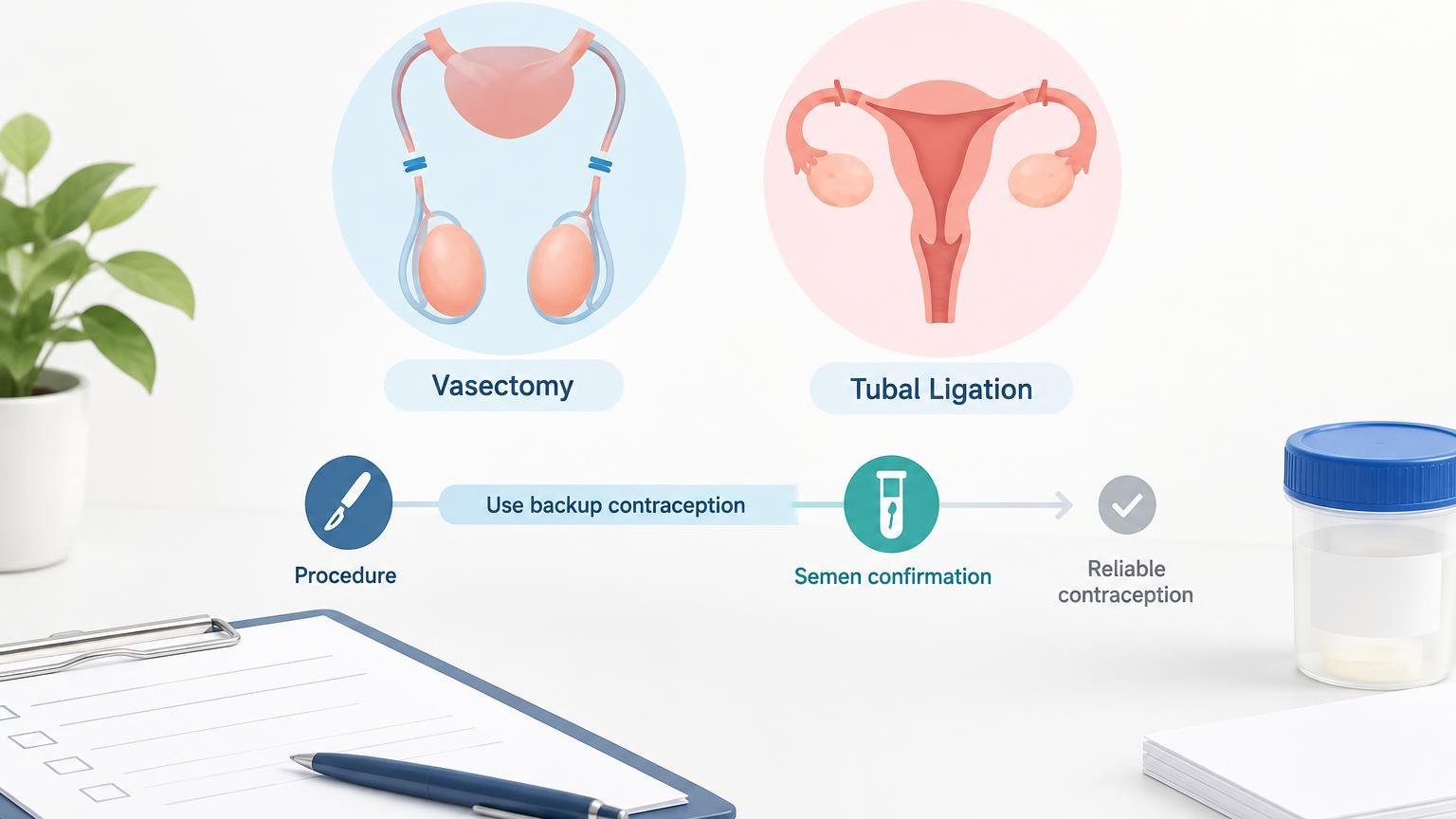
Vasectomy is a permanent male contraceptive operation that interrupts the tubes carrying sperm, not the blood supply to the testicles. Consumer and exam sources describe it as a procedure through a small scrotal opening without abdominal entry, and it is commonly presented as one of the most effective reversible-to-permanent options because it does not depend on remembering a daily method. The central comparison question is not only which operation is more effective, but what happens between the procedure and reliable contraception.[1][2]
A comparison page citing Centers for Disease Control and Prevention figures lists typical-use first-year pregnancy rates of about 0.15% for vasectomy and about 0.5% for tubal ligation or salpingectomy. A separate set of revision notes gives the same approximate hierarchy, around 0.15% for vasectomy and around 0.5% for tubal ligation. These are short-horizon, typical-use figures, not a guarantee about any individual's long-term outcome, and the sources do not provide the underlying study designs or denominators.[3]
The practical catch is that vasectomy is not immediately effective. Residual sperm can remain in the tract after the procedure, so the educational sources advise continuing another contraceptive method until a semen analysis confirms clearance. One source describes confirmation at roughly 20 ejaculations or about 3 months, while the same source elsewhere quotes at least 8-16 weeks, illustrating that postoperative protocols vary. A clinic comparison page citing AUA guidance estimates later pregnancy risk at roughly 1 in 2,000 after confirmed clearance.
- Vasectomy is permanent and should be chosen with that expectation; reversals exist but are not guaranteed to restore fertility.
- Tubal sterilization does not routinely use a post-procedure confirmation test analogous to semen analysis, so the follow-up pathway differs between the two operations.
- Neither vasectomy nor tubal sterilization protects against sexually transmitted infections.
Why This Matters
Permanent contraception is often discussed as a couple-level decision, but the two operations are not symmetric. A Planned Parenthood affiliate notes that vasectomy shifts some contraceptive responsibility from the person with a uterus and gives couples more flexibility in planning their reproductive futures. The clinic comparison page similarly frames the discussion around body autonomy: no one should be pressured into surgery, and either partner choosing to take the step is making a generous decision rather than a default one.
This framing matters because effectiveness numbers are often read as a simple ranking. If vasectomy has a lower typical-use first-year pregnancy rate than tubal ligation in the cited comparison, someone may conclude that it is automatically the better choice. That conclusion skips recovery, surgical access, the need for postoperative testing, reversal expectations and the possibility that a concurrent gynecologic operation changes the balance. The evidence in this packet supports a more careful conversation.
How Vasectomy Prevents Pregnancy
Vasectomy works by occluding the vas deferens, the tube that carries sperm from the epididymis toward the ejaculatory duct. The revision notes describe the vas deferens as the structure deliberately divided or sealed during the operation, while the testicular artery and vein are preserved so that blood flow and hormone production are not the target. In plain terms, the testicles continue to produce sperm and testosterone, but sperm no longer reach the ejaculate in the same way.
The procedure is typically performed through a small scrotal opening and does not require abdominal entry, according to the clinic comparison page. That structural difference is one reason recovery is often described in days rather than weeks. The same page states that recovery after vasectomy is often measured in days, while a Planned Parenthood affiliate lists a recovery estimate of 1-2 days for vasectomy, compared with 1-2 weeks for tubal ligation and 4-8 weeks for hysterectomy. These are general consumer estimates without a cited definition of recovery, so they should be read as orientation rather than a personal recovery prediction.
The revision notes state that no-scalpel vasectomy is preferred over conventional vasectomy because of lower rates of bleeding, hematoma, infection and pain. The clinic page lists bleeding, infection, hematoma and persistent scrotal pain among the risks discussed during counseling, citing a 2026 AUA guideline publication. These sources do not provide absolute risk frequencies for each complication, which is important: a lower relative rate does not tell a person what their own chance of a complication is.
What the Evidence Shows on Effectiveness
| Variable | Source-grounded description | How to interpret it |
|---|---|---|
| Vasectomy typical-use first-year pregnancy rate | About 0.15%, described as a CDC figure on a clinic comparison page. | A short-horizon typical-use estimate; not a promise about long-term or individual risk. |
| Tubal ligation or salpingectomy typical-use first-year pregnancy rate | About 0.5%, described as a CDC figure on the same comparison page. | The comparison suggests lower first-year typical-use pregnancy risk after vasectomy, but the underlying study details are not given. |
| Vasectomy failure rate in revision notes | Approximately 0.15%, described as lower than tubal ligation. | Consistent in direction with the clinic comparison, but based on exam revision material without a cited primary source. |
| Recanalization failure | Listed as under 1% in late complications. | A rare failure mode; the source does not give a time window or study population. |
| Pregnancy risk after confirmed semen clearance | Roughly 1 in 2,000, cited to AUA guidance on the clinic page. | This is a different measure from the first-year typical-use rate: it applies after the postoperative semen check confirms clearance. |
The most defensible reading is that vasectomy is presented in these sources as somewhat more effective than tubal sterilization on a typical-use first-year basis, with both being highly effective. The exact numbers should not be over-interpreted. The clinic page attributes its figures to the CDC but does not reproduce the CDC's methods, and the exam notes do not cite a primary study. A reader should treat the about 0.15% and about 0.5% figures as consistent directional evidence rather than as precise, transportable risks for a specific person.
It is also important not to conflate the first-year typical-use rate with the post-clearance risk. The clinic page cites AUA guidance estimating later pregnancy risk at roughly 1 in 2,000 after confirmed clearance, and it advises continuing another contraceptive method until the result is available and clearance is confirmed. That sequence creates a window in which the procedure has been performed but should not yet be relied upon. The size of that window is not fixed across sources: one educational source says approximately 20 ejaculations or about 3 months, and the same source elsewhere says at least 8-16 weeks.
Why Backup Contraception and a Semen Check Matter
The need for backup contraception follows directly from the biology. Occluding the vas deferens stops sperm from being added to the ejaculate, but sperm already downstream of the blockage can remain until they are cleared. The revision notes state plainly that vasectomy is not immediately effective and that backup contraception should be used until azoospermia is confirmed. They describe confirmation as around 20 ejaculations or about 3 months after the procedure.
The clinic comparison page adds a clinical-practice layer: post-vasectomy semen analysis is used before the procedure is relied upon for contraception, and another contraceptive method should be continued until the result is available and the clinic confirms clearance. This is not bureaucratic caution for its own sake. It separates the period when the operation has been done from the period when its contraceptive effect has been documented. The page estimates later pregnancy risk at roughly 1 in 2,000 after confirmed clearance, which is a favorable figure but still not zero.
Tubal sterilization follows a different follow-up model. The clinic comparison page states that tubal sterilization does not routinely use a post-procedure confirmation test analogous to semen analysis. That does not mean tubal sterilization is ineffective; it means the confirmation pathway is different. A couple comparing the two procedures should ask what each pathway requires in practice, including who is responsible for the follow-up visit, how long backup contraception is needed, and what happens if the semen result is not yet clear.
The revision notes add that a failed tubal ligation significantly increases ectopic pregnancy risk. This is a reminder that failure after permanent contraception is not only about the possibility of pregnancy but also about the type of pregnancy. The source does not quantify the increase, and it is exam revision material rather than a primary epidemiologic study, so it should be presented as a counseling consideration rather than a precise risk estimate.
Decision-Making: Permanence, Reversal and Alternatives
Both vasectomy and tubal sterilization are presented as permanent. The Planned Parenthood affiliate states that vasectomy should be chosen only if a person is certain they do not want children or do not want more, and that while reversals exist in the community, they are not offered there and are not guaranteed to work. The revision notes similarly describe vasectomy reversal as possible but with success that varies, listing patency above 90% and pregnancy roughly 50-70% after vasovasostomy, with results decreasing as the interval since vasectomy lengthens.
Those reversal figures deserve careful handling. They come from revision notes without a cited primary study, and they describe selected men who underwent reversal procedures, not everyone who regrets a vasectomy. They also combine patency, which means sperm return to the ejaculate, with pregnancy, which depends on a partner's fertility and many other factors. A person considering vasectomy should not treat the existence of reversal as a safety net. The Planned Parenthood source is more direct: reversal is not guaranteed to work, which is why the decision should be made with permanence in mind.
Alternatives should be discussed before a permanent procedure, not only after. The revision notes describe comprehensive counseling on permanence, risks, benefits and alternatives as the most crucial step, and they mention a structured framework for benefits, risks, alternatives, inquiries, decision, explanation and documentation. That is a general educational description rather than a validated protocol, but it captures the right sequence: understand the alternatives, clarify what permanence means for the person and any partner, and document the decision.
The salpingectomy question complicates a simple vasectomy-versus-tubal-ligation comparison. The clinic page states that a complete bilateral salpingectomy removes both fallopian tubes rather than cutting or blocking them, and that ACOG's 2026 Clinical Practice Update identifies it as the preferred tubal procedure for patients choosing permanent contraception after shared decision-making. The same page reports observational evidence associating bilateral salpingectomy with lower future epithelial ovarian cancer risk, while noting that it does not eliminate that risk or establish benefit for an individual patient.
The clinic page also notes that ACOG supports salpingectomy during hysterectomy and certain other abdominal or pelvic operations when future fertility is not desired, but states that more research is needed before routinely recommending standalone salpingectomy solely for cancer prevention in average-risk patients. This is a good example of why couples should not reduce the decision to one number. A concurrent cesarean or other planned abdominal procedure, or a potential cancer-risk-reduction discussion, can shift the calculus toward a gynecologic option, whereas the absence of abdominal entry and the postoperative semen-analysis pathway can shift it toward vasectomy.
Interpretation and Limitations
This evidence base is designed for education, not for individualized risk prediction. Two of the sources are exam revision notes, one is a Planned Parenthood affiliate's consumer page, and one is a commercial clinic comparison page that cites CDC, AUA and ACOG material secondhand. The packet does not include the primary guideline documents or the underlying effectiveness studies. That means the numbers are best used to explain the direction and scale of the comparison, not to calculate a precise personal probability of pregnancy or complications.
There are also definitional inconsistencies within the packet. The timing of postoperative clearance is given as approximately 20 ejaculations or about 3 months in one place and at least 8-16 weeks in another, which suggests variation in protocols or in how the notes summarize them. The recovery estimates are general and lack a definition of recovery. The complication list does not give absolute frequencies. These gaps do not undermine the main educational message, but they do mean that a clinical conversation should rely on the operating clinician's specific protocol rather than on a general article.
A final limitation concerns causation. The observational salpingectomy evidence is described as an association with lower future ovarian cancer risk, not proof that the procedure causes that reduction for an individual. Similarly, the lower typical-use pregnancy rate for vasectomy in these sources could reflect differences in how the procedures are performed, how typical use is defined, or which populations are included. The packet does not provide those details, so the comparison should be presented as a difference in reported rates, not as a proven causal hierarchy.
Research Outlook
The most useful research questions follow from the gaps above. How do semen-analysis protocols after vasectomy vary, and what proportion of men return for confirmation? How do typical-use pregnancy rates compare when the first year is separated from longer-term follow-up? How do decision tools affect regret or satisfaction when couples weigh vasectomy against salpingectomy? The packet does not answer these questions, but the sources' emphasis on counseling, confirmation and individualized choice makes them the natural next topics for evidence review.
Key Takeaways
- Vasectomy interrupts the vas deferens through a small scrotal opening and does not require abdominal entry.
- Cited typical-use first-year pregnancy rates are about 0.15% for vasectomy and about 0.5% for tubal ligation or salpingectomy, but the packet does not include the underlying study methods.
- Vasectomy is not immediately effective; backup contraception is advised until semen analysis confirms clearance, described as around 20 ejaculations or about 3 months in one source and at least 8-16 weeks in the same source.
- After confirmed clearance, one clinic page citing AUA guidance estimates later pregnancy risk at roughly 1 in 2,000.
- Permanence should be central to the decision; reversal exists but is not guaranteed to restore fertility, and neither sterilization method protects against sexually transmitted infections.
Questions and Answers
How does a vasectomy prevent pregnancy if the testicles still make sperm?
A vasectomy occludes the vas deferens, the tube that carries sperm from the epididymis toward the ejaculatory duct. Sperm are still produced, but they no longer reach the ejaculate in the same way. The procedure is typically done through a small scrotal opening and does not require abdominal entry. The cited sources describe it as permanent, so it should be chosen only when a person is certain about not wanting future children.
Is vasectomy more effective than tubal ligation for preventing pregnancy?
The cited sources report typical-use first-year pregnancy rates of about 0.15% for vasectomy and about 0.5% for tubal ligation or salpingectomy, so vasectomy appears somewhat more effective in those figures. However, the packet does not include the underlying study designs or denominators, and the exam notes give only approximate rates. The comparison is best read as directional rather than as a precise personal risk estimate.
Why do you need backup contraception after a vasectomy, and for how long?
Residual sperm can remain in the tract after the vas deferens is occluded, so vasectomy is not immediately effective. The revision notes advise another contraceptive method until azoospermia is confirmed, described as around 20 ejaculations or about 3 months. The same source elsewhere says at least 8-16 weeks, and a clinic page advises waiting until the semen result is available and clearance is confirmed, so the exact timing follows the operating clinician's protocol.
What does a post-vasectomy semen analysis confirm, and what happens if it is not clear?
A post-vasectomy semen analysis is used to confirm that sperm are absent or sufficiently cleared before the procedure is relied upon for contraception. If clearance is not confirmed, backup contraception should continue and the clinician will advise on repeat testing or further management. The packet does not detail what threshold is used or how repeat testing is scheduled; those are protocol-specific. The clinic page estimates later pregnancy risk at roughly 1 in 2,000 after confirmed clearance.
Can a vasectomy be reversed, and how reliable is reversal?
Reversal surgery exists, but it is not guaranteed to restore fertility. One Planned Parenthood affiliate does not offer reversal and advises choosing vasectomy only with certainty about not wanting future children. Revision notes describe vasovasostomy patency above 90% and pregnancy roughly 50-70%, decreasing with longer intervals since vasectomy. Those figures come from exam notes without a cited primary study and describe selected men who underwent reversal, not everyone who regrets vasectomy.
Does a vasectomy or tubal ligation protect against sexually transmitted infections?
No. The revision notes state that vasectomy and tubal ligation provide no protection against sexually transmitted infections. These operations prevent pregnancy by interrupting sperm transport or tubal function, not by creating a barrier to infections. Condoms or other barrier methods are the relevant discussion for infection prevention, and that should be part of counseling alongside the permanent contraception decision.
Sources and References
- Amit Gupta. Vasectomy vs. Tubal Ligation & Salpingectomy. 2026
- Planned Parenthood Great Rivers. Tubal Ligation, Hysterectomy, Vasectomy — Which is Right for You?. 2026
- Permanent Contraception Methods: High-Yield Obstetrics and Gynecology Notes.
SANYUN Science Center explains published research on men's reproductive and sexual health, connecting scientific evidence with everyday questions while making sources and limitations clear.
Disclaimer: This article is for scientific education and research communication only. It does not provide medical advice, diagnosis, or individualized treatment recommendations, and does not endorse any medication, supplement, device, penile enlargement procedure, or other intervention. Decisions about sexual and reproductive health should be made in consultation with a qualified healthcare professional. Do not delay seeking professional care because of information in this article.
Original Content & Copyright Notice
- This article is prepared for SANYUN Science Center, drawing on published research and publicly available academic literature on men’s sexual and reproductive health. Its editorial explanations and presentation are developed for this platform.
- Copyright in the original editorial content, selection, and arrangement is reserved by SANYUN Science Center to the extent protected by applicable law. Referenced research, quotations, and third-party materials remain subject to the rights of their respective owners. This notice does not claim ownership of scientific facts or third-party research.
- Except where permitted by applicable law or an applicable license, prior written permission is required to reproduce, republish, translate, adapt, redistribute, or commercially reuse protected content. Attribution alone does not grant permission for such reuse.
- For permitted quotation or authorized reuse, clearly identify the source and retain a link to the original article.
- Source: SANYUN Science Center
- Original URL: Retain the original article URL on science.san-yun.com.
- Copyright Holder: SANYUN Science Center, for its own protected editorial content.
- Quotation, excerpts, or authorized reuse must not distort the scientific meaning, omit material limitations or disclaimers, or imply unverified medical claims, product efficacy, or endorsement by SANYUN Science Center.



