




Category: Reproductive Care
Core Research Direction: Male versus female sterilization: how vasectomy and tubal ligation differ in procedure, anesthesia requirements, recovery and risk, and how couples should weigh these differences. Note: the supplied evidence is a single general information article without empirical data.
Search Intent: How do male sterilization (vasectomy) and female sterilization (tubal ligation) differ in procedure, anesthesia, recovery and risk, and how should a couple choose between them?
Platform: SANYUN Science Center
Evidence reviewed through: 2026-11-15
The Short Answer
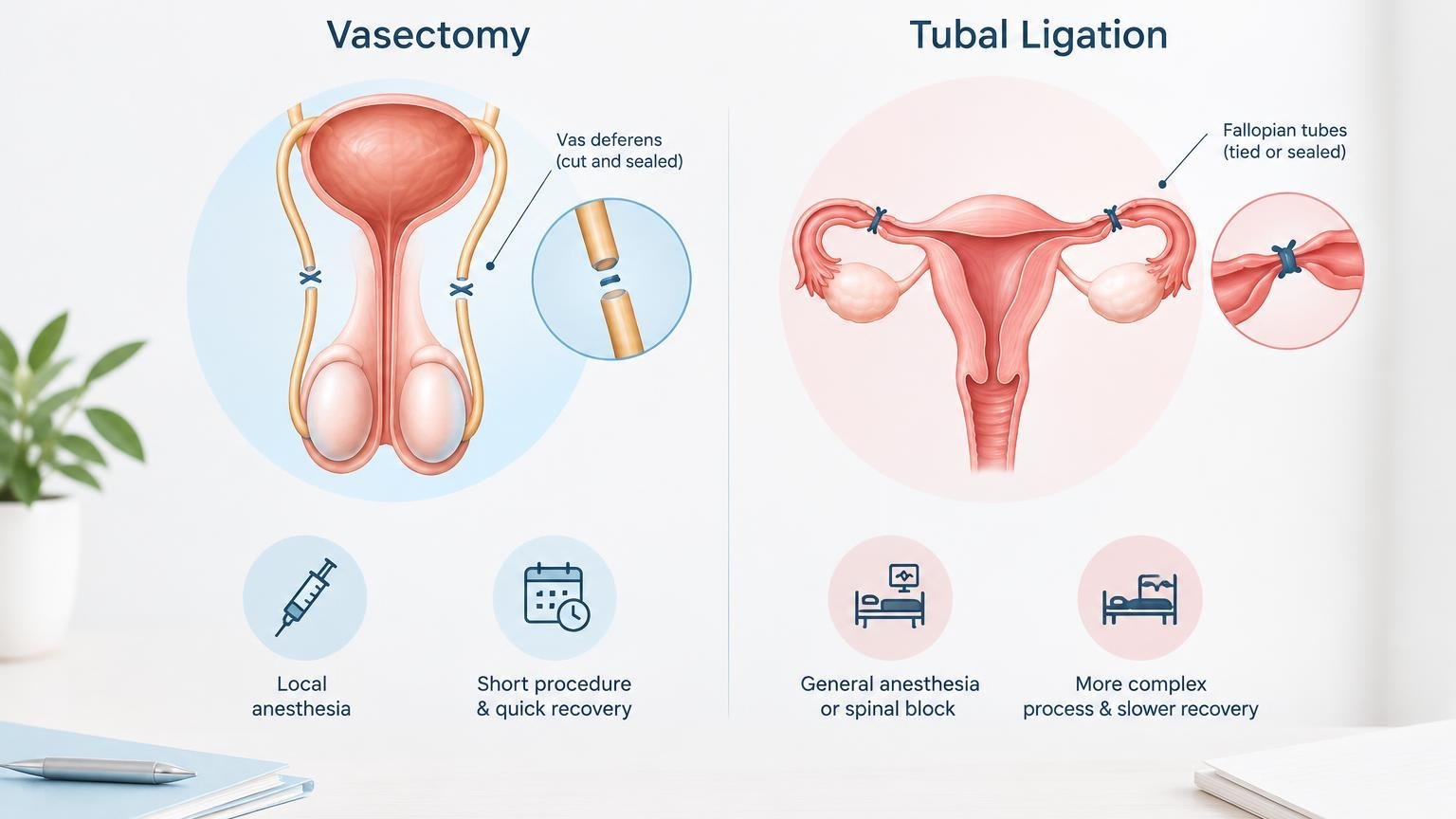
Vasectomy and tubal ligation are both described as methods for people who have decided not to have more children, but they act on different anatomy. Vasectomy involves cutting and sealing the vas deferens, the tube that carries sperm; tubal ligation involves tying or sealing the fallopian tubes. The general information article used for this explainer presents vasectomy as the shorter, simpler procedure, performed with local anesthesia and followed by quicker recovery, while tubal ligation is described as minor surgery requiring general anesthesia or a spinal block, with a more complex process and slower recovery.[1]
That contrast is the heart of most couple-level discussions, but it comes with an important caveat: the source is a single general information article. It contains no study data, no complication rates and no comparison of pregnancy or regret outcomes. It should therefore be treated as a description of how the procedures differ in principle, not as proof that one method is clinically superior for a particular couple.
Why This Distinction Matters
Sterilization is usually chosen when a couple regards their family as complete. The article describes sterilization as one of the most effective permanent birth control methods for couples who have definitively decided not to have more children, and it stresses that this is a long-term decision: couples should be sure there are no plans for more children and should consult a doctor first.
Because the decision is intended to be permanent, the practical details matter more than for a reversible method. Who undergoes the procedure, how much anesthesia is involved, how long recovery takes and what risks are attached all shape the decision. The article's own framing reflects this: when risk and convenience are the priority, it suggests male sterilization is often the more suitable option, and it places joint discussion between both partners as the most important element of the choice.
How the Two Procedures Work
The two operations interrupt the path of gametes in different places. In vasectomy, the vas deferens is cut and sealed, so sperm are prevented from joining the rest of the ejaculate. The article notes that semen ejaculation continues normally after vasectomy but without sperm. In tubal ligation, the fallopian tubes are tied or sealed, which interrupts the passage of the egg through the tube. Both are mechanical interruptions of fertility rather than hormonal treatments, and both are presented as permanent.
The downstream implications of that anatomy differ. Because vasectomy does not stop semen production or ejaculation, the visible aspect of ejaculation is unchanged apart from the absence of sperm. Because tubal ligation is an abdominal procedure in the article's description, its practical burden is framed around surgery and anesthesia rather than around ejaculation. For readers who want a closer look at how vasectomy is performed and how its success is later confirmed, a separate explainer on how vasectomy works and how success is confirmed covers that ground.
Anesthesia, Procedure Burden and Recovery
The clearest contrast in the source lies in anesthesia. Vasectomy is described as using local anesthesia, with no need for general anesthesia. Tubal ligation is described as requiring minor surgery with general anesthesia or a spinal block. This is a difference in kind, not just in degree: local anesthesia numbs a specific area while the person remains awake, whereas general anesthesia and spinal block are forms of regional or systemic anesthesia that require a more involved clinical setting.
The source pairs anesthesia with recovery. Vasectomy is described as having a short surgery time and quick recovery. Tubal ligation is described as a more complex process with slower recovery. Neither statement comes with a number: the article gives no minutes for surgery, no days for recovery and no definition of what counts as recovery. The comparison is therefore directional rather than measurable, and readers should not convert it into expectations such as a specific number of days off work.
What the Evidence Shows About Risk
On risk, the article describes vasectomy as low risk with minimal complications, and it states that tubal ligation carries higher risk from anesthesia or surgery. Read carefully, that second statement is specifically about anesthesia and surgical risk, not about every possible outcome of either method. It also does not quantify the gap: no percentages, no absolute risks and no comparison of serious versus minor events are provided.
This matters for how couples use the information. A qualitative statement that one procedure carries lower anesthesia and surgical risk is clinically plausible as a general orientation, because local anesthesia and a shorter, less invasive procedure carry a different risk profile from general or spinal anesthesia and abdominal surgery. But the source does not establish the size of that difference, and it does not address long-term outcomes after either procedure. The absence of data is an evidence gap, not evidence that the risks are identical.
Readers should also keep in mind that risk is person-specific. Age, health conditions, body weight, previous abdominal surgery, anesthetic history and anatomy all influence how a given procedure is likely to go. A general article cannot account for those factors, and a clinician assessing an individual couple can.
When One Procedure May Be Favored
The source offers two practical considerations. First, it suggests that if the couple is weighing risk and convenience, male sterilization is often more suitable, a recommendation framed around the lighter anesthesia and recovery burden described above rather than around outcome data. Second, it notes that if the woman is already undergoing a cesarean section, female sterilization can be considered at the same time, which avoids a separate operation.
That second point is about timing and opportunity, not about superiority. It illustrates a general principle in surgical planning: combining procedures can reduce the total burden of anesthesia and recovery when a person is already having surgery. It does not mean tubal ligation is preferable in other circumstances, and the source gives no outcome data for sterilization performed during cesarean delivery.
What the Source Does Not Tell You
The article's statements are descriptive and comparative in tone, but they rest on no presented study. It does not report failure rates for either method, time to confirmed sterility, regret or reversal rates, or complications broken down by type or severity. It does not address cost, access, waiting times, legal requirements or counseling standards. Its claims that vasectomy is low risk and that tubal ligation carries higher risk from anesthesia or surgery have no supporting citations in the text.
The article's suggestion that male sterilization is often more suitable is an editorial recommendation, not a finding derived from the data it presents. Similarly, its statement that sterilization is one of the most effective permanent methods is a general assertion rather than a result from a study. These distinctions do not make the article wrong, but they limit what can be concluded from it.
A Comparison at a Glance
| Feature | Vasectomy (male sterilization) | Tubal ligation (female sterilization) |
|---|---|---|
| Anatomical target | Vas deferens is cut and sealed | Fallopian tubes are tied or sealed |
| Anesthesia described | Local anesthesia; no general anesthesia required | Minor surgery with general anesthesia or spinal block |
| Procedure and recovery | Short surgery time; quick recovery | More complex process; slower recovery |
| Risk description | Low risk with minimal complications | Higher risk from anesthesia or surgery |
| Effect on ejaculation | Normal semen ejaculation but without sperm | Not addressed in the source |
| Situation favoring it | Suggested when risk and convenience are the priority | Can be considered during a cesarean section |
The table summarizes how the single source describes the two procedures. Every entry is qualitative; the source provides no numerical complication rates, durations or failure rates for either method.
How Couples Can Use This Information
The source's most direct advice is procedural rather than technical: the decision should be joint, and it should be made only after both partners are confident they want no more children, with medical consultation beforehand. That framing is consistent with the permanence of both procedures. A couple considering sterilization could reasonably use the contrasts above to structure a clinical conversation: which procedure is being proposed, what anesthesia it would require, what the recovery is likely to involve, and which risks are relevant to this particular couple's health.
It is also worth asking about what happens after the procedure, such as how success is checked and what follow-up is needed; for couples considering vasectomy, a dedicated explainer on vasectomy effectiveness, sperm testing before stopping contraception, recovery and permanence sets out those aftercare points. The general source used here does not cover them.
Key Takeaways
- Vasectomy cuts and seals the vas deferens; tubal ligation ties or seals the fallopian tubes.
- The source describes vasectomy as local-anesthesia, short and quick to recover from, and tubal ligation as minor surgery under general anesthesia or spinal block with a more complex process and slower recovery.
- The source characterizes vasectomy as low risk with minimal complications and tubal ligation as carrying higher risk from anesthesia or surgery, without giving rates or citations.
- It suggests male sterilization is often more suitable when risk and convenience are the priority, and that female sterilization can be considered during a cesarean section.
- Because sterilization is a permanent decision, the source advises certainty about future children, joint discussion between partners and prior medical consultation.
Questions and Answers
What is the difference between a vasectomy and tubal ligation?
Both are permanent sterilization methods that interrupt fertility mechanically. A vasectomy cuts and seals the vas deferens so semen is ejaculated without sperm, while tubal ligation ties or seals the fallopian tubes. The source describes vasectomy as a local-anesthesia procedure with quick recovery and tubal ligation as minor surgery under general anesthesia or spinal block.
Which sterilization method is described as requiring less anesthesia?
The source describes vasectomy as using local anesthesia with no need for general anesthesia. Tubal ligation is described as requiring minor surgery with general anesthesia or a spinal block. That is a difference in the type of anesthesia, but the article provides no data on anesthesia-related complication rates for either method.
How does recovery compare after vasectomy and tubal ligation?
The source characterizes vasectomy as having a short surgery time and quick recovery, and tubal ligation as a more complex process with slower recovery. No specific durations are given, so this should be read as a general contrast rather than a predicted number of days or weeks for either procedure.
Is vasectomy lower risk than tubal ligation?
The source characterizes vasectomy as low risk with minimal complications and states that tubal ligation carries higher risk from anesthesia or surgery. However, it provides no rates, no severity breakdown and no citations, so the comparison is qualitative. Individual risk can also depend on health history and the clinical setting.
When might female sterilization be preferred over male sterilization?
The source offers one specific situation: if the woman is already having a cesarean section, female sterilization can be considered at the same time, avoiding a separate procedure. It otherwise suggests that when risk and convenience are the priority, male sterilization is often more suitable. Both points are general guidance, not findings from presented study data.
What should a couple discuss before choosing sterilization?
The source emphasizes that joint discussion between both partners is the most important factor. It advises being certain there are no plans for more children, since sterilization is a long-term decision, and consulting a doctor first. It gives no information on failure rates, regret rates, cost or access, so those questions need clinical or service-specific answers.
Sources and References
SANYUN Science Center explains published research on men's reproductive and sexual health, connecting scientific evidence with everyday questions while making sources and limitations clear.
Disclaimer: This article is for scientific education and research communication only. It does not provide medical advice, diagnosis, or individualized treatment recommendations, and does not endorse any medication, supplement, device, penile enlargement procedure, or other intervention. Decisions about sexual and reproductive health should be made in consultation with a qualified healthcare professional. Do not delay seeking professional care because of information in this article.
Original Content & Copyright Notice
- This article is prepared for SANYUN Science Center, drawing on published research and publicly available academic literature on men’s sexual and reproductive health. Its editorial explanations and presentation are developed for this platform.
- Copyright in the original editorial content, selection, and arrangement is reserved by SANYUN Science Center to the extent protected by applicable law. Referenced research, quotations, and third-party materials remain subject to the rights of their respective owners. This notice does not claim ownership of scientific facts or third-party research.
- Except where permitted by applicable law or an applicable license, prior written permission is required to reproduce, republish, translate, adapt, redistribute, or commercially reuse protected content. Attribution alone does not grant permission for such reuse.
- For permitted quotation or authorized reuse, clearly identify the source and retain a link to the original article.
- Source: SANYUN Science Center
- Original URL: Retain the original article URL on science.san-yun.com.
- Copyright Holder: SANYUN Science Center, for its own protected editorial content.
- Quotation, excerpts, or authorized reuse must not distort the scientific meaning, omit material limitations or disclaimers, or imply unverified medical claims, product efficacy, or endorsement by SANYUN Science Center.



