




Category: Latest Research
Core Research Direction: Men's beliefs, treatment-utilisation patterns and barriers/enablers shaping use of erectile dysfunction treatments
Search Intent: Why do men stop or avoid erectile dysfunction treatment, and what factors are associated with continued use?
Platform: SANYUN Science Center
Evidence reviewed through: 2026-11-20
Executive Summary
Erectile dysfunction treatment can improve quality of life, yet many men never start it or stop it early. A systematic review published in January 2021 examined 50 studies to map how often men use erectile dysfunction treatments and what barriers and enablers they report.[1][2]
The review found wide variation in discontinuation: 4.4% to 76% for phosphodiesterase type 5 inhibitors, 18.6% to 79.9% for intracavernosal injections, and 32% to 69.2% for urethral suppositories. Among men with a penile prosthesis, 30% discontinued having sex for reasons such as device complications, lack of a partner or loss of sexual interest.
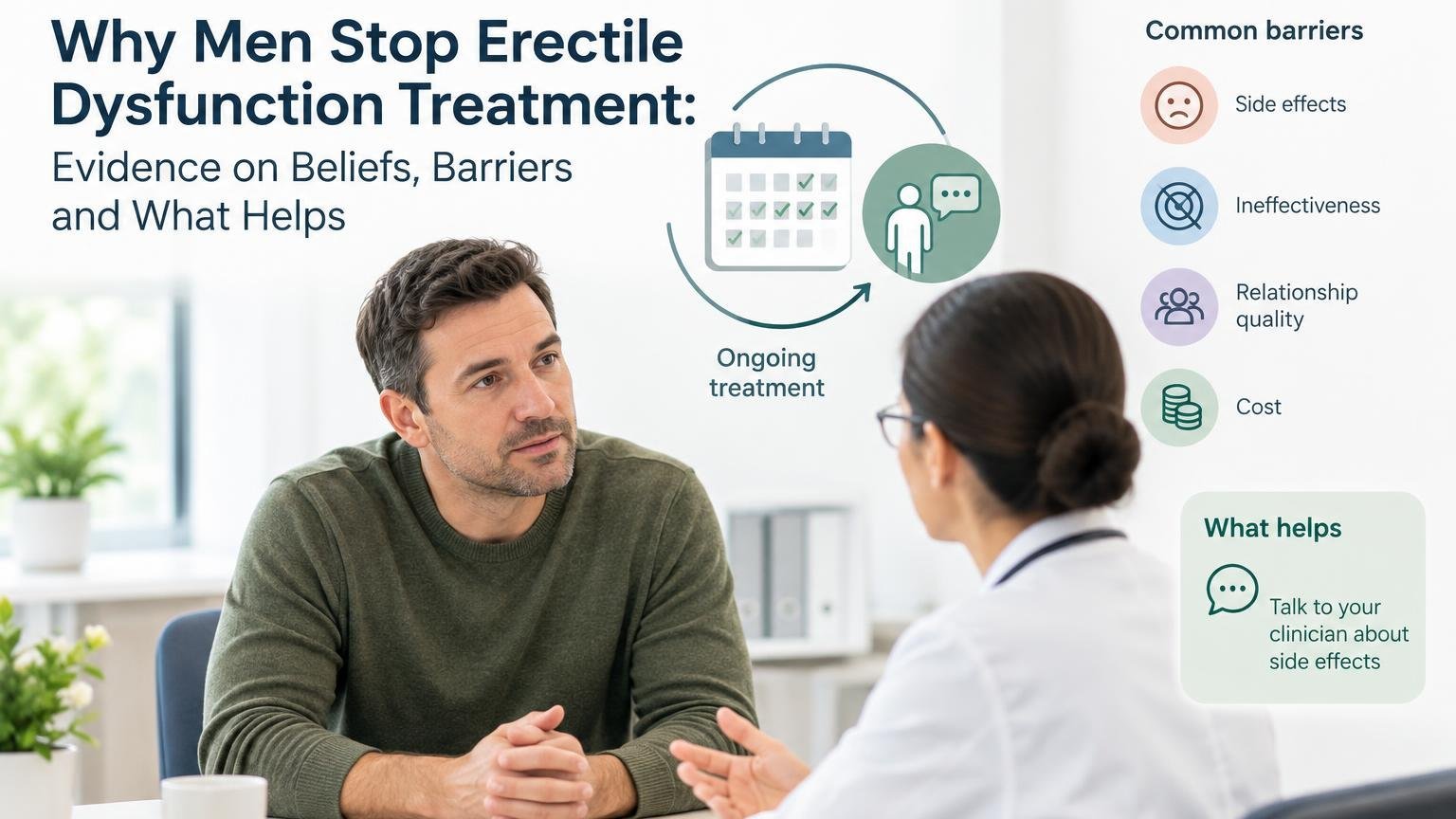
The most prevalent barriers were treatment ineffectiveness, side effects, the quality of men's intimate relationships and treatment costs. The most salient enabler was communication: men who reported side effects to a healthcare professional were significantly less likely to discontinue treatment. However, the included studies did not use validated measures of utilisation or barriers, and none applied psychological theory, so the findings describe associations rather than proven causes.
Why This Matters
Erectile dysfunction is common, and effective treatments exist. The review's framing is that successful treatment is associated with improvements in quality of life, but treatment utilisation remains sub-optimal. That gap matters because a treatment that is never started, or is abandoned after a short trial, cannot deliver its potential benefit.
The review also suggests that men's beliefs about erectile dysfunction and its treatment are potentially modifiable. If beliefs such as fear of side effects, doubts about effectiveness or embarrassment shape whether men seek care, then clinicians have a plausible route to support better treatment use. This remains an interpretive proposal rather than a tested intervention.
For readers trying to understand their own options, the distinction between a treatment that does not work and a treatment that was stopped too early, used incorrectly or never discussed with a clinician is important. The evidence here does not establish which scenario applies to any individual.
What the Review Examined
The systematic review aimed to identify rates of erectile dysfunction treatment utilisation and the barriers and enablers men experience when using treatment. Its authors searched MEDLINE, Embase, the Cochrane Library, AMED, HMIC, HTA, CINAHL, PsycARTICLES and PsycINFO through August 2018, and included 50 studies.
The search cut-off matters for interpretation. This is not a current-year study; it is a peer-reviewed synthesis of evidence available up to August 2018, published in January 2021. Any subsequent changes in treatment options, costs or online information environments are not captured.
How Often Men Discontinue Treatment
The headline finding is heterogeneity. Discontinuation rates ranged from 4.4% to 76% for phosphodiesterase type 5 inhibitors, from 18.6% to 79.9% for intracavernosal injections, and from 32% to 69.2% for urethral suppositories. Such wide ranges indicate that the studies differed substantially in populations, settings, definitions and follow-up.
For men with a penile prosthesis, 30% discontinued having sex for reasons such as device complications, lack of a partner or a loss of sexual interest. This figure concerns stopping sex rather than stopping a medication, and the source does not specify the denominator, so it should not be treated as a precise device-failure rate.
| Treatment or outcome | Reported range or value | Population or context | Interpretation |
|---|---|---|---|
| PDE5 inhibitor discontinuation | 4.4% to 76% | Men using phosphodiesterase type 5 inhibitors across included studies | Very wide range suggests differences in definitions, settings and follow-up |
| Intracavernosal injection discontinuation | 18.6% to 79.9% | Men using intracavernosal injections | Discontinuation is common in some studies but not uniformly high |
| Urethral suppository discontinuation | 32% to 69.2% | Men using urethral suppositories | Substantial attrition reported across studies |
| Discontinued having sex with a penile prosthesis | 30% | Men with a penile prosthesis | Reasons include device complications, lack of partner or loss of sexual interest; denominator not specified |
Barriers Men Report
The most prevalent barriers to utilisation were treatment ineffectiveness, side effects, the quality of men's intimate relationships and treatment costs. These are not interchangeable: ineffectiveness and side effects concern the treatment itself, relationship quality concerns the context in which sex occurs, and cost concerns access.
The review notes that most included research examined barriers and therefore focused on reasons for discontinuing treatment, while only a small number explored factors men found helpful. This asymmetry means the evidence base is stronger for describing why men stop than for explaining how to help them continue.
A separate survey table, not part of the systematic review, illustrates how beliefs and access can interact. Among respondents who gave reasons for not seeking medical consultation, social embarrassment was cited 70 times (29.8%), satisfaction with self-medication 73 times (31.0%), and concern about harmful effects of medications 61 times (26.0%); multiple responses were allowed among 235 respondents.[3]
The same survey found that 158 respondents (41.1%) considered sexual enhancers unsafe, compared with 114 (29.7%) who considered them safe and 112 (29.2%) who were uncertain. These perceptions are relevant context for conversations about treatment, but the supplied table does not describe the survey's sampling or methods, so the figures cannot be generalised with confidence.
The survey table also reported that 190 of 384 respondents (49.5%) perceived a need for erectile dysfunction treatment, 181 (47.1%) reported using medication for erectile dysfunction, and 180 (46.9%) had consulted at male clinics for erectile dysfunction. These overlapping categories are not a care cascade, and the table does not establish why some men who perceived a need did not use medication.
What Helped: Communication About Side Effects
The most salient enabler finding was that men who reported side effects to a healthcare professional were significantly less likely to discontinue treatment. This is an association, not proof that disclosure itself prevents discontinuation. Men who feel comfortable talking to a clinician may differ in other ways, such as having a better relationship with their provider or more severe symptoms.
For clinical practice, the finding supports a simple conversational habit: asking about side effects and making it easier for men to raise them. A side effect that is not mentioned cannot be managed, and an unexplained side effect may be interpreted as a reason to stop. The review does not test a specific communication intervention, so the practical implication is a hypothesis for care rather than a validated protocol.
The review's authors also highlight the importance of men's beliefs about erectile dysfunction and its treatment, proposing that beliefs are potentially modifiable and therefore relevant to how healthcare professionals support men. That framing is plausible but not directly tested in the included studies.
Interpreting the Evidence and Its Limits
The review's own methodological assessment is important. The included studies did not use validated measures of treatment utilisation or of barriers and enablers, and no study used psychological theory to inform the examination of factors influencing utilisation. These gaps affect how much weight the findings can bear.
Without validated measures, a study's definition of discontinuation may vary from another's. A man who stopped and restarted treatment might be counted differently from one who stopped permanently. Similarly, a barrier such as cost may be measured as a reason for discontinuation, a reason for not starting, or a general concern, and these are not equivalent.
The absence of psychological theory also limits explanation. The review can list barriers and enablers, but it cannot say how beliefs, intentions and behaviour connect over time. That is a gap for future research rather than a flaw that invalidates the descriptive findings.
Publication timing adds another boundary. The literature search ended in August 2018, and the review appeared in January 2021. It should be read as a synthesis of evidence up to that point, not as a statement about the current treatment landscape. The survey table provides a cross-sectional snapshot but lacks the methodological detail needed for causal inference.
Research Outlook
The review points toward several research priorities: validated measures of erectile dysfunction treatment utilisation, validated measures of barriers and enablers, and theory-informed studies that examine how beliefs translate into starting, continuing or stopping treatment. It also highlights the need to study enablers more directly rather than inferring them from reasons for discontinuation.
A clinically relevant question is whether structured communication about side effects and expectations improves continuation. The review's enabler finding supports testing that question, but it does not answer it. Until such trials exist, clinicians and patients should treat the finding as a reason to talk openly rather than as a guarantee.
Readers who want to understand why erectile dysfunction deserves clinical attention beyond the prescription itself may find a broader perspective on erectile dysfunction as a health signal useful, while those interested in cost as a practical barrier can explore out-of-pocket costs of recommended treatments.
Key Takeaways
- A 2021 systematic review of 50 studies found that erectile dysfunction treatment discontinuation varies widely, from 4.4% to 76% for PDE5 inhibitors, 18.6% to 79.9% for intracavernosal injections and 32% to 69.2% for urethral suppositories.
- The most prevalent barriers were treatment ineffectiveness, side effects, the quality of intimate relationships and cost; most included studies examined barriers rather than enablers.
- Men who reported side effects to a healthcare professional were significantly less likely to discontinue treatment, but this is an association and not proof of cause and effect.
- Included studies lacked validated measures and psychological theory, so the review describes patterns rather than explaining behaviour; its search ended in August 2018.
- A separate survey table reported that 41.1% of respondents considered sexual enhancers unsafe and 29.8% of responses cited social embarrassment as a reason for not seeking consultation, but its sampling and methods were not described in the supplied material.
Questions and Answers
Why do men stop taking erectile dysfunction medication?
A 2021 systematic review of 50 studies found the most prevalent barriers were treatment ineffectiveness, side effects, the quality of men's intimate relationships and treatment costs. Discontinuation rates varied widely, from 4.4% to 76% for PDE5 inhibitors. The included studies did not use validated measures, so these are reported reasons and associations rather than proven causes.
What are common barriers to seeking erectile dysfunction treatment?
The systematic review identified perceived ineffectiveness, side effects, relationship quality and cost as the most prevalent barriers. A separate survey table reported social embarrassment in 29.8% of responses and concern about harmful medication effects in 26.0% as reasons for not seeking consultation. That survey's sampling and methods were not described in the supplied material, limiting generalisation.
Does talking to a doctor about side effects help men continue ED treatment?
The review found that men who reported side effects to a healthcare professional were significantly less likely to discontinue treatment. This was the most salient enabler finding, but it is an association rather than proof that disclosure prevents discontinuation. No included study tested a specific communication intervention, so the finding supports open conversation rather than a validated protocol.
How strong is the evidence on erectile dysfunction treatment discontinuation?
The evidence is descriptive and heterogeneous. The review included 50 studies, but they did not use validated measures of utilisation or barriers and enablers, and none applied psychological theory. Discontinuation ranges were very wide, and the literature search ended in August 2018. The findings are useful for identifying patterns but cannot establish causation or precise rates.
What percentage of men discontinue PDE5 inhibitors for erectile dysfunction?
Across the included studies, discontinuation rates for phosphodiesterase type 5 inhibitors ranged from 4.4% to 76%. This wide range reflects differences in study populations, settings, definitions and follow-up rather than a single reliable estimate. The review's authors note that studies did not use validated measures of treatment utilisation.
What do men believe about the safety of erectile dysfunction medications?
In one survey table, 158 respondents (41.1%) considered sexual enhancers such as Viagra and Snafi unsafe, 114 (29.7%) considered them safe and 112 (29.2%) were uncertain. These beliefs may shape whether men seek care, but the supplied table does not describe the survey's population or methods, so the figures should be interpreted cautiously.
Sources and References
- Williams Paul; McBain Hayley; Amirova Aliya; Newman Stanton; Mulligan Kathleen. Men's beliefs about treatment for erectile dysfunction-what influences treatment use? A systematic review (Mulligan, Newman, 2021) | East London NHS Foundation Trust. International journal of impotence research. 2021 33(1):16-42
- Paul Williams; Hayley McBain; Aliya Amirova; Stanton Newman; Kathleen Mulligan. Men's beliefs about treatment for erectile dysfunction-what influences treatment use? A systematic review. International Journal of Impotence Research. 2021 33(1):16-42 DOI: 10.1038/s41443-020-0249-1.
- Table 3..
SANYUN Science Center explains published research on men's reproductive and sexual health, connecting scientific evidence with everyday questions while making sources and limitations clear.
Disclaimer: This article is for scientific education and research communication only. It does not provide medical advice, diagnosis, or individualized treatment recommendations, and does not endorse any medication, supplement, device, penile enlargement procedure, or other intervention. Decisions about sexual and reproductive health should be made in consultation with a qualified healthcare professional. Do not delay seeking professional care because of information in this article.
Original Content & Copyright Notice
- This article is prepared for SANYUN Science Center, drawing on published research and publicly available academic literature on men’s sexual and reproductive health. Its editorial explanations and presentation are developed for this platform.
- Copyright in the original editorial content, selection, and arrangement is reserved by SANYUN Science Center to the extent protected by applicable law. Referenced research, quotations, and third-party materials remain subject to the rights of their respective owners. This notice does not claim ownership of scientific facts or third-party research.
- Except where permitted by applicable law or an applicable license, prior written permission is required to reproduce, republish, translate, adapt, redistribute, or commercially reuse protected content. Attribution alone does not grant permission for such reuse.
- For permitted quotation or authorized reuse, clearly identify the source and retain a link to the original article.
- Source: SANYUN Science Center
- Original URL: Retain the original article URL on science.san-yun.com.
- Copyright Holder: SANYUN Science Center, for its own protected editorial content.
- Quotation, excerpts, or authorized reuse must not distort the scientific meaning, omit material limitations or disclaimers, or imply unverified medical claims, product efficacy, or endorsement by SANYUN Science Center.



