




Category: Clinical Insights
Core Research Direction: The 2026 AUA guideline's evidence-based evaluation and management framework for lower urinary tract symptoms attributed to benign prostatic hyperplasia in adult men (Part I evaluation; Part II medical therapy; Part III procedural therapy)
Search Intent: What does the 2026 AUA guideline recommend for evaluating and treating lower urinary tract symptoms attributed to BPH, and how strong is the evidence behind each recommendation?
Platform: SANYUN Science Center
Evidence reviewed through: 2026-11-21
Executive Summary
The American Urological Association released its 2026 guideline on lower urinary tract symptoms attributed to benign prostatic hyperplasia on May 7, 2026, replacing the 2023 version and organizing its recommendations across three linked publications: presentation and evaluation, medical management, and procedural or surgical management. The three parts share a single systematic review, built from searches of major bibliographic and Cochrane databases through January 2025, with update searches run on December 15, 2025.[1][2][3]
Two features of the document matter more than any single recommendation. First, the guideline defines its subject carefully: benign prostatic hyperplasia is proliferation of glandular and stromal tissue within the prostate transition zone, but non-neurogenic lower urinary tract symptoms can arise from bladder, prostate, urethral or other pathology, so prostate enlargement alone does not explain every symptom. Second, bother rather than prostate size is presented as the main reason men seek care and the main driver of management decisions, which places shared decision-making at the center of both initiating and escalating treatment.[4]
The grade structure is the most useful lens for a reader trying to judge certainty. Strong, Grade A recommendations anchor the drug and surgical core: three uroselective alpha blockers, 5-alpha reductase inhibitors in men above volume or PSA thresholds, transurethral resection of the prostate, and laser enucleation. Many equally consequential steps, including the entire four-element core workup, are labeled Clinical Principle, a consensus designation that is not an evidence grade. Others rest on Expert Opinion. The article below separates those tiers rather than presenting every line of the guideline as equally established.
Why This Matters
Lower urinary tract symptoms attributed to BPH sit at the intersection of primary care, urology and, increasingly, interventional radiology. The 2026 update adds or repositions options that patients may encounter in direct-to-consumer material, including prostate artery embolization, robotic waterjet treatment and temporary implants, while explicitly declining to endorse high-intensity focused ultrasound or cryoablation outside a clinical trial. A reader who understands which options carry Grade A support and which rest on expert consensus is better equipped to ask useful questions and to resist the assumption that a newer device is a better-evidenced one.[5]
The guideline also reframes the diagnostic pathway. Because isolated storage symptoms without voiding symptoms are not typically BPH-related, the initial evaluation is explicitly a differential-diagnosis exercise, and the guideline builds in structured checkpoints: re-evaluation within six months of starting treatment, at least one year of follow-up after a procedure, and a defined pathway when symptoms fail to improve.
Mechanistic and Clinical Background
The biological rationale behind the two dominant drug classes follows directly from the definition. Alpha blockers relax smooth muscle at the bladder neck and prostate, widening the channel without changing gland size, which is why symptom relief is typically rapid. The three uroselective agents endorsed in the guideline – alfuzosin, silodosin and tamsulosin – produce broadly similar symptomatic improvement, so the recommendation explicitly steers selection toward adverse-effect profiles, patient preference and comorbidities rather than toward differences in efficacy.
5-alpha reductase inhibitors act on the growth axis instead. A secondary educational summary describes them as blocking conversion of testosterone to dihydrotestosterone and reducing prostate volume by roughly 20 to 25 percent over 6 to 12 months, with downstream reductions in retention and surgery risk. That mechanism narrative is plausible and consistent with the guideline's threshold-based recommendation, but the packet does not supply the primary trial data behind the percentage, so the figure should be read as a secondary-source estimate rather than a verified pooled effect.
Tadalafil occupies a different niche. A secondary source cites a Cochrane review of four randomized trials with 933 participants reporting tadalafil as similarly effective to alpha blockers for symptom improvement, attributed to phosphodiesterase-5 inhibition raising cGMP and relaxing smooth muscle across bladder, prostate and urethra. The guideline itself endorses daily 5 mg tadalafil with or without erectile dysfunction at Grade B. Because the underlying review is not in the packet, the comparative claim is best described as a secondary summary of moderate-certainty evidence, not an independently verified head-to-head finding.
What the Evidence Shows: Evaluation
Part I establishes a four-element core workup: medical history, physical examination, standardized symptom scores and urinalysis. This is designated a Clinical Principle, meaning the panel judged the benefit clear enough not to require grading rather than that high-quality trials compared workup strategies. Prostate-specific antigen testing is deliberately reframed as a shared-decision option rather than a routine item, and post-void residual or uroflowmetry are positioned as tools to assess retention or exclude other disorders, with urodynamics reserved for genuine diagnostic uncertainty or worsening during follow-up.
The pre-procedural requirements are similarly structured. Before any intervention, post-void residual measurement and imaging of prostate volume and shape are recommended, with cystoscopy optional. These steps matter because nearly every procedural recommendation downstream is keyed to prostate size or anatomy, so the imaging requirement is what makes size-contingent guidance operational.
What the Evidence Shows: Medical and Procedural Therapy
The following table compares representative recommendations across the three parts, preserving the guideline's own grading language rather than harmonizing certainty.
| Recommendation area | Guideline wording and grade | Population or threshold | Interpretation |
|---|---|---|---|
| Behavioral and lifestyle interventions | Moderate Recommendation; Grade B | All patients with LUTS/BPH | Recommended before or alongside drug therapy |
| Uroselective alpha blocker (alfuzosin, silodosin, tamsulosin) | Strong Recommendation; Grade A | Patients with LUTS/BPH | Similar symptom relief across agents; choose on adverse effects and comorbidity |
| Daily tadalafil 5 mg | Moderate Recommendation; Grade B | With or without erectile dysfunction | Monotherapy option; combinations carry weaker Grade C support |
| 5-alpha reductase inhibitor | Moderate Recommendation; Grade A for symptom relief | Prostate volume >30 cc and/or PSA >1.5 ng/mL | Progression-risk reduction is a Clinical Principle, not separately graded here |
| 5-ARI plus alpha blocker | Moderate Recommendation; Grade B | Meeting volume and/or PSA threshold | Combination reserved for men above the size or PSA threshold |
| Anticholinergic or beta-3 agonist for storage symptoms | Conditional Recommendation; Grade C | Moderate to severe predominant storage LUTS | May be used alone or with an alpha blocker; weaker evidence |
| TURP or laser enucleation (HoLEP, ThuLEP) | Strong Recommendation; Grade A | Surgical candidates | Core Grade A procedural options |
| Prostate artery embolization | Conditional Recommendation; Grade B | Prostate 50 cc or larger | Requires urologist assessment and trained interventional radiologist |
Three patterns emerge from this structure. The strongest grades cluster around long-established drug and surgical options. Newer minimally invasive technologies for prostates between 30 and 80 cc – water vapor thermal therapy, robotic waterjet treatment and prostatic urethral lift in men without an obstructing median lobe – sit at Grade B, with the waterjet extension to 80 to 150 cc resting on Expert Opinion alone. Size thresholds organize the procedural menu: transurethral incision for prostates under 30 cc without a median lobe, simple prostatectomy for glands above 80 cc, and a dense middle band of office and operating-room options in between.
Tadalafil-based combinations are graded lower than tadalafil monotherapy, at Conditional Recommendation and Grade C, and the same grade applies to bladder-targeted add-on therapy for predominant storage symptoms. That asymmetry is informative: it does not mean these combinations are ineffective, but that the panel judged the supporting evidence less robust or the trade-offs less settled than for the Grade A core.
Counseling, Safety and Special Populations
Several recommendations concern what clinicians must disclose rather than what they must prescribe. Patients planning cataract surgery should be counseled about intraoperative floppy iris syndrome with alpha blockers and encouraged to speak with their ophthalmologist. Men on active surveillance for prostate cancer should be told that 5-alpha reductase inhibitor therapy is unlikely to increase cancer progression risk, an Expert Opinion statement rather than a graded trial conclusion. Patients considering ejaculation-sparing procedures should understand that the tissue-preserving design of those technologies raises the risk of BPH-specific retreatment, again at Expert Opinion level.
Acute urinary retention receives its own pathway: optimize modifiable risk factors and give a uroselective alpha blocker for at least three days before a voiding trial, with counseling that successfully passing the trial still leaves elevated risk of recurrence. For men at high bleeding risk or requiring anticoagulant or antiplatelet therapy, holmium or thulium enucleation, photoselective vaporization or prostate artery embolization may be offered, though this is Expert Opinion rather than graded evidence. A secondary source reports that embolization was upgraded in the 2026 document; the packet's guideline summary shows it at Conditional Recommendation, Grade B, which supports describing it as an accepted rather than top-tier option.
Interpretation and Limitations
The central limitation is structural. The available evidence base is a systematic review restricted by publication date – medical therapy studies from 2009 onward and surgical studies from 2014 onward – so older randomized work that shaped clinical practice is not represented in the grading. That is a reasonable efficiency choice, but it means a Grade A label reflects the panel's appraisal of a filtered literature, not the totality of all evidence ever produced.
A second limitation concerns how recommendations are labeled. Clinical Principle and Expert Opinion designations appear on many of the most practically important statements: the core workup, PSA as a shared decision, the six-month reassessment, the pre-procedural imaging requirement, procedural indications in complicated disease, and the one-year post-procedure follow-up. These are consensus judgments about clear benefit, not products of comparative trials. Readers should not treat a long list of recommendations as a long list of proven interventions, and the guideline does not claim that they are.
A third limitation is source quality in this review. The packet includes two guideline-derived FAQ summaries and a journal abstract, but not the full guideline text, and several mechanistic and quantitative details – the 20 to 25 percent volume reduction, the tadalafil versus alpha blocker comparison, the non-selective alpha blocker contraindication – come from a commercial educational guide rather than the primary publications. Those details are presented here as secondary-source context and should carry correspondingly lower confidence. The packet also contains sources unrelated to BPH/LUTS, which were excluded.
Finally, this review is not a systematic review, meta-analysis or independent appraisal of the primary trials. It interprets a published guideline and its summaries. Where the guideline itself offers no pooled effect size, none is presented here, and no recommendation grade should be read as a quantified treatment benefit.
Research Outlook
The clearest evidence gaps follow the grade structure. Bladder-targeted add-on therapy for predominant storage symptoms and tadalafil-based combinations sit at Grade C, and the newest devices – temporary implants and intraprostatic drug-coated balloons – rest on Expert Opinion or Grade C with narrow anatomic criteria. Comparative and long-term data in these areas would move recommendations rather than merely refine them. The waterjet extension to prostates of 80 to 150 cc is explicitly Expert Opinion, and the guideline's own note that ejaculation-sparing procedures trade durability for tissue preservation invites head-to-head retreatment analyses.
Two further questions deserve attention. The first is how the six-month medical re-evaluation checkpoint and the one-year post-procedural follow-up perform in practice, since both are consensus-based and untested as strategies. The second is whether restricting the evidence search by publication year leaves clinically meaningful older trials outside the graded base, particularly for surgical comparisons that predate 2014.
Key Takeaways
- The 2026 AUA guideline replaced the 2023 version and spans evaluation, medical therapy and procedural care, built on a systematic review through January 2025 with update searches on December 15, 2025.
- Bother, not prostate size, drives care-seeking and management decisions, and shared decision-making is central to starting and escalating treatment.
- The strongest support covers three uroselective alpha blockers, 5-ARIs above volume or PSA thresholds, TURP and laser enucleation; many diagnostic and counseling steps are Clinical Principle or Expert Opinion rather than graded evidence.
- Recommendations are size- and anatomy-contingent, which is why pre-procedural imaging of prostate volume and shape is required before intervention.
- Tadalafil combinations and bladder-targeted add-on therapy carry Grade C support, and high-intensity focused ultrasound or cryoablation are not recommended outside clinical trials.
- Re-evaluate within six months of starting treatment and for at least one year after a procedure, using standardized symptom scores and adverse-event assessment.
Questions and Answers
What is benign prostatic hyperplasia and why does prostate enlargement alone not explain urinary symptoms?
Benign prostatic hyperplasia is proliferation of glandular and stromal tissue within the prostate transition zone, but the guideline stresses that non-neurogenic lower urinary tract symptoms may come from bladder, prostate, urethral or other pathology. That is why isolated storage symptoms without voiding symptoms are not typically BPH-related, and why the evaluation is framed as a differential-diagnosis exercise rather than an assumption of prostate causation.
What does the 2026 AUA guideline recommend as the initial evaluation for LUTS/BPH?
The core workup is medical history, physical examination, standardized symptom scores and urinalysis, designated a Clinical Principle rather than a graded evidence recommendation. Prostate-specific antigen testing is an option discussed through shared decision-making, not mandatory. Post-void residual or uroflowmetry may be used to assess retention or exclude other disorders, and urodynamics are reserved for diagnostic uncertainty or worsening during follow-up.
How strong is the evidence for alpha blockers, 5-alpha reductase inhibitors and tadalafil in BPH?
Alpha blockers are the strongest medical recommendation: alfuzosin, silodosin or tamsulosin at Strong Recommendation, Grade A, with similar symptom relief, so choice turns on adverse effects and comorbidity. 5-ARIs carry Grade A for symptom relief in men with prostate volume above 30 cc or PSA above 1.5 ng/mL. Daily tadalafil 5 mg is Grade B, with tadalafil-based combinations weaker at Grade C.
Which BPH procedures does the 2026 AUA guideline recommend, and how do prostate size thresholds shape the choice?
TURP and laser enucleation such as HoLEP or ThuLEP hold Strong Recommendation, Grade A. Prostate size then organizes the menu: transurethral incision for glands under 30 cc without a median lobe, water vapor thermal therapy, waterjet treatment and prostatic urethral lift for 30 to 80 cc, simple prostatectomy above 80 cc, and prostate artery embolization for 50 cc or larger at Conditional Recommendation, Grade B.
What are the main limitations of the evidence behind the 2026 AUA BPH/LUTS guideline?
The systematic review was limited to medical therapy studies published since 2009 and surgical studies since 2014, so older randomized evidence is excluded from grading. Many practically important steps, including the core workup, six-month reassessment, pre-procedural imaging and one-year post-procedure follow-up, are Clinical Principle or Expert Opinion rather than graded. Several quantitative details in secondary summaries were not verified against primary publications.
What should men on active surveillance for prostate cancer know about 5-alpha reductase inhibitors and BPH treatment?
The guideline states that men on active surveillance should be counseled that 5-ARI treatment is unlikely to increase prostate cancer progression risk, though this is an Expert Opinion statement rather than a graded trial conclusion. The guideline also allows procedural BPH treatment in this population at Expert Opinion level. Decisions should be individualized with both the urologist and the treating oncology team.
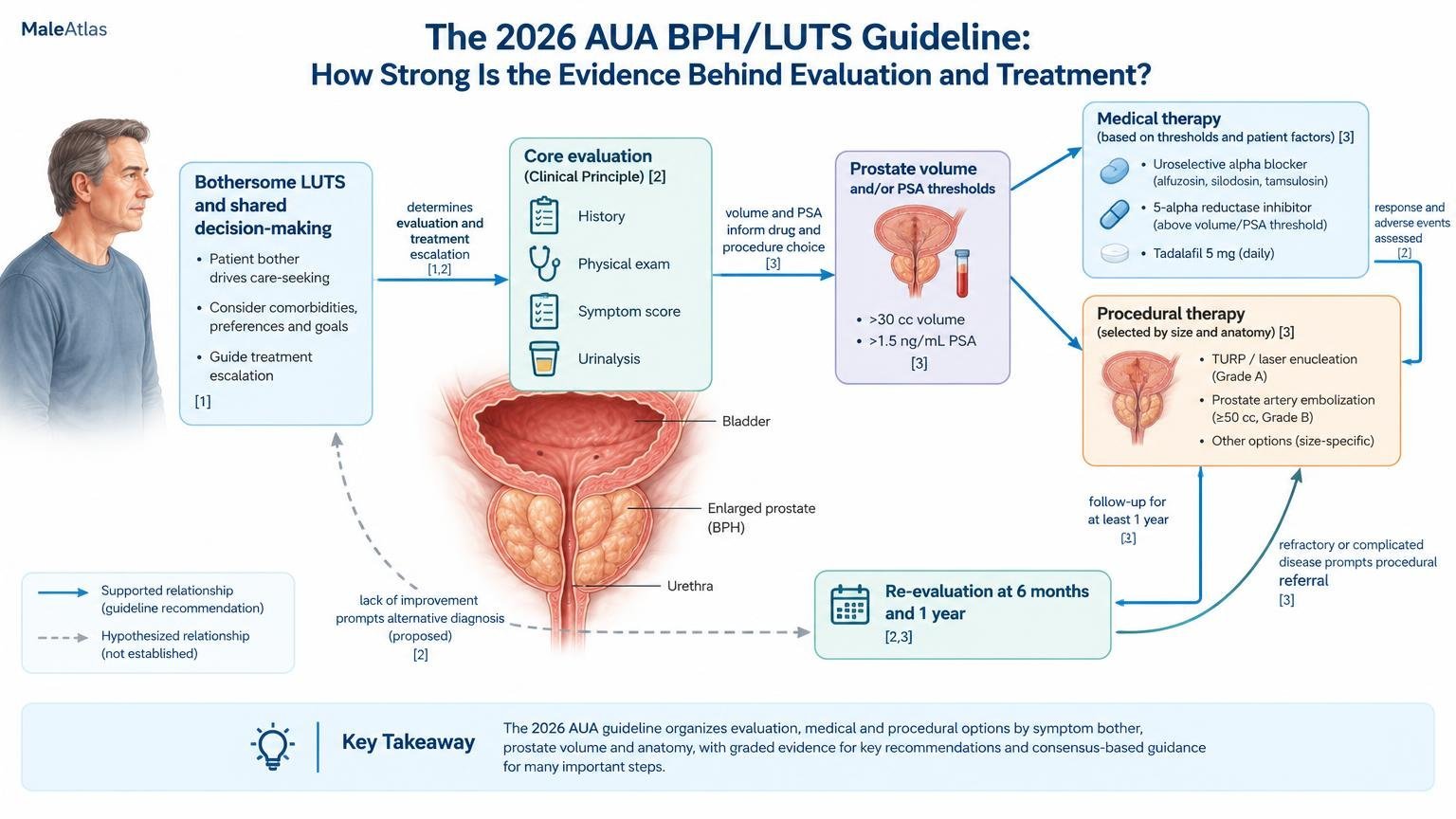
Conceptual framework: Conceptual framework, not a tested causal model. The figure organizes variables discussed in this review of the 2026 AUA LUTS/BPH guideline: patient bother and shared decision-making, the four-element evaluation, volume and PSA thresholds, medical therapy, size- and anatomy-contingent procedural options, and scheduled re-evaluation. Arrows indicate reported guideline relationships; the return path from re-evaluation to alternative diagnosis is proposed rather than established. Key limitation: many guideline steps are consensus-based, and the packet lacks the full guideline text.
Academic References & Evidence
- Ramy Goueli; Gopal H. Badlani; Charles Welliver; Paul D. Anderson; Scott R. Bauer; Tracy Dana; Rodrigo Donalisio da Silva; Rebecca Holmes; Sennett K. Kim; Erin Kirkby; Steven Maislos; Bradley C. Gill; Timothy McClure; Nicole L. Miller; Iraj Roshan; Stephen J. Summers; Annette Totten; Jaspreet S. Sandhu. Management of Lower Urinary Tract Symptoms Attributed to Benign Prostatic Hyperplasia: AUA Guideline (2026) Part I: Presentation and Evaluation. Journal of Urology. 2026 DOI: 10.1097/JU.0000000000005097.
- Goueli R; Badlani GH; Welliver C. FAQs: Presentation and evaluation of LUTS/BPH under the 2026 AUA guideline | Urology Times. J Urol. 2026 0(0) DOI: 10.1097/JU.0000000000005097.
- Goueli R; Badlani GH; Welliver C. FAQs: Medical and surgical management of LUTS/BPH under the 2026 AUA guideline | Urology Times. J Urol. 2026 0(0) DOI: 10.1097/JU.0000000000005098.
- Management of Benign Prostatic Hyperplasia: A New Guideline.
- Benign Prostatic Hyperplasia (BPH) & Lower Urinary Tract Symptoms: 2026 Treatment Guide.
SANYUN Science Center explains published research on men's reproductive and sexual health, connecting scientific evidence with everyday questions while making sources and limitations clear.
Disclaimer: This article is for scientific education and research communication only. It does not provide medical advice, diagnosis, or individualized treatment recommendations, and does not endorse any medication, supplement, device, penile enlargement procedure, or other intervention. Decisions about sexual and reproductive health should be made in consultation with a qualified healthcare professional. Do not delay seeking professional care because of information in this article.
Original Content & Copyright Notice
- This article is prepared for SANYUN Science Center, drawing on published research and publicly available academic literature on men’s sexual and reproductive health. Its editorial explanations and presentation are developed for this platform.
- Copyright in the original editorial content, selection, and arrangement is reserved by SANYUN Science Center to the extent protected by applicable law. Referenced research, quotations, and third-party materials remain subject to the rights of their respective owners. This notice does not claim ownership of scientific facts or third-party research.
- Except where permitted by applicable law or an applicable license, prior written permission is required to reproduce, republish, translate, adapt, redistribute, or commercially reuse protected content. Attribution alone does not grant permission for such reuse.
- For permitted quotation or authorized reuse, clearly identify the source and retain a link to the original article.
- Source: SANYUN Science Center
- Original URL: Retain the original article URL on science.san-yun.com.
- Copyright Holder: SANYUN Science Center, for its own protected editorial content.
- Quotation, excerpts, or authorized reuse must not distort the scientific meaning, omit material limitations or disclaimers, or imply unverified medical claims, product efficacy, or endorsement by SANYUN Science Center.



