




Category: Erectile Dysfunction
Core Research Direction: Antihypertensive drug exposure and erectile dysfunction: real-world pharmacovigilance signals versus evidence quality for ED treatments
Search Intent: Do different classes of blood-pressure medications carry different erectile dysfunction risks, and how strong is the underlying evidence?
Platform: SANYUN Science Center
Evidence reviewed through: 2026-11-27
Executive Summary
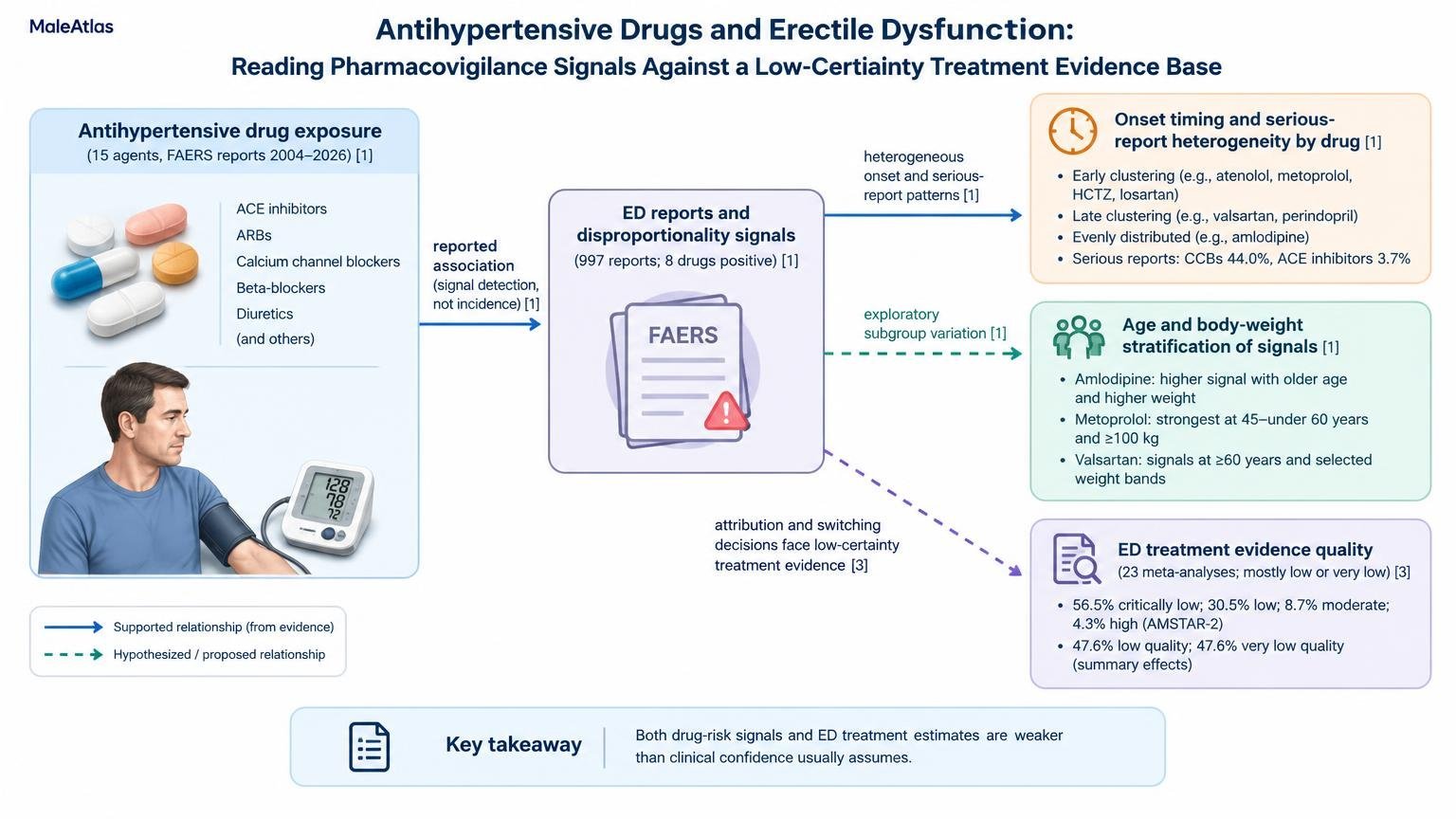
Do different blood-pressure medications carry different erectile dysfunction (ED) risks? A pharmacovigilance analysis published in China Pharmacy mined the US Food and Drug Administration Adverse Event Reporting System (FAERS) for ED reports linked to 15 antihypertensive drugs, covering the first quarter of 2004 through the first quarter of 2026. It included 997 reports, of which 931 involved male patients and 511 concerned ages 18 to under 65 years. Reports were most numerous for amlodipine (413), metoprolol (133) and valsartan (82). Three proportional disproportionality measures produced positive signals for 8 of the 15 drugs, including amlodipine and metoprolol.[1][2]
The analysis also reported heterogeneity that matters for interpretation. Onset timing clustered within 30 days for atenolol, candesartan, metoprolol, hydrochlorothiazide and losartan, but mostly beyond 360 days for valsartan and perindopril, and was spread evenly across periods for amlodipine. Of 835 serious reports, calcium channel blockers accounted for 44.0% and ACE inhibitors for 3.7%. Signal intensity varied by age and weight for amlodipine, metoprolol and valsartan. None of this estimates incidence and none of it establishes causation; spontaneous reporting captures what someone chose to report, not what happened in a defined population.
The treatment side of the question rests on a separate evidence base. An umbrella review of 23 published meta-analyses, available as a 2026 preprint with searches through October 2025, extracted 42 summary effects across 36 ED interventions. Using AMSTAR-2, 13 of 23 meta-analyses (56.5%) were rated critically low quality, 7 (30.5%) low, 2 (8.7%) moderate and 1 (4.3%) high. Of the 42 summary effects, 20 (47.6%) were low quality and 20 (47.6%) very low. The authors concluded that ED treatment evidence is predominantly low or very low quality. Together, the two datasets describe a field in which both drug-risk signals and treatment-benefit estimates are weaker than clinical confidence usually assumes.[3]
Why This Matters
Erectile dysfunction is common enough that drug-attribution questions arise routinely in hypertension care. The clinical fear is concrete: a man starts a blood-pressure medication, notices weaker erections, and stops the drug. That decision trades a possible quality-of-life effect for a well-established vascular risk. The FAERS analysis is relevant because it suggests that reporting patterns are not uniform across antihypertensive classes, and that timing may differ by agent. If some drugs generate early reports and others generate late ones, then a symptom appearing months after initiation may still be worth discussing rather than dismissing as unrelated.[4][5]
The treatment-evidence side matters for a different reason. Patients and clinicians make attribution judgments in both directions: they ask whether a drug caused the problem and whether a proposed fix works. The umbrella review indicates that most meta-analytic support for ED interventions is methodologically limited, with few high-quality summary effects and heavy reliance on subjective outcome scales. That does not mean treatments fail; it means the confidence attached to comparative claims should be modest, and the uncertainty applies to switching decisions as much as to starting treatment.
Biological and Clinical Mechanism
Erection depends on nitric oxide signalling, cyclic GMP-mediated smooth-muscle relaxation and adequate arterial inflow. Any antihypertensive class can intersect with this system, but the proposed routes differ. Older beta-blockers and thiazide diuretics have been discussed as contributors through effects on sympathetic activity, blood volume and hormonal milieu, while ACE inhibitors, angiotensin receptor blockers and calcium channel blockers are often described as neutral or occasionally favourable. These are plausible pharmacological narratives, not findings of the FAERS analysis, which measured reporting patterns rather than endothelial or haemodynamic mechanisms. Hypertension itself damages the vasculature that erection depends on, so the underlying disease and its treatment pull in opposite directions.
The heterogeneity reported in FAERS can be read in mechanistic terms only cautiously. Early-clustering reports for metoprolol, hydrochlorothiazide, atenolol, candesartan and losartan are compatible with a pharmacological effect that appears soon after exposure, but they are equally compatible with a user noticing a new symptom shortly after starting a new prescription and reporting it. Late-clustering reports for valsartan and perindopril may reflect gradual vascular or metabolic change, cumulative dosing, or delayed recognition; the evenly distributed amlodipine reports fit no single temporal story. The analysis stratified by age and body weight, and found that amlodipine signal intensity increased with older age and higher body weight, whereas metoprolol signals were most pronounced at ages 45 to under 60 years and at 100 kg or more. Such patterns are hypothesis-generating.
What the Evidence Shows
The FAERS analysis is a disproportionality study, a standard signal-detection design in pharmacovigilance. It asks whether a given drug appears more often than expected among ED reports relative to its share of all other reports. Three measures — reporting odds ratio, proportional reporting ratio and empirical Bayesian geometric mean — were applied to 997 reports across 15 target drugs. Positive signals emerged for 8 drugs, including amlodipine and metoprolol. Report counts concentrated on amlodipine (413), metoprolol (133) and valsartan (82), but report volume is driven by prescribing volume, media attention, patient awareness and reporting culture, so it cannot be read as an incidence ranking.
| Variable | Reported finding | Interpretation |
|---|---|---|
| ED reports included | 997 reports for 15 antihypertensive drugs; 931 male; 511 aged 18 to under 65 years | Descriptive denominators; a report is a suspicion, not a confirmed case |
| Drugs with positive disproportionality signals | 8 of 15, including amlodipine and metoprolol | Signal detection only; no incidence or causal inference |
| Report counts by drug | Amlodipine 413; metoprolol 133; valsartan 82 | Reflects prescribing volume and reporting behaviour as much as risk |
| Onset timing | Within 30 days for atenolol, candesartan, metoprolol, hydrochlorothiazide and losartan; over 360 days for valsartan and perindopril; evenly spread for amlodipine | Timing categories from reporter-supplied dates; inconsistent with one shared mechanism |
| Serious reports | 835 serious reports; calcium channel blockers 44.0%; ACE inhibitors 3.7% | Reporter-based seriousness classification; denominator excludes non-serious reports |
| Age and weight stratification | Amlodipine signals increased with age and weight; metoprolol strongest at 45 to under 60 years and 100 kg or more; valsartan signals only at 60 years or older and selected weight bands | Subgroup analyses with small cells; exploratory, not confirmatory |
The umbrella review addresses a different question: how good is the evidence that ED treatments work? Its searches covered PubMed, Web of Science, Cochrane Library and Embase through October 2025, yielding 23 published meta-analyses and 42 summary effects across 36 interventions measured with the International Index of Erectile Function instruments or the erectile hardness score. The headline is not that treatments fail but that the evidence is fragile. More than half of the included meta-analyses were rated critically low on AMSTAR-2, only one reached high quality, and nearly half of all summary effects were very low quality. Statistically significant improvements were observed for both pharmacological and non-pharmacological interventions, yet the authors urge caution because of limited patient numbers and subjective outcome measures.
Interpretation and Limitations
The most important limitation is structural. FAERS is a spontaneous reporting system with no defined denominator, no verified diagnosis, incomplete demographic and timing fields, and strong dependence on reporting behaviour. A disproportionality signal means the drug appears more often among ED reports than expected under a proportional distribution; it does not mean the drug causes ED, and it cannot rank drugs by risk. The serious-report proportions carry a further trap: ACE inhibitors showing the lowest share of serious reports among serious ED reports (3.7%) may reflect fewer total reports, different reporting channels, or different patient populations rather than a safer profile. Class-level statements such as calcium channel blockers at 44.0% should not be translated into individual patient counselling.
The age and weight findings need the same discipline. Amlodipine signal intensity increasing with advancing age and higher body weight, metoprolol signals concentrated at ages 45 to under 60 years and 100 kg or more, and valsartan signals confined to age 60 years or older and selected weight bands could reflect confounding by indication, differences in prescribing, or chance in small strata. None of these are adjusted effect estimates. The authors describe marked heterogeneity rather than a single class effect, which is a cautious reading appropriate to the design.
The umbrella review has its own limits. It is available as a preprint, so it has not completed journal peer review in the supplied record. It included only published meta-analyses, so overlapping primary trials may inflate apparent consistency, and it did not perform a pooled head-to-head comparison across treatments. The AMSTAR-2 ratings describe methodological quality of reviews, not the quality of every underlying trial. The patient counts in contributing studies varied and outcome scales are partly subjective. These constraints support a call for better single-treatment trials and high-quality intertreatment comparisons rather than firm claims about which option is superior.
A separate weakness is that neither dataset directly answers the switching question. The FAERS analysis describes reporting patterns by drug and time window but does not follow patients after a change in antihypertensive therapy. The umbrella review aggregates intervention effects but does not model ED attributable to blood-pressure medication or the effect of substituting one class for another. Anyone presenting these sources as proof that a particular drug should be avoided, or that a particular switch restores erectile function, would be overreading both.
Research Outlook
What would move this field forward is not more disproportionality mining but designs with denominators. Cohort or trial data with standardised erectile-function measurement before and after antihypertensive initiation, recorded onset dates, and adjustment for age, weight, diabetes, smoking and baseline sexual function could estimate incidence rather than reporting imbalance. Within-drug dose-response analyses would help separate pharmacological effects from reporting artefacts. For treatment evidence, the umbrella review's own recommendation is well targeted: well-designed trials of single treatments and high-quality meta-analyses of intertreatment comparisons are needed, particularly with objective or at least blinded outcome assessment.
For clinicians, the practical implication is procedural rather than prescriptive. A new erectile complaint after starting or changing an antihypertensive deserves a structured conversation covering timing, other contributors, cardiovascular risk and the consequences of stopping treatment; it does not justify reflexive discontinuation. The FAERS heterogeneity and the low certainty of ED treatment evidence both argue for cautious, documented, shared decisions and for treating pharmacovigilance signals as questions to investigate, not answers to act on.
Key Takeaways
- A 2026 FAERS disproportionality analysis included 997 ED reports linked to 15 antihypertensive drugs; 931 were male and 511 were aged 18 to under 65 years.
- Report counts were highest for amlodipine (413), metoprolol (133) and valsartan (82), but these counts reflect prescribing and reporting behaviour, not incidence.
- Positive disproportionality signals were detected for 8 of 15 drugs, including amlodipine and metoprolol; such signals are hypothesis-generating.
- Reported onset timing differed by agent: mostly within 30 days for atenolol, candesartan, metoprolol, hydrochlorothiazide and losartan, mostly beyond 360 days for valsartan and perindopril, and evenly distributed for amlodipine.
- Of 835 serious reports, calcium channel blockers accounted for 44.0% and ACE inhibitors for 3.7%, but seriousness is reporter-based and denominators are undefined.
- An umbrella review of 23 meta-analyses rated 13 (56.5%) critically low and only 1 (4.3%) high on AMSTAR-2; 20 of 42 summary effects were very low quality.
- The umbrella review concluded that ED treatment evidence is predominantly low or very low quality and called for better single-treatment trials and head-to-head meta-analyses.
Questions and Answers
What did the 2026 FAERS analysis find about antihypertensive drugs and erectile dysfunction?
It included 997 erectile dysfunction reports linked to 15 antihypertensive drugs from 2004 to early 2026. Reports were most numerous for amlodipine (413), metoprolol (133) and valsartan (82), and disproportionality analysis produced positive signals for 8 drugs, including amlodipine and metoprolol. These are reporting signals, not incidence rates or proof of causation.
Why is a FAERS disproportionality signal not the same as a drug causing erectile dysfunction?
FAERS is a spontaneous reporting system without a defined population denominator or verified diagnosis. A signal means a drug appears more often among ED reports than expected proportionally, which can reflect prescribing volume, media attention or reporting habits. It cannot estimate incidence, rank drugs by risk or establish causation, which is why the authors describe heterogeneous signals rather than confirmed harms.
Did the timing of erectile dysfunction reports differ between blood-pressure medications?
Yes. Reports for atenolol, candesartan, metoprolol, hydrochlorothiazide and losartan mostly occurred within 30 days of medication, while valsartan and perindopril reports mostly occurred beyond 360 days. Amlodipine reports were evenly distributed across time periods. These timing categories come from reporter-supplied dates and do not establish a mechanism or a causal window.
How strong is the evidence behind erectile dysfunction treatments according to the umbrella review?
An umbrella review of 23 meta-analyses covering 36 interventions found the evidence predominantly low or very low quality. On AMSTAR-2, 13 of 23 meta-analyses (56.5%) were critically low and only 1 (4.3%) high; of 42 summary effects, 20 (47.6%) were low and 20 (47.6%) very low. Statistically significant improvements were reported, but the authors urge caution. The review is a preprint.
Do the FAERS findings apply to an individual man taking amlodipine or metoprolol?
Not directly. The analysis reports population-level reporting patterns, and its age and weight strata are small exploratory subgroups. Amlodipine signal intensity increased with older age and higher body weight, and metoprolol signals were strongest at ages 45 to under 60 years and 100 kg or more, but these are unadjusted patterns. An individual symptom still needs clinical assessment rather than attribution from a pharmacovigilance signal alone.
What should a man do if he notices erectile problems after starting a blood-pressure medicine?
He should discuss it with his clinician rather than stop the medication himself. The FAERS analysis supports a conversation about timing and possible drug contribution but cannot confirm cause, and uncontrolled hypertension carries established vascular risks. The umbrella review's low-certainty treatment evidence also argues for cautious, shared decisions. Any change should be clinician-guided and based on the individual's cardiovascular and sexual health context.
Conceptual framework: Conceptual framework, not a tested causal model. Evidence comes from a FAERS disproportionality analysis of 997 ED reports for 15 antihypertensive drugs and a preprint umbrella review of 23 ED treatment meta-analyses. Arrows show reported associations and proposed interpretive links; they do not establish causation, incidence or treatment effects.
Academic References & Evidence
- Search Results. China Pharmacy. 2026 37(18):2389-2394
- 降压药物相关勃起功能障碍风险信号挖掘. 中国药房. 2026 (18):2389-2394
- Current treatment for erectile dysfunction: an umbrella review of systematic reviews and meta-analyses. 2026 DOI: 10.6084/m9.figshare.31562993.v1. (preprint)
- 降压药对性功能有影响?.
- Erectile Dysfunction.
SANYUN Science Center explains published research on men's reproductive and sexual health, connecting scientific evidence with everyday questions while making sources and limitations clear.
Disclaimer: This article is for scientific education and research communication only. It does not provide medical advice, diagnosis, or individualized treatment recommendations, and does not endorse any medication, supplement, device, penile enlargement procedure, or other intervention. Decisions about sexual and reproductive health should be made in consultation with a qualified healthcare professional. Do not delay seeking professional care because of information in this article.
Original Content & Copyright Notice
- This article is prepared for SANYUN Science Center, drawing on published research and publicly available academic literature on men’s sexual and reproductive health. Its editorial explanations and presentation are developed for this platform.
- Copyright in the original editorial content, selection, and arrangement is reserved by SANYUN Science Center to the extent protected by applicable law. Referenced research, quotations, and third-party materials remain subject to the rights of their respective owners. This notice does not claim ownership of scientific facts or third-party research.
- Except where permitted by applicable law or an applicable license, prior written permission is required to reproduce, republish, translate, adapt, redistribute, or commercially reuse protected content. Attribution alone does not grant permission for such reuse.
- For permitted quotation or authorized reuse, clearly identify the source and retain a link to the original article.
- Source: SANYUN Science Center
- Original URL: Retain the original article URL on science.san-yun.com.
- Copyright Holder: SANYUN Science Center, for its own protected editorial content.
- Quotation, excerpts, or authorized reuse must not distort the scientific meaning, omit material limitations or disclaimers, or imply unverified medical claims, product efficacy, or endorsement by SANYUN Science Center.



