




Category: Erectile Dysfunction
Core Research Direction: How antihypertensive drug classes differ in their association with erectile dysfunction—including what real-world pharmacovigilance signals suggest about drug-specific ED reporting, onset timing, and modifier heterogeneity—and how that compares with the broader, largely low-quality evidence base for ED treatments overall.
Search Intent: Do some blood pressure medications raise the risk of erectile dysfunction more than others, and how strong is the evidence behind that concern?
Platform: SANYUN Science Center
Evidence reviewed through: 2026-11-26
Executive Summary
Erectile dysfunction (ED) and hypertension frequently coexist, and they share a vascular pathophysiology, while antihypertensive treatment may itself affect sexual function. That overlap makes the clinical question unusually difficult: a man who develops ED after starting a blood pressure medicine may be experiencing a drug effect, an expression of the underlying vascular disease, or both.[1]
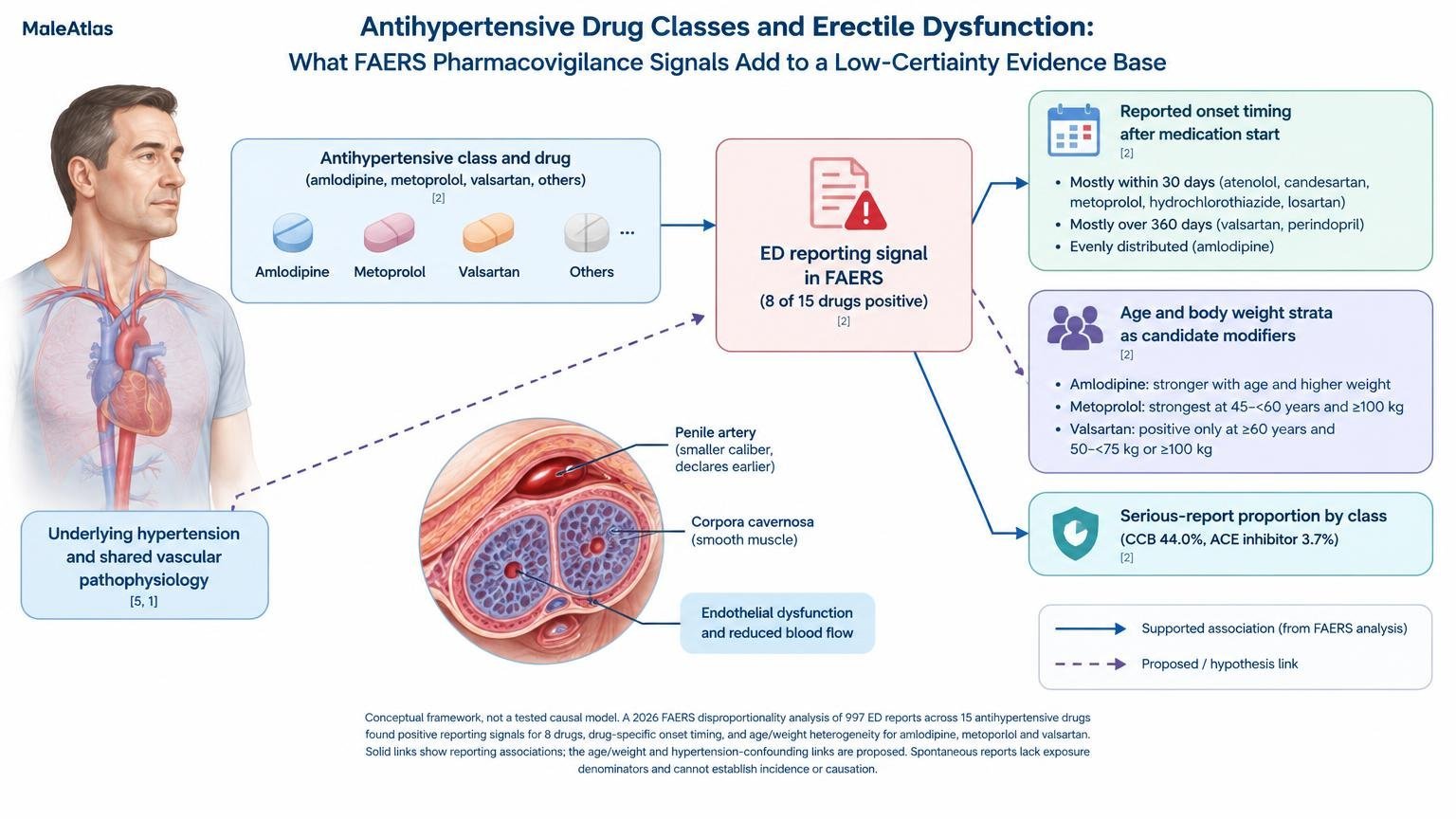
The most granular recent data in this packet come from a pharmacovigilance disproportionality analysis of the US FDA Adverse Event Reporting System (FAERS), covering the first quarter of 2004 to the first quarter of 2026. The study included 997 ED reports associated with 15 antihypertensive drugs, of which 931 involved male patients. Raw report counts were highest for amlodipine (413), metoprolol (133) and valsartan (82), and positive disproportionality signals were detected for 8 of the 15 drugs.[2]
Onset timing differed by drug: reports for atenolol, candesartan, metoprolol, hydrochlorothiazide and losartan mostly occurred within 30 days of medication, whereas valsartan and perindopril reports mostly occurred beyond 360 days, and amlodipine reports were spread evenly across time periods. Of 835 serious reports, calcium channel blockers accounted for the highest proportion (44.0%) and ACE inhibitors the lowest (3.7%). Signal intensity also varied by age and body weight for amlodipine, metoprolol and valsartan.
These are reporting signals, not incidence rates or proof of causation. Set against them, an umbrella review of 23 meta-analyses covering studies to October 2025 found that the evidence base for ED treatments overall is predominantly low or very low quality, with 13 of 23 meta-analyses (56.5%) rated critically low on AMSTAR-2. The contrast is instructive: drug-specific safety signals are accumulating faster than the underlying trial evidence needed to confirm them.[3]
Why This Matters
ED is not a trivial quality-of-life footnote in hypertensive men. A 2021 umbrella review summarized in a clinical guide reported that ED predicts cardiovascular disease (relative risk 1.45), coronary heart disease (relative risk 1.50) and stroke (relative risk 1.36), and the 2024 Princeton IV Consensus advises treating men with ED as at risk for cardiac events until proven otherwise.[4]
That framing changes how a possible drug-related sexual side effect should be handled. Abandoning effective blood pressure control to protect erectile function carries its own cardiovascular cost, while ignoring a new onset of ED may miss an opportunity to assess vascular risk. The practical task is to separate, as far as the evidence allows, the contribution of the disease from the contribution of the drug class.
Biological and Clinical Mechanism
An erection depends on nitric oxide signalling, cyclic GMP-mediated smooth-muscle relaxation and adequate arterial inflow to the corpora cavernosa. Hypertension damages the endothelium through the same atherosclerotic process that narrows coronary arteries, and because penile arteries are smaller, they may declare themselves earlier. The narrative review in this packet states that ED has a high prevalence among hypertensive people because of the condition itself, and that different antihypertensive medication types alter penile blood flow and endothelial function.[5]
Class-level mechanistic reasoning has long been used to explain why older beta-blockers and thiazide diuretics are implicated in medication-induced ED, whereas ACE inhibitors and ARBs are generally described as better tolerated. A separate 2026 invited review makes a related point: some older antihypertensives had a significant impact on erectile function, while newer agents may exert a neutral or even beneficial effect, and recent evidence paints a more nuanced picture.
Mechanism, however, is not the same as measured risk. The graded incidence asserted in one narrative review — diuretics and beta-blockers highest, vasodilators, calcium channel blockers and ACE inhibitors intermediate, ARBs rare — is presented without quantitative data, denominators or described study designs. It should be read as a hypothesis-generating summary rather than a ranking of risk.
What the Evidence Shows
The FAERS analysis offers the most detailed drug-by-drug picture in this packet, but its design shapes what can be concluded. Reports were extracted for 15 target antihypertensive drugs, and three proportional disproportionality measures — reporting odds ratio, proportional reporting ratio and empirical Bayesian geometric mean — were used to mine signals, with stratified analyses by age and body weight. In spontaneous reporting, a positive signal means a drug is reported with ED more often than expected relative to other drugs and events in the database; it does not mean the drug caused ED at a measurable rate.
The demographic profile of the 997 reports is itself informative about reporting behaviour. Beyond the 931 male patients, 511 reports came from people aged 18 to under 65 years, 366 involved body weight of 50 to under 100 kg, and 497 were filed by consumers or patients rather than clinicians. A consumer-dominated reporting stream can amplify publicity-driven reporting and may not mirror clinically adjudicated diagnoses.
Raw report counts and disproportionality signals answer different questions. Amlodipine's 413 reports, metoprolol's 133 and valsartan's 82 reflect both how often these drugs are prescribed and how often ED is reported with them, so they cannot be converted into risk per user. The finding that 8 of 15 drugs generated positive signals is more meaningful as evidence of heterogeneity across classes than as a league table.
The onset-timing analysis adds a dimension rarely available in trial data. Clustering of atenolol, candesartan, metoprolol, hydrochlorothiazide and losartan reports within 30 days is compatible with an early drug effect, but could equally reflect heightened attention soon after starting a new medicine. Late clustering beyond 360 days for valsartan and perindopril is harder to attribute to a direct pharmacological action and may reflect cumulative vascular disease, dose changes or reporting artefacts. The even distribution for amlodipine does not favour any single timing narrative.
Serious-report proportions point in a direction that partly conflicts with the older class narrative. Calcium channel blockers accounted for 44.0% of the 835 serious reports, the highest share, while ACE inhibitors accounted for 3.7%, the lowest — even though older reviews often place CCBs in a medium-incidence tier and beta-blockers higher. Seriousness in FAERS reflects reporter classification and may capture severity, hospitalization or other regulatory criteria rather than frequency, so this proportion should not be read as a class risk ranking.
Effect modification by age and body weight was drug-specific. Amlodipine signal intensity increased with advancing age and higher body weight; metoprolol signals were most pronounced at ages 45 to under 60 years and at weights of 100 kg or more; valsartan positive signals appeared only in people aged 60 years or older and in the 50 to under 75 kg or 100 kg or more weight strata. Such subgroup patterns are exploratory and can be unstable when strata are small.
| Drug or class | Reported pattern in FAERS analysis | Reported onset timing | Age/weight signal pattern |
|---|---|---|---|
| Amlodipine | 413 reports; positive signal | Evenly distributed across time periods | Signal intensity increased with age and weight |
| Metoprolol | 133 reports; positive signal | Mostly within 30 days | Strongest at 45 to <60 years and ≥100 kg |
| Valsartan | 82 reports; positive signal | Mostly over 360 days | Positive only at ≥60 years and in specified weight strata |
| Atenolol, candesartan, hydrochlorothiazide, losartan | Reported among the 15 drugs studied | Mostly within 30 days | Not specified in the supplied summary |
| Perindopril | Reported among the 15 drugs studied | Mostly over 360 days | Not specified in the supplied summary |
| Calcium channel blockers (class) | 44.0% of 835 serious reports | Not specified by class | Not specified by class |
| ACE inhibitors (class) | 3.7% of 835 serious reports | Not specified by class | Not specified by class |
The Wider ED Treatment Evidence Base
If antihypertensive safety signals are uncertain, the treatment evidence they are often compared against is not much stronger. An umbrella review searched PubMed, Web of Science, the Cochrane Library and Embase for studies published up to October 2025, using the International Index of Erectile Function or its simplified versions and the erectile hardness score as endpoints. From 1,191 studies it extracted 23 published meta-analyses yielding 42 summary effects on 36 interventions.
Quality appraisal was sobering. Thirteen of the 23 meta-analyses (56.5%) were rated critically low on AMSTAR-2, 7 (30.5%) low, 2 (8.7%) moderate and 1 (4.3%) high. At the level of individual summary effects, only two were rated high and moderate quality respectively, while 20 (47.6%) were low and 20 (47.6%) very low.
The review still found statistically significant improvements in ED with both pharmacological and nonpharmacological interventions, but its authors caution that these findings should be interpreted with caution because of limited patient numbers and the subjective nature of outcome indicators. Their overall conclusion is that the current evidence base for ED treatments is predominantly of low or very low quality — a reminder that statistical significance in a meta-analysis of small, heterogeneous trials is not the same as clinical certainty.
Two examples illustrate how soft that base remains. A 2023 meta-analysis reported that aerobic exercise improves IIEF-EF scores by about 2.8 points, a modest average gain whose confidence intervals and trial count are not detailed in the supplied summary. Separately, the 2023 TRAVERSE trial found testosterone therapy in hypogonadal men at high cardiovascular risk noninferior to placebo for major adverse cardiac events, addressing cardiac safety rather than erectile efficacy.
Interpretation and Limitations
The central interpretive trap is to convert disproportionality into incidence. FAERS captures voluntary reports from clinicians, consumers and manufacturers; a drug that is widely prescribed, recently publicized or used by patients who discuss sexual function openly will accumulate more reports. None of the 997 reports provides a denominator of exposed users, so the analysis cannot say what proportion of men taking amlodipine, metoprolol or valsartan develop ED.
A second limitation is confounding by indication. Hypertension itself causes endothelial dysfunction and ED, and the men who receive particular drug classes differ systematically in age, comorbidity, severity and co-medication. The age and weight stratification in the FAERS analysis is a partial response, but subgroup signals in spontaneous reports are vulnerable to multiple testing and small numbers; the authors themselves describe marked heterogeneity rather than a clean modifier effect.
Source quality also varies across this packet. The FAERS analysis is a structured pharmacovigilance study with explicit methods, but the two narrative reviews are review-level interpretation without primary data in the supplied text, and the class rankings they describe are not supported here by numbers. The clinical guide is a secondary summary of cited studies. Together they support a discussion of heterogeneity, not a definitive statement that one class is safer than another.
Finally, the comparison with the ED treatment literature cuts both ways. Low-quality evidence for treatments does not validate low-quality concerns about antihypertensives; it simply means both sides of the clinical conversation rest on weaker foundations than patients might assume. Systematic reviews of drug-specific ED risk with proper exposure denominators would narrow that gap.
Research Outlook
The most useful next step is not another spontaneous-report mining exercise but an analysis that combines prescription denominators with confirmed ED outcomes, ideally with active comparators and adjustment for blood pressure control and baseline vascular risk. Stratified designs should be pre-specified rather than exploratory, because the age and weight patterns reported for amlodipine, metoprolol and valsartan could reflect true effect modification, prescribing patterns or random variation in small strata.
On the treatment side, the umbrella review's own authors call for further well-designed studies of single treatments and high-quality meta-analyses of inter-treatment comparisons. If those are delivered, the quality profile — 56.5% of included meta-analyses rated critically low — could improve, which would also give clinicians a firmer benchmark against which to weigh possible drug-related sexual harms.
For now, the signals suggest drug-specific and possibly time-dependent reporting patterns rather than a simple class hierarchy. That nuance is clinically relevant: if a man reports new ED soon after starting a beta-blocker or thiazide-type regimen, timing and class both merit attention; if ED appears more than a year into therapy, vascular progression, metabolic change and other contributors deserve equal scrutiny.
Key Takeaways
- A 2026 FAERS analysis included 997 ED reports linked to 15 antihypertensive drugs, with 931 involving male patients and positive disproportionality signals for 8 drugs, including amlodipine and metoprolol.
- Raw report counts were highest for amlodipine (413), metoprolol (133) and valsartan (82), but these counts reflect reporting and prescribing patterns rather than risk per user.
- Reported onset timing clustered within 30 days for atenolol, candesartan, metoprolol, hydrochlorothiazide and losartan, and beyond 360 days for valsartan and perindopril; amlodipine reports were evenly distributed.
- Calcium channel blockers accounted for 44.0% of 835 serious reports and ACE inhibitors for 3.7%, a proportion that does not translate directly into class risk.
- An umbrella review of 23 meta-analyses found ED treatment evidence predominantly low or very low quality, with 13 meta-analyses (56.5%) rated critically low on AMSTAR-2.
Questions and Answers
How do blood pressure medications differ in their reported association with erectile dysfunction?
A 2026 FAERS pharmacovigilance analysis found positive ED reporting signals for 8 of 15 antihypertensive drugs, including amlodipine and metoprolol. Raw report counts were highest for amlodipine (413), metoprolol (133) and valsartan (82), and calcium channel blockers accounted for 44.0% of 835 serious reports versus 3.7% for ACE inhibitors. These are reporting patterns, not incidence or causal risk.
When do erectile dysfunction symptoms appear after starting different antihypertensive drugs?
In the FAERS analysis, ED reports for atenolol, candesartan, metoprolol, hydrochlorothiazide and losartan mostly occurred within 30 days of medication, while valsartan and perindopril reports mostly occurred beyond 360 days. Amlodipine reports were evenly distributed across time periods. Onset times derived from spontaneous reports can be incomplete or imprecise.
Does body weight or age change erectile dysfunction reporting signals for amlodipine, metoprolol and valsartan?
Yes, in exploratory stratified analyses. Amlodipine signals increased with advancing age and higher body weight; metoprolol signals were strongest at ages 45 to under 60 years and at 100 kg or more; valsartan positive signals appeared only at age 60 or older and in specific weight strata. Subgroup signals in small strata can be unstable and need confirmation.
How strong is the evidence that blood pressure drugs cause erectile dysfunction?
Relatively weak for causal claims. The FAERS analysis shows disproportionality in spontaneous reports, which are voluntary and lack exposure denominators, so it cannot establish incidence or causation. Narrative reviews describe older beta-blockers and thiazides as contributors and ACE inhibitors and ARBs as better tolerated, but the supplied texts provide no quantitative data supporting class rankings.
How good is the overall evidence for erectile dysfunction treatments?
An umbrella review of 23 meta-analyses published up to October 2025 found the ED treatment evidence base predominantly low or very low quality. Thirteen meta-analyses (56.5%) were rated critically low on AMSTAR-2, and only two of 42 summary effects were rated high or moderate quality. Statistically significant improvements were seen, but limited patient numbers and subjective endpoints warrant caution.
What should a man on blood pressure medication know about erectile dysfunction risk?
Erectile dysfunction and hypertension share vascular causes, and antihypertensive treatment may also affect sexual function. Reported signals differ by drug and by onset timing, so a new ED symptom is worth discussing rather than assuming one explanation. Because ED can predict cardiovascular events (relative risk 1.45 in one umbrella review), evaluation should consider vascular risk alongside medication review.
Conceptual framework: Conceptual framework, not a tested causal model. A 2026 FAERS disproportionality analysis of 997 ED reports across 15 antihypertensive drugs found positive reporting signals for 8 drugs, drug-specific onset timing, and age/weight heterogeneity for amlodipine, metoprolol and valsartan. Solid links show reporting associations; the age/weight and hypertension-confounding links are proposed. Spontaneous reports lack exposure denominators and cannot establish incidence or causation.
Academic References & Evidence
- Athanasios J Manolis; Manolis S Kallistratos; Maria Koutsaki; Nikolaos Papaioannou; Michael Doumas. Erectile dysfunction and antihypertensive therapy: A critical reappraisal. 2026
- Search Results. China Pharmacy. 2026 37(18):2389-2394
- Current treatment for erectile dysfunction: an umbrella review of systematic reviews and meta-analyses. 2026 DOI: 10.6084/m9.figshare.31562993.v1.
- Erectile Dysfunction. 2026
- Hypertension can increase risk of erectile dysfunction (ed) however; Antihypertensive drugs also can contribute to the problem – Global Pharma Tek.
SANYUN Science Center explains published research on men's reproductive and sexual health, connecting scientific evidence with everyday questions while making sources and limitations clear.
Disclaimer: This article is for scientific education and research communication only. It does not provide medical advice, diagnosis, or individualized treatment recommendations, and does not endorse any medication, supplement, device, penile enlargement procedure, or other intervention. Decisions about sexual and reproductive health should be made in consultation with a qualified healthcare professional. Do not delay seeking professional care because of information in this article.
Original Content & Copyright Notice
- This article is prepared for SANYUN Science Center, drawing on published research and publicly available academic literature on men’s sexual and reproductive health. Its editorial explanations and presentation are developed for this platform.
- Copyright in the original editorial content, selection, and arrangement is reserved by SANYUN Science Center to the extent protected by applicable law. Referenced research, quotations, and third-party materials remain subject to the rights of their respective owners. This notice does not claim ownership of scientific facts or third-party research.
- Except where permitted by applicable law or an applicable license, prior written permission is required to reproduce, republish, translate, adapt, redistribute, or commercially reuse protected content. Attribution alone does not grant permission for such reuse.
- For permitted quotation or authorized reuse, clearly identify the source and retain a link to the original article.
- Source: SANYUN Science Center
- Original URL: Retain the original article URL on science.san-yun.com.
- Copyright Holder: SANYUN Science Center, for its own protected editorial content.
- Quotation, excerpts, or authorized reuse must not distort the scientific meaning, omit material limitations or disclaimers, or imply unverified medical claims, product efficacy, or endorsement by SANYUN Science Center.



