




Category: Clinical Insights
Core Research Direction: AUA 2025 guideline on chronic pelvic pain in men: evidence- and consensus-based management of chronic scrotal content pain (CSCP) and chronic prostatitis/chronic pelvic pain syndrome (CP/CPPS), with emphasis on the limited strength of CSCP evidence and recommended treatment options.
Search Intent: What does the AUA 2025 guideline recommend for treating chronic scrotal content pain and chronic prostatitis/chronic pelvic pain syndrome in men, and how strong is the supporting evidence?
Platform: SANYUN Science Center
Evidence reviewed through: 2026-11-26
The American Urological Association released its Guideline on Chronic Pelvic Pain in Men in April 2025, covering the evaluation and treatment of men who present with chronic pelvic pain, including chronic prostatitis/chronic pelvic pain syndrome (CP/CPPS) and chronic scrotal content pain (CSCP). The document comprises 44 recommendations. The treatment section on CSCP is published as Part III of a three-part series, and its authors are direct about the state of the evidence: specific CSCP data are lacking, most management options are described as off-label use, and although multiple evolving treatments show promising results, most currently lack sufficient data to be recommended and require further investigation.[1][2]
Executive Summary
The guideline's supporting systematic review searched Ovid MEDLINE from 1946 to June 6, 2023, the Cochrane Central Register of Controlled Trials through May 2023, and the Cochrane Database of Systematic Reviews through May 2023, with an updated search in June 2024. That means the document reflects evidence available at those cutoffs; publications after the updated search are not captured.
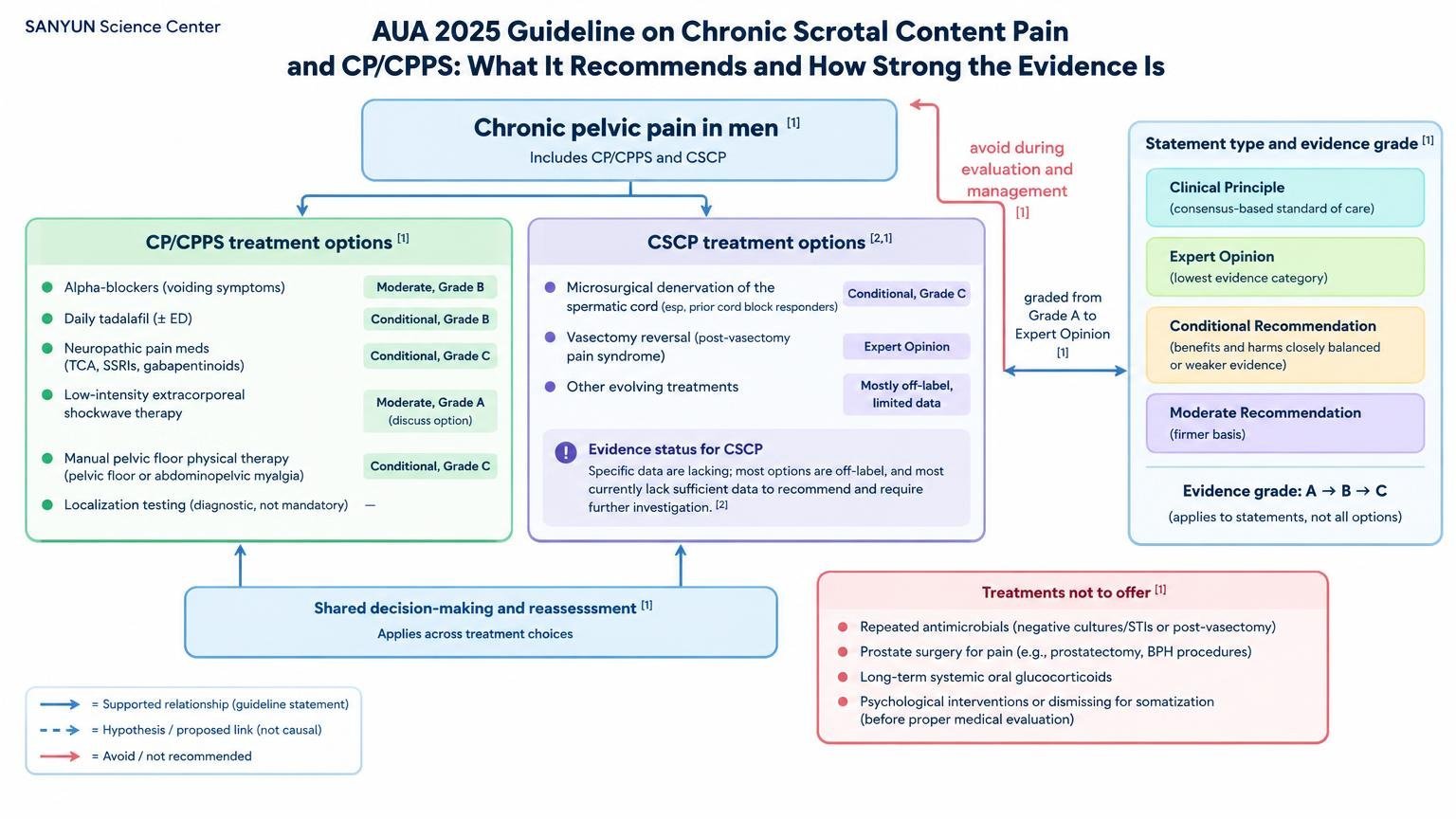
The CP/CPPS recommendations are differentiated by symptom context and drug class, ranging from a Moderate Recommendation with Grade A evidence for low-intensity extracorporeal shockwave therapy to Conditional Recommendations with Grade B or Grade C evidence and, for some options, Expert Opinion. The CSCP recommendations are dominated by Clinical Principle and Expert Opinion statements, with a small number of Conditional Grade C recommendations for procedural and neuromodulation options.
The guideline's core management principle is procedural rather than pharmacological: shared decision-making with disclosure of risks, benefits and alternatives, initial nonsurgical treatment, periodic reassessment, discontinuation of ineffective treatments, and reconsideration of the diagnosis if multiple approaches fail. It also names treatments that should not be offered, including repeated antimicrobial courses when cultures and STI tests are negative or after vasectomy.
Why This Matters
Chronic pelvic pain in men is a heterogeneous complaint, and many patients have seen several clinicians before reaching a urologist with a pelvic-pain interest. The guideline responds by defining three diagnostic constructs as Expert Opinion statements: interstitial cystitis/bladder pain syndrome, CP/CPPS and CSCP. CSCP is characterised as unilateral chronic scrotal pain in the absence of other pelvic sites of pain or urinary symptoms, whereas CP/CPPS is described as chronic perineal pain, bilateral scrotal content pain, penile pain, suprapubic pain, dysuria or pain with ejaculation.
That separation matters because the treatment evidence is not interchangeable. CP/CPPS draws on a broader literature and supports several Grade B conditional or moderate recommendations. CSCP is where the guideline is most transparent about uncertainty, and readers should not carry a CP/CPPS evidence grade across to a scrotal-pain question. For background on how the evaluation side of CP/CPPS is framed, see this analysis of chronic prostatitis evaluation under the 2025 AUA guideline.
The guideline also places evaluation before intervention. It calls for a comprehensive history, complete symptom review, physical examination and laboratory studies to document symptoms and signs, screen for concurrent pelvic pathology, and exclude confusable disorders. It also recommends transrectal digital palpation of the pelvic floor muscles to identify tenderness suggestive of pelvic floor myalgia.
Reading the Recommendation Language
Two classification axes appear in the guideline, and conflating them causes most misreading. The first axis is the statement type: a Clinical Principle is a consensus-based statement about a widely accepted standard of care; Expert Opinion is the lowest evidence category; a Conditional Recommendation signals that benefits and harms are closely balanced or the evidence is weaker; a Moderate Recommendation signals a firmer basis. The second axis is the evidence grade, from A to C, describing the body of evidence underpinning the statement. An Expert Opinion statement is therefore not equivalent to a Grade A statement, and a Clinical Principle should not be read as a trial-derived effect estimate.
| Treatment or Strategy | Population or Context | Statement Type | Evidence Grade |
|---|---|---|---|
| Alpha-blockers | CP/CPPS with voiding symptoms | Moderate Recommendation | Grade B |
| Daily tadalafil | CP/CPPS symptoms, with or without erectile dysfunction | Conditional Recommendation | Grade B |
| Neuropathic pain medications (tricyclic antidepressants, SSRIs, gabapentinoids) | CP/CPPS | Conditional Recommendation | Grade C |
| Low-intensity extracorporeal shockwave therapy | CP/CPPS | Moderate Recommendation; clinicians should discuss the option | Grade A |
| Individualized manual pelvic floor physical therapy | Pelvic floor or abdominopelvic muscle myalgia | Conditional Recommendation | Grade C |
| Microsurgical denervation of the spermatic cord | CSCP, especially prior spermatic cord block responders | Conditional Recommendation | Grade C |
| Vasectomy reversal (vasovasostomy) | Post-vasectomy pain syndrome | Expert Opinion | Not graded |
Biological and Clinical Context
The guideline does not propose a single unifying mechanism for either CP/CPPS or CSCP. Instead it treats pelvic floor myalgia as a clinically identifiable contributor and recommends transrectal palpation to detect tenderness. One clinician interviewed about the guideline described two clinical heuristics: that patients with pelvic floor dysfunction are about 6 times more likely to report bowel symptoms, and that pain with ejaculation is nearly pathognomonic for a stricture or pelvic floor dysfunction. These are clinical observations from an individual expert rather than quantified study findings, and they should be treated as hypothesis-generating rather than as established associations.
Psychosocial factors are framed as part of the clinical picture rather than as a replacement for medical evaluation. The guideline encourages clinicians to discuss anxiety, depression, major life stress and effects on daily functioning, and it states explicitly that clinicians should not send patients for psychological interventions or dismiss them for somatization before appropriate medical evaluation. That sequencing is a safeguard against premature attribution of pain to psychological causes.
What the Evidence Shows for CP/CPPS
For CP/CPPS, alpha-blockers should be offered to patients with voiding symptoms under a Moderate Recommendation with Grade B evidence. Daily tadalafil may be prescribed for prostatitis symptoms with or without concomitant erectile dysfunction under a Conditional Recommendation with Grade B evidence. Neuropathic pain medications, including tricyclic antidepressants, SSRIs and gabapentinoids, carry a Conditional Recommendation with Grade C evidence.
Among nonpharmacologic options, low-intensity extracorporeal shockwave therapy is the only CP/CPPS intervention in the source summary carrying a Grade A evidence label; the guideline gives it a Moderate Recommendation and states that clinicians should discuss the option. Individualized manual pelvic floor physical therapy, including internal and external myofascial release of affected tissues, may be offered to men with pelvic floor or abdominopelvic muscle myalgia as a Conditional Recommendation with Grade C evidence.
Localisation testing sits in the diagnostic rather than the treatment layer. A prostate massage, 2-glass or 4-glass localisation test may be performed when there is diagnostic uncertainty in distinguishing chronic bacterial prostatitis from CP/CPPS, but the guideline does not mandate these tests.
What the Evidence Shows for CSCP
The CSCP section is where the guideline is most explicit about uncertainty. The authors state that specific data on CSCP are lacking and that most management options are described as off-label use. They add that while multiple evolving treatments have shown promising results, most currently lack sufficient data to recommend as treatment and require further investigation to establish a role in patient care. That is a statement about the evidence base, not a judgment that the treatments are ineffective.
Among CSCP options that do appear with a graded recommendation, microsurgical denervation of the spermatic cord is a Conditional Recommendation with Grade C evidence, especially in patients who previously responded to a spermatic cord block. Vasectomy reversal (vasovasostomy) for post-vasectomy pain syndrome is listed as an Expert Opinion recommendation. Readers interested in how vasectomy follow-up is handled in a separate 2026 AUA document may find this review of post-vasectomy semen analysis useful context, but the two guidelines answer different questions.
The guideline also specifies what should not be offered: repeated courses of antimicrobial therapy for CP/CPPS or CSCP when urine cultures and STI tests are negative or following a vasectomy; surgical procedures on the prostate, such as radical prostatectomy and outlet procedures for benign prostatic hyperplasia, to relieve pelvic pain, although such procedures may be discussed in patients with coexisting pain and prostate cancer or bladder outlet obstruction; long-term systemic oral glucocorticoids; and referral for psychological interventions or dismissal for somatization before appropriate medical evaluation.
Interpretation and Limitations
Several limitations deserve emphasis. First, the primary evidence review is a guideline-supporting systematic review, not a series of new randomised trials, and its searches were current to June 2023 with an updated search in June 2024, so later publications are not reflected. Second, the available summary does not report effect sizes, confidence intervals or numbers needed to treat for the listed interventions, which means the recommendations cannot be used to estimate the magnitude of benefit for an individual patient. Third, the guideline is a United States professional-association document, and applicability elsewhere depends on local resources, reimbursement and specialist availability.
The grading system itself carries interpretive weight. A Grade A label for low-intensity extracorporeal shockwave therapy indicates a stronger body of evidence than Grade C, but it does not mean the therapy is universally effective or preferred for every patient. Conversely, an Expert Opinion recommendation for vasovasostomy in post-vasectomy pain syndrome reflects limited formal evidence rather than established ineffectiveness. The distinction between statistical significance and clinical importance cannot be resolved from the summary alone.
Research Outlook
The guideline authors identify CSCP as an area where further investigation is required to establish the role of evolving treatments in patient care. That is a direct call for better-designed studies in a population where most current options are off-label. For clinicians, the practical implication is to use the shared decision-making framework, disclose the limits of the evidence, reassess periodically and discontinue ineffective treatments rather than accumulating them.
Key Takeaways
- The AUA released its chronic pelvic pain guideline in April 2025 with 44 recommendations covering CP/CPPS and CSCP, the latter addressed in Part III of a three-part series.
- CSCP-specific data are described as lacking, most CSCP management options are off-label, and most evolving CSCP treatments lack sufficient data to be recommended.
- CP/CPPS recommendations are graded variably, from alpha-blockers for voiding symptoms at Moderate Recommendation with Grade B evidence to low-intensity extracorporeal shockwave therapy at Moderate Recommendation with Grade A evidence.
- Repeated antimicrobial courses are not recommended for CP/CPPS or CSCP when urine cultures and STI tests are negative or following a vasectomy.
- Shared decision-making, initial nonsurgical treatment, periodic reassessment and discontinuation of ineffective therapies are core management principles.
Questions and Answers
What is chronic scrotal content pain (CSCP) as defined in the AUA 2025 guideline?
The AUA 2025 guideline defines CSCP as unilateral chronic scrotal pain in the absence of other pelvic sites of pain or urinary symptoms, distinguishing it from CP/CPPS, which includes perineal, bilateral scrotal, penile or suprapubic pain, dysuria or pain with ejaculation. The definition is an Expert Opinion statement, and CSCP treatment is addressed in Part III of the three-part guideline series.
What does the AUA 2025 guideline recommend for treating chronic prostatitis and chronic pelvic pain syndrome (CP/CPPS)?
For CP/CPPS, alpha-blockers should be offered to patients with voiding symptoms at Moderate Recommendation with Grade B evidence; daily tadalafil is a Conditional Recommendation with Grade B evidence; and neuropathic pain medications are a Conditional Recommendation with Grade C evidence. Low-intensity extracorporeal shockwave therapy carries a Moderate Recommendation with Grade A evidence and should be discussed with patients, while manual pelvic floor physical therapy is Conditional/Grade C for pelvic floor myalgia.
How strong is the evidence for chronic scrotal content pain treatments in the AUA 2025 guideline?
The evidence is weak overall. The guideline authors state that specific CSCP data are lacking and most options are off-label, and that most evolving treatments lack sufficient data to recommend. Microsurgical denervation of the spermatic cord is a Conditional Recommendation with Grade C evidence, and vasectomy reversal for post-vasectomy pain syndrome is Expert Opinion, the lowest evidence category.
Does the AUA 2025 guideline recommend repeated antibiotics for chronic prostatitis or scrotal pain?
No. The guideline states that repeated courses of antimicrobial therapy for CP/CPPS or CSCP should not be offered when urine cultures and STI tests are negative or following a vasectomy, classified as a Clinical Principle. This targets prolonged empirical prescribing rather than any use of antibiotics, and it sits alongside the guideline's general warning against accumulating ineffective treatments without reassessment.
Can psychological support be part of chronic pelvic pain care without dismissing the pain as psychological?
Yes, but sequencing matters. The guideline encourages clinicians to discuss anxiety, depression, major life stress and effects on daily functioning, and it states that clinicians should not send patients for psychological interventions or dismiss them for somatization before appropriate medical evaluation. Psychological support is positioned as part of multidisciplinary care, not as a replacement for medical assessment of the pain.
What are the main limitations of the evidence behind the AUA 2025 chronic pelvic pain guideline?
The supporting systematic review searched MEDLINE to June 6, 2023 and Cochrane sources to May 2023, with an updated search in June 2024, so later publications are not reflected. The available summary reports no effect sizes or confidence intervals for the listed treatments, and the guideline is a United States professional-association document whose applicability elsewhere depends on local resources. CSCP evidence is especially sparse and largely off-label.
Conceptual framework: Conceptual framework of the AUA 2025 chronic pelvic pain guideline for men. CP/CPPS treatments span Grade A to Expert Opinion, while CSCP options are mostly off-label with limited or Expert Opinion evidence. Relations are supported by guideline statements, not a tested causal model.
Academic References & Evidence
- FAQs: Navigating the AUA's 2025 Guideline on Chronic Pelvic Pain in Men | Urology Times. Urology Times. 2026
- Lai HH; Pontari MA; Argoff CE; Bresler L; Breyer BN; Chou R; Clemens JQ; De EJ; Doiron RC; Johnson D; Kirkby E; MacDonald SM; Osborne JH; Parekattil SJ; Shelly B. PEDro Consumer search. The Journal of Urology. 2025 214(2):138-146
SANYUN Science Center explains published research on men's reproductive and sexual health, connecting scientific evidence with everyday questions while making sources and limitations clear.
Disclaimer: This article is for scientific education and research communication only. It does not provide medical advice, diagnosis, or individualized treatment recommendations, and does not endorse any medication, supplement, device, penile enlargement procedure, or other intervention. Decisions about sexual and reproductive health should be made in consultation with a qualified healthcare professional. Do not delay seeking professional care because of information in this article.
Original Content & Copyright Notice
- This article is prepared for SANYUN Science Center, drawing on published research and publicly available academic literature on men’s sexual and reproductive health. Its editorial explanations and presentation are developed for this platform.
- Copyright in the original editorial content, selection, and arrangement is reserved by SANYUN Science Center to the extent protected by applicable law. Referenced research, quotations, and third-party materials remain subject to the rights of their respective owners. This notice does not claim ownership of scientific facts or third-party research.
- Except where permitted by applicable law or an applicable license, prior written permission is required to reproduce, republish, translate, adapt, redistribute, or commercially reuse protected content. Attribution alone does not grant permission for such reuse.
- For permitted quotation or authorized reuse, clearly identify the source and retain a link to the original article.
- Source: SANYUN Science Center
- Original URL: Retain the original article URL on science.san-yun.com.
- Copyright Holder: SANYUN Science Center, for its own protected editorial content.
- Quotation, excerpts, or authorized reuse must not distort the scientific meaning, omit material limitations or disclaimers, or imply unverified medical claims, product efficacy, or endorsement by SANYUN Science Center.



