




Category: Penis Enlargement
Core Research Direction: Commercial (clinic/marketing) sources on cosmetic penile enlargement discuss pricing and claim average size gains, but no peer-reviewed study data are supplied in this packet; the review must therefore address whether cosmetic penile enlargement is effective and safe for adult men, and what the supplied non-peer-reviewed claims can and cannot establish.
Search Intent: For adult men of normal penile size considering cosmetic penile enlargement, what do the supplied sources actually claim about size gains and risks, and what can they not establish because they are commercial or unverified rather than peer-reviewed studies?
Platform: SANYUN Science Center
Evidence reviewed through: 2026-11-15
Commercial pages promoting cosmetic penile enlargement describe a subcutaneous silicone implant, suspensory ligament release, autologous fat transfer and injectable fillers, and report average girth increases of about 1–2 inches (roughly 2.5–5 cm) plus approximately a 50% flaccid-length increase. None of the supplied sources reports a peer-reviewed study design, measurement protocol, sample denominator or follow-up schedule. This review asks what those claims can and cannot establish for adult men considering an elective procedure.[1][2][3]
Executive Summary
The sources supplied for this review are commercial: a clinic network's pricing and location pages for a subcutaneous silicone implant, and two provider-authored cost explainers covering implants, ligament release, fat transfer and fillers. All describe size gains. None reports a peer-reviewed study design, recruitment method, measurement protocol, follow-up schedule or statistical analysis. The girth figures recur almost verbatim across pages at roughly 1–2 inches (about 2.5–5 cm) of added circumference, and the flaccid-length figure is expressed as about a 50% increase. Whether those numbers reflect a published cohort, a device registry, surgeon impression or marketing copy cannot be determined from the material provided.[4][5][6]
The same pages are more cautious in specific places than their headline claims suggest. Two location pages state that any change in erect length is unpredictable and depends on individual anatomy. One clinic page acknowledges possible changes in penile sensation in either direction, usually described as temporary. A surgeon-authored explainer concedes that scientific support for long-term, consistent results is limited and that most studies rely on small groups and short follow-ups, while also attributing to a professional foundation the view that risks outweigh benefits for most men and that surgery is medically legitimate only for true micropenis. Those caveats are the most informative content in the packet.
Why This Matters
Most men who seek penile enlargement have penile size within the normal range, according to one of the supplied explainers, which cites an average stretched length of about 5.25 inches (roughly 13.3 cm). Cosmetic rather than reconstructive motivation therefore dominates this population, and the decision is elective, out-of-pocket and irreversible in several of the offered techniques. The commercial pages confirm that insurance does not cover these procedures as elective cosmetics. When the expected benefit is measured in inches and the payment is entirely personal, the quality of the underlying evidence becomes a practical consumer question rather than an academic one.
There is also a measurement problem hidden in the marketing. Penile size outcomes depend on whether length is flaccid, stretched or erect, on room temperature and arousal, on the point of anatomical reference, and on who holds the ruler. A stated average gain without a stated measurement protocol cannot be compared across techniques, across surgeons or against a man's own baseline. This review treats the reported figures as claims to be interpreted, not as findings to be pooled.
The Techniques Being Marketed
Four categories appear across the packet. The subcutaneous silicone implant is described as a soft medical-grade silicone sheath placed beneath the penile skin to add circumference and flaccid length; the pages state the outpatient procedure usually takes under an hour, that results are durable, and that the implant is removable. Suspensory ligament release is described mechanistically as cutting the internal ligament anchoring the penile base to the pubic bone so that more of the hidden shaft drops forward and down — a repositioning of existing tissue rather than creation of new tissue. Autologous fat transfer harvests fat, processes it and injects it into the shaft in layers. Hyaluronic acid and other fillers add volume without surgery.
The implant pages emphasize a regulatory distinction. They describe the device as the first and only FDA-authorized cosmetic penile implant currently marketed, and a surgeon-authored explainer separates FDA-cleared devices from fillers that are FDA-approved for other uses, such as facial wrinkles, and used off-label for penile girth. One clinic page states that fillers are neither approved nor reviewed by the FDA for penile enhancement and that uneven results and deformity are documented risks. That regulatory distinction is real in kind, but it speaks to how a product was reviewed for marketing, not to the size of its measured benefit in an independent trial.
What the Evidence Shows — and How Thin It Is
| Claim area | What the commercial sources state | What is missing |
|---|---|---|
| Implant girth gain | Average increase of about 1–2 inches (roughly 2.5–5 cm) in circumference, repeated across clinic and explainer pages | No sample size, measurement method, time point or cited primary study in the supplied text |
| Implant flaccid length | Roughly a 50% increase in flaccid length on average; up to 1–2 inches (about 2.5–5 cm) of flaccid length in one explainer | No baseline distribution, so a percentage cannot be converted into an absolute gain |
| Implant erect length | Described as unpredictable; any increase depends on individual anatomy | No erect-length outcome data reported at all |
| Functional safety | An unnamed 5-year clinical review of 400 patients said to show no cases of changed penile function, erectile ability or ejaculation during intercourse | Review not identified, cited or peer-reviewed in the text; no incidence denominators |
| Sensation | Possible increase or decrease in sensitivity, usually described as temporary and resolving as skin expands | No frequency, duration data or assessment instrument |
| Fat transfer durability | Roughly 30%–50% of transferred fat resorbed within the first 6–12 months, prompting repeat sessions | Presented as certainty without citation; no imaging or volumetric confirmation |
| Capsule formation around implant | Capsule forming around the device is described as taking 6–12 months in total and contributing to a more natural feel | Mechanistic description without supporting data |
| Surgical complications | Permanent deformity, severe shortening, curvature, chronic edema, non-healing wounds and erectile dysfunction listed as reported in the literature | No citations, incidence rates or denominators given |
| Overall evidence base | Conceded as limited for long-term, consistent results, with most studies using small groups and short follow-ups | Concession is itself unsourced; no study list supplied |
Read together, the table shows a consistent asymmetry. Positive outcomes are stated as averages with specific magnitudes. Harms are stated qualitatively, with hedged frequency language and no denominators. That pattern is common in promotional writing and is precisely why promotional writing cannot substitute for outcome reporting. A claim that a review of 400 patients over 5 years found no functional changes is a strong safety statement; without the review's identity, its inclusion criteria, its method of assessing erectile function, and its loss to follow-up, the statement cannot be weighed against the same page's admission that sensation may change.
The fat-transfer figures illustrate a second problem: assertions presented as biological inevitability. Two independent commercial sources state that roughly 30%–50% of grafted fat is resorbed in the first 6–12 months. The range is plausible and consistent with general graft behavior, but in this packet it arrives without a citation, and the phrase presenting it as a certainty overstates what uncontrolled clinical experience can establish. If resorption of that magnitude occurs, it also reframes the advertised outcome: a single session may not deliver a stable result, and the explainers themselves note that repeat sessions are common.
Biological and Clinical Mechanism
The mechanisms described in the packet are mechanical and anatomical rather than pharmacological. Ligament release does not lengthen the penis; it alters its resting angle and exposes shaft that was previously internal, which is why the sources describe apparent flaccid length and why the effect on erect length would be expected to be small or absent. A subcutaneous implant adds a physical layer of volume around the shaft, increasing circumference directly; the pages also state that a capsule forms around the device over 6–12 months, which they say contributes to a more natural feel. Fat transfer adds volume that is partly reabsorbed as the graft establishes blood supply. Fillers add gel volume that degrades over time.
This mechanistic framing matters for interpreting the claims. Girth change from an implant or filler is a direct geometric consequence of added material, so a real average increase is biologically plausible. Flaccid length change from ligament release is a positional effect, so gains are plausible while true tissue elongation is not. Erect length change is limited by the anatomy of the tunica and the vascular bodies, which none of these techniques is described as altering — consistent with the sources' own statement that erect length change is unpredictable. A reader can therefore accept the mechanism while still rejecting the specific magnitudes as unverified.
What the Sources Say About Cost
The pricing information is commercial and geographic. Published implant prices are quoted as a range from $10,500 to $25,000, with individual Jeddah listings of $14,500, $12,000 and $12,500 and an Istanbul starting price of $12,000. A separate explainer gives a global range of $3,000 to over $25,000. These figures describe what clinics charge; they say nothing about value, and they are not evidence of effectiveness. They are included here because cost is part of the decision a man actually faces, not because they validate any outcome claim.
Interpretation and Limitations
Several limitations bound what this review can conclude. First, every supplied source is commercial and non-peer-reviewed; three are clinic marketing pages for a single device brand, and two are provider-authored cost explainers that also sell the procedures. Their cost tables and gain tables are not independent. Second, none of them reports a study design, so it is impossible to tell whether the recurring 1–2 inch figure derives from one small series, several series, surgeon records or repetition of an earlier marketing claim. Third, the packet contains no primary urological literature, no guideline text and no complication registry, so the safety discussion here reflects what the commercial sources themselves concede rather than an independent synthesis.
The sources also disagree with themselves on recovery. One clinic page advises clearance for intercourse at 6–8 weeks and gradual exercise at 3–4 weeks; a surgeon-authored explainer advises 4–6 weeks of sexual restriction after surgery and 7–10 days after fillers, with 1–2 days to normal activity after non-surgical treatment. These are not equivalent protocols, and the discrepancy illustrates how much of the practical guidance is surgeon preference rather than shared evidence.
The Patient-Selection Question Nobody Markets
The most consequential statement in the packet appears in a cost explainer rather than a clinic page: that most men seeking enlargement are within the normal range, that small penis anxiety and body dysmorphic disorder are common drivers, and that for cosmetic dissatisfaction in men of normal size the risks often outweigh the modest, variable benefits. The same source reports the view that surgery is medically legitimate only for true micropenis. These are attributed claims rather than demonstrated findings, and the packet does not supply the underlying documents, but they point to a selection problem that pricing pages do not address: the men most likely to be dissatisfied after a technically successful operation may be those whose concern was never anatomical.
A related and unmeasured variable is partner perception. One clinic page states that patients often report partners do not notice the implant, while acknowledging the implant is a foreign body that may be detectable. That is anecdotal patient reporting without systematic assessment, and it is not a substitute for satisfaction data collected with a validated instrument.
Research Outlook
What would change this picture is not more clinic pages but transparent outcome reporting: prespecified measurement of flaccid, stretched and erect length and of girth at defined points, with standardized technique, adequate follow-up, independent assessment, and complete reporting of revisions, removals and sensory or erectile adverse events. Device-based procedures lend themselves to registry designs because the product can be tracked; graft and filler procedures would need volumetric imaging or validated circumferences rather than photographs. Until such data are available and peer-reviewed, the honest summary of the supplied material is that plausible mechanisms exist, commercial claims are specific, and independent verification is absent.
Key Takeaways
- The packet contains no peer-reviewed study data; all size figures come from commercial clinic pages or provider-authored cost explainers.
- Reported implant gains cluster around 1–2 inches (roughly 2.5–5 cm) of girth; flaccid length is expressed as about a 50% increase, which cannot be converted to an absolute gain without a baseline distribution.
- The sources themselves state that erect-length change is unpredictable, and no erect-length outcome data are reported.
- A claimed 5-year review of 400 patients reporting no functional changes is unidentified and uncited, and it sits alongside a concession that sensation may increase or decrease.
- Fat transfer is described as losing roughly 30%–50% of grafted volume within 6–12 months, usually requiring repeat sessions.
- Listed prices range from $10,500 to $25,000 for the implant, with regional listings between $12,000 and $14,500; these are charges, not evidence of benefit.
- For most men with normal size, the supplied material attributes to a professional foundation the view that risks outweigh benefits outside true micropenis.
Questions and Answers
What is cosmetic penile enlargement and which techniques are described in these commercial sources?
It refers to elective procedures intended to increase penile girth or visible flaccid length in men without a reconstructive indication. The supplied sources describe a subcutaneous silicone implant placed under the penile skin, suspensory ligament release that lets internal shaft drop forward, autologous fat transfer, and hyaluronic acid or other injectable fillers. Each is marketed with claimed gains, but the packet contains no peer-reviewed outcome data for any of them.
How much girth and length do silicone penile implants reportedly add?
Clinic pages and a surgeon-authored explainer claim an average girth increase of about 1–2 inches (roughly 2.5–5 cm) and roughly a 50% increase in flaccid length, with up to 1–2 inches of flaccid length in one account. The same sources state that any erect-length change is unpredictable. No sample size, measurement protocol, time point or cited primary study accompanies these figures, so they remain unverified marketing claims rather than established outcomes.
How strong is the evidence that penile enlargement surgery is safe?
Weak in this packet. The strongest safety statement is a claimed 5-year clinical review of 400 patients reporting no changes in penile function, erectile ability or ejaculation, but the review is not identified or cited. Elsewhere the sources concede possible increases or decreases in sensation and list permanent deformity, curvature, chronic edema, non-healing wounds and erectile dysfunction as reported complications, without incidence data. This is commercial assertion, not independently verifiable evidence.
Does fat transfer or filler give permanent penile girth?
Probably not fully. Two commercial sources state that roughly 30%–50% of transferred fat is resorbed within the first 6–12 months, and repeat or touch-up sessions are described as common. Hyaluronic acid fillers are described as temporary, requiring maintenance over time. These figures are asserted without citation, so the magnitude and reliability of volume loss remain uncertain, and no volumetric study data are supplied.
Who is actually a candidate for cosmetic penile enlargement rather than reconstructive surgery?
One supplied explainer states most men seeking enlargement are within the normal size range and that surgery is described as medically legitimate only for true micropenis, while small penis anxiety and body dysmorphic disorder are common drivers. That attribution is secondhand and unverified here. Eligibility on clinic pages is broad — generally adults 21 and over in good health — so psychological assessment and realistic expectation setting are not standardized in the material.
Why does it matter that these penile enlargement claims come from commercial clinics rather than peer-reviewed studies?
Commercial sources have an interest in emphasizing benefits and softening harms. In this packet, favorable outcomes are stated as precise averages while complications are described qualitatively without denominators, and pricing pages repeat the same gain figures across locations. Without study design, measurement methods, follow-up duration and independent analysis, readers cannot distinguish a real measured effect from repeated promotional copy, and cannot compare techniques fairly.
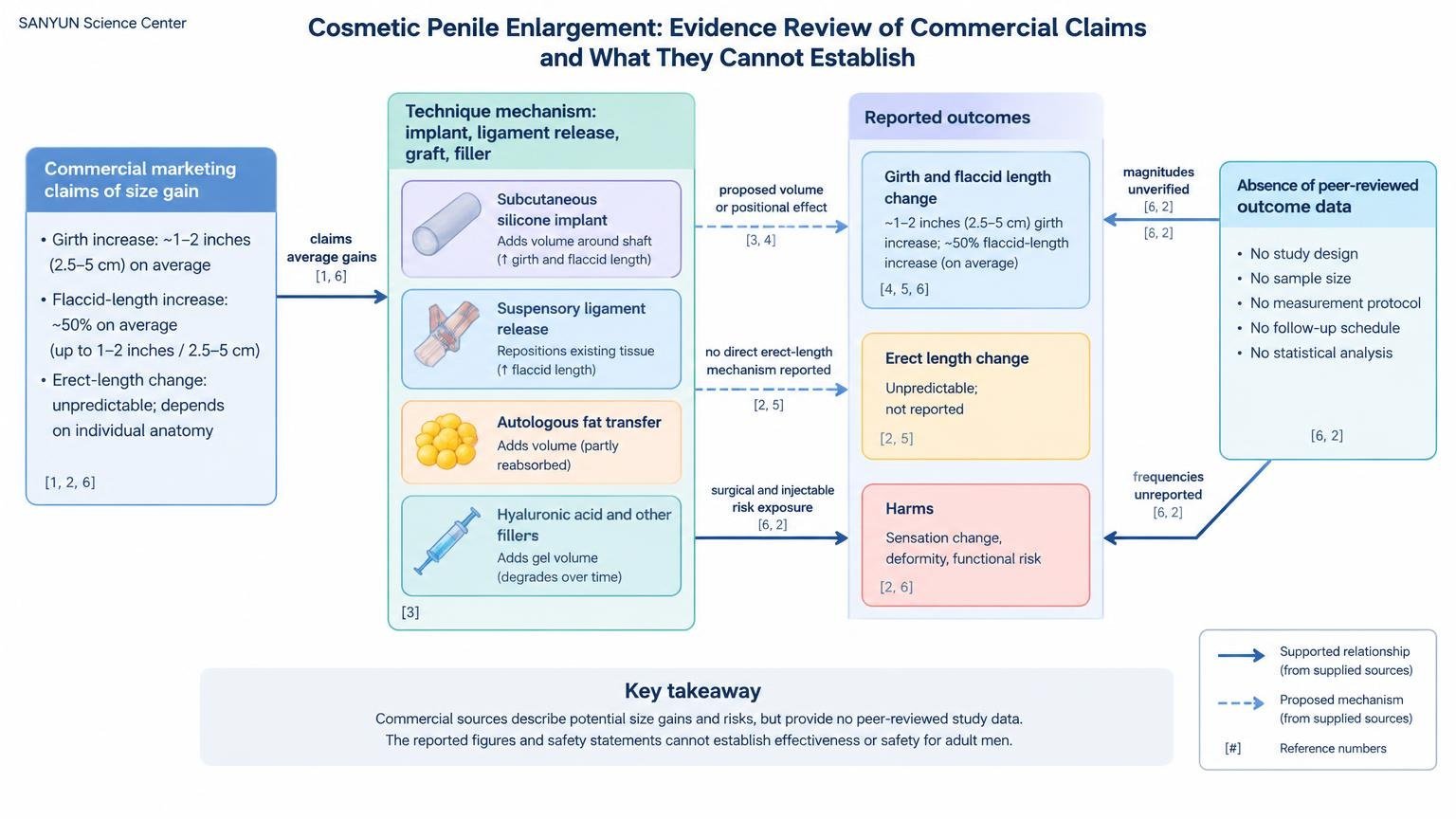
Conceptual framework: Conceptual framework, not a tested causal model. Commercial marketing claims for subcutaneous silicone implants, suspensory ligament release, fat transfer and fillers are shown alongside the mechanisms those sources describe, the girth and flaccid-length gains they report, the erect-length outcome they call unpredictable, and the harms they list. Solid links indicate relationships stated in the supplied non-peer-reviewed commercial sources; dashed links indicate proposed mechanisms. A key limitation is that no source supplies study design, sample size or peer-reviewed outcome data.
Academic References & Evidence
- ¿Cuánto cuesta la cirugía de alargamiento del pene Himplant®? | Precios de Himplant®.
- Médicos Jeddah, Saudi Arabia en implantes de pene | Himplant®.
- Penis Enlargement Surgery Cost: What Factors Affect Price?.
- أطباء غرسة القضيب في إسطنبول، تركيا | Himplant®.
- Médicos Al Ahsa, Arabia Saudita en implantes de pene | Himplant®.
- Victor Liu. Penile Enlargement Procedure Costs: Breaking Down Fees Across Different Techniques | Victor Liu, MD.
SANYUN Science Center explains published research on men's reproductive and sexual health, connecting scientific evidence with everyday questions while making sources and limitations clear.
Disclaimer: This article is for scientific education and research communication only. It does not provide medical advice, diagnosis, or individualized treatment recommendations, and does not endorse any medication, supplement, device, penile enlargement procedure, or other intervention. Decisions about sexual and reproductive health should be made in consultation with a qualified healthcare professional. Do not delay seeking professional care because of information in this article.
Original Content & Copyright Notice
- This article is prepared for SANYUN Science Center, drawing on published research and publicly available academic literature on men’s sexual and reproductive health. Its editorial explanations and presentation are developed for this platform.
- Copyright in the original editorial content, selection, and arrangement is reserved by SANYUN Science Center to the extent protected by applicable law. Referenced research, quotations, and third-party materials remain subject to the rights of their respective owners. This notice does not claim ownership of scientific facts or third-party research.
- Except where permitted by applicable law or an applicable license, prior written permission is required to reproduce, republish, translate, adapt, redistribute, or commercially reuse protected content. Attribution alone does not grant permission for such reuse.
- For permitted quotation or authorized reuse, clearly identify the source and retain a link to the original article.
- Source: SANYUN Science Center
- Original URL: Retain the original article URL on science.san-yun.com.
- Copyright Holder: SANYUN Science Center, for its own protected editorial content.
- Quotation, excerpts, or authorized reuse must not distort the scientific meaning, omit material limitations or disclaimers, or imply unverified medical claims, product efficacy, or endorsement by SANYUN Science Center.



