




Category: Clinical Insights
Core Research Direction: What the 2025-2026 EAU sexual and reproductive health guideline updates changed for male infertility, hypogonadism, ejaculation disorders, Peyronie's disease and priapism, and how strong the underlying evidence is
Search Intent: What do the most recent European Association of Urology guideline updates recommend across male sexual and reproductive health, and what are the stated limits of the evidence behind them?
Platform: SANYUN Science Center
Evidence reviewed through: 2026-11-23
Executive Summary
The European Association of Urology (EAU) Sexual and Reproductive Health Guidelines are scoped as a comprehensive overview of the medical aspects of sexual and reproductive health in adult men, first published in 2020. Two documents matter for the 2025–2026 period: a male infertility update published in European Urology in May 2025, and a 2026 guideline version that the EAU itself describes as a limited update of the 2025 publication. The separation is important, because the two documents drew on different sections of the literature and produced different kinds of change.[1][2][3]
The 2025 male infertility update was built from a structured literature assessment searching Medline, EMBASE and the Cochrane Libraries, and its changes were substantive rather than cosmetic: two entirely new sections on exome sequencing and probiotic treatment, plus a significant update of the evidence base and recommendations for the diagnostic work-up. Its headline clinical messages were process messages — a thorough urological assessment for every man presenting with fertility problems, parallel investigation of the female partner, and counselling of infertile men and men with abnormal semen parameters about associated health risks.
The 2026 update took a different shape. New evidence was appraised only for the hypogonadism, ejaculation disorders, penile curvature and priapism sections, producing 116 updated studies across the guidelines. Male infertility was not among the sections listed as newly appraised in that update. Reported changes include a full revision of the ejaculation disorders text and references, significant revision of hypogonadism and prostate cancer safety text, and substantial reworking of the conservative and surgical Peyronie's disease and ischaemic priapism sections.[4]
The most instructive feature of both updates is not the list of new options but the transparency about evidence quality. Recommendation strength was set by weighing desirable and undesirable consequences, the quality and certainty of estimates, and variability in patient values and preferences — a process that produces strong recommendations for some diagnostic steps and weak recommendations where comparative data are thin. Several 2026 recommendations carry explicit weak ratings, and the guideline's own introduction warns that following recommendations does not guarantee the best outcome.
Why This Matters
Guideline updates are often reported as a list of new treatments. For male sexual and reproductive health, the more consequential changes are frequently subtractive or procedural: which tests are considered necessary, which interventions are no longer endorsed, and which clinical distinctions — functional versus organic hypogonadism, acute versus stable Peyronie's disease, ischaemic versus non-ischaemic priapism — determine the entire management pathway.[5][6]
The 2026 update was characterised in EAU discussion as removing ineffective treatments and revising conservative management, alongside the introduction of options such as hyaluronic acid for Peyronie's disease. That framing matters for readers: a removal is an evidence judgement about the absence of demonstrated benefit, and it can be as clinically important as an addition. It also means the 2026 document should not be read as an expansion of therapeutic options alone.[7]
There is also a practical access issue. These guidelines are written for adult men in a European specialist context, and the source material itself insists that guidelines cannot replace clinical expertise when treating individual patients, and that personal values and circumstances must be taken into account. For a global readership, the recommendations describe a standard of reasoning rather than a universal standard of care.
How the Two Updates Were Built and Graded
The 2025 male infertility update describes a structured assessment of the literature with searches in Medline, EMBASE and the Cochrane Libraries. Recommendations were developed to prioritise clinically important care decisions, and strength was determined by balancing desirable and undesirable consequences of alternative management strategies, evidence quality including certainty of estimates, and the nature and variability of patient values and preferences. Notably, the summary does not state a search date range, the number of records screened, or how many studies were ultimately included, which limits any attempt to judge the sensitivity of the process from the summary alone.
A secondary commentary on a companion 2025 guideline paper covering hypogonadism, erectile dysfunction, premature ejaculation and Peyronie's disease reports that the panel performed an updated systematic review of research published from 2021 to 2024 across the same three databases. That detail should be treated with care: it is a second-hand description of a different paper than the male infertility update, and the search window and databases are reported by the commentator rather than by the primary guideline summary available here.
The 2026 version is explicitly a limited update rather than a full revision. New and relevant evidence was identified, collated and appraised through a structured assessment of the literature for four sections only, and 116 updated studies were included across the guidelines. No breakdown by section, study design or risk of bias is provided in the summary of changes, so the figure describes volume of updating, not weight or direction of evidence.
| Domain | What changed in 2025–2026 | Stated evidence position |
|---|---|---|
| Male infertility (2025) | Two new sections on exome sequencing and probiotic treatment; significant update of diagnostic work-up evidence and recommendations. | Structured literature assessment in Medline, EMBASE and Cochrane; no included-study count reported in the summary. |
| Hypogonadism (2026) | Significant changes to supporting text throughout the section; revision of the prostate cancer subsection and relocation of two recommendations there. | Explicitly limited high-quality evidence for testosterone therapy in prostate cancer survivors; weak ratings in that setting. |
| Ejaculation disorders (2026) | Full update and revision of supporting text and references throughout the section. | Limited high-quality evidence for treatment options, according to EAU expert discussion. |
| Peyronie's disease (2026) | Significant revision of epidemiology, conservative treatment, oral treatment, other treatments and surgical treatment subsections; hyaluronic acid described as a new option. | Strong recommendation that platelet-rich plasma data remain limited; strong recommendation that surgery is only for stable disease compromising intercourse. |
| Priapism (2026) | Significant revision of ischaemic priapism, its second-line surgical management, and priapism in special situations. | Strong recommendation for corporal blood gas analysis; weak recommendation for peno-scrotal decompression as a first-line alternative. |
Male Infertility: Process Over Novelty
The clinical content of the 2025 infertility update is less about new drugs than about how the couple is assessed. The guideline emphasises a thorough urological assessment of all men seeking medical help for fertility problems to ensure appropriate treatment, and stresses parallel investigation of the female partner during diagnostic and management work-up so that timing and therapeutic strategy can be shared decisions. It further recommends counselling all infertile men and men with abnormal semen parameters on associated health risks.
That counselling recommendation is more consequential than it may appear. Abnormal semen parameters are being framed as a marker requiring broader health attention, not merely a reproductive result. The summary available here does not enumerate which associated health risks are meant, so the precise scope of that counselling remains unspecified within this excerpt and should be confirmed against the full guideline text.
The two new sections are where the update is most exposed. Adding sections on exome sequencing and probiotic treatment signals panel interest in genetic characterisation beyond routine karyotyping and in microbiome-adjacent interventions, but the summary does not state the direction of either recommendation — whether exome sequencing is endorsed for specific phenotypes, and whether probiotics are recommended, discouraged or simply described as unproven. A reader who infers a treatment endorsement from the existence of a section would be going beyond the evidence presented.
A related point concerns what a diagnostic update can and cannot claim. Expanding the recommended diagnostic work-up is largely a statement that certain tests are considered informative enough to justify use; it is not, by itself, evidence that the added testing changes live birth outcomes. That distinction between diagnostic yield and reproductive outcome benefit is one the guideline structure does not resolve in the summary.
Hypogonadism: Measurement Discipline and Prostate Cancer Uncertainty
The 2026 hypogonadism changes begin with measurement. The guideline carries a strong recommendation to measure total testosterone in the morning between 07.00 and 10.00 hours in the fasting state using a reliable laboratory assay. This is a quality-control recommendation grounded in diurnal and prandial variation rather than a therapeutic claim, and it targets a common real-world failure mode: diagnosing a condition from a single poorly timed or poorly assayed sample.
The same section carries a strong recommendation not to use testosterone therapy for the treatment of male infertility or in men wishing to be fathers. This is a clear boundary between two indications that patients frequently conflate. The strength of the rating is notable given how often exogenous testosterone is encountered in reproductive-age men; the guideline treats suppression of spermatogenesis as a sufficiently established undesirable consequence to justify an unambiguous recommendation, although this excerpt does not detail the underlying trial data.
Where the evidence thins is prostate cancer survivorship. For men after prostate cancer surgery, the guideline advises restricting testosterone therapy to those at low risk of recurrence, starting after at least one year of follow-up with PSA below 0.01 ng/mL and no evidence of recurrence — a weak recommendation. For men on active surveillance or treated with non-surgical curative intent, clinicians should advise that safety data are unclear — also weak. The asymmetry is deliberate: the first is a narrow permission, the second is an explicit statement of ignorance.
Expert discussion reinforces this. EAU commentary highlights limited high-quality evidence for testosterone therapy in prostate cancer survivors, and also emphasises distinguishing functional from organic causes of hypogonadism during diagnosis. That distinction shapes whether treatment addresses an underlying reversible driver or replaces a persistent deficiency, and it is a classification problem the evidence base supports poorly in absolute terms because the underlying studies are heterogeneous and the outcome definitions vary.
Ejaculation Disorders: New Text, Old Evidence Problem
The 2026 update fully revised the supporting text and references throughout the Disorders of Ejaculation section, making it one of the more thoroughly reworked parts of the document. Yet the accompanying expert discussion is candid that treatment options for ejaculation disorders remain an area of limited high-quality evidence. A complete textual revision and a strong evidence base are therefore not the same thing, and the volume of revision here reflects reassessment rather than the arrival of robust comparative trials.
A secondary commentary on the companion 2025 guideline paper describes the clinical logic in more detail: after subtyping premature ejaculation — primary or secondary, absolute or relative, ante portas or intramoenia, and by aetiology (organic, psycho-emotional, lifestyle-related, mixed) — the clinician should discuss the patient's expectations in depth. Pharmacotherapy is then considered first-line for primary or lifelong premature ejaculation, whereas treating the underlying cause is the initial goal in secondary or acquired premature ejaculation.
This is a coherent decision framework, but its evidential footing is uneven. The recommendation to treat the underlying cause first in acquired premature ejaculation rests on clinical reasoning about causality rather than on head-to-head trials demonstrating that this sequence outperforms symptomatic drug treatment. And because the commentary reports no comparative efficacy data or effect sizes, the framework should be read as a structured approach to individualisation, not as a demonstrated superiority of one pathway.
Peyronie's Disease: Timing, Subtraction and Limited Adjuncts
Penile curvature was heavily revised in 2026, including the epidemiology subsection, conservative treatment, oral treatment, other treatments and surgical treatment. The clinical spine of the guidance, as reflected in the commentary, is staging: baseline evaluation should distinguish the acute from the stable phase. Surgery should be offered only when the deformity actually has a negative impact on sexual function, and men with concomitant erectile dysfunction should be offered a penile prosthesis. The guideline text itself rates as strong the recommendation to perform surgery only when disease is stable and intercourse is compromised by the deformity.
The conservative side of the section became more restrictive in spirit. The guideline carries a strong recommendation to counsel patients fully that data on intralesional platelet-rich plasma, alone or in combination with oral treatment, to reduce pain or penile curvature are still limited. A strong recommendation to explain limited evidence is a distinctive construction: it does not forbid the intervention, but it places the burden of informed counselling on the clinician and signals that patient expectation management is the active ingredient supported by the evidence.
Hyaluronic acid is described in EAU discussion as a newly introduced option for Peyronie's disease within an update that also removed ineffective treatments. Taken together, these changes suggest a narrowing of the conservative menu toward fewer, better-characterised options. The available sources do not provide comparative outcome data for hyaluronic acid, so its introduction should be understood as a change in the guideline's considered options rather than a demonstrated advantage over established approaches.
Priapism: A Strong Diagnostic Rule and a Weak Surgical One
Ischaemic priapism was significantly revised, including second-line surgical management and priapism in special situations. The clearest anchor is diagnostic: in the emergency setting, blood gas analysis of aspirated corporal blood is rated a strong recommendation as essential to distinguish ischaemic from non-ischaemic priapism. This is an example of a guideline doing its most useful work — specifying a test that changes the entire treatment pathway before any intervention is chosen.
The therapeutic side is weaker. The guideline notes, as a weak recommendation, that peno-scrotal decompression may be used as a first-line option instead of distal shunting with or without tunnelling. A weak rating here does not mean the procedure is ineffective; it reflects the absence of comparative evidence strong enough to prefer one approach over another with confidence. For clinicians, that translates into latitude informed by local expertise, resource availability and individual anatomy rather than a mandated sequence.
The distinction between a strong diagnostic recommendation and a weak procedural one is a useful illustration of how the guideline grades evidence. Diagnostic accuracy can be established with relatively straightforward comparative studies, whereas emergency surgical comparisons are difficult to randomise, ethically constrained and often small. The 2026 priapism revisions should therefore be read as an updated algorithm with uneven certainty across its steps.
Interpretation and Limitations
Three structural limitations should constrain how these updates are read. First, the 2026 document is a limited update, not a comprehensive re-review; the sections appraised were hypogonadism, ejaculation disorders, penile curvature and priapism, and male infertility content in 2026 rests on the separate 2025 publication. Second, the summary of changes reports 116 updated studies without disclosing how many were randomised trials, how many were observational, or how the evidence was distributed across sections. Third, the recommendation strength system is explicitly value-sensitive: it incorporates variability in patient preferences, so a strong rating reflects a favourable balance of consequences as judged by the panel, not certainty about effect size.
There is also a source-type limitation specific to this review. Much of what is known here about the direction and tone of the 2026 changes — removal of ineffective treatments, introduction of hyaluronic acid, the ejaculation disorder decision framework, the functional-versus-organic hypogonadism distinction, the weak evidence in prostate cancer survivors — derives from EAU podcast summaries and secondary commentary rather than from quantitative primary data. Those sources are informative about panel reasoning but provide no effect sizes, confidence intervals or sample sizes, and they should not be treated as evidence of comparative efficacy.
Finally, the guidelines describe themselves as best evidence available to the experts, while stating that following recommendations will not necessarily produce the best outcome and that guidelines cannot replace clinical expertise or individual values. That self-description should be taken literally. Guideline-concordant care is a starting point for reasoning about an individual man, not a guarantee of outcome, and it is not a legal standard of care.
Research Outlook
The clearest research gaps signposted by the updates are comparative rather than descriptive. Testosterone therapy in prostate cancer survivors needs safety data beyond the narrow low-risk surgical population currently addressed, and the guideline itself states that safety data in men on active surveillance or after non-surgical curative treatment are unclear. Emergency priapism management needs comparative surgical evidence to move peno-scrotal decompression and distal shunting from a weak either/or into a ranked recommendation.
Ejaculation disorders require the largest evidentiary lift. A fully revised section paired with explicit acknowledgement of limited high-quality treatment evidence indicates that the literature has been reassessed without being resolved. Trials that subtype premature ejaculation properly and compare cause-directed management with symptomatic pharmacotherapy would address the exact uncertainty the current framework manages by clinical reasoning.
For male infertility, the newly added exome sequencing and probiotic sections create an immediate need for clarity about patient selection and outcome definition. The question is not whether these topics deserve attention, but which phenotypes justify exome sequencing and whether any probiotic intervention has demonstrated benefit on semen parameters or reproductive outcomes. The 2025 summary does not answer this, and until primary trials do, the sections should be read as scoping rather than endorsement.
Key Takeaways
- The 2025 male infertility update added exome sequencing and probiotic sections and substantially revised the diagnostic work-up, while emphasising thorough urological assessment, parallel female partner investigation and health-risk counselling.
- The 2026 guideline is a limited update covering hypogonadism, ejaculation disorders, penile curvature and priapism, incorporating 116 updated studies without a published breakdown by design or section.
- Hypogonadism guidance pairs a strong measurement standard — fasting morning total testosterone between 07.00 and 10.00 hours with a reliable assay — with a strong recommendation against testosterone therapy for male infertility or in men wishing to be fathers.
- Testosterone therapy after prostate cancer treatment carries deliberately asymmetric advice: a weak narrow permission after surgery at low recurrence risk with PSA below 0.01 ng/mL after at least a year, and a weak statement that safety data are unclear for active surveillance or non-surgical curative treatment.
- In Peyronie's disease, surgery is strongly restricted to stable disease compromising intercourse, while a strong recommendation requires full counselling that platelet-rich plasma data remain limited.
- In priapism, corporal blood gas analysis is strongly recommended to separate ischaemic from non-ischaemic disease, but peno-scrotal decompression as an alternative to distal shunting remains a weak recommendation.
Questions and Answers
What is the EAU Sexual and Reproductive Health guideline and which parts were updated in 2025 and 2026?
It is the European Association of Urology guidance giving a comprehensive overview of medical aspects of sexual and reproductive health in adult men, first published in 2020. The 2025 male infertility update added exome sequencing and probiotic sections and revised the diagnostic work-up. The 2026 version is a limited update of the 2025 publication covering hypogonadism, ejaculation disorders, penile curvature and priapism, incorporating 116 updated studies.
What did the 2025 EAU male infertility update recommend for assessment and counselling?
It emphasises a thorough urological assessment for all men seeking help for fertility problems, parallel investigation of the female partner to support shared decisions on timing and treatment strategy, and counselling of all infertile men and men with abnormal semen parameters about associated health risks. The summary does not enumerate those health risks or report how many studies informed the diagnostic revision, so the scope should be checked against the full guideline.
How strong is the evidence behind EAU recommendations on testosterone therapy in prostate cancer survivors?
It is explicitly limited. Restricting therapy after prostate cancer surgery to men at low recurrence risk, starting after at least one year of follow-up with PSA below 0.01 ng/mL and no evidence of recurrence, is a weak recommendation. Advising men on active surveillance or after non-surgical curative treatment that safety data are unclear is also weak. EAU discussion separately highlights limited high-quality evidence in survivors, so these are cautious permissions rather than established safety.
Does the EAU guideline recommend testosterone therapy for male infertility or men trying to conceive?
No. The guideline carries a strong recommendation not to use testosterone therapy for the treatment of male infertility or in men wishing to be fathers. This separates hypogonadism treatment for deficient men from fertility treatment for couples trying to conceive, two indications patients often conflate. The summary supplied here does not detail the underlying trial data supporting that rating, though suppression of sperm production is the recognised undesirable consequence driving the recommendation.
What changed for Peyronie's disease and priapism in the 2026 EAU update?
Peyronie's disease had significant revisions to epidemiology, conservative, oral, other and surgical treatment, with hyaluronic acid described as a new option and ineffective treatments removed. Surgery remains strongly restricted to stable disease compromising intercourse, and full counselling on limited platelet-rich plasma data is strongly recommended. For priapism, corporal blood gas analysis is strongly recommended to distinguish ischaemic from non-ischaemic disease, while peno-scrotal decompression instead of distal shunting is only a weak recommendation.
Why do EAU ejaculation disorder recommendations remain uncertain despite a full guideline revision?
Because the section was fully revised in text and references while high-quality treatment evidence remains limited, a limitation EAU experts explicitly acknowledge. The framework subtypes premature ejaculation, discusses expectations, and considers pharmacotherapy first-line for lifelong disease while treating underlying causes first in acquired disease. That sequencing rests on clinical reasoning about causality rather than comparative trials, and the available commentary reports no effect sizes, so it supports individualisation rather than proven superiority.
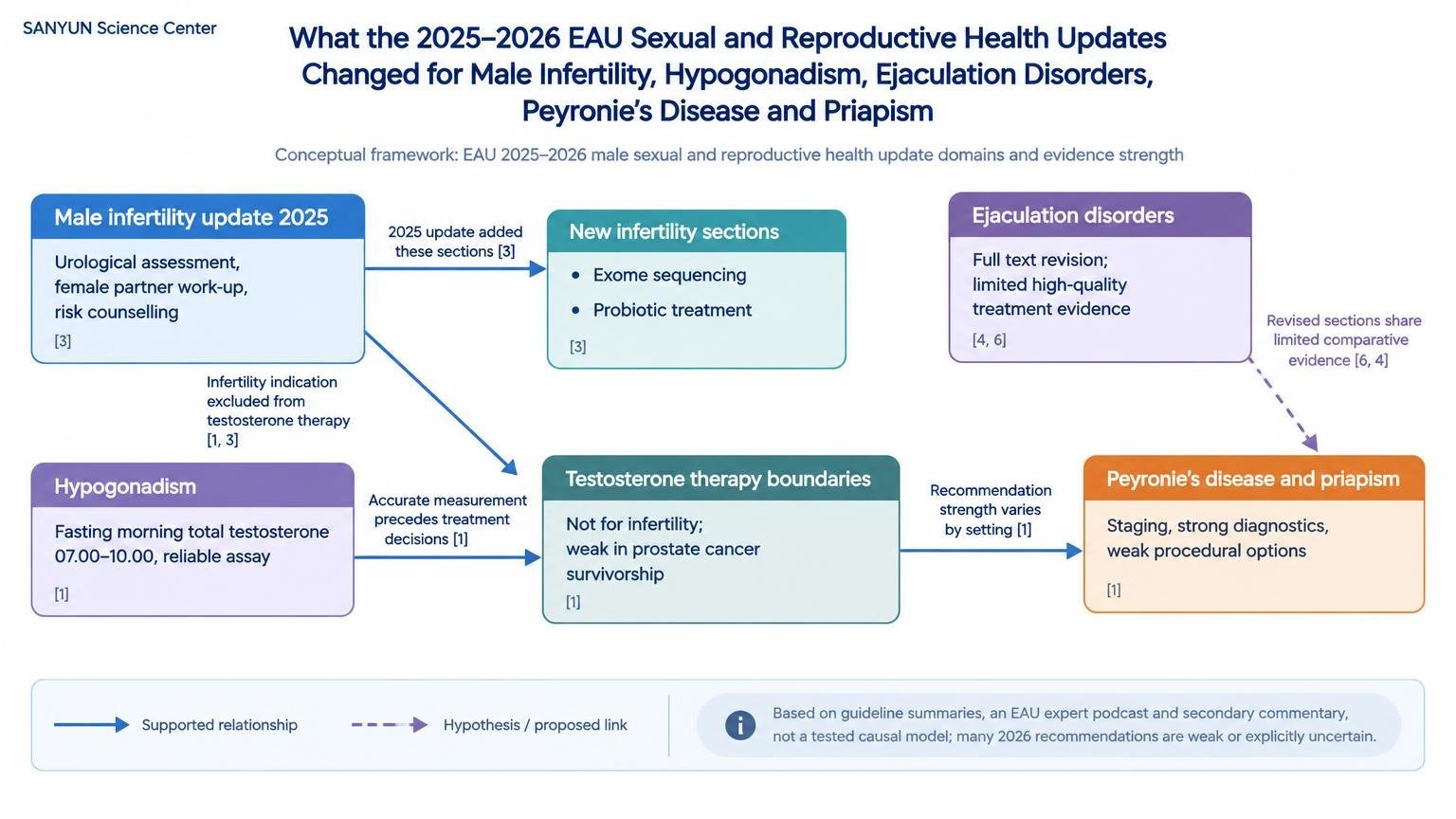
Conceptual framework: Conceptual framework of the 2025–2026 EAU sexual and reproductive health updates. Nodes represent guideline domains and evidence-boundary constructs for adult men; edges show supported or proposed relationships. Based on guideline summaries, an EAU expert podcast and secondary commentary, not a tested causal model; many 2026 recommendations are weak or explicitly uncertain.
Academic References & Evidence
- Introduction – EAU Guidelines on Sexual and Reproductive Health – Uroweb. EAU Guidelines on Sexual and Reproductive Health – Uroweb. 2026
- Suks Minhas; Luca Boeri; Paolo Capogrosso; Andrea Cocci; Giovanni Corona; Marij Dinkelman-Smit; Marco Falcone; Christian Fuglesang Jensen; Murat Gül; Arif Kalkanli; Ates Kadioğlu; Juan I Martinez-Salamanca; L Afonso Morgado; Giorgio I Russo; Ege Can Serefoğlu; Paolo Verze; Andrea Salonia. European Association of Urology Guidelines on Male Sexual and Reproductive Health: 2025 Update on Male Infertility. European Urology. 2025 87(5):601-616 DOI: 10.1016/j.eururo.2025.02.026.
- Minhas, S; Boeri, L; Capogrosso, P; Cocci, A; Corona, G; Dinkelman-Smit, M; Falcone, M; Jensen, CF; Gül, M; Kalkanli, A; Kadioğlu, A; Martinez-Salamanca, JI; Morgado, LA; Russo, GI; Serefoğlu, EC; Verze, P; Salonia, A. European Association of Urology Guidelines on Male Sexual and Reproductive Health: 2025 Update on Male Infertility.. European urology. 2025 87(5):601-616 DOI: 10.1016/j.eururo.2025.02.026.
- EAU Guidelines on Sexual and Reproductive Health – Uroweb. EAU Guidelines on Sexual and Reproductive Health – Uroweb. 2026
- Graziottin A.. Disturbi sessuali e riproduttivi maschili: le linee guida dell'Associazione Europea di Urologia – Disturbi sessuali maschili – Alessandra Graziottin. 2026
- 2026 update on EAU Guidelines for Sexual & Reproductive Health – EAU Podcast. EAU Podcast
- 2026 update on EAU Guidelines for Sexual & Reproductive Health.
SANYUN Science Center explains published research on men's reproductive and sexual health, connecting scientific evidence with everyday questions while making sources and limitations clear.
Disclaimer: This article is for scientific education and research communication only. It does not provide medical advice, diagnosis, or individualized treatment recommendations, and does not endorse any medication, supplement, device, penile enlargement procedure, or other intervention. Decisions about sexual and reproductive health should be made in consultation with a qualified healthcare professional. Do not delay seeking professional care because of information in this article.
Original Content & Copyright Notice
- This article is prepared for SANYUN Science Center, drawing on published research and publicly available academic literature on men’s sexual and reproductive health. Its editorial explanations and presentation are developed for this platform.
- Copyright in the original editorial content, selection, and arrangement is reserved by SANYUN Science Center to the extent protected by applicable law. Referenced research, quotations, and third-party materials remain subject to the rights of their respective owners. This notice does not claim ownership of scientific facts or third-party research.
- Except where permitted by applicable law or an applicable license, prior written permission is required to reproduce, republish, translate, adapt, redistribute, or commercially reuse protected content. Attribution alone does not grant permission for such reuse.
- For permitted quotation or authorized reuse, clearly identify the source and retain a link to the original article.
- Source: SANYUN Science Center
- Original URL: Retain the original article URL on science.san-yun.com.
- Copyright Holder: SANYUN Science Center, for its own protected editorial content.
- Quotation, excerpts, or authorized reuse must not distort the scientific meaning, omit material limitations or disclaimers, or imply unverified medical claims, product efficacy, or endorsement by SANYUN Science Center.



