




Category: Erectile Dysfunction
Core Research Direction: An evidence-quality review of erectile dysfunction treatment: what systematic reviews and meta-analyses actually establish about pharmacological and non-pharmacological therapies, how strong that evidence is, and what remains uncertain for clinical decision-making
Search Intent: How reliable is the evidence behind current erectile dysfunction treatments, and which interventions have genuinely supported benefits versus low-certainty or unproven effects?
Platform: SANYUN Science Center
Evidence reviewed through: 2026-11-22
Executive Summary
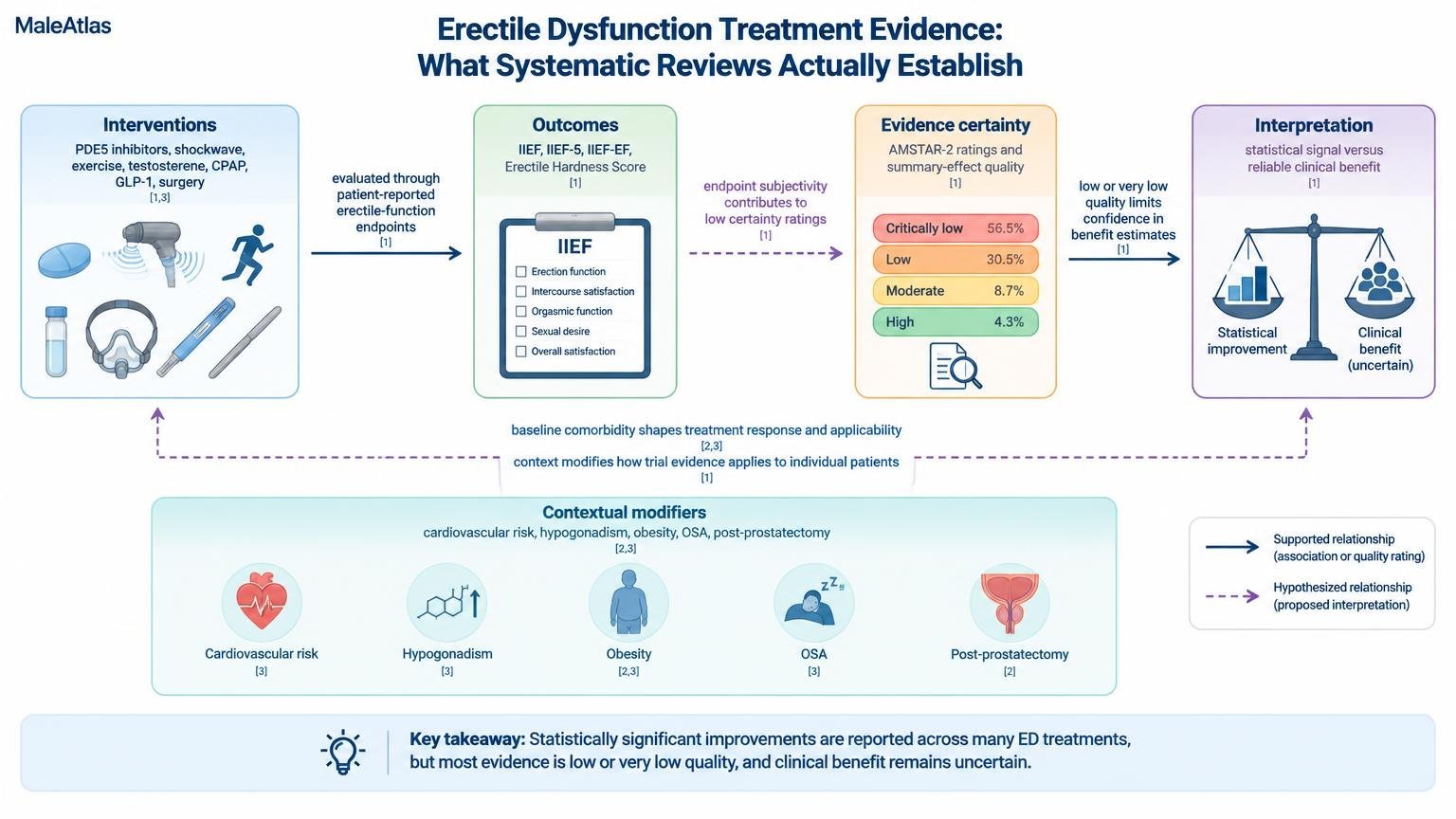
A 2026 umbrella review of systematic reviews and meta-analyses offers a sobering map of erectile dysfunction treatment evidence. It screened 1,191 studies, extracted 23 published meta-analyses and distilled 42 summary effects across the International Index of Erectile Function, its short and erectile-function versions, and the Erectile Hardness Score, covering 36 interventions. Appraised with AMSTAR-2, 13 meta-analyses (56.5%) were rated critically low quality and 7 (30.5%) low; 2 were moderate and 1 high. At the level of individual summary effects, 20 (47.6%) were low quality and 20 (47.6%) very low, with only two rated high or moderate.[1]
The authors did not conclude that treatments fail. They concluded that both pharmacological and non-pharmacological interventions show statistically significant improvements, but that the evidence base is predominantly low or very low quality because of limited patient numbers and subjective outcome indicators. That gap between a statistical signal and reliable clinical evidence is the central issue for anyone choosing among therapies, and it frames this updated 2026 evidence review.
Why This Matters
Erectile dysfunction is defined as the persistent inability to attain and maintain an erection sufficient for satisfactory sexual performance, and it can affect psychosocial health and quality of life for both patients and partners. The European Association of Urology guideline cautions that most cases are of mixed aetiology, so strict organic or psychogenic labels should be used carefully. The same guideline rates the shared risk factors between erectile dysfunction and cardiovascular disease at Level of Evidence 2b.[2]
Because the condition sits at the intersection of vascular medicine, endocrinology, psychology and surgery, the treatment market is broad and promotional claims are common. Low-certainty evidence does not mean a treatment is ineffective; it means the estimated benefit is imprecise, potentially biased, or based on surrogate endpoints that may not reflect what patients value. Understanding that distinction helps patients ask better questions and helps clinicians avoid presenting preference-sensitive choices as settled.
The cardiovascular context raises the stakes. A 2021 umbrella review summarized in a physician-authored guide reported that men with erectile dysfunction had increased relative risks for cardiovascular disease (RR 1.45), coronary heart disease (RR 1.50), cardiovascular mortality (RR 1.50), myocardial infarction (RR 1.55), stroke (RR 1.36) and all-cause mortality (RR 1.25), all with P less than 0.001. These are associations from a secondary citation, not proof of causation, but they support treating erectile dysfunction as a marker worth investigating.[3]
Biological and Measurement Context
An erection depends on coordinated vascular, neurological, hormonal and psychological processes. Phosphodiesterase type 5 inhibitors block the enzyme that breaks down cyclic GMP, the molecule that relaxes penile smooth muscle and allows blood to fill the corpora cavernosa. This mechanism explains why these drugs require sexual stimulation and why they are absolutely contraindicated with nitrate medications and recreational nitrites: the combination can cause severe, potentially fatal hypotension.
The disputed question is not mechanism but magnitude and durability of benefit in real populations. The umbrella review relied on the International Index of Erectile Function and its variants plus the Erectile Hardness Score. These are validated patient-reported instruments, yet they remain subjective and can be influenced by expectation, unblinding and inconsistent definitions of meaningful change. That is a key reason the authors caution that statistically significant improvements should be interpreted cautiously.
What the Evidence Shows by Intervention
| Intervention or context | Reported finding | Evidence character |
|---|---|---|
| Pharmacological and non-pharmacological treatments overall | Statistically significant improvements reported across 42 summary effects on erectile-function endpoints | Predominantly low or very low quality; limited patient numbers; subjective outcomes |
| Lifestyle modification (exercise, reduced BMI) | Can improve erectile function | Guideline Level of Evidence 1b; a 2023 meta-analysis cited in a secondary guide reported about a 2.8-point IIEF-EF gain with aerobic exercise |
| Low-intensity shockwave therapy | May improve IIEF-EF by roughly 3.9 points short term and 5.3 points long term versus sham | Low certainty in a 2025 Cochrane review of 21 trials and 1,357 men; several industry-funded trials |
| Testosterone in confirmed hypogonadism | Improves libido and can augment PDE5 inhibitor response; not standalone ED therapy | TRAVERSE (n=5,246) found noninferior major adverse cardiac events (HR 0.96, 95% CI 0.78-1.17) but more atrial fibrillation, acute kidney injury and pulmonary embolism |
| CPAP for obstructive sleep apnea | Erectile function scores rose after three months in one study, but stand-alone benefit unproven | 2023 meta-analysis found higher IIEF-5 with sildenafil than CPAP (37.7 vs 27.3); 2021 Cochrane review rated CPAP evidence very uncertain |
| GLP-1 receptor agonists | Bidirectional: improved IIEF-5 in obesity-associated hypogonadism pilot; higher new ED diagnosis rates in non-hypogonadal semaglutide users | Pilot and database designs; absolute rates low; causation not established |
| Radical prostatectomy | 25-75% experience post-RP ED; unassisted recovery 20-25% in most studies | Guideline synthesis; robot-assisted versus open comparison inconclusive |
| Radiotherapy for prostate cancer | ED prevalence 34% at one year and 57% at 5.5 years | Systematic review and meta-analysis summarized in guideline |
PDE5 inhibitors remain the most commonly used first treatment. The umbrella review's abstract does not provide per-intervention effect sizes, which limits any attempt to rank drugs against one another from this source alone. What can be said is that the review found statistically significant improvements with both pharmacological and non-pharmacological interventions while assigning most of that evidence limited certainty.
Shockwave therapy illustrates the gap between statistical signal and clinical certainty. A 2025 Cochrane review of 21 randomized trials involving 1,357 men found that low-intensity shockwave therapy may improve short-term IIEF-EF scores by roughly 3.9 points and long-term scores by 5.3 points versus sham, but rated the certainty of evidence as low. Several trials were industry-funded, mainly by device makers. In practice this means shockwave therapy may help some men, but the evidence is not strong enough to recommend it routinely or to present it as equivalent to established options.
Testosterone occupies a different evidentiary position. In men with confirmed hypogonadism it can improve libido and augment the response to PDE5 inhibitors, but it is not effective as standalone erectile dysfunction therapy. The TRAVERSE trial, a 2023 NEJM study of 5,246 men with hypogonadism and pre-existing or high cardiovascular risk, found transdermal testosterone noninferior to placebo for major adverse cardiac events (HR 0.96, 95% CI 0.78-1.17) over a mean 21.7 months, although atrial fibrillation, acute kidney injury and pulmonary embolism were more common in the testosterone group. These findings come from a secondary citation.
After prostate cancer treatment the evidence is more concrete but sobering. In the ProtecT trial of 1,643 patients with localised prostate cancer, the proportion reporting erections firm enough for intercourse fell from 67% at baseline to 30% in the active monitoring group, 27% in the radiotherapy group and 17% in the radical prostatectomy group at six years. The guideline reports that 25-75% of men experience erectile dysfunction after radical prostatectomy, with unassisted recovery of 20-25% in most studies. Whether robot-assisted surgery is superior to open retropubic prostatectomy remains inconclusive: one systematic review found a 12-month potency advantage, but two randomised trials found only marginal or no clinically meaningful difference.
After radiotherapy, a systematic review and meta-analysis including men treated with external beam radiotherapy (65%), brachytherapy (31%) or both (4%) reported erectile dysfunction prevalence of 34% at one year and 57% at 5.5 years. These figures underscore that post-treatment erectile dysfunction is common across modalities and that rehabilitation conversations should begin early.
Interpretation and Limitations
The most important limitation is structural. An umbrella review of meta-analyses cannot repair weak primary trials. If the included meta-analyses pooled small, short, heterogeneous studies with inconsistent definitions of response, the summary effect carries that uncertainty forward. The high proportion of critically low AMSTAR-2 ratings suggests many included reviews had methodological problems serious enough to limit confidence, and the even split between low and very low summary effects shows the problem is not confined to a few outliers.
The supplied record of the umbrella review does not provide per-intervention effect sizes, confidence intervals or the number of patients contributing to each summary effect. That makes it impossible to compare the magnitude of benefit across drug classes, shockwave therapy, exercise or devices using this source alone. Absence of those details is not evidence that treatments are equivalent; it is evidence that the current literature does not support confident ranking.
Several other sources used here are secondary. The physician-authored patient guide that summarises the TRAVERSE trial, the shockwave Cochrane review, the CPAP analyses and the GLP-1 database studies is not itself a primary trial report, and the 2021 umbrella review on cardiovascular risk is cited second-hand. The European guideline is a rigorous synthesis but relies on the primary literature it cites. Trial results and relative risks reported here should be read as accurate summaries of those secondary sources, not independent verification.
A safety dimension deserves separate emphasis because evidence-quality reviews can blur it. Spontaneous reporting analyses, such as a 2025 FAERS review of 53,517 reports from 2004 to 2024, can identify signals but cannot establish incidence or causation. The absolute contraindication between PDE5 inhibitors and nitrates is not a statistical controversy. Low certainty about comparative efficacy should never be mistaken for uncertainty about known harms.
Research Outlook
The umbrella review authors call for well-designed studies on single treatments and high-quality meta-analyses of inter-treatment comparisons. That is a reasonable priority. The field needs trials with adequate sample sizes, prespecified clinically meaningful differences, longer follow-up and transparent funding reporting, and it needs head-to-head comparisons because patients and clinicians choose between treatments rather than between a treatment and nothing.
Several specific questions remain open. Does shockwave therapy produce durable benefit in men who are partial responders to PDE5 inhibitors, or is the signal confined to short-term score changes in selected populations? How should GLP-1 receptor agonists be positioned in men with obesity-associated hypogonadism versus men without it, given the conflicting pilot and database signals? And can post-prostatectomy rehabilitation improve beyond the 20-25% unassisted recovery rate that has remained stable for two decades? These are testable hypotheses that current evidence cannot settle.
Key Takeaways
- An umbrella review of 23 meta-analyses and 42 summary effects found that most evidence for erectile dysfunction treatments is rated low or very low quality; only two summary effects were rated high or moderate.
- Statistically significant improvements were reported for both pharmacological and non-pharmacological interventions, but limited patient numbers and subjective outcome measures reduce confidence.
- PDE5 inhibitors remain the most commonly used first treatment, and the absolute contraindication with nitrates is a settled safety rule, not an area of evidentiary uncertainty.
- Low-intensity shockwave therapy may improve IIEF-EF scores by roughly 3.9 points short term and 5.3 points long term versus sham, but a 2025 Cochrane review rated the certainty of evidence as low and noted industry funding.
- Lifestyle modification, including regular exercise and reduced body mass index, is supported at Level of Evidence 1b in guideline synthesis, and a 2023 meta-analysis found aerobic exercise improved IIEF-EF scores by about 2.8 points.
- Post-prostatectomy erectile dysfunction remains common, with 25-75% affected and unassisted recovery of 20-25% in most studies, and surgical modality comparisons are inconclusive.
Questions and Answers
What did the 2026 umbrella review find about the quality of erectile dysfunction treatment evidence?
It screened 1,191 studies and extracted 23 meta-analyses yielding 42 summary effects across 36 interventions. Using AMSTAR-2, 13 meta-analyses (56.5%) were rated critically low and 7 (30.5%) low, with only 2 moderate and 1 high. At summary-effect level, 20 of 42 were low quality and 20 very low, with only two high or moderate. Most evidence is therefore low certainty.
Does low-intensity shockwave therapy have good evidence for erectile dysfunction?
A 2025 Cochrane review of 21 randomised trials involving 1,357 men found shockwave therapy may improve short-term IIEF-EF scores by roughly 3.9 points and long-term scores by 5.3 points versus sham. However, certainty was rated low, and several trials were industry-funded, mainly by device makers. It may help some men but is not strong enough to recommend routinely.
How strong is the evidence that exercise or lifestyle change improves erectile function?
Guideline synthesis rates lifestyle modification, including regular exercise and reduced body mass index, as able to improve erectile function at Level of Evidence 1b. A 2023 meta-analysis cited in a secondary guide found aerobic exercise improved IIEF-EF scores by about 2.8 points. The effect is modest but consistent with vascular risk reduction, and it does not replace pharmacotherapy in significant erectile dysfunction.
How common is erectile dysfunction after prostate cancer surgery and radiotherapy?
In ProtecT, involving 1,643 patients, erections firm enough for intercourse fell from 67% at baseline to 30% with active monitoring, 27% with radiotherapy and 17% with radical prostatectomy at six years. The guideline reports 25-75% experience erectile dysfunction after radical prostatectomy, with unassisted recovery of 20-25%. After radiotherapy, prevalence was 34% at one year and 57% at 5.5 years.
What is the evidence for testosterone therapy in men with erectile dysfunction and hypogonadism?
Testosterone is not effective as standalone erectile dysfunction therapy, but in confirmed hypogonadism it can improve libido and augment PDE5 inhibitor response. TRAVERSE, involving 5,246 hypogonadal men at high cardiovascular risk, found transdermal testosterone noninferior to placebo for major adverse cardiac events (HR 0.96, 95% CI 0.78-1.17) over a mean 21.7 months, but atrial fibrillation, acute kidney injury and pulmonary embolism were more common.
Why does the evidence certainty rating matter for erectile dysfunction treatment decisions?
A statistically significant result does not guarantee a reliable or durable benefit. Most erectile dysfunction summary effects rest on small studies, subjective patient-reported scores and inconsistent definitions of meaningful change. Low certainty means the estimate of benefit is imprecise or potentially biased, so patients and clinicians should treat preference-sensitive choices as uncertain rather than settled, while still respecting known safety rules.
Conceptual framework: Conceptual framework. This figure maps the relationships discussed in this evidence-quality review: intervention categories are evaluated through patient-reported erectile-function endpoints, evidence certainty is low for most summary effects, and contextual factors such as cardiovascular risk, hypogonadism, obesity, sleep apnea and post-prostatectomy status modify applicability. Solid links show reported associations or quality ratings; dashed links show proposed interpretations. It is not a tested causal model and does not represent a biological pathway.
Academic References & Evidence
- Current treatment for erectile dysfunction: an umbrella review of systematic reviews and meta-analyses. 2026 DOI: 10.6084/m9.figshare.31562993.v1.
- Management of Erectile Dysfunction – EAU Guidelines on Sexual and Reproductive Health – Uroweb.
- Parth Bhavsar. Erectile Dysfunction.
SANYUN Science Center explains published research on men's reproductive and sexual health, connecting scientific evidence with everyday questions while making sources and limitations clear.
Disclaimer: This article is for scientific education and research communication only. It does not provide medical advice, diagnosis, or individualized treatment recommendations, and does not endorse any medication, supplement, device, penile enlargement procedure, or other intervention. Decisions about sexual and reproductive health should be made in consultation with a qualified healthcare professional. Do not delay seeking professional care because of information in this article.
Original Content & Copyright Notice
- This article is prepared for SANYUN Science Center, drawing on published research and publicly available academic literature on men’s sexual and reproductive health. Its editorial explanations and presentation are developed for this platform.
- Copyright in the original editorial content, selection, and arrangement is reserved by SANYUN Science Center to the extent protected by applicable law. Referenced research, quotations, and third-party materials remain subject to the rights of their respective owners. This notice does not claim ownership of scientific facts or third-party research.
- Except where permitted by applicable law or an applicable license, prior written permission is required to reproduce, republish, translate, adapt, redistribute, or commercially reuse protected content. Attribution alone does not grant permission for such reuse.
- For permitted quotation or authorized reuse, clearly identify the source and retain a link to the original article.
- Source: SANYUN Science Center
- Original URL: Retain the original article URL on science.san-yun.com.
- Copyright Holder: SANYUN Science Center, for its own protected editorial content.
- Quotation, excerpts, or authorized reuse must not distort the scientific meaning, omit material limitations or disclaimers, or imply unverified medical claims, product efficacy, or endorsement by SANYUN Science Center.



