




Category: Erectile Dysfunction
Core Research Direction: An umbrella review of systematic reviews and meta-analyses evaluating the effectiveness and evidence quality of current pharmacological and nonpharmacological treatments for erectile dysfunction (IIEF and EHS endpoints)
Search Intent: How reliable is the current evidence base for the range of erectile dysfunction treatments, and what does the quality assessment of published meta-analyses reveal about confidence in their reported effects?
Platform: SANYUN Science Center
Evidence reviewed through: 2026-11-24
Executive Summary
An umbrella review of systematic reviews and meta-analyses set out to summarise the effectiveness of current erectile dysfunction treatments and to grade the quality of that evidence. The review searched major databases for studies published up to October 2025 and used the International Index of Erectile Function and the erectile hardness score as its outcome measures.[1]
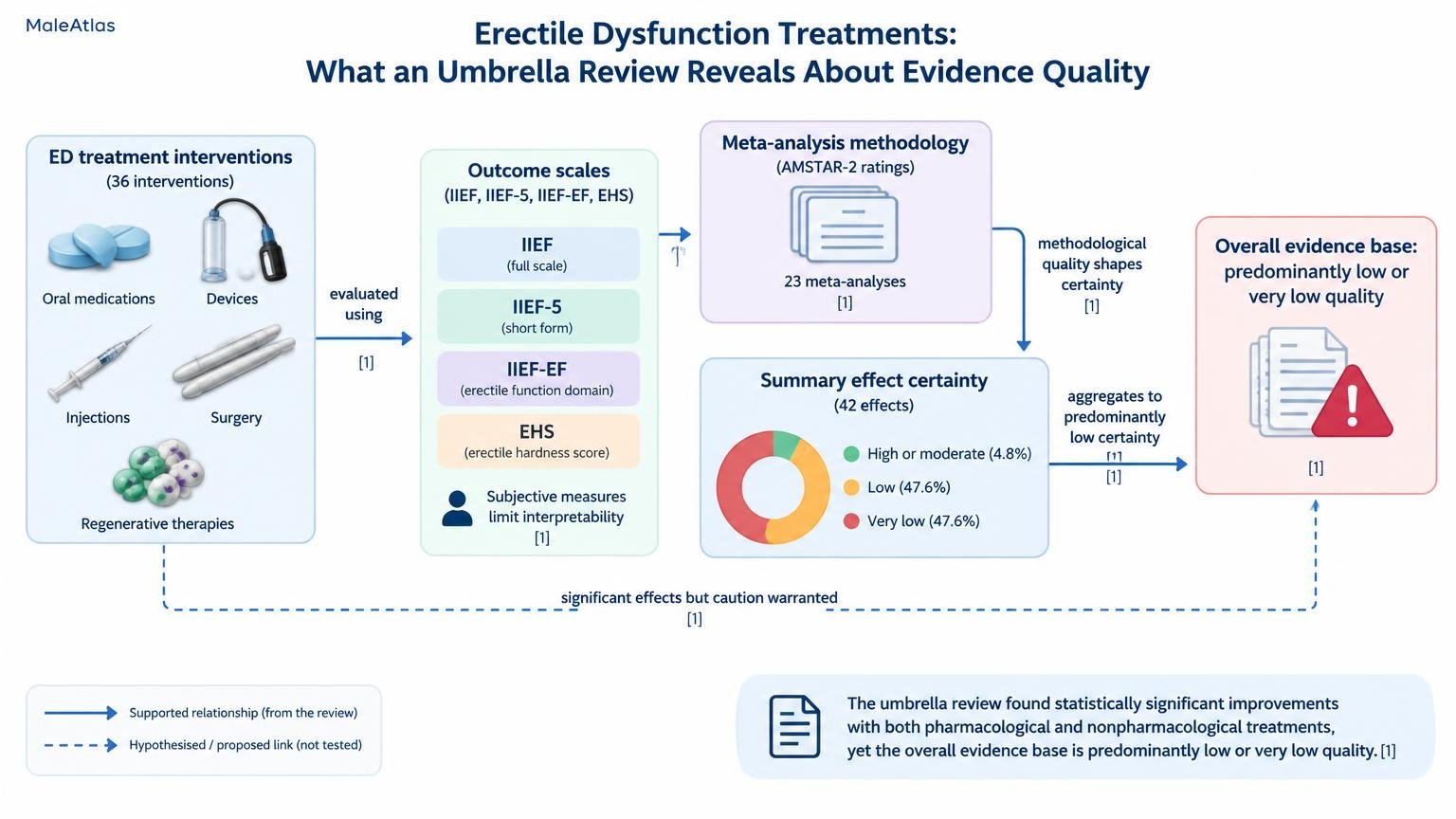
From 1,191 screened studies, the authors extracted 23 published meta-analyses covering 36 interventions and yielding 42 summary effects. Applying AMSTAR-2 to every meta-analysis, they rated 13 (56.5%) critically low quality, 7 (30.5%) low, 2 (8.7%) moderate and 1 (4.3%) high. At the level of individual summary effects, only two of 42 were rated high or moderate quality, while 20 (47.6%) were rated low and 20 (47.6%) very low.
The headline finding is a paradox familiar in evidence synthesis: statistically significant improvements in erectile function were reported for both pharmacological and nonpharmacological interventions, yet the authors concluded the evidence base is predominantly low or very low quality and urged caution because of limited patient numbers and subjective outcome measures.
This article interprets what that quality signal means for clinicians, researchers and readers of treatment claims. It is an evidence review of a published umbrella review, not a new systematic review or clinical trial.
Why This Matters
Erectile dysfunction is common and its treatment market is broad. In the Massachusetts Male Aging Study, 52% of men aged 40 to 70 reported some degree of erectile dysfunction, and a single-clinic series found that one in four men seeking first help for new ED was aged 40 or younger. A condition of that scale attracts many interventions, from established oral medicines to devices, injections, surgery and regenerative therapies.[2]
When a meta-analysis reports a statistically significant improvement, readers often treat the number as settled. Guidance documents reinforce a sense of established practice: for example, clinicians are advised to treat the underlying cause of ED where possible, and PDE5 inhibitors are described as oral medicines that improve penile blood flow and may help achieve and maintain an erection. Those are reasonable clinical summaries, but they do not tell us how confident we should be in each pooled effect estimate.[3]
The umbrella review addresses that gap directly by grading the meta-analyses themselves. Its conclusion that the evidence base is predominantly low or very low quality does not mean treatments are ineffective. It means the confidence we can place in reported effects is limited, and that distinction matters for shared decision-making, for how guidelines weigh recommendations, and for where future research should concentrate.
How the Review Was Built and What It Measured
An umbrella review sits above ordinary systematic reviews: rather than pooling individual trials, it pools and appraises existing meta-analyses. This review drew from PubMed, Web of Science, the Cochrane Library and Embase, covering studies published up to October 2025. Its endpoints were the International Index of Erectile Function or its simplified versions, plus the erectile hardness score.
The yield was 23 meta-analyses and 42 summary effects distributed across endpoint families: 20 on the full IIEF, 9 on IIEF-5, 6 on the IIEF erectile function domain (IIEF-EF) and 7 on EHS, spanning 36 interventions. This spread itself is informative: evidence is fragmented across many instruments and interventions rather than concentrated in a few definitive comparisons.
| Quality dimension | What was assessed | Reported distribution | Interpretation |
|---|---|---|---|
| Meta-analysis methodology | AMSTAR-2 appraisal of 23 meta-analyses | 13 critically low (56.5%); 7 low (30.5%); 2 moderate (8.7%); 1 high (4.3%) | Most pooled analyses rest on methodologically weak reviews |
| Summary effect certainty | Quality rating of 42 summary effects | 2 high or moderate; 20 low (47.6%); 20 very low (47.6%) | Confidence in individual pooled estimates is generally limited |
| Endpoint families | IIEF, IIEF-5, IIEF-EF and EHS | 20 IIEF; 9 IIEF-5; 6 IIEF-EF; 7 EHS | Effects are dispersed across several patient-reported and clinician-rated scales |
| Intervention scope | Number of interventions covered | 36 interventions | A broad landscape without concentrated high-certainty comparisons |
| Overall conclusion | Authors' synthesis of the evidence base | Predominantly low or very low quality | Statistically significant effects require cautious interpretation |
Reading the Quality Signal: Mechanism and Measurement
Why would a field with decades of trial activity produce mostly low-certainty pooled evidence? Part of the answer lies in the outcome instruments. IIEF, IIEF-5, IIEF-EF and EHS are scales that convert subjective experience — erectile confidence, ability to maintain an erection, hardness — into numbers. The review authors singled out the subjective nature of outcome indicators as a reason for caution, alongside limited patient numbers in the underlying comparisons.
Statistical significance and clinical certainty are not the same thing. A pooled mean difference can be significant while the contributing trials are small, heterogeneous in population, inconsistent in dosing or co-interventions, and measured on scales whose minimal important difference is itself debated. AMSTAR-2 captures many of these problems: inadequate search strategies, missing risk-of-bias assessment, poor handling of heterogeneity, and absent publication-bias checks all push a review toward critically low ratings.
The mechanistic plausibility of a treatment does not rescue weak trial evidence. PDE5 inhibitors act by improving penile blood flow during sexual stimulation, a well-described pharmacological action, but the umbrella review's question is whether the pooled trial evidence reliably demonstrates benefit across populations and comparisons. Mechanism and evidence quality are separate questions, and conflating them is a common source of overconfidence.
What the Evidence Shows Across Treatment Categories
The umbrella review does not report that any category failed. It reports that statistically significant improvements were observed with both pharmacological and nonpharmacological interventions, while the quality grades remained low. That is a statement about confidence, not about direction of effect.
Surrounding literature illustrates how uneven certainty is across categories. A 2025 Cochrane review of 21 randomised trials with 1,357 men found low-intensity shockwave therapy may improve short-term IIEF-EF scores by roughly 3.9 points and long-term scores by 5.3 points versus sham, with low certainty of evidence; several trials were funded by device makers. That pattern — a numerically encouraging effect wrapped in low certainty — mirrors the umbrella review's broader conclusion.[4]
Regenerative options show the same tension more starkly. A 2024 meta-analysis of 12 controlled trials with 991 patients found better erectile function scores with platelet-rich plasma than controls (standardised mean difference 0.59), and its authors called for larger, higher-quality trials with longer follow-up. A 2026 meta-analysis restricted to randomised placebo-controlled trials, pooling 7 trials with 479 men, found no difference from placebo at 1, 3 or 6 months, with low to moderate certainty.
Newer regulatory pathways do not automatically supply high-certainty efficacy data either. A drug-free topical gel was authorised as a new medical device through the FDA De Novo pathway in June 2023, not approved as a drug, and its supporting 24-week home-use study was open-label and not designed to compare the gel with pills; 62% of men improved by more than the minimum meaningful amount.[5]
For established oral therapy, post-marketing data add safety signals rather than certainty about efficacy. A 2025 analysis of 53,517 FDA Adverse Event Reporting System reports from 2004 to 2024 identified the labelled side effects for all four PDE5 inhibitors plus some nervous-system, cardiovascular and eye signals not on the labels that need further study. Spontaneous reporting can generate hypotheses but cannot establish causality.
Interpretation and Limitations
Several cautions apply. First, AMSTAR-2 and summary-effect quality ratings assess methodology and certainty, not whether a treatment works; a critically low-rated meta-analysis can still be describing a real effect, and a high-rated one can be describing a trivial one. Second, the review's own synthesis is constrained by the primary literature it inherited: small trials, subjective endpoints and heterogeneous populations propagate upward into every level of the evidence hierarchy.
Third, the umbrella review is a dataset record describing a review with a search cutoff of October 2025; it is not a new experiment, and its stated aim and search parameters are design features rather than results. Readers should not treat its quality distribution as evidence that any specific intervention lacks benefit, nor as proof that another is superior.
Fourth, the wider sources used here are mixed in nature: government patient education, clinic-authored summaries and secondary reporting. Findings such as the cardiovascular risk associations reported in a 2021 umbrella review — cardiovascular disease RR 1.45 (95% CI 1.36–1.54), coronary heart disease 1.50, stroke 1.36 — are observational associations reported secondhand and should be read as such.
Finally, outcome heterogeneity limits cross-category comparison. Pooling effects measured on IIEF, IIEF-5, IIEF-EF and EHS, across 36 interventions, does not produce a league table; it produces a map of where the evidence is dense and where it is thin. The review authors explicitly recommend well-designed single-treatment studies and high-quality meta-analyses of intertreatment comparisons, which signals that head-to-head certainty is largely missing.
Where Uncertainty Is Greatest
Certainty is unevenly distributed. Combination and hormonal strategies illustrate the problem. For men with ED and low testosterone, clinicians may combine testosterone with PDE5 inhibitors, yet the evidence for that combination is generally presented as treatment guidance rather than high-certainty pooled effect data.
Testosterone therapy carries its own evidence profile dominated by safety rather than efficacy endpoints. In TRAVERSE, transdermal testosterone in 5,246 hypogonadal men with preexisting or high cardiovascular risk was noninferior to placebo for major adverse cardiac events (HR 0.96, 95% CI 0.78–1.17) over a mean 21.7 months, though atrial fibrillation, acute kidney injury and pulmonary embolism were more common with testosterone. A 2026 observational cohort reported higher major cardiac event risk with testosterone use (HR 1.27) but noted the same increase in men diagnosed with deficiency, leaving causality unclear.
Emerging therapies remain at an early evidentiary stage. Per the AUA guideline, platelet-rich plasma therapy for ED should be considered experimental and is not FDA-approved for ED, while a 2021 review reported favourable early stem cell data in diabetes-related and post-prostate-surgery ED but concluded larger, well-designed trials are still needed.
Adjunctive and lifestyle-adjacent options also carry mixed certainty. A 2023 meta-analysis of 8 studies with 457 patients reported higher post-treatment IIEF-5 scores with sildenafil than with CPAP (37.7 versus 27.3) and suggested combining them may add benefit, while a 2021 Cochrane review rated CPAP versus no CPAP evidence as very uncertain. In a 2018 cohort of 150 men newly diagnosed with moderate to severe obstructive sleep apnea, ED prevalence was 51%.
Over-the-counter and supplement claims deserve particular scepticism. There is no definite evidence that any herbal product is effective or safe for ED, and the physical activity guideline of at least 150 minutes of moderate-intensity activity per week is a general population recommendation, not ED-specific trial evidence.
Research Outlook and Clinical Relevance
The umbrella review's recommendations point toward the structural fixes the field needs: better-designed single-treatment trials, larger and more consistent samples, validated and less subjective outcome measures, and high-quality meta-analyses that compare treatments directly rather than in isolation. It also implicitly argues for transparent reporting of industry funding, a recurring concern in device-based therapies such as shockwave treatment.
What should clinicians and readers take from a predominantly low-certainty evidence base? Not paralysis. Established options remain reasonable because mechanism, clinical experience and consistent direction of effect align, even where certainty is graded low. But claims of superiority between treatments, and claims of strong proof for newer regenerative or device-based approaches, should be made cautiously until higher-quality comparative evidence exists.
For patients, the practical translation is that treatment decisions remain individual, guided by evaluation of underlying causes, cardiovascular risk assessment and shared discussion of benefits and harms. The quality signal is a prompt for humility in how evidence is communicated, not a verdict that the available treatments fail.
Key Takeaways
- An umbrella review extracted 23 meta-analyses and 42 summary effects across 36 ED interventions, using IIEF, IIEF-5, IIEF-EF and EHS as endpoints.
- AMSTAR-2 ratings placed 13 of 23 meta-analyses (56.5%) at critically low quality and 7 (30.5%) at low quality; only 3 were moderate or high.
- Of 42 summary effects, just two were rated high or moderate quality, while 20 (47.6%) were low and 20 (47.6%) very low.
- Statistically significant improvements were reported for pharmacological and nonpharmacological interventions, but the authors caution that patient numbers were limited and outcome indicators subjective.
- The authors call for well-designed single-treatment studies and high-quality meta-analyses comparing treatments directly.
Questions and Answers
What did the umbrella review of erectile dysfunction treatments actually measure?
It pooled published meta-analyses and graded their methodology with AMSTAR-2. Effectiveness endpoints were the International Index of Erectile Function or its simplified versions, plus the erectile hardness score. From 1,191 screened studies it extracted 23 meta-analyses yielding 42 summary effects across 36 interventions, then rated the quality of each meta-analysis and each summary effect.
How reliable is the evidence base for erectile dysfunction treatments?
Predominantly low certainty. The review rated 13 of 23 meta-analyses (56.5%) critically low and 7 (30.5%) low on AMSTAR-2, with only two moderate and one high. At summary-effect level, only two of 42 were high or moderate quality, while 20 were low and 20 very low. Statistically significant effects existed, but confidence in them is limited.
Does low-certainty evidence mean erectile dysfunction treatments do not work?
No. Low certainty means the available evidence cannot firmly establish the size or consistency of benefit; it does not show absence of effect. The review reported statistically significant improvements with both pharmacological and nonpharmacological interventions, while cautioning about small patient numbers and subjective outcome scales. Mechanism, clinical experience and consistent direction of effect can still support cautious use.
Why are subjective outcome scales a problem in erectile dysfunction trials?
Instruments such as IIEF, IIEF-5, IIEF-EF and erectile hardness score translate self-reported experience into numbers. The umbrella review explicitly cited the subjective nature of outcome indicators, alongside limited patient numbers, as reasons to interpret pooled effects cautiously. Subjective scales can be sensitive to expectation and reporting bias, and their minimal important difference is debated.
What are the main limitations of this umbrella review of ED treatment evidence?
It grades methodology and certainty, not whether treatments work, and it inherits the weaknesses of the trials it summarises. Its search cutoff is October 2025, and its synthesis cannot resolve heterogeneity across 36 interventions and four endpoint families. It is a dataset record of a review, not a new experiment, and some supporting context comes from secondary sources.
What research does the umbrella review recommend for erectile dysfunction?
The authors urgently recommend further well-designed studies of single treatments, plus high-quality meta-analyses that directly compare treatments with each other. This reflects a field where evidence is dispersed across many interventions and scales, with little head-to-head certainty. Addressing industry funding transparency, a concern in device-based therapies such as shockwave treatment, is also relevant.
Conceptual framework: Conceptual framework for interpreting an umbrella review of erectile dysfunction treatments. Interventions were evaluated on IIEF, IIEF-5, IIEF-EF and EHS scales; AMSTAR-2 ratings of 23 meta-analyses and certainty grades of 42 summary effects converge on a predominantly low- or very-low-quality evidence base. Relationships are conceptual, not a tested causal model.
Academic References & Evidence
- Current treatment for erectile dysfunction: an umbrella review of systematic reviews and meta-analyses. Figshare. 2026 DOI: 10.6084/m9.figshare.31562993.v1.
- Jen Adams; Josh Allen. Erectile Dysfunction Treatments: What the Evidence Shows. 2026
- Treatment for Erectile Dysfunction – NIDDK.
- Parth Bhavsar. Erectile Dysfunction. 2026
- Jen Adams; Josh Allen. New ED Treatments in 2026: What Works and What Is in Trials. 2026
SANYUN Science Center explains published research on men's reproductive and sexual health, connecting scientific evidence with everyday questions while making sources and limitations clear.
Disclaimer: This article is for scientific education and research communication only. It does not provide medical advice, diagnosis, or individualized treatment recommendations, and does not endorse any medication, supplement, device, penile enlargement procedure, or other intervention. Decisions about sexual and reproductive health should be made in consultation with a qualified healthcare professional. Do not delay seeking professional care because of information in this article.
Original Content & Copyright Notice
- This article is prepared for SANYUN Science Center, drawing on published research and publicly available academic literature on men’s sexual and reproductive health. Its editorial explanations and presentation are developed for this platform.
- Copyright in the original editorial content, selection, and arrangement is reserved by SANYUN Science Center to the extent protected by applicable law. Referenced research, quotations, and third-party materials remain subject to the rights of their respective owners. This notice does not claim ownership of scientific facts or third-party research.
- Except where permitted by applicable law or an applicable license, prior written permission is required to reproduce, republish, translate, adapt, redistribute, or commercially reuse protected content. Attribution alone does not grant permission for such reuse.
- For permitted quotation or authorized reuse, clearly identify the source and retain a link to the original article.
- Source: SANYUN Science Center
- Original URL: Retain the original article URL on science.san-yun.com.
- Copyright Holder: SANYUN Science Center, for its own protected editorial content.
- Quotation, excerpts, or authorized reuse must not distort the scientific meaning, omit material limitations or disclaimers, or imply unverified medical claims, product efficacy, or endorsement by SANYUN Science Center.



