




Category: Erectile Dysfunction
Core Research Direction: An umbrella review of systematic reviews and meta-analyses of current erectile dysfunction treatments, examining effectiveness signals (IIEF/IIEF-5/IIEF-EF and EHS) alongside the quality of the underlying evidence base and the reliability of claims across pharmacological and non-pharmacological interventions.
Search Intent: How strong is the evidence behind current erectile dysfunction treatments, and what do systematic reviews actually show about their effectiveness?
Platform: SANYUN Science Center
Evidence reviewed through: 2026-11-24
Executive Summary
A 2026 umbrella review of systematic reviews and meta-analyses set out to answer a deceptively simple question: how good is the evidence behind the treatments now offered for erectile dysfunction? The review searched PubMed, Web of Science, the Cochrane Library and Embase for studies published up to October 2025, extracted 23 published meta-analyses from 1,191 records, and assembled 42 summary effects across 36 interventions, measured with the International Index of Erectile Function (IIEF) or its shortened versions and the erectile hardness score (EHS).[1]
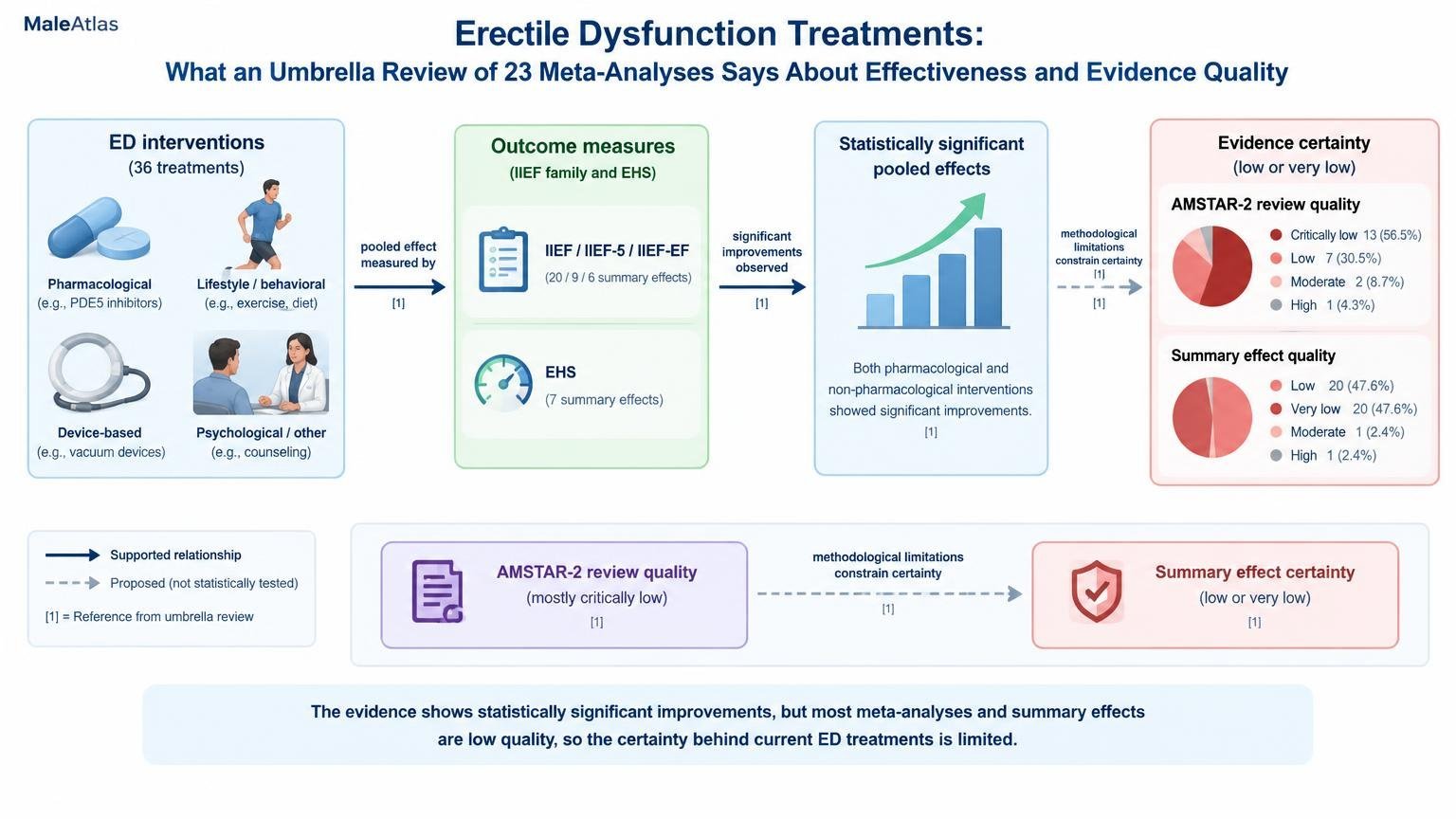
The headline result is split. Statistically significant improvements were observed for both pharmacological and non-pharmacological interventions. Yet when the review team applied AMSTAR-2 to the included meta-analyses, 13 of 23 (56.5%) were rated critically low quality, 7 (30.5%) low, 2 (8.7%) moderate and only 1 (4.3%) high. At the level of individual summary effects, 20 of 42 (47.6%) were rated low quality and another 20 (47.6%) very low, with only one high and one moderate.
In other words, the treatment landscape is broad and statistically active, but the reliability of the evidence is poor. The authors concluded that the evidence base is predominantly of low or very low quality and called for better-designed single-treatment studies and high-quality meta-analyses comparing treatments directly. This article examines what that conclusion means biologically, statistically and clinically.
Why This Matters
Erectile dysfunction is not merely a sexual complaint. A narrative review in the 2026 literature characterizes ED as a multifactorial condition associated not only with local erectile dysfunction but also closely with systemic metabolic and cardiovascular health. That framing is clinically important because the same vascular and metabolic disturbances that produce erectile difficulty may be early signals of broader cardiometabolic disease.[2]
For patients and clinicians, the practical question is not whether “something works” but which treatment is supported by trustworthy evidence for a given person. An umbrella review is a useful lens because it aggregates the systematic reviews that guidelines and clinicians already rely on. If the best available synthesis shows that most of those reviews are of critically low quality, then confidence in apparently positive effects should be calibrated accordingly. That is not a reason to dismiss treatment; it is a reason to distinguish statistical significance from reliable, clinically meaningful benefit.
The gap between evidence volume and evidence certainty also matters for shared decision-making. A large menu of options may create an impression of maturity, but the umbrella review's authors noted that the treatment landscape is increasingly diverse while evidence reliability remains poor. Patients weighing treatments deserve to know that distinction, and clinicians should be able to explain it without overstating either benefit or harm.
Biological and Clinical Mechanism
Erection is a vascular event coordinated by nerves, blood vessels, hormones and psychological state. Sexual arousal triggers nerve signals that release nitric oxide in the penile arteries. Nitric oxide activates guanylate cyclase, which produces cyclic GMP. Cyclic GMP relaxes smooth muscle in the arterial walls, allowing blood to fill the corpora cavernosa. Disruption anywhere along that chain—endothelial dysfunction, nerve injury, hormonal deficiency or psychological interference—can produce erectile dysfunction.[3]
This mechanism explains why pharmacotherapy represented by phosphodiesterase type 5 inhibitors remains the mainstay of treatment: these drugs slow the breakdown of cyclic GMP, amplifying the natural signal. But the same mechanism also explains why PDE5 inhibitors are not a complete solution. They require sexual stimulation to initiate the nitric oxide signal, and they do not repair damaged endothelium, injured nerves or deficient testosterone. That is why comprehensive management and individualized therapy are receiving increasing emphasis.
The multifactorial nature of ED also shapes the evidence problem. A condition with vascular, neurological, hormonal and psychological contributors is unlikely to respond uniformly to any single intervention, and trials that enroll heterogeneous populations may generate positive average effects that mask important variation. The narrative review synthesizing risk factors and neurovascular and endocrine mechanisms makes this point implicitly: the disease is complex, so single-mechanism treatments may produce statistically detectable but clinically modest average changes.
What the Evidence Shows
The umbrella review is best understood as a map of the evidence landscape rather than a ranking of treatments. It included 23 meta-analyses yielding 42 summary effects across 36 interventions. The endpoints were the IIEF or its simplified versions—IIEF-5 and IIEF-EF—and the EHS. These are patient-reported and clinician-administered measures of erectile function and hardness, and their subjective nature is one of the reasons the authors urged caution.
| Variable | Definition in This Review | Interpretation |
|---|---|---|
| Included meta-analyses | 23 published meta-analyses extracted from 1,191 records | The unit of synthesis; each summarizes multiple primary studies |
| Summary effects | 42 estimates across 36 interventions | Each represents a pooled treatment–outcome comparison |
| IIEF / IIEF-5 / IIEF-EF | 20, 9 and 6 summary effects respectively | Patient-reported erectile function domains; different versions are not interchangeable |
| EHS | 7 summary effects | Erectile hardness score; a narrower, clinician-oriented measure |
| AMSTAR-2 review quality | 13 critically low (56.5%), 7 low (30.5%), 2 moderate (8.7%), 1 high (4.3%) | Most included meta-analyses had serious methodological limitations |
| Summary effect quality | 20 low (47.6%), 20 very low (47.6%), 1 high, 1 moderate | Even where pooled effects were significant, certainty was usually poor |
The distribution of quality ratings is the central finding. At the review level, more than half of the included meta-analyses were rated critically low by AMSTAR-2, a tool that assesses whether a systematic review was conducted with adequate search, selection, appraisal and synthesis methods. Only one meta-analysis reached high quality. When the review team rated the certainty of each summary effect, the picture was even starker: 40 of 42 effects were low or very low quality.
This does not mean the treatments are ineffective. The review explicitly reports that statistically significant improvements were observed with both pharmacological and non-pharmacological interventions. A statistically significant pooled effect means the observed change is unlikely to be due to chance under the assumed model. It does not mean the effect is large, durable, free of bias or clinically important for an individual patient. The authors themselves caution that the findings should be interpreted with caution due to limited patient numbers and the subjective nature of outcome indicators.
The review's conclusions align with the broader clinical literature. A separate narrative review states that PDE5 inhibitors remain the mainstay and that high-quality clinical research is still needed to clarify the long-term efficacy and safety of emerging treatments. That is a notable convergence: an umbrella review focused on methodological quality and a narrative review focused on pathogenesis and therapeutic advances both point to the same gap between widespread clinical use and durable, high-certainty evidence.
Interpretation and Limitations
The most important limitation is structural. An umbrella review can only be as good as the meta-analyses it includes, and those meta-analyses can only be as good as the primary trials beneath them. When 13 of 23 included reviews are critically low quality, the umbrella review is documenting a problem in the evidence ecosystem rather than delivering a precise effect estimate for any single treatment. That is useful, but it should not be read as a definitive comparative effectiveness ranking.
The subjective nature of the outcome measures is another constraint. IIEF and EHS scores are valuable because they capture patient experience, but they are susceptible to reporting bias, expectation effects and inconsistent administration across trials. The review authors also cite limited patient numbers as a reason for caution. Small trials are more likely to produce imprecise or inflated effect estimates, and when they are pooled in meta-analyses with methodological weaknesses, the resulting summary effect can appear more certain than it is.
There are also limits to what this review can say about specific agents or devices. The 42 summary effects are spread across 36 interventions, so many interventions are represented by very few comparisons. The review did not establish head-to-head superiority of one treatment over another with high certainty; indeed, its authors specifically recommend high-quality meta-analyses of intertreatment comparisons. That recommendation is an admission that the comparative evidence is currently inadequate, not a finding that treatments are equivalent.
Finally, the review's search ended in October 2025. It is a snapshot of the evidence base at that point, and newer trials may not be reflected. This article interprets the published umbrella review and related context; it is not a new systematic review and does not independently verify the primary studies.
Clinical Relevance and Cautions
For clinicians, the review's message is not that treatment should be withheld but that the confidence attached to claims should be proportionate to the evidence. A statistically significant IIEF improvement in a low-certainty meta-analysis may justify offering a treatment while being transparent that the long-term benefit and safety are not firmly established. The narrative review's emphasis on comprehensive management and individualized therapy is consistent with this posture: treatment selection should account for comorbidities, patient priorities and the quality of supporting evidence, not merely the existence of a positive pooled result.
Safety considerations remain paramount and are not diminished by uncertainty about efficacy. PDE5 inhibitors are absolutely contraindicated with nitrate medications and recreational nitrites because the combination can cause severe, potentially fatal hypotension. This is a well-established safety boundary that applies regardless of how the efficacy evidence is rated.
Patients should also understand that an umbrella review of this kind is not a personalized treatment recommendation. It describes the state of the evidence, not what will work for a particular person. Decisions about ED treatment should involve a qualified clinician who can assess cardiovascular risk, review medications, evaluate hormonal status where appropriate and discuss the uncertainty honestly.
Research Outlook
The umbrella review's authors make two concrete recommendations: further well-designed studies on single treatments, and high-quality meta-analyses of intertreatment comparisons. Both address the core weakness identified—that the evidence base is broad but unreliable. Single-treatment trials with adequate sample sizes, standardized outcome measurement and low risk of bias would strengthen the foundation. Comparative meta-analyses would then allow clinicians to distinguish between treatments on the basis of trustworthy head-to-head evidence rather than indirect inference.
The narrative review adds a parallel call: high-quality clinical research is still needed to clarify the long-term efficacy and safety of emerging treatments. That is particularly relevant for newer device-based and regenerative approaches, where enthusiasm often outpaces evidence. The convergence of these two reviews suggests that the field's next step is not more interventions but better evidence about the interventions already available.
Key Takeaways
- An umbrella review of 23 meta-analyses covering 36 ED interventions found statistically significant improvements in IIEF and EHS outcomes for both pharmacological and non-pharmacological treatments, but rated most of the underlying evidence low or very low quality.
- Of the 23 included meta-analyses, 13 (56.5%) were rated critically low quality by AMSTAR-2, 7 (30.5%) low, 2 (8.7%) moderate and 1 (4.3%) high; of 42 summary effects, only one was high quality and one moderate.
- Statistical significance is not the same as clinical certainty: the review authors caution that limited patient numbers and subjective outcome measures mean positive findings should be interpreted cautiously.
- PDE5 inhibitors remain the mainstay of pharmacotherapy, but the evidence base supporting the broader treatment landscape is predominantly low or very low quality, and high-quality comparative research is urgently needed.
- PDE5 inhibitors are absolutely contraindicated with nitrate medications and recreational nitrites because the combination can cause severe, potentially fatal hypotension—a safety boundary independent of efficacy certainty.
Questions and Answers
What did the 2026 umbrella review of erectile dysfunction treatments find?
It extracted 23 meta-analyses from 1,191 records, yielding 42 summary effects across 36 interventions measured by IIEF, IIEF-5, IIEF-EF and EHS. Statistically significant improvements were seen for both pharmacological and non-pharmacological treatments, but 13 of 23 meta-analyses were rated critically low quality by AMSTAR-2, and 40 of 42 summary effects were low or very low quality. The authors concluded the evidence base is predominantly unreliable.
What do IIEF and EHS scores measure in erectile dysfunction research?
The International Index of Erectile Function (IIEF) and its shortened versions IIEF-5 and IIEF-EF are patient-reported instruments that assess erectile function domains, while the erectile hardness score (EHS) is a narrower measure of hardness. In this umbrella review they were the endpoints used to judge treatment effectiveness. Because they rely on subjective reporting, the review authors cautioned that outcome measurement is one reason positive findings should be interpreted carefully.
How strong is the evidence for current erectile dysfunction treatments?
The evidence is broad but weak in certainty. Of 23 included meta-analyses, 13 (56.5%) were rated critically low quality and only 1 (4.3%) high quality by AMSTAR-2. At the summary-effect level, 20 of 42 (47.6%) were low quality and 20 (47.6%) very low, with only one high and one moderate. The review concluded the evidence base is predominantly low or very low quality, so statistically significant improvements should not be equated with reliable clinical benefit.
Does the umbrella review show which erectile dysfunction treatment works best?
No. The review maps 42 summary effects across 36 interventions but does not establish high-certainty head-to-head superiority. Its authors specifically recommend high-quality meta-analyses of intertreatment comparisons, which indicates comparative evidence is currently inadequate. The finding that many treatments show statistically significant pooled effects does not mean they are equivalent or that one is preferable; it means the evidence is too uncertain to rank them confidently.
What are the limitations of the erectile dysfunction treatment evidence review?
The umbrella review is limited by the quality of the meta-analyses it includes. With 13 of 23 rated critically low, the synthesis documents problems in the evidence base rather than delivering precise effect estimates. Outcomes are subjective, patient numbers in underlying trials are limited, and the search ended in October 2025. Many interventions are represented by very few comparisons, and comparative evidence is insufficient. It is a snapshot, not a definitive ranking.
What should patients understand about the evidence behind PDE5 inhibitors and other ED treatments?
PDE5 inhibitors remain the mainstay of pharmacotherapy, but the broader evidence base for ED treatments is predominantly low or very low quality. A statistically significant result in a meta-analysis does not guarantee meaningful personal benefit, and long-term safety and efficacy of emerging treatments still need high-quality research. Patients should discuss options with a qualified clinician who can assess cardiovascular risk and explain uncertainty. PDE5 inhibitors are absolutely contraindicated with nitrate medications and recreational nitrites due to severe hypotension risk.
Conceptual framework: Conceptual framework of the umbrella review's variables: 36 ED interventions, IIEF/IIEF-5/IIEF-EF and EHS outcome measures, statistically significant pooled effects, and evidence certainty constrained by mostly critically low AMSTAR-2 ratings. Supported links reflect measured associations; the influence of review quality on certainty is proposed, not statistically tested. The framework is conceptual, not a causal model or clinical recommendation.
Academic References & Evidence
- Current treatment for erectile dysfunction: an umbrella review of systematic reviews and meta-analyses. 2026 DOI: 10.6084/m9.figshare.31562993.v1.
- 魏燕; 赵勇; 揣云海; 商微; 高金芳; 杜昕. Pathogenesis and Therapeutic Advances in Erectile Dysfunction. 转化医学杂志. 2026 15(4):716-720 DOI: 10.3639/j.issn.2095-3097.2026.04.031.
- Erectile Dysfunction.
SANYUN Science Center explains published research on men's reproductive and sexual health, connecting scientific evidence with everyday questions while making sources and limitations clear.
Disclaimer: This article is for scientific education and research communication only. It does not provide medical advice, diagnosis, or individualized treatment recommendations, and does not endorse any medication, supplement, device, penile enlargement procedure, or other intervention. Decisions about sexual and reproductive health should be made in consultation with a qualified healthcare professional. Do not delay seeking professional care because of information in this article.
Original Content & Copyright Notice
- This article is prepared for SANYUN Science Center, drawing on published research and publicly available academic literature on men’s sexual and reproductive health. Its editorial explanations and presentation are developed for this platform.
- Copyright in the original editorial content, selection, and arrangement is reserved by SANYUN Science Center to the extent protected by applicable law. Referenced research, quotations, and third-party materials remain subject to the rights of their respective owners. This notice does not claim ownership of scientific facts or third-party research.
- Except where permitted by applicable law or an applicable license, prior written permission is required to reproduce, republish, translate, adapt, redistribute, or commercially reuse protected content. Attribution alone does not grant permission for such reuse.
- For permitted quotation or authorized reuse, clearly identify the source and retain a link to the original article.
- Source: SANYUN Science Center
- Original URL: Retain the original article URL on science.san-yun.com.
- Copyright Holder: SANYUN Science Center, for its own protected editorial content.
- Quotation, excerpts, or authorized reuse must not distort the scientific meaning, omit material limitations or disclaimers, or imply unverified medical claims, product efficacy, or endorsement by SANYUN Science Center.



