




Category: Premature Ejaculation
Core Research Direction: How an ongoing phase 3 trial is designed to test whether a lidocaine/prilocaine aerosol improves intravaginal ejaculation latency time (IELT) and ejaculatory control in adult men with lifelong (primary) premature ejaculation, and what this registry record can and cannot establish about efficacy.
Search Intent: What does the registered phase 3 design of a lidocaine/prilocaine aerosol for lifelong premature ejaculation actually measure, and does a registry entry tell us whether the treatment works?
Platform: SANYUN Science Center
Evidence reviewed through: 2026-11-20
Executive Summary
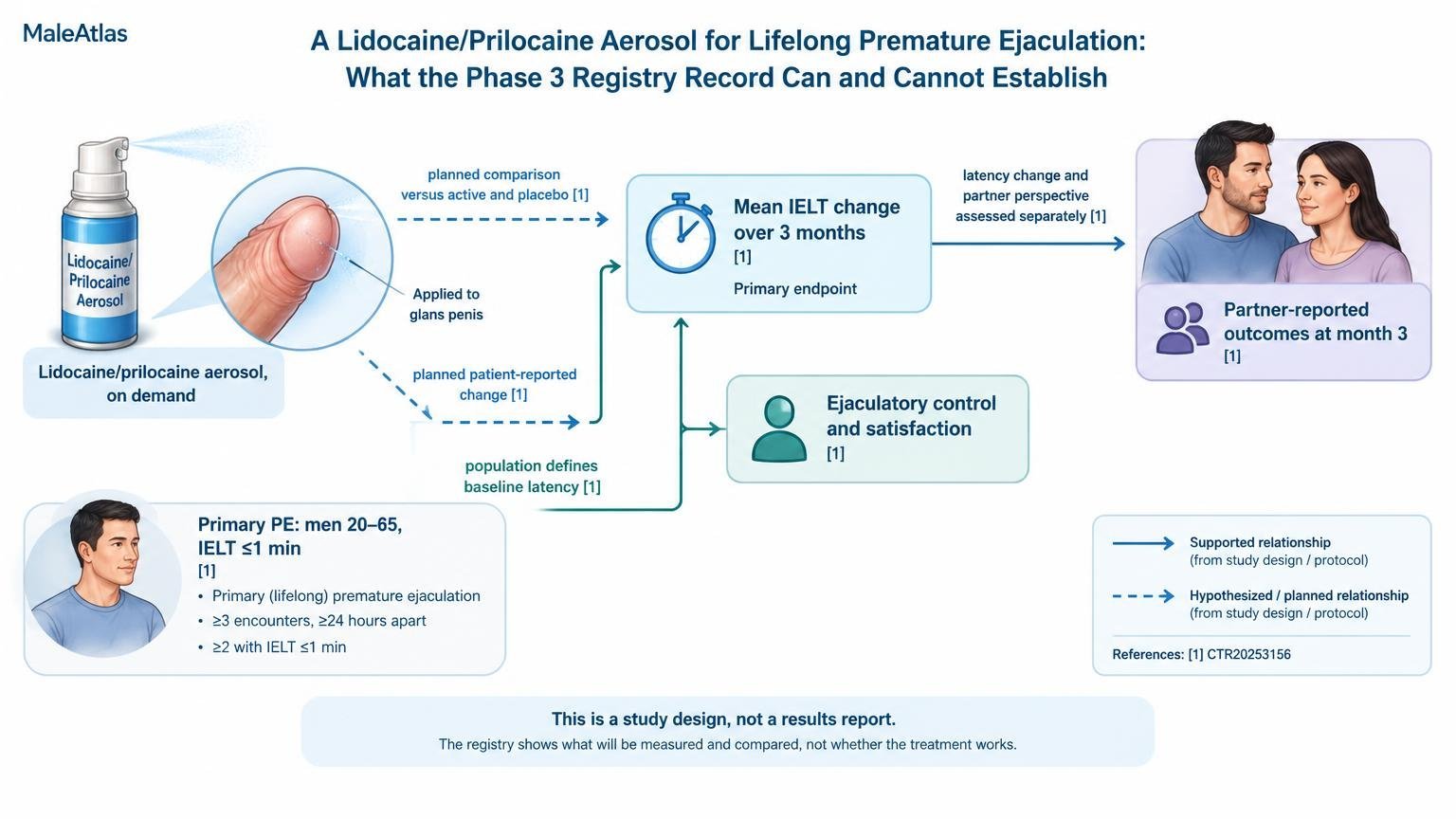
A phase 3 trial registered in China (CTR20253156) is designed to test whether an on-demand lidocaine/prilocaine aerosol improves ejaculatory latency in adult men with primary, or lifelong, premature ejaculation. It is registered as a randomized, double-blind, active- and placebo-controlled, multicenter study, and the primary endpoint is the change from baseline in mean intravaginal ejaculation latency time (IELT) across a three-month double-blind treatment period.[1]
The registry record is a protocol description, not a report of findings. Its stated objectives are to assess equivalence between the investigational aerosol and the reference product and superiority of the test or reference product over placebo on a clinical endpoint. Ejaculatory control, satisfaction, distress, PEDT score and partner-reported outcomes are planned secondary endpoints. No results summary has been posted, so the record defines what will be measured and how, but cannot show whether the treatment works.
Why a Registry Record Matters Here
Premature ejaculation is common enough that claims about topical anesthetics circulate widely, and men often encounter marketing language before they encounter trial data. A registry entry serves a different purpose: it fixes the question in advance. Because the record was posted before results and specifies eligibility, comparators, endpoints and monitoring, readers can later judge whether the eventual report answers the question that was asked, rather than a question chosen after the data were seen.[2]
The distinction between a registered design and demonstrated benefit is not pedantic. Many trials are registered, completed and never reported, or reported with endpoints altered. The current record is explicitly ongoing and recruiting, with no results summary completed. Any statement that the aerosol "works" or "improves control" would therefore be a prediction, not a reading of evidence.
The Biological Rationale for a Topical Anesthetic
Lidocaine and prilocaine are amide local anesthetics. Applied to the glans penis, they reduce the sensory input that contributes to the ejaculatory reflex, and the intended clinical effect is delayed ejaculation. The investigational product is an aerosol containing lidocaine and prilocaine, classified as a chemical drug, and the reference comparator is the same combination under the name Fortacin. The mechanism is therefore sensory modulation at the site of application, not a central or hormonal action.
That mechanism carries a predictable trade-off. Reduced glans sensation can delay ejaculation, but excessive numbness may reduce pleasure or interfere with erection, and systemic absorption of the anesthetics creates a theoretical risk of methemoglobinemia, particularly with prilocaine. The protocol reflects this by excluding men or partners with a history of G6PD deficiency or congenital or idiopathic methemoglobinemia, or who use drugs that increase susceptibility. This is a precaution embedded in eligibility, not an observed rate of harm.
This mechanism has prior trial history: a completed phase 2/3 record exists for lidocaine in premature ejaculation, described as an efficacy, safety and tolerability study of the topical anesthetic PSD502. A commercial pipeline aggregation also lists historical phase 2/3 studies for lidocaine and prilocaine. Those listings establish that the approach has been tested before; they do not supply effect sizes, and the aggregator sources provide no outcome data.[3][4]
Who Is Being Studied
The eligible population is narrowly and deliberately defined. Participants must be male, aged 20 to 65 years, and diagnosed with primary premature ejaculation according to International Society for Sexual Medicine criteria: ejaculation always or nearly always before or within about one minute of vaginal penetration since first intercourse, an inability to delay ejaculation, and negative personal consequences such as distress, worry, frustration or avoidance of sexual intimacy.
Baseline measurement is also specified. Men must have recorded at least three sexual encounters at least 24 hours apart, with at least two showing an IELT of 1 minute or less. This requirement matters for interpretation: it selects men with objectively short latency by stopwatch or timed assessment, not merely men who feel their latency is short. Results in this group may not transfer to men with acquired premature ejaculation, variable latency, or distress without markedly short IELT.
Several exclusions sharpen the population further. Men with erectile dysfunction, defined as an IIEF-5 score of 21 or less, are excluded unless the investigator judges the low score to be entirely due to premature ejaculation symptoms. Men who received any premature ejaculation treatment in the four weeks before screening, including dapoxetine, antidepressants, topical anesthetic sprays, intracavernosal injection or psychotherapy, are also excluded, as are men or partners with known allergy or intolerance to amide local anesthetics. The resulting sample is treatment-naive in the short term and free of major comorbid sexual or allergic confounders.
What the Trial Measures
The primary endpoint is the change from baseline in mean IELT over the three-month double-blind treatment period. IELT is a continuous, time-based measure, and the trial also plans to report the proportion of participants with mean IELT above 1 minute and above 2 minutes during treatment, along with month-by-month change. These threshold analyses matter because a statistically significant mean change can coexist with many men remaining below a clinically meaningful latency.
| Planned measure | Definition in the registry | What it can and cannot show |
|---|---|---|
| Primary endpoint: mean IELT change | Change from baseline in mean intravaginal ejaculation latency time across 3 months of double-blind treatment | A latency difference between arms; cannot by itself show whether couples judge the change as meaningful |
| Responder thresholds | Proportion with mean IELT >1 min and >2 min during the 3-month period | How many men cross specified latency thresholds; thresholds are not the same as satisfaction |
| Ejaculatory control domain | Change from baseline in the IPE ejaculatory control domain at months 1, 2 and 3 | A patient-reported control signal; subject to expectation and unblinding effects |
| PEDT score | Change in Premature Ejaculation Diagnostic Tool score at months 1, 2 and 3 | A diagnostic-severity signal; not a direct measure of intercourse duration |
| Partner-reported outcomes | Partner PEP ratings of control, satisfaction, distress and interpersonal difficulty at month 3 | A dyadic perspective; measured only at month 3, limiting trajectory analysis |
| Safety monitoring | Vital signs, physical exam, blood and urine labs, coagulation, pregnancy test, penile exam, ECG, all adverse events, monthly | Detects common and measurable harms; rare events and long-term effects remain uncertain |
Patient-reported and partner-reported measures broaden the picture beyond the stopwatch. The IPE control domain, satisfaction and distress domains, PEDT score, orgasm quality and partner PEP ratings are all planned. This is a sensible design choice because IELT alone does not capture whether sex becomes more satisfactory or less distressing. It also introduces the usual limitation of subjective endpoints: expectations, relationship factors and the difficulty of blinding a product that produces numbness can influence reported control and satisfaction.
The Comparison Structure
The trial is designed with three functional arms: the investigational aerosol, the reference product Fortacin as an active comparator, and a matching placebo aerosol containing no lidocaine or prilocaine. The stated objectives combine an equivalence question (investigational product versus reference) with a superiority question (test or reference versus placebo) on a clinical endpoint. This structure is more informative than a simple placebo comparison because it can distinguish a genuinely equivalent generic-like product from one that is merely better than nothing.
The dosing regimen is standardized: three sprays applied to the glans penis five minutes before intercourse, excess wiped off, at least 24 hours between doses, and no ejaculation-inducing activity in the 24 hours before each dose. The three-month double-blind duration is long enough to capture a stable treatment effect rather than a single-use response, but short enough that durability beyond three months, tachyphylaxis, and partner tolerance over longer periods remain unknown.
Interpretation and Limitations
The most important limitation is simple: this is a protocol record, not a results report. The registry lists a target enrollment of 430 participants domestically and an enrolled count of 164 at the time of the record, with the first participant consenting on 24 November 2025. These are recruitment facts. They tell us the trial is progressing and give a sense of its intended size, but they say nothing about effect direction, effect size or safety.
Several design features limit what even a completed trial will be able to claim. First, the trial is conducted within China, so applicability to other populations and healthcare settings requires replication. Second, the strict eligibility criteria exclude men with comorbid erectile dysfunction, recent treatment, and certain medical histories, which improves internal validity but narrows generalizability. Third, partner outcomes are measured only at month 3, so the couple-level trajectory cannot be fully described. Fourth, no data safety monitoring committee is listed, which is a governance detail readers may wish to note rather than a finding about safety.
There is also a measurement caveat. IELT is typically recorded by stopwatch or timed report during intercourse, and both approaches depend on participant adherence and accurate timing. The protocol requires at least three baseline encounters, which improves the baseline estimate, but treatment-period IELT will still be self-recorded in real-world conditions. A statistically significant mean IELT gain should therefore be read alongside responder proportions, patient-reported control, and partner ratings before being translated into a clinical recommendation.
Research Outlook
What should readers watch for? The trial's results summary is currently empty, and the registry reports the study as ongoing and recruiting. A completed report would need to show the primary IELT analysis, the equivalence and superiority comparisons, the responder proportions, the patient-reported domains, partner outcomes and the adverse-event profile. Until then, the appropriate stance is that the design is informative and the efficacy question is open.
The broader research context includes earlier phase 2/3 work on topical lidocaine for premature ejaculation and additional listed studies of lidocaine sprays, some with unknown status. Those records indicate sustained interest in topical approaches but do not substitute for the missing results of the current trial. A reasonable future synthesis would compare latency outcomes, responder rates and partner-reported satisfaction across topical anesthetic studies, while noting differences in formulations, dosing and populations.[5]
Key Takeaways
- The registered phase 3 trial tests an on-demand lidocaine/prilocaine aerosol against an active reference product and placebo in men aged 20 to 65 with primary premature ejaculation.
- Its primary endpoint is change from baseline in mean IELT over three months of double-blind treatment, supported by responder thresholds, patient-reported control and partner ratings.
- The record is a protocol, not a results report: no results summary has been posted, and the trial remains ongoing and recruiting.
- The design's strengths include randomization, double blinding, active and placebo controls, and monthly safety monitoring; its limits include narrow eligibility, a single-country setting and short follow-up.
- Men considering topical anesthetics should discuss sensitivity, irritation, partner exposure and methemoglobinemia risk with a clinician rather than inferring benefit from a registry listing.
Questions and Answers
What is the lidocaine/prilocaine aerosol being tested for in the phase 3 premature ejaculation trial?
It is an on-demand topical anesthetic spray applied to the glans penis before intercourse, intended to reduce glans sensation and delay ejaculation. The registered phase 3 trial tests it in adult men aged 20 to 65 with primary, or lifelong, premature ejaculation, comparing it with an active reference product and a placebo aerosol over three months of double-blind treatment.
What is the primary endpoint of the lidocaine/prilocaine aerosol trial for lifelong premature ejaculation?
The primary endpoint is the change from baseline in mean intravaginal ejaculation latency time (IELT) over the three-month double-blind treatment period. Planned secondary endpoints include the proportion of men with mean IELT above 1 minute and above 2 minutes, ejaculatory control and satisfaction domains, PEDT score, and partner-reported outcomes at month 3.
Does the phase 3 registry record show that the lidocaine/prilocaine aerosol works?
No. The registry record is a protocol description, and no results summary has been posted. It states the trial's objectives, eligibility criteria, endpoints and safety monitoring, and reports that the study is ongoing and recruiting. Registry listings do not provide efficacy estimates; a separate results report is needed before any conclusion about benefit is possible.
Who is eligible for the lidocaine/prilocaine premature ejaculation trial, and who is excluded?
Eligible men are 20 to 65 years old with primary premature ejaculation by ISSM criteria and at least two of three baseline encounters showing IELT of 1 minute or less. Exclusions include erectile dysfunction with IIEF-5 of 21 or less, recent premature ejaculation treatment, amide local anesthetic allergy, and history of G6PD deficiency or methemoglobinemia.
How strong is the evidence for topical lidocaine/prilocaine in premature ejaculation?
The evidence base includes earlier phase 2/3 trial records for topical lidocaine and related sprays, but the sources here provide titles and status listings rather than outcome data. The current phase 3 trial is designed to generate comparative evidence, but its results are not yet posted. Claims of proven benefit are therefore not supported by the available registry material.
What safety concerns are monitored in the lidocaine/prilocaine aerosol trial?
Monthly monitoring includes vital signs, physical examination, blood and urine tests, coagulation, penile examination, ECG and all adverse events. The protocol excludes people with amide local anesthetic allergy and those at risk of methemoglobinemia, reflecting recognized concerns with this drug class. These are planned precautions and monitoring steps, not observed rates of harm.
Conceptual framework: Conceptual framework for the registered phase 3 trial of an on-demand lidocaine/prilocaine aerosol in adult men with primary premature ejaculation. The figure shows the intervention, the primary latency endpoint, patient-reported control and satisfaction, and partner-reported outcomes. Relations reflect planned comparisons in an ongoing protocol without posted results; they are not tested causal effects or observed findings.
Academic References & Evidence
- 商学军. CTR20253156详细信息. (protocol)
- 试验公示和查询.
- Premature Ejaculation Completed Phase 2 / 3 Trials for Lidocaine (DB00281).
- Plethora Solutions · Clinical Trials & Pipeline.
- Lidocaine Unknown Status Phase 3 Trials for Premature Ejaculation Treatment.
SANYUN Science Center explains published research on men's reproductive and sexual health, connecting scientific evidence with everyday questions while making sources and limitations clear.
Disclaimer: This article is for scientific education and research communication only. It does not provide medical advice, diagnosis, or individualized treatment recommendations, and does not endorse any medication, supplement, device, penile enlargement procedure, or other intervention. Decisions about sexual and reproductive health should be made in consultation with a qualified healthcare professional. Do not delay seeking professional care because of information in this article.
Original Content & Copyright Notice
- This article is prepared for SANYUN Science Center, drawing on published research and publicly available academic literature on men’s sexual and reproductive health. Its editorial explanations and presentation are developed for this platform.
- Copyright in the original editorial content, selection, and arrangement is reserved by SANYUN Science Center to the extent protected by applicable law. Referenced research, quotations, and third-party materials remain subject to the rights of their respective owners. This notice does not claim ownership of scientific facts or third-party research.
- Except where permitted by applicable law or an applicable license, prior written permission is required to reproduce, republish, translate, adapt, redistribute, or commercially reuse protected content. Attribution alone does not grant permission for such reuse.
- For permitted quotation or authorized reuse, clearly identify the source and retain a link to the original article.
- Source: SANYUN Science Center
- Original URL: Retain the original article URL on science.san-yun.com.
- Copyright Holder: SANYUN Science Center, for its own protected editorial content.
- Quotation, excerpts, or authorized reuse must not distort the scientific meaning, omit material limitations or disclaimers, or imply unverified medical claims, product efficacy, or endorsement by SANYUN Science Center.



