




Category: Premature Ejaculation
Core Research Direction: Lifelong versus acquired premature ejaculation: what etiologic, epidemiologic and consensus evidence actually supports (including comorbidity links such as erectile difficulties, thyroid disease and prostatitis) and the limits of that evidence at the 2026 consensus
Search Intent: What does current evidence identify as likely causes of lifelong versus acquired premature ejaculation, how common is each type, and how confident can we be in those explanations?
Platform: SANYUN Science Center
Evidence reviewed through: 2026-11-16
Executive Summary
Premature ejaculation is repeatedly described as the most common male sexual complaint, and the 5th International Consultation on Sexual Medicine classifies it into lifelong, acquired, variable and subjective subtypes. The clinically useful question is not whether a cause can be named, but which explanations survive scrutiny. The most consistent message across the older International Society for Sexual Medicine guidance and the 2026 consensus literature is that no single biological factor has been shown to cause premature ejaculation in most men, and no proposed cause has been confirmed in large studies.[1][2][3]
Two strands of evidence carry the most weight. First, prevalence data show a wide gap between complaint and diagnosis: in a survey of 2,593 Turkish couples, 20% of men complained of ejaculating too fast, yet only 2.3% met criteria for lifelong and 3.9% for acquired premature ejaculation. Second, the acquired form has a more identifiable trigger profile than the lifelong form, dominated by erectile difficulties, anxiety and relationship factors, with narrower and far less certain contributions from thyroid disease and prostatic inflammation.
- Lifelong premature ejaculation is best framed as a probable biological predisposition involving serotonergic and genetic factors, but the supporting data remain indirect, small or statistically fragile.
- Erectile difficulty is the strongest and most reproducible comorbidity signal, with regional odds ratios of 3.7 to 11.9 for also reporting early ejaculation in a 29-country survey.
- Hyperthyroidism and chronic prostatitis are real but narrow or mechanistically unresolved associations; neither justifies routine screening of every man with premature ejaculation.
- Complaint is common; the two diagnosable classical subtypes are not, and clinic populations look very different from community samples.
Why the Subtype Question Matters
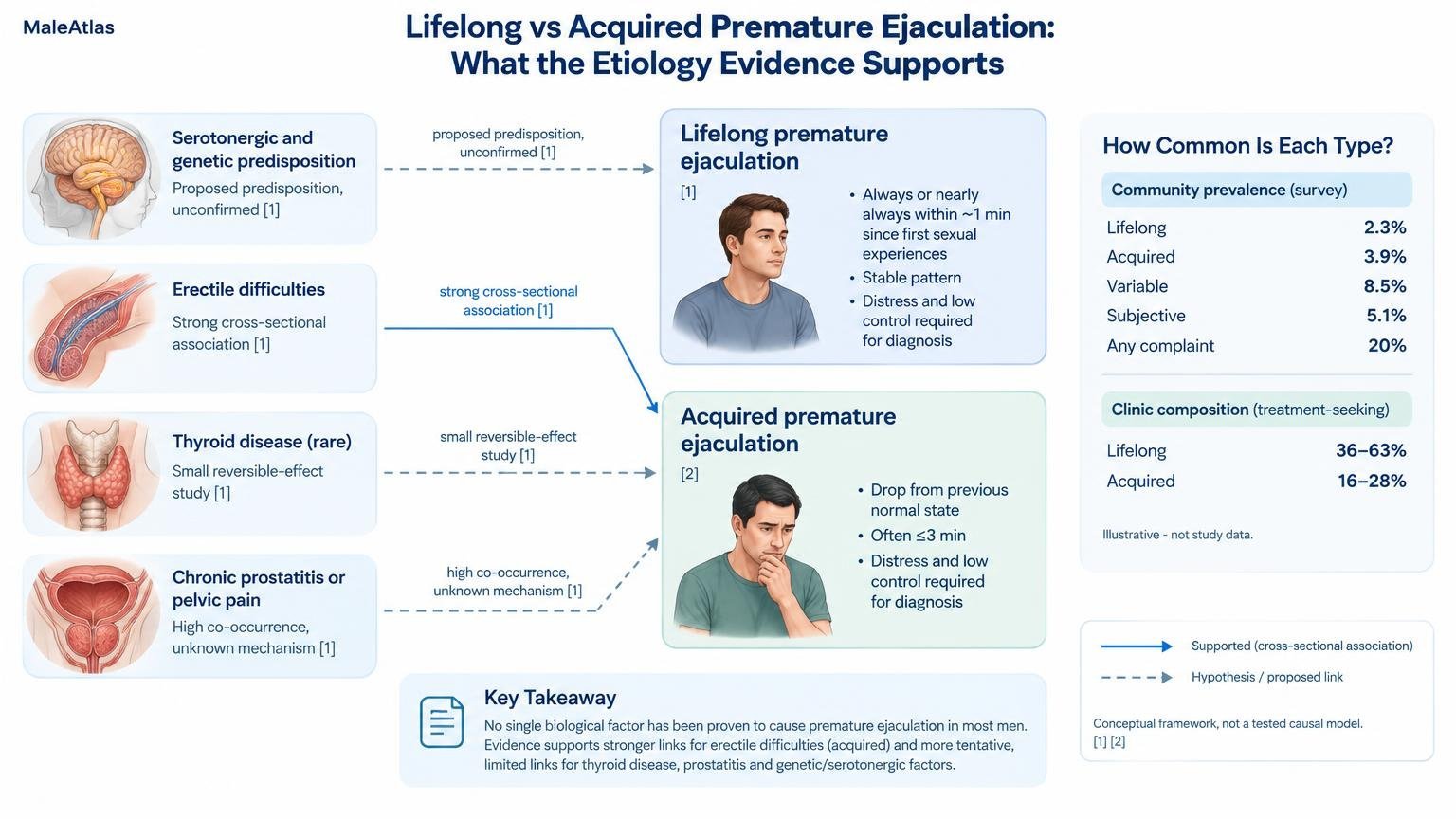
Splitting premature ejaculation into lifelong and acquired forms is not a taxonomic nicety. The two have different onset patterns and different latency thresholds: lifelong disease is characterised by ejaculation always or nearly always within about 1 minute of penetration since first sexual experiences, whereas acquired disease involves a clear drop after a period of normal sex, often to about 3 minutes or less. The consensus definitions add distress and perceived control to timing, so a man can report very short latency without meeting a disorder threshold if he is not distressed and feels in control.
This distinction shapes what a clinician looks for. In the lifelong form, the search is for constitutional vulnerability, because the pattern has been stable since sexual debut. In the acquired form, a change from a previously normal state implies something new: a new relationship, new anxiety, new erectile difficulty, new pelvic or prostatic symptoms, or, rarely, a systemic condition such as thyroid disease. That logic is clinically intuitive but rests on weaker formal evidence than it appears to, because the causal claims are built largely on cross-sectional associations and expert synthesis rather than prospective cohorts.
How Common Is Each Type?
Community and clinic data diverge sharply, and conflating them is a common error. In the Turkish couple survey, complaint prevalence was roughly an order of magnitude higher than diagnostic prevalence. Lifelong premature ejaculation affected 2.3%, acquired 3.9%, variable 8.5% and subjective 5.1%, while 20% of men simply complained of ejaculating too fast. This is a reminder that most men who say they finish too quickly do not meet criteria for either classical subtype, and that the variable pattern is regarded by the ISSM as a normal variation in sexual performance rather than a sexual dysfunction.
Clinic-based series reverse the proportions. Among men who seek treatment, reported ranges are 36% to 63% with lifelong and 16% to 28% with acquired premature ejaculation. Selection explains much of the difference: men distressed enough to attend a clinic are more likely to have a persistent, lifelong pattern. The honest reading is that community prevalence estimates and clinic composition answer different questions, and the ranges across clinics indicate substantial heterogeneity in referral pathways and diagnostic practice.
Lifelong Premature Ejaculation: Predisposition Without Proof
The dominant hypothesis is that lifelong premature ejaculation reflects a biological predisposition, with serotonin signalling and genetic variation as the leading candidate mechanisms. Serotonin generally delays ejaculation, and differences in serotonergic activity or receptor function have been proposed to lower the ejaculatory threshold. The 2026 consensus synthesis covers etiology, epidemiology, evaluation and management, but it is a review and consensus process, not a set of new primary experiments, so the mechanistic claims inherit the strength of the underlying literature.
Genetic evidence illustrates the gap between plausibility and proof. In a study of 1,196 Finnish male twins, genes were estimated to explain about 28% of the variation in premature ejaculation symptoms, but the estimate was not statistically significant. The ISSM concluded that single gene variants have a minor effect at most, that genes may create a predisposition rather than directly cause the condition, and that the data are scant and controversial. A heritability figure that fails significance cannot carry a causal argument on its own, however biologically reasonable it sounds.
Psychological accounts of the lifelong form are equally tentative. Conditioning during early sexual experiences, traumatic sexual experiences and restrictive beliefs about sex are commonly listed as possible contributors, but the ISSM notes that research on psychological causes is limited and mostly shows associations rather than cause and effect. The direction of any relationship is genuinely uncertain: anxiety may shape ejaculatory control, or repeated early ejaculation may generate anxiety.
There is also open disagreement between guideline bodies. The British Society for Sexual Medicine describes lifelong premature ejaculation as often associated with performance anxiety and with erection problems that develop as a result, whereas the ISSM considers erection problems unlikely as a cause or companion of the lifelong type. Two respected sources pointing in different directions is a signal that the comorbidity architecture of the lifelong form is not settled.
Acquired Premature Ejaculation: The Comorbidity Evidence
Erectile difficulties
The erectile difficulty link is the most robust association in this literature, which is not the same as the most robust causal claim. In a global survey of 11,205 men from 29 countries, men who sometimes or often had difficulty getting and keeping erections had 3.7 to 11.9 times the odds, depending on region, of also reporting early ejaculation. The regional spread is wide enough that a single pooled number would misrepresent the data, and the cross-sectional design means direction cannot be resolved.
A plausible behavioural loop is well described: men who fear losing their erection may rush intercourse to finish while rigidity is adequate, and performance anxiety reinforces the pattern. Whether this explains most co-occurring cases is unknown, but the behavioural account is at least consistent with the association being strong and repeatable across countries. Clinically, the implication is that assessment of acquired premature ejaculation should routinely include erectile function, because the two problems interact in ways that affect how each is managed.
Thyroid disease
Thyroid disease is the clearest example of a real but narrow association. In a study of 34 men with hyperthyroidism, half had premature ejaculation; after thyroid levels were normalised the proportion fell to 15%, and average time to ejaculation rose from 2.4 to 4.0 minutes. That before-and-after pattern is suggestive of a reversible contribution, but the sample was very small, the citation is secondhand in this literature, and no control group is described.
The population-level importance is much smaller than the within-study effect. The ISSM states that hyperthyroidism plays no role in lifelong premature ejaculation and has been linked to the acquired type in only very few patients. In other words, thyroid disease is worth considering when the history suggests it, but it does not explain the bulk of acquired cases and does not justify universal thyroid testing.
Prostatitis and pelvic pain
Prostatic and pelvic pain syndromes show a consistently high co-occurrence with early ejaculation, but the numbers vary enormously. Between 26% and 77% of men with chronic prostatitis or chronic pelvic pain report early ejaculation. In the reverse direction, one study of 46 men with premature ejaculation found that 56.5% had signs of prostate inflammation and 47.8% had chronic bacterial prostatitis, significantly more than in men without premature ejaculation. Small samples and wide ranges limit how much weight these figures can bear.
Crucially, the mechanism is unknown. The ISSM found too little evidence to screen every man with premature ejaculation for prostatitis, while recommending prostate examination in men with painful ejaculation or pelvic pain. This is a proportionate position: targeting investigation to symptoms rather than applying it universally. It also illustrates a general principle in this field, that co-occurrence is documented more confidently than causation.
What the Evidence Does Not Support
Several popular explanations fail on current evidence. Penile hypersensitivity has been proposed as a cause, but like other proposed causes it has not been confirmed in large studies. Hormonal findings are similarly weak: in men attending clinics for sexual problems, low prolactin and relatively high testosterone were linked to premature ejaculation, but the ISSM states these cannot be considered causes and the relationship is unclear. Clinic-based hormone associations are particularly vulnerable to selection effects.
Two behavioural beliefs are also poorly supported. In a 2025 survey of 528 men in São Paulo, frequent pornography use was not linked to ejaculation problems, though a single cross-sectional survey cannot settle the question. In a stopwatch study across the Netherlands, the UK, Spain and the US, circumcised and uncircumcised men did not differ significantly. Neither finding proves absence of effect, but neither supports the strong claims sometimes made.
Pelvic floor status is often discussed as causal, but neither weakness nor tension is an established cause of premature ejaculation. Pelvic floor training remains a plausible route to better control rather than a correction of a proven deficit, and that distinction matters when counselling men about what exercises can and cannot do.
Interpretation and Limitations
Four limitations govern how confidently any etiologic statement can be made. First, much of the mechanistic detail reaches this evidence base through secondhand guideline summaries, and the foundational ISSM guidance dates from 2014. Second, most comorbidity data are cross-sectional, so odds ratios describe co-occurrence rather than temporal sequence. Third, key studies are small, including 34 men with hyperthyroidism and 46 men with premature ejaculation and prostatic findings, and the twin heritability estimate was not statistically significant.
Fourth, the 2026 consensus is a synthesis using modified Delphi methods and GRADE-style appraisal rather than new primary research, so it can formalise the strength of existing evidence but cannot manufacture evidence that was never collected. The consensus definition incorporating timing, distress and control is a genuine advance in standardisation, yet it does not resolve etiology.
A further interpretative caution concerns subtype boundaries in practice. Because the variable and subjective patterns are common in community samples, many men who present with distress do not fit either classical category. Applying lifelong-versus-acquired causal reasoning to them is a category error, and it can lead to unnecessary investigation or to reassurance that misses the actual problem.
| Proposed contributor | Subtype mainly linked | Best supporting evidence | Main limitation |
|---|---|---|---|
| Erectile difficulties | Acquired | 29-country survey of 11,205 men: odds ratios 3.7 to 11.9 by region | Cross-sectional; direction unresolved |
| Hyperthyroidism | Acquired (rare) | 34 men: premature ejaculation fell from about half to 15% after normalisation; latency 2.4 to 4.0 minutes | Very small, no control group described; rare among men with premature ejaculation |
| Chronic prostatitis or pelvic pain | Acquired | 26% to 77% report early ejaculation; 56.5% and 47.8% prostatic findings in 46 men | Wide ranges, small samples, mechanism unknown; universal screening not justified |
| Genetic predisposition | Lifelong | Twin study of 1,196 men: about 28% of variance, not statistically significant | Fragile estimate; single gene effects minor at most |
| Psychological and relationship factors | Acquired and lifelong | Guideline-described associations with anxiety and relationship conflict | Mostly associational; limited causal research |
| Penile hypersensitivity | Unclear | Proposed mechanism only | Not confirmed in large studies |
Clinical and Research Outlook
For clinical practice, the defensible position is a history-led approach. Onset pattern, latency, distress and control separate the subtypes; erectile function should be assessed in acquired presentations because that association is the strongest; prostate examination is warranted with painful ejaculation or pelvic pain; and laboratory testing should follow specific pointers rather than being routine. Treating an identified linked condition is reasonable, but the claim that this improves long-term outcomes is consensus opinion rather than a quantified trial result in this evidence base.
For research, the priorities are clear. Prospective cohorts are needed to establish whether erectile difficulty precedes, follows or reciprocally maintains early ejaculation. Larger, controlled studies of thyroid and prostatic contributions are needed to move those associations beyond small series. Genetic work requires adequately powered samples before predisposition claims can be stated confidently. The 2026 consensus itself calls for stronger evidence-based treatment research, and the etiologic literature needs the same upgrade.
Key Takeaways
- No biological factor has been shown to cause premature ejaculation in most men, and no proposed cause has been confirmed in large studies.
- Lifelong disease is probably a biological predisposition, but the genetic and serotonergic evidence is indirect, small or not statistically significant.
- Acquired disease has a more identifiable trigger profile, led by erectile difficulties, with the strongest quantitative association in the literature.
- Thyroid disease and prostatitis are genuine but narrow or mechanistically unresolved contributors; targeted rather than universal investigation is appropriate.
- Complaint prevalence far exceeds diagnostic prevalence, and clinic samples are not representative of community cases.
- The 2026 consensus improves definition and classification but is a synthesis, not new primary evidence on causation.
Questions and Answers
What is the difference between lifelong and acquired premature ejaculation?
Lifelong premature ejaculation has been present since first sexual experiences, with ejaculation always or nearly always within about 1 minute of penetration. Acquired premature ejaculation begins after a period of normal sex, often with latency dropping to about 3 minutes or less. Consensus definitions also require distress and impaired control, so timing alone does not establish either diagnosis.
What does research suggest causes lifelong premature ejaculation?
The leading hypothesis is a biological predisposition involving serotonin signalling and genetic variation. However, in 1,196 Finnish male twins, genes were estimated to explain about 28% of symptom variation and the estimate was not statistically significant, and the ISSM concluded that single gene variants have a minor effect at most. Psychological and conditioning explanations rest mainly on associations, not cause and effect.
How strong is the link between erectile difficulties and acquired premature ejaculation?
It is the most consistent comorbidity signal available. In a global survey of 11,205 men from 29 countries, men who sometimes or often had difficulty getting and keeping erections had 3.7 to 11.9 times the odds, depending on region, of also reporting early ejaculation. The design was cross-sectional, so it shows association rather than proving that erectile problems cause early ejaculation.
Can thyroid disease or prostatitis cause premature ejaculation?
Both are linked, but narrowly. In 34 men with hyperthyroidism, half had premature ejaculation, falling to 15% after thyroid levels normalised, yet the ISSM notes thyroid disease is linked to acquired cases in very few patients. Between 26% and 77% of men with chronic prostatitis or pelvic pain report early ejaculation, but the mechanism is unknown and universal screening is not supported.
How common are lifelong and acquired premature ejaculation in the general population?
They are much less common than complaints suggest. In a survey of 2,593 Turkish couples, 20% of men complained of ejaculating too fast, but only 2.3% had lifelong and 3.9% acquired premature ejaculation, with 8.5% variable and 5.1% subjective types. Among men seeking treatment, clinic studies report 36% to 63% lifelong and 16% to 28% acquired, reflecting referral selection.
How much confidence should patients place in explanations for premature ejaculation?
Moderate confidence for the overall message, low confidence for specific mechanisms. Guidelines agree that no single cause explains most cases, and most comorbidity data are cross-sectional associations from surveys or small series. The 2026 consensus standardises definitions but synthesises existing literature rather than generating new causal evidence, so explanations should be presented as probabilities, not certainties.
Conceptual framework: Conceptual framework, not a tested causal model. It maps how the reviewed evidence relates proposed contributors to lifelong and acquired premature ejaculation. Erectile difficulties show a supported cross-sectional association with the acquired form; genetic, thyroid and prostatic relationships remain proposed and are limited by small samples, indirect data and unknown mechanisms.
Academic References & Evidence
- Adaging Editorial Team. Premature ejaculation causes: lifelong vs acquired | Adaging. 2026
- 国际性医学咨询会(ICSM). 2026 ICSM专家共识:早泄和延迟射精的当代共识与新兴方向. Sex Med Rev. 2026 14(4)
- Contemporary consensus and emerging directions in premature and delayed ejaculation: recommendations from the 5th International Consultation on Sexual Medicine.. Sexual medicine reviews PMID: 42855438.
SANYUN Science Center explains published research on men's reproductive and sexual health, connecting scientific evidence with everyday questions while making sources and limitations clear.
Disclaimer: This article is for scientific education and research communication only. It does not provide medical advice, diagnosis, or individualized treatment recommendations, and does not endorse any medication, supplement, device, penile enlargement procedure, or other intervention. Decisions about sexual and reproductive health should be made in consultation with a qualified healthcare professional. Do not delay seeking professional care because of information in this article.
Original Content & Copyright Notice
- This article is prepared for SANYUN Science Center, drawing on published research and publicly available academic literature on men’s sexual and reproductive health. Its editorial explanations and presentation are developed for this platform.
- Copyright in the original editorial content, selection, and arrangement is reserved by SANYUN Science Center to the extent protected by applicable law. Referenced research, quotations, and third-party materials remain subject to the rights of their respective owners. This notice does not claim ownership of scientific facts or third-party research.
- Except where permitted by applicable law or an applicable license, prior written permission is required to reproduce, republish, translate, adapt, redistribute, or commercially reuse protected content. Attribution alone does not grant permission for such reuse.
- For permitted quotation or authorized reuse, clearly identify the source and retain a link to the original article.
- Source: SANYUN Science Center
- Original URL: Retain the original article URL on science.san-yun.com.
- Copyright Holder: SANYUN Science Center, for its own protected editorial content.
- Quotation, excerpts, or authorized reuse must not distort the scientific meaning, omit material limitations or disclaimers, or imply unverified medical claims, product efficacy, or endorsement by SANYUN Science Center.



