




Category: Premature Ejaculation
Core Research Direction: Premature ejaculation (PE) as a multidimensional disorder: how its subtypes, pathophysiology, diagnostic measurement (IELT, validated questionnaires), and the 2026 EAU guideline's treatment recommendations translate into clinical decision-making in adult men
Search Intent: How is premature ejaculation diagnosed across its lifelong, acquired, variable and subjective subtypes, and what does current guideline evidence support for treatment?
Platform: SANYUN Science Center
Evidence reviewed through: 2026-11-15
Executive Summary
Premature ejaculation (PE) is often described as a single condition, but current classification treats it as a family of syndromes with different mechanisms, different measurement implications and different treatment priorities. The European Association of Urology guideline separates lifelong, acquired, variable and subjective PE, and the ICD-11 renamed the complaint early ejaculation while retaining a requirement for clinically significant distress.[1]
The 2026 EAU Sexual and Reproductive Health guideline is a limited update of the 2025 document, but it fully revised the supporting text and references for Disorders of Ejaculation and added 116 updated studies across the guideline as a whole. The update podcast discussion emphasises that high-quality evidence remains limited for several ejaculation treatments, so recommendations should be read as decision aids rather than mandates.[2][3][4][5]
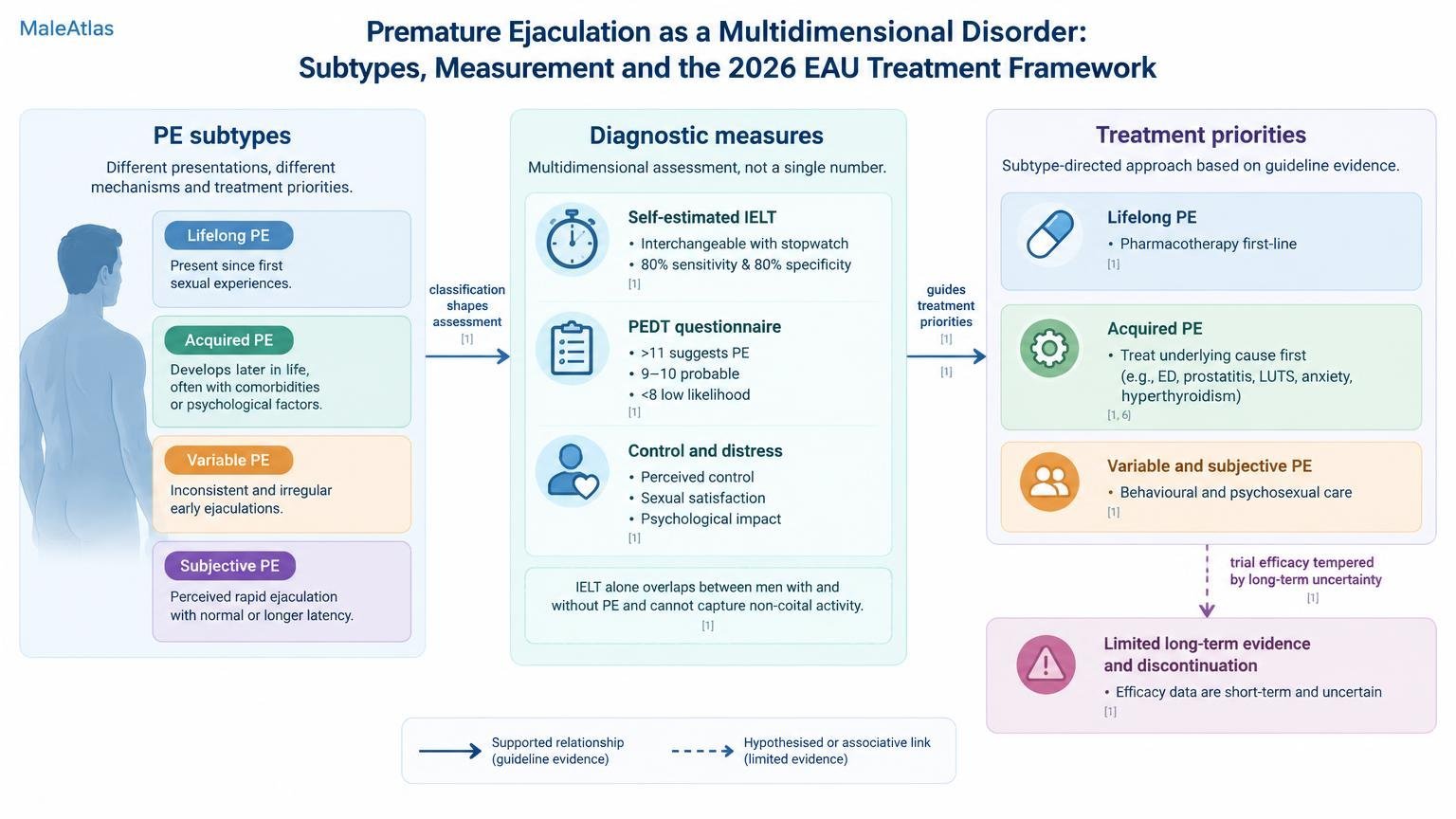
Measurement is multidimensional. IELT alone overlaps substantially between men with and without PE, while self-estimated IELT performs similarly to stopwatch measurement in routine care and the PEDT provides a structured symptom score. Treatment is subtype-directed: pharmacotherapy is first-line for lifelong PE, whereas acquired PE calls first for management of underlying causes such as erectile dysfunction, prostatitis, lower urinary tract symptoms, anxiety or hyperthyroidism.
Why This Matters
PE is common and undertreated. A narrative review of European and American guidelines cites prevalence estimates of 20-30% of men across various studies, while noting that estimates vary with methodology, culture and diagnostic criteria. The EAU text reports that few men with PE seek treatment despite potentially serious psychological and quality-of-life consequences.[6]
The consequences extend beyond latency. Men with PE more often report low satisfaction with their sexual relationship and with intercourse, difficulty relaxing during intercourse and less frequent intercourse; the guideline also links PE to reduced self-confidence, partner strain and emotional distress. Because the partner's sexual satisfaction decreases with increasing severity of the man's condition, PE is reasonably framed as a dyadic as well as an individual concern.
A further practical issue is diagnostic overlap with erectile dysfunction. Many men with ED develop secondary PE driven by performance anxiety, and some men misinterpret normal loss of erection after ejaculation as ED when the primary complaint is rapid ejaculation. Misassignment changes the treatment target, which is why history-taking rather than a single number anchors diagnosis.
Biological and Clinical Mechanism: What Is Established and What Is Hypothesised
The aetiology of PE is relatively unknown. The guideline describes anxiety, penile hypersensitivity and serotonin receptor dysfunction as suggested biological and psychological hypotheses with limited supporting data. That wording matters: these are candidate mechanisms, not settled pathways, and no single mechanism explains all subtypes.
Lifelong PE has been hypothesised to reflect a complex interplay of central and peripheral serotonergic, dopaminergic, oxytocinergic, endocrinological, genetic and epigenetic factors. This is a hypothesis-level formulation. It is consistent with the observation that serotonergic drugs delay ejaculation, but pharmacological response does not by itself establish the cause of the disorder.
Acquired PE is framed differently. It may occur with psychological problems such as sexual performance anxiety or relationship difficulties, and/or with comorbidity including erectile dysfunction, prostatitis, hyperthyroidism and poor sleep quality. These are associative attributions from guideline synthesis, not proven causal links, but they justify a search for reversible contributors before escalating ejaculation-specific therapy.
Variable PE is characterised by inconsistent and irregular early ejaculations and is considered a normal variation in sexual performance. Subjective PE involves a perception of rapid ejaculation while latency is in the normal range or longer, and the guideline states it should not be regarded as true medical pathology. Grouping these presentations with lifelong PE would over-medicalise normal variation and risk treating the wrong problem.
A narrative review adds a pelvic-floor perspective: hypertonicity of pelvic floor muscles is associated with PE, and muscle exercises including superficial and deep pelvic floor work have been reported to improve control and latency. This is emerging, largely associative evidence rather than a confirmed mechanism, and it does not replace guideline-directed diagnosis.
What the Evidence Shows: Diagnosis and Measurement
Diagnosis rests on medical and sexual history, classified by onset (lifelong versus acquired) and consistency (situational versus generalised), with attention to perceived control, distress and interpersonal difficulty. The guideline strongly recommends history-based diagnosis and a physical examination to identify anatomical or comorbid contributors, and strongly recommends against routine laboratory or physiological testing unless history or examination directs it.
IELT is useful but insufficient. The guideline notes significant overlap between men with and without PE, and IELT cannot capture non-coital sexual activity such as masturbation, oral or anal intercourse. In routine practice, self-estimated IELT is sufficient: self-estimated and stopwatch-measured IELT were reported as interchangeable and correctly assign PE status with 80% sensitivity and 80% specificity. Stopwatch measurement remains mandatory in clinical trials.
Two questionnaires discriminate between men with and without PE: the five-item PEDT, where a total score above 11 suggests PE, 9-10 suggests probable PE and below 8 indicates low likelihood, and the seven-item AIPE with a cut-off of 30. The PEP, IPE and MSHQ-Ejaculatory Dysfunction are used to characterise PE and measure treatment effects but are optional in everyday practice. The guideline gives a weak recommendation for routine patient-reported outcomes.
| Measure or concept | What it captures | Reported interpretation | Key limitation |
|---|---|---|---|
| Self-estimated IELT | Patient's estimate of time to ejaculation during vaginal intercourse | Interchangeable with stopwatch IELT; 80% sensitivity and 80% specificity for PE status | Not applicable to non-coital activity; overlap between men with and without PE |
| Stopwatch IELT | Objectively timed latency in clinical trials | Mandatory in drug trials; geometric means preferred because data are skewed | Research instrument rather than a stand-alone diagnostic criterion |
| PEDT total score | Control, frequency, minimal stimulation, distress, interpersonal difficulty | Above 11 suggests PE; 9-10 probable; below 8 low likelihood | Screening aid; not definitive |
| Variable PE | Inconsistent, irregular early ejaculations | Normal variation in sexual performance | Risk of over-medicalisation |
| Subjective PE | Perceived rapid ejaculation with normal or longer latency | Not true medical pathology | Distress may still warrant psychological support |
Treatment Evidence in the 2026 Guideline Framework
The guideline requires subtype definition and expectation-setting before treatment. For lifelong PE, pharmacotherapy is considered first-line. For acquired PE, treating the underlying cause is the initial goal. This bifurcation is the single most important decision rule in the document and explains why an identical drug can be appropriate in one man and premature in another.
Dapoxetine 30 mg and 60 mg is the first on-demand oral agent approved for lifelong and acquired PE in many countries, though not in the USA. Trial data show 2.5-fold and 3.0-fold increases in IELT overall, rising to 3.4-fold and 4.3-fold in men with baseline average IELT under 30 seconds. Treatment-emergent adverse events caused discontinuation in 4% of subjects on 30 mg and 10% on 60 mg.
Real-world persistence is a separate question from trial efficacy. Cumulative dapoxetine discontinuation reached 90% at two years after initiation, with reasons including cost (29.9%), disappointment that PE was not curable and the on-demand nature of the drug (25%), adverse effects (11.6%) and perceived poor efficacy (9.8%). These figures come from cited cohort data and should not be read as a universal expectation, but they temper claims about long-term acceptability.
Off-label daily SSRIs, including paroxetine, sertraline, fluoxetine and others, are widely used; meta-analyses suggest they may increase geometric mean IELT by 2.6- to 13.2-fold, with paroxetine exerting the most substantial delay. Clomipramine, a tricyclic, showed an IELT fold change of 4.66 ± 5.64 versus 2.80 ± 2.19 with placebo in one RCT (P < 0.05). Safety cautions include suicide-related risk in adolescents aged 18 years or younger and in men with comorbid depression, and potential detrimental effects on sperm cells in couples trying to conceive.
Topical anaesthetics are the oldest pharmacological approach. Lidocaine/prilocaine cream significantly increased stopwatch-measured IELT from 1-2 minutes to 6-9 minutes, and a meta-analysis found local anaesthetics had the best efficacy among options for less than 8 weeks of therapy. Partner transfer causing vaginal numbness, allergy contraindications and sperm cytotoxicity concerns are practical limits that require counselling.
Psychosexual interventions have a weaker evidence base when used alone. Behavioural techniques may benefit variable and subjective PE, and start-stop exercises combined with psychoeducation and mindfulness have been reported to improve symptoms and associated distress, but the guideline describes the effectiveness evidence as weak and inconsistent, with unknown long-term outcomes. Combining psychosexual approaches with pharmacotherapy yields superior outcomes compared with pharmacotherapy alone, at a low level of evidence.
PDE5 inhibitors are not indicated as specific PE treatment, but European and American guidelines recognise their use when PE is associated with erectile dysfunction, improving rigidity, performance anxiety and ejaculatory control. This reinforces the need to distinguish primary PE from PE secondary to ED rather than treating every rapid ejaculation with an ejaculation-specific drug.
Interpretation and Limitations
The central limitation is the evidence base itself. The guideline states that long-term outcomes of pharmacological treatments are unknown, and the 2026 update podcast again highlights limited high-quality evidence for ejaculation disorder treatments. Most efficacy data are short-term, trial-based and expressed as group mean fold changes rather than individual probabilities of meaningful benefit.
Several distinctions are easy to blur. A statistically significant IELT fold change is not the same as restored perceived control or reduced distress. Self-estimated IELT performing well in routine care does not make it a trial-grade endpoint. Guideline recommendations carry strength ratings that reflect evidence quality, and the document explicitly states that guidelines cannot replace clinical expertise or patient preferences.
Epidemiological claims also require caution. The statement that PE prevalence is not affected by age comes from the National Health and Social Life Survey and contrasts with ED, which rises with age; prevalence estimates depend heavily on which definition and survey method were used. The 20-30% figure from a narrative review is a useful orientation, not a precise population parameter.
Research Outlook
The 2026 update fully revised the ejaculation section's supporting text and references, which signals active evidence surveillance rather than a settled field. Priorities implied by the guideline include better longitudinal data on pharmacological treatment, clearer validation of patient-reported tools across presentations, and stronger trials of combined psychological and pharmacological care.
Mechanistic work will need to move beyond single-factor hypotheses. The interplay model for lifelong PE and the comorbidity model for acquired PE both remain hypothesis-level, and pelvic-floor findings are emerging and largely associative. None of these yet supports a definitive causal story or a universal first-line biological target.
Key Takeaways
- PE is a family of subtypes: lifelong, acquired, variable and subjective. Variable and subjective presentations should not be managed as if they were lifelong PE.
- Diagnosis is history-led and multidimensional, combining self-estimated IELT, perceived control, distress and interpersonal difficulty; IELT alone is insufficient.
- The PEDT is a practical structured screen, with scores above 11 suggesting PE and 9-10 suggesting probable PE.
- Pharmacotherapy is first-line for lifelong PE, while acquired PE calls first for evaluation and treatment of underlying contributors such as ED, prostatitis or thyroid disease.
- Dapoxetine and topical anaesthetics have short-term trial support, but long-term outcomes are unknown and real-world discontinuation can be substantial.
- Combining psychosexual care with pharmacotherapy may outperform drug therapy alone, although the evidence is low-level and long-term data are lacking.
Questions and Answers
What are the four subtypes of premature ejaculation?
Current classification separates lifelong PE, acquired PE, variable PE and subjective PE. Lifelong PE is present from early sexual experience, acquired PE develops after a period of normal function, variable PE is inconsistent and considered a normal variation, and subjective PE involves perceived rapid ejaculation despite normal or longer latency. The subtypes imply different mechanisms and treatment priorities.
Is IELT enough to diagnose premature ejaculation?
No. IELT values overlap substantially between men with and without PE, and IELT cannot be applied to non-coital activity. Self-estimated IELT is nevertheless useful in routine care and was reported as interchangeable with stopwatch measurement, correctly assigning PE status with 80% sensitivity and 80% specificity. Diagnosis should also include perceived control, distress and interpersonal difficulty.
What does the 2026 EAU guideline recommend for premature ejaculation treatment?
The guideline directs treatment by subtype: pharmacotherapy is first-line for lifelong PE, whereas acquired PE should first be managed by treating underlying causes such as erectile dysfunction, prostatitis, lower urinary tract symptoms, anxiety or hyperthyroidism. Dapoxetine and topical lidocaine/prilocaine are approved on-demand options in some regions, while SSRIs and clomipramine are used off-label. Long-term outcomes remain unknown.
How strong is the evidence for psychological therapy in premature ejaculation?
Evidence is weak and inconsistent when psychosexual interventions are used alone, and long-term outcomes are unknown. Behavioural techniques may benefit variable and subjective PE, and combining psychosexual approaches with pharmacotherapy was reported to yield superior outcomes compared with pharmacotherapy alone, though at a low level of evidence. Mindfulness and start-stop exercises have some reported support.
What are the risks of dapoxetine and other drug treatments for premature ejaculation?
Dapoxetine caused treatment-emergent adverse event discontinuation in 4% of subjects on 30 mg and 10% on 60 mg in trials. Real-world cumulative discontinuation reached 90% at two years, with cost, adverse effects and perceived poor efficacy among the reasons. SSRIs carry cautions regarding suicide-related risk in adolescents and men with depression, and potential sperm effects in couples trying to conceive.
How common is premature ejaculation and does it increase with age?
A narrative review cites prevalence of 20-30% of men across various studies, though estimates vary with methodology and criteria. In the National Health and Social Life Survey, PE prevalence was not affected by age, in contrast to erectile dysfunction, which increases with age. Few men with PE seek treatment despite quality-of-life effects.
Conceptual framework: Conceptual framework, not a tested causal model. This figure organises the review's variables: PE subtypes (lifelong, acquired, variable, subjective), diagnostic measures (self-estimated IELT, PEDT, control and distress), and subtype-directed treatment priorities. Arrows reflect guideline-supported clinical logic and reported associations; long-term pharmacological evidence remains limited, and the framework does not establish causation or individual treatment response.
Academic References & Evidence
- Disorders of Ejaculation – EAU Guidelines on Sexual and Reproductive Health – Uroweb.
- EAU Guidelines on Sexual and Reproductive Health – Uroweb.
- Introduction – EAU Guidelines on Sexual and Reproductive Health – Uroweb.
- 2026 update on EAU Guidelines for Sexual & Reproductive Health.
- 2026 update on EAU Guidelines for Sexual & Reproductive Health – EAU Podcast.
- Dra. Natalia Pérez Romero. Trastornos eyaculatorios: revisión basada en guías europeas y americanas. Urología Madrid
SANYUN Science Center explains published research on men's reproductive and sexual health, connecting scientific evidence with everyday questions while making sources and limitations clear.
Disclaimer: This article is for scientific education and research communication only. It does not provide medical advice, diagnosis, or individualized treatment recommendations, and does not endorse any medication, supplement, device, penile enlargement procedure, or other intervention. Decisions about sexual and reproductive health should be made in consultation with a qualified healthcare professional. Do not delay seeking professional care because of information in this article.
Original Content & Copyright Notice
- This article is prepared for SANYUN Science Center, drawing on published research and publicly available academic literature on men’s sexual and reproductive health. Its editorial explanations and presentation are developed for this platform.
- Copyright in the original editorial content, selection, and arrangement is reserved by SANYUN Science Center to the extent protected by applicable law. Referenced research, quotations, and third-party materials remain subject to the rights of their respective owners. This notice does not claim ownership of scientific facts or third-party research.
- Except where permitted by applicable law or an applicable license, prior written permission is required to reproduce, republish, translate, adapt, redistribute, or commercially reuse protected content. Attribution alone does not grant permission for such reuse.
- For permitted quotation or authorized reuse, clearly identify the source and retain a link to the original article.
- Source: SANYUN Science Center
- Original URL: Retain the original article URL on science.san-yun.com.
- Copyright Holder: SANYUN Science Center, for its own protected editorial content.
- Quotation, excerpts, or authorized reuse must not distort the scientific meaning, omit material limitations or disclaimers, or imply unverified medical claims, product efficacy, or endorsement by SANYUN Science Center.



