




Category: Penis Enlargement
Core Research Direction: Standardized diagnosis of micropenis versus perceived small penis in adults: when hormonal, surgical, or conservative/psychological management is justified, and the limits of penile-lengthening interventions
Search Intent: When is a small penis a medical diagnosis (micropenis) rather than normal variation, and what do hormonal, surgical, and conservative approaches actually achieve and risk in adults?
Platform: SANYUN Science Center
Evidence reviewed through: 2026-11-21
Executive Summary
Most men who seek help because they believe their penis is too small do not have a medical disorder. The clinical literature separates a developmental anomaly — micropenis — from normal variation in size and from distress driven by comparison and anxiety. In micropenis, penile length is abnormally short at birth and during development, with proposed causes including hormonal imbalance, genetic factors and androgen insensitivity, and the condition can carry major physical and psychological consequences.[1][2]
The evidence base available here is thin and largely narrative. A 2026 narrative review covers measurement methods, diagnostic evaluation, drug and surgical treatment and follow-up care, while a consumer health article offers a practical triage framework. Neither supplies outcome data, effect sizes or risk rates, so this review cannot quantify how much any intervention achieves. What it can do is clarify the logic of assessment and the boundaries of justified treatment.
Why the Distinction Matters
The central question is not whether a man wishes to be larger but whether there is an identifiable medical problem. Accurate measurement and a clear diagnosis early in life are treated in the review literature as important for treatment planning, which implies that the diagnostic step is not a formality but the foundation of any decision. When diagnosis is skipped, normal variation can be mislabelled as disease and invasive options can be offered for a problem that does not exist.
The consumer guidance is blunt about this: only a minority of men who consult because they feel short actually need medical intervention, and being somewhat shorter than others does not by itself constitute a diagnosis. That framing is consistent with the review's description of micropenis as an abnormality of genital development rather than a statistical position on a size distribution.
Defining Micropenis and Ruling Out Look-Alikes
Micropenis is described as an external genital developmental anomaly characterized by abnormally short penile length at birth and through development. The proposed causes are broad categories — hormonal imbalance, genetic factors and insensitivity to androgens — which is a reminder that a short penis can be the visible endpoint of several distinct underlying problems rather than a single condition.
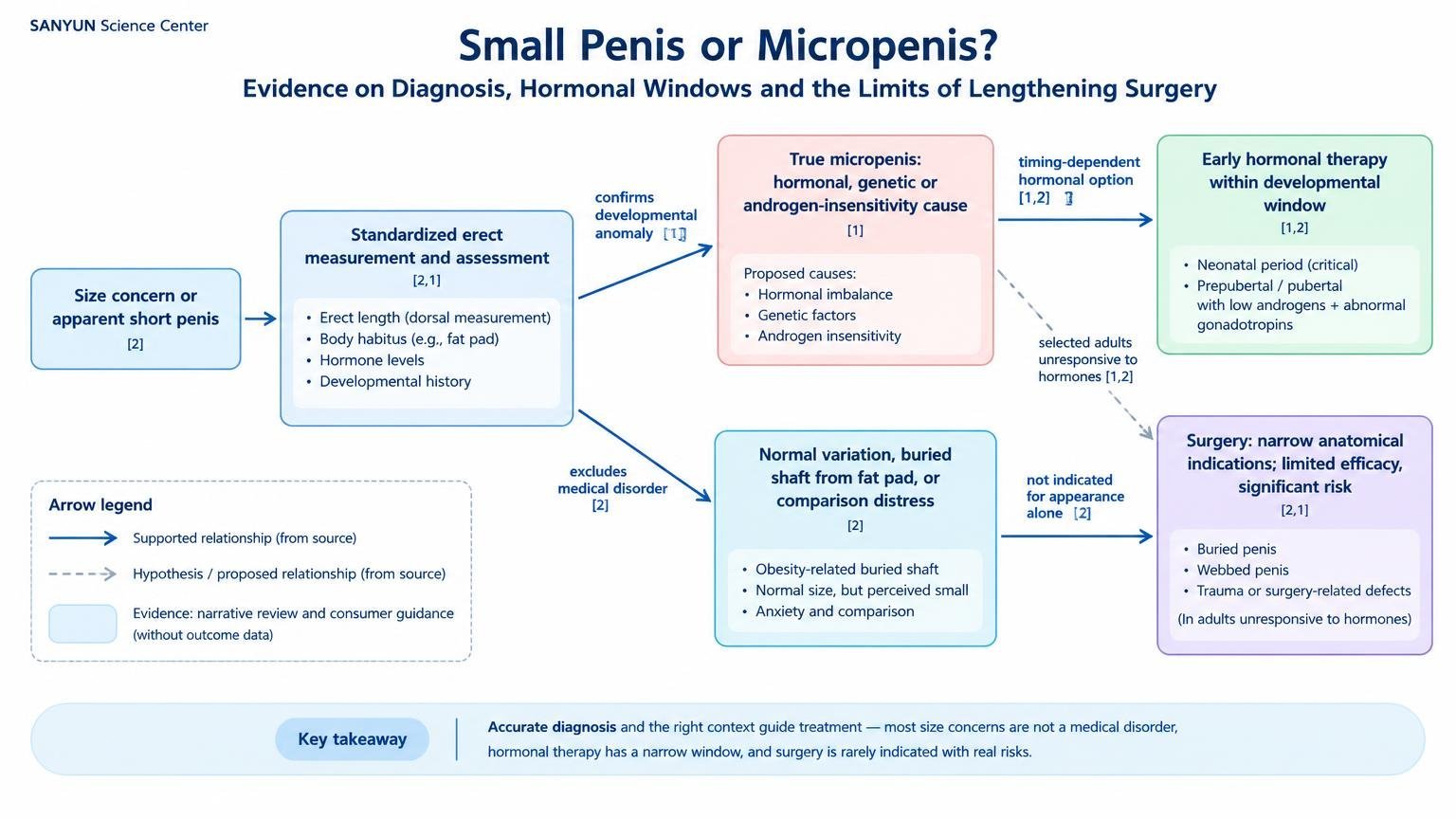
Assessment is described as multifactorial. The consumer article states that a determination generally considers whether erect length is significantly below the average for the same age group, combined with body habitus, hormone levels and developmental history. That combination matters because apparent shortness can have non-anatomical explanations. In men with obesity, a thicker lower-abdominal fat pad can bury part of the penile shaft, producing an appearance of shortness while actual length is normal; this often improves markedly with weight loss.
Measurement technique itself shapes the judgment. Correct measurement is described as taking place in the erect state, from the pubic symphysis along the dorsal side to the tip of the glans, rather than estimating from the skin surface. Length is also described as fluctuating with state, temperature and emotional state, which means a single casual observation is a poor basis for any conclusion, let alone a surgical one.
What the Evidence Shows: Hormonal Treatment and Its Window
The strongest signal in this packet concerns timing rather than magnitude. The review states that early intervention in the neonatal period, especially hormonal therapy, is critical for penile development. Separately, the consumer article explains that hormonal treatment may be considered when androgen levels are low and gonadotropins abnormal and the patient is still prepubertal or pubertal, with the aim of promoting development.
Both sources converge on a narrow window. The consumer article states that this treatment has strict timing and eligibility constraints, and that after adulthood — once the epiphyseal growth plates have closed — the effect is very limited, with self-treatment not advised. The review's position that hormonal therapy is critical early is compatible with this, but neither source provides outcome data, response rates or follow-up durations, so the size of the benefit in eligible children remains unquantified here.
The clinical implication is that hormonal treatment is not a late fix. For an adult with a normal hormonal profile, there is no described rationale for androgen therapy as a size intervention, and the stated limitation after skeletal maturity makes the point explicit. For a child with documented abnormalities, the decision belongs to specialist evaluation, not to a general assumption that hormones enlarge the penis.
Surgery: Narrow Indications, Limited Benefit, Real Risk
Both sources treat surgery as a narrow option. The consumer article states that truly suitable cases are few and lists them: buried penis, in which the penile body is concealed; webbed penis; and partial defects caused by trauma or surgery. The review states that for adults who do not respond well to hormonal therapy, surgery may be an option, but with limited efficacy and significant risks.
For men whose hormones and development are normal and who merely appear short, the consumer article is explicit that lengthening surgery offers limited benefit with considerable risk, naming scarring, reduced sensation and impaired erectile function, and states that reputable physicians generally do not recommend it readily. The review's parallel phrasing — limited efficacy, greater risk — is notable because it appears in a clinical journal review, not only in consumer guidance, though neither source provides complication rates or measured gains.
| Clinical situation | What the sources describe | Interpretation and main caveat |
|---|---|---|
| True micropenis in a neonate or child | Early intervention, especially hormonal therapy, described as critical for penile development | Timing appears central, but no response rates or outcome data are supplied in this packet |
| Low androgens with abnormal gonadotropins before or during puberty | Hormonal treatment may be considered to promote development | Strict eligibility and timing; benefit after skeletal maturity is described as very limited |
| Adult unresponsive to hormonal therapy | Surgery may be an option with limited efficacy and significant risk | Review-level assertion without quantified outcomes |
| Buried, webbed or traumatically deformed penis | Among the few situations described as genuinely suitable for surgery | Anatomical correction, not cosmetic lengthening of a normal penis |
| Normal hormones and development, appearance only | Limited benefit with risks of scarring, reduced sensation and impaired erection | Reputable physicians generally do not recommend it readily |
| Obesity-related apparent shortness | Fat pad buries the shaft; actual length may be normal | Appearance often improves markedly with weight loss |
| Anxiety and comparison-driven distress | Sex education and psychological counseling described as often more effective than physical treatment | Assertion without trial data; framed as a hypothesis-level claim |
Conservative and Psychological Management
For men without an anatomical or endocrine problem, the described conservative pathway is not a consolation prize. In obesity-related apparent shortness, controlling weight and reducing the suprapubic fat pad is said to improve both appearance and function. For distress rooted in anxiety and comparison with others, the consumer article argues that sex education and psychological counseling are often more effective than any physical treatment.
That claim should be read with appropriate caution. It is a reasoned clinical position rather than a trial result, and the packet contains no comparative data on counseling outcomes. Even so, its logic is coherent with the rest of the evidence: if the presenting problem is perception and distress rather than anatomy, then an intervention aimed at anatomy addresses the wrong target while still carrying the risks listed above.
Interpretation and Limitations
The evidence summarized here is best described as expert narrative guidance. The review is a narrative synthesis of measurement, diagnosis, drug and surgical treatment and follow-up care, not a systematic review or primary study, and it reports no sample sizes, effect estimates or confidence intervals. The consumer article is not peer-reviewed and cites no studies for its clinical statements. Any statement about how much hormonal or surgical treatment achieves therefore remains unquantified in this article.
Several specific gaps deserve emphasis. The threshold used to define abnormally short length is not specified numerically in either source; the review names hormonal, genetic and androgen-insensitivity causes without detailing diagnostic tests; and the claim that counseling outperforms physical treatment for comparison-driven distress is asserted rather than demonstrated. Readers should also note that the cited review and the consumer article were published in 2026, so the clinical framing is current, while the absence of outcome data reflects the source type rather than the state of the field.
One further boundary is practical. The sources describe red flags — difficulty urinating, painful erection, post-trauma deformity or sudden change — that warrant prompt urology or andrology evaluation rather than a cosmetic consultation. Those symptoms point to a different diagnostic pathway than size concern, and conflating the two can delay appropriate care.
Research Outlook
What this topic needs is not more assertion but better outcome measurement: standardized measurement protocols applied consistently, clearly defined eligibility for hormonal therapy in childhood, and long-term follow-up of adults who undergo reconstructive or lengthening procedures, reported with complication rates and validated satisfaction and function measures. The current sources establish the structure of the clinical decision — diagnose first, treat the cause, operate rarely, counsel where the problem is distress — but they cannot yet tell a patient how large a benefit to expect.
Key Takeaways
- Micropenis is a developmental anomaly defined by abnormally short length, with proposed causes including hormonal imbalance, genetic factors and androgen insensitivity — not simply being shorter than peers.
- Accurate erect measurement and multifactorial assessment, including body habitus, hormones and developmental history, are described as essential before any treatment decision.
- Hormonal therapy is tied to a narrow developmental window; after skeletal maturity its effect is described as very limited, and self-treatment is not advised.
- Surgery is described as suitable in few situations — buried or webbed penis and trauma or surgery-related defects — with limited efficacy and significant risk in adults unresponsive to hormones.
- For appearance concerns with normal anatomy and hormones, weight reduction where relevant and psychological support are presented as the preferred first-line options.
Questions and Answers
What is the medical difference between micropenis and a small penis?
Micropenis is described as an external genital developmental anomaly in which penile length is abnormally short at birth and during development, with proposed causes including hormonal imbalance, genetic factors and androgen insensitivity. Being somewhat shorter than peers is not a diagnosis; assessment combines erect length relative to the age group with body habitus, hormone levels and developmental history.
Can testosterone or hormonal treatment enlarge the penis in adults?
The sources indicate the opposite. Hormonal treatment may be considered before or during puberty when androgens are low and gonadotropins abnormal, aiming to promote development, and early neonatal intervention is described as critical. After adulthood, with growth plates closed, the effect is described as very limited, and self-treatment is not advised.
When is penile lengthening surgery actually justified?
The consumer guidance lists few suitable situations: buried penis, webbed penis, and partial defects from trauma or surgery. For adults unresponsive to hormonal therapy, a review states surgery may be an option with limited efficacy and significant risks. For men with normal hormones and development who merely appear short, benefit is described as limited with risks of scarring, reduced sensation and impaired erection.
How strong is the evidence behind these recommendations?
It is relatively weak in design terms. The clinical source is a narrative review covering measurement, diagnosis, drug and surgical treatment and follow-up, and the other is a consumer health article. Neither reports sample sizes, effect estimates or complication rates, so the recommendations reflect expert framing rather than quantified trial evidence.
Can obesity make the penis look smaller than it is?
Yes, according to the consumer source. In men with obesity, a thicker lower-abdominal fat pad can bury part of the penile shaft, so the penis appears short while actual length is normal. This appearance often improves markedly after weight loss, which is why body habitus is part of the assessment.
When should a man with penis size concerns see a specialist?
Evaluation by urology or andrology is advised promptly if there is difficulty urinating, painful erection, deformity after trauma, or a sudden change. For size concerns alone, the described first step is accurate measurement and assessment of hormones, development and body habitus, with psychological support where distress rather than anatomy is the main issue.
Conceptual framework: Conceptual framework. A size concern is assessed by standardized erect measurement and multifactorial evaluation; true micropenis follows a timing-dependent hormonal pathway, while normal variation, buried shaft from a fat pad, or comparison distress favor conservative and psychological management. Arrows show conceptual relationships, not tested causal effects; evidence is narrative review and consumer guidance without outcome data.
Academic References & Evidence
- 小阴茎的规范化诊断和合理治疗选择. 临床泌尿外科杂志. 2026 (1):71-75,80
- 阴茎的短小的治疗方法怎么选?医生给出思路. 39健康网 (39.net). 2026
SANYUN Science Center explains published research on men's reproductive and sexual health, connecting scientific evidence with everyday questions while making sources and limitations clear.
Disclaimer: This article is for scientific education and research communication only. It does not provide medical advice, diagnosis, or individualized treatment recommendations, and does not endorse any medication, supplement, device, penile enlargement procedure, or other intervention. Decisions about sexual and reproductive health should be made in consultation with a qualified healthcare professional. Do not delay seeking professional care because of information in this article.
Original Content & Copyright Notice
- This article is prepared for SANYUN Science Center, drawing on published research and publicly available academic literature on men’s sexual and reproductive health. Its editorial explanations and presentation are developed for this platform.
- Copyright in the original editorial content, selection, and arrangement is reserved by SANYUN Science Center to the extent protected by applicable law. Referenced research, quotations, and third-party materials remain subject to the rights of their respective owners. This notice does not claim ownership of scientific facts or third-party research.
- Except where permitted by applicable law or an applicable license, prior written permission is required to reproduce, republish, translate, adapt, redistribute, or commercially reuse protected content. Attribution alone does not grant permission for such reuse.
- For permitted quotation or authorized reuse, clearly identify the source and retain a link to the original article.
- Source: SANYUN Science Center
- Original URL: Retain the original article URL on science.san-yun.com.
- Copyright Holder: SANYUN Science Center, for its own protected editorial content.
- Quotation, excerpts, or authorized reuse must not distort the scientific meaning, omit material limitations or disclaimers, or imply unverified medical claims, product efficacy, or endorsement by SANYUN Science Center.



