




Category: Premature Ejaculation
Core Research Direction: Pelvic floor muscle training for premature ejaculation: how do conventional training, biofeedback-assisted training, and electromagnetic pelvic floor stimulation compare for ejaculatory latency and control, and what does the wider guideline evidence say about the strength and limits of non-pharmacological and emerging treatments?
Search Intent: For men with lifelong premature ejaculation, do pelvic-floor-based therapies actually extend intravaginal ejaculatory latency time, and how strong is the current evidence compared with drug treatments?
Platform: SANYUN Science Center
Evidence reviewed through: 2026-11-21
Executive Summary
Men searching for non-drug options for premature ejaculation will encounter pelvic floor muscle training, biofeedback-assisted versions of that training, and device-based electromagnetic pelvic floor stimulation. The clinical question is simple to state and hard to answer: do any of these approaches meaningfully lengthen intravaginal ejaculatory latency time or improve a man's sense of control, and how do they compare with each other?[1][2]
A registered randomized controlled trial, the PE-PFMT study sponsored by Tanta University, is designed to compare the three modalities head-to-head in men with lifelong premature ejaculation. Its planned primary outcome is change in intravaginal ejaculatory latency time from baseline to the end of a six-week treatment period. It is active and recruiting, and it has not reported results.[3]
At the guideline level, the picture is shifting rather than settled. The amended AUA/SMSNA guidance revised its statement on non-pharmacological therapies for premature ejaculation to reflect new evidence that some of these therapies may be effective, while recommending shared decision-making across all treatment options. That is a qualitative signal, not a ranking of pelvic floor approaches.
For readers, the honest summary is that pelvic floor-based therapy is biologically plausible, guideline-acknowledged as a possible non-drug option, and still under-powered by direct comparative outcome data. The trial now underway is designed to fill part of that gap, but its results are pending.
Why This Matters
Premature ejaculation is one of the most common male sexual dysfunctions and can affect quality of life, sexual satisfaction and relationships. Drug treatment has been the mainstream approach because it acts quickly and is convenient, but not every man tolerates it or wants long-term medication, which keeps demand for credible non-drug options high.[4][5]
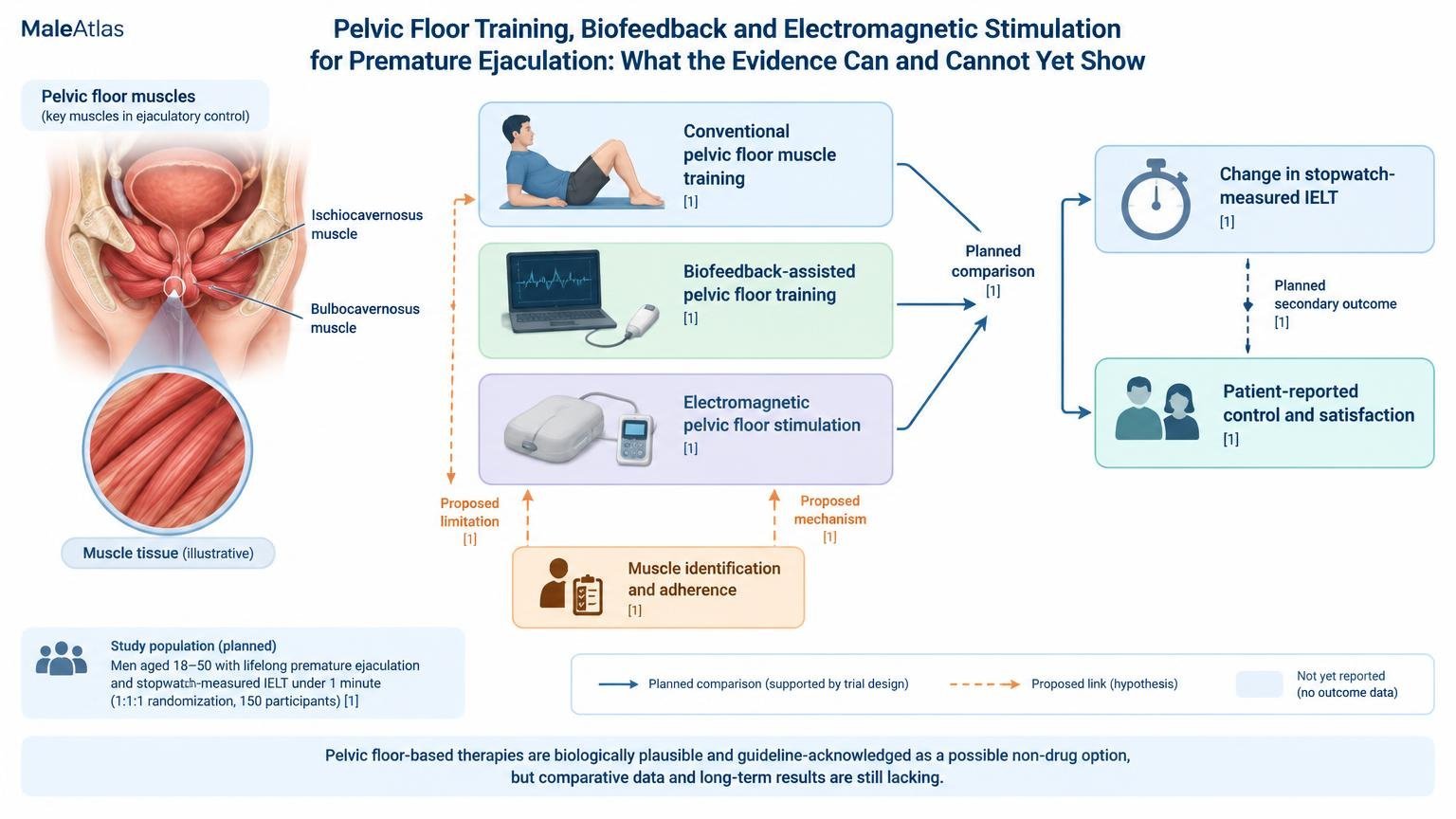
Pelvic floor muscle training has already been used as a non-pharmacological treatment for premature ejaculation. The trial authors suggest its real-world effectiveness may be limited by incorrect muscle identification and poor adherence, which is precisely the problem that biofeedback and device-driven stimulation are meant to address.
That framing matters because it reframes the debate. The question is not simply whether pelvic floor training works in principle, but whether better-targeted delivery, through supervised biofeedback or repeated device-induced contractions, produces larger or more durable gains than conventional instruction alone. Until comparative data exist, claims of superiority in either direction are speculative.
Biological Rationale: Pelvic Floor Muscles and Ejaculatory Control
The mechanistic case rests on anatomy. The trial background states that pelvic floor muscles, particularly the bulbocavernosus and ischiocavernosus muscles, are involved in ejaculatory control. Ejaculation involves coordinated rhythmic contraction of these and related muscles, so strength, awareness and voluntary control of the pelvic floor are plausible contributors to delaying the ejaculatory reflex.
This is a rationale, not a proven mechanism. The source describes the muscle involvement as background to a trial, not as a tested causal pathway, and it does not quantify how much of the variation in latency or control is attributable to pelvic floor function. Men should read mechanism claims in this area as biologically reasonable hypotheses rather than settled physiology.
The three interventions target that rationale differently. Conventional training relies on teaching a man to identify and exercise the correct muscles. Biofeedback adds a signal, such as visual or auditory feedback from sensors, so a man can see whether he is contracting the right muscles. Electromagnetic stimulation uses a device to induce repeated pelvic floor contractions without requiring voluntary effort.
What the PE-PFMT Trial Is Designed to Test
The PE-PFMT trial is a randomized, single-blind, parallel-assignment study planned to enroll 150 men aged 18 to 50 with lifelong premature ejaculation and stopwatch-measured intravaginal ejaculatory latency time under one minute. Participants are to be assigned in a 1:1:1 ratio to electromagnetic pelvic floor stimulation, biofeedback-assisted pelvic floor muscle training, or conventional pelvic floor muscle training.
The primary endpoint is the change in intravaginal ejaculatory latency time from baseline to the end of treatment at six weeks. Latency is to be measured as the average of at least three consecutive intercourse attempts using a stopwatch, with assessments planned at baseline, at six weeks, and at three-month follow-up. That structure is important: it separates a short-term treatment effect from durability.
Secondary outcomes are to include the Premature Ejaculation Diagnostic Tool score, the International Index of Erectile Function-5 score, patient-reported ejaculatory control, sexual satisfaction, partner satisfaction, treatment adherence and adverse events. The inclusion of control, satisfaction and adherence measures acknowledges that latency alone does not capture what men and partners consider improvement.
| Trial element | Planned specification | Why it matters for interpretation |
|---|---|---|
| Population | Men aged 18-50 with lifelong premature ejaculation and stopwatch-measured IELT under 1 minute | Restricts findings to lifelong PE with very short baseline latency; men with acquired PE or longer latency are not represented |
| Arms | Electromagnetic pelvic floor stimulation; biofeedback-assisted pelvic floor muscle training; conventional pelvic floor muscle training | Head-to-head design can compare modalities directly rather than against no treatment |
| Primary outcome | Change in stopwatch-measured IELT from baseline to end of 6-week treatment | Objective latency endpoint; change scores may be affected by baseline severity and measurement variability |
| Secondary outcomes | PEDT score, IIEF-5 score, patient-reported ejaculatory control, sexual and partner satisfaction, adherence, adverse events | Adds patient-centred and safety dimensions beyond latency |
| Time points | Baseline, end of treatment at 6 weeks, 3-month follow-up | Short treatment window; follow-up is planned but no durability data yet |
| Exclusions | Erectile dysfunction, neurological disease, previous pelvic surgery | Limits applicability to men with comorbid ED, neurological conditions or prior pelvic surgery |
What the Evidence Shows So Far
For the PE-PFMT comparison itself, the evidence is not yet available. The trial was listed as active and recruiting, with a start date of April 26, 2026 and an estimated completion date of April 30, 2027. The 150-participant figure is an enrollment target, not an observed sample, and no outcome data have been reported in the supplied sources.
The broader guideline evidence is more informative about direction than about size. The AUA/SMSNA amendment searched Ovid MEDLINE and Embase for studies published between January 1, 2020 and December 19, 2024, identified 727 abstracts, and included 89. Evidence quality for outcomes was assessed across 25 studies in 2025 to inform statement updates.
The most relevant output for this topic is the revised non-pharmacological therapy statement, which now reflects new evidence that some of these therapies may be effective. That wording is deliberately cautious: it supports considering non-drug options, but the available text does not specify which pelvic floor techniques were supported, how large the effects were, or how they compare with each other.
The same amendment added an expert-opinion statement on PDE5 inhibitors for premature ejaculation and, separately, evidence-supported statements on daily or on-demand clomipramine and glans hyaluronic acid injection. The panel emphasized informed consent and clinician involvement for the latter two. This is useful context: the treatment landscape is broadening, and non-pharmacological options are part of a shared decision rather than a standalone answer.
Review-level guidance also reminds readers what is being managed. The Fifth International Consultation on Sexual Medicine synthesis covers etiology, epidemiology, evaluation and management of ejaculatory disorders, and states its aim as evidence-based recommendations on definition, classification and treatment. Only abstract-level detail is available here, so its specific positions on pelvic floor therapy cannot be evaluated from this text.
Interpretation and Limitations
Several limits deserve emphasis. First, the head-to-head comparison that would answer the practical question is still running; any claim that electromagnetic stimulation outperforms biofeedback-assisted training, or vice versa, would currently be unsupported. Second, the trial population is narrow: lifelong premature ejaculation with latency under one minute, and exclusion of men with erectile dysfunction, neurological disease or previous pelvic surgery, so findings may not extend to those groups.
Third, the primary endpoint is a six-week change. That is a short window for a behavioral or muscular intervention, and the planned three-month follow-up will be important for judging durability. Fourth, stopwatch-measured latency averaged over at least three attempts reduces some recall bias, but it still varies with partner, context and measurement conditions; a statistically detectable change in latency is not automatically a clinically meaningful one for a given couple.
Fifth, the guideline signal is qualitative. A statement that some non-pharmacological therapies may be effective does not tell clinicians or patients which technique to choose, how many sessions are needed, or who is most likely to respond. Adherence is also a real-world confounder: the trial records adherence and adverse events, which is welcome, because a therapy that works only when perfectly performed may not work in ordinary life.
Research Outlook
The near-term research question is comparative effectiveness within pelvic floor-based approaches. If the PE-PFMT trial reports, readers should look for the between-arm differences in latency change, not only within-arm improvements, and for whether patient-reported control and partner satisfaction move in the same direction as the stopwatch measure.
Longer follow-up and broader populations are the next gaps. Men with acquired premature ejaculation, comorbid erectile dysfunction or prior pelvic surgery are excluded from the current design, and the three-month follow-up will say little about whether gains persist for a year or more. The guideline evidence window ending December 2024 also means newer trials will need to be incorporated into future updates.
For now, the appropriate clinical conversation is a shared one. Pelvic floor-based therapies can be discussed as plausible non-drug options with uncertain comparative advantage, alongside behavioral approaches and medication where appropriate, with attention to correct technique, realistic expectations and follow-up. The field is moving, but it has not arrived at a definitive ranking.
Key Takeaways
- A three-arm randomized trial is planned to compare electromagnetic pelvic floor stimulation, biofeedback-assisted pelvic floor muscle training and conventional pelvic floor muscle training in 150 men with lifelong premature ejaculation, with change in stopwatch-measured latency at six weeks as the primary outcome.
- No results from that comparison are available yet; recruitment status and dates describe a planned study, not observed effects.
- The biological rationale centres on the bulbocavernosus and ischiocavernosus muscles and their role in ejaculatory control, but this remains a rationale rather than a quantified mechanism.
- Current guideline evidence acknowledges that some non-pharmacological therapies may be effective for premature ejaculation, but does not rank pelvic floor techniques or provide effect sizes in the available text.
- Exclusions of erectile dysfunction, neurological disease and prior pelvic surgery, plus a short six-week treatment window, limit how far the planned findings can be generalized.
- Shared decision-making is the recommended framework for managing ejaculatory disorders, which fits a field where non-drug options are promising but not yet definitively compared.
Questions and Answers
What is pelvic floor muscle training for premature ejaculation?
It is a non-drug approach that teaches a man to identify and exercise the pelvic floor muscles involved in ejaculatory control, particularly the bulbocavernosus and ischiocavernosus muscles. The aim is better awareness, strength and voluntary control. The trial background notes that real-world effectiveness may be limited by incorrect muscle identification and poor adherence, which is why biofeedback and device-assisted versions are being studied.
Does biofeedback-assisted pelvic floor training work better than conventional training for premature ejaculation?
That is not yet established. A randomized trial is designed to compare biofeedback-assisted training, conventional training and electromagnetic stimulation head-to-head, but it is active and recruiting and has not reported results. Biofeedback is proposed to improve muscle awareness and coordination, which is a hypothesis rather than a demonstrated advantage over conventional instruction.
How is intravaginal ejaculatory latency time measured in the pelvic floor trial?
The planned method is stopwatch-measured intravaginal ejaculatory latency time, calculated as the average of at least three consecutive intercourse attempts. Assessments are planned at baseline, at the end of six weeks of treatment, and at three-month follow-up. The primary endpoint is the change from baseline to the six-week end-of-treatment point. This measurement reduces recall bias but still varies with context and partner.
What do current guidelines say about non-drug treatments for premature ejaculation?
The AUA/SMSNA guideline amendment revised its statement on non-pharmacological therapies to reflect new evidence that some of these therapies may be effective. However, the available text does not specify which techniques were supported or how large the effects were, and it recommends shared decision-making across all treatment options. The statement is a qualitative signal, not a ranking of pelvic floor approaches.
Who is excluded from the pelvic floor premature ejaculation trial and why does that matter?
Men with erectile dysfunction, neurological disease or previous pelvic surgery are excluded. That matters because the results will not directly tell us whether the therapies help men with those common coexisting conditions. The trial also enrolls only men aged 18 to 50 with lifelong premature ejaculation and latency under one minute, so men with acquired premature ejaculation or longer baseline latency are not represented.
Is electromagnetic pelvic floor stimulation a proven treatment for premature ejaculation?
Not proven. Electromagnetic pelvic floor stimulation is a non-invasive modality designed to induce repeated pelvic floor contractions and may improve pelvic floor muscle function, but the comparative trial testing it against biofeedback-assisted and conventional training has not reported outcomes. It should be discussed as a plausible investigational option, not a guaranteed or established treatment.
Conceptual framework: Conceptual framework of the planned PE-PFMT trial in men with lifelong premature ejaculation. Three pelvic floor-based interventions are compared for change in stopwatch-measured intravaginal ejaculatory latency time and patient-reported control and satisfaction. Arrows show planned comparisons and proposed mechanisms, not demonstrated effects; muscle identification and adherence are proposed modifiers. No outcome data are yet reported.
Academic References & Evidence
- Mohamed I Elmaadawy; Hany F Badawy. Pelvic Floor Therapies for Lifelong Premature Ejaculation.
- Disorders of Ejaculation: AUA/SMSNA Guideline (2027) | Journal of Urology. Journal of Urology DOI: 10.1097/JU.0000000000005378.
- Pelvic Floor Therapies for Lifelong Premature Ejaculation.
- Contemporary consensus and emerging directions in premature and delayed ejaculation: recommendations from the 5th International Consultation on Sexual Medicine.. Sexual medicine reviews PMID: 42855438.
- 药物+理疗,早泄最优解.
SANYUN Science Center explains published research on men's reproductive and sexual health, connecting scientific evidence with everyday questions while making sources and limitations clear.
Disclaimer: This article is for scientific education and research communication only. It does not provide medical advice, diagnosis, or individualized treatment recommendations, and does not endorse any medication, supplement, device, penile enlargement procedure, or other intervention. Decisions about sexual and reproductive health should be made in consultation with a qualified healthcare professional. Do not delay seeking professional care because of information in this article.
Original Content & Copyright Notice
- This article is prepared for SANYUN Science Center, drawing on published research and publicly available academic literature on men’s sexual and reproductive health. Its editorial explanations and presentation are developed for this platform.
- Copyright in the original editorial content, selection, and arrangement is reserved by SANYUN Science Center to the extent protected by applicable law. Referenced research, quotations, and third-party materials remain subject to the rights of their respective owners. This notice does not claim ownership of scientific facts or third-party research.
- Except where permitted by applicable law or an applicable license, prior written permission is required to reproduce, republish, translate, adapt, redistribute, or commercially reuse protected content. Attribution alone does not grant permission for such reuse.
- For permitted quotation or authorized reuse, clearly identify the source and retain a link to the original article.
- Source: SANYUN Science Center
- Original URL: Retain the original article URL on science.san-yun.com.
- Copyright Holder: SANYUN Science Center, for its own protected editorial content.
- Quotation, excerpts, or authorized reuse must not distort the scientific meaning, omit material limitations or disclaimers, or imply unverified medical claims, product efficacy, or endorsement by SANYUN Science Center.



