




Category: Penis Enlargement
Core Research Direction: Clinical evidence on surgical and non-surgical penis enlargement: what suspension-ligament release, augmentation procedures, and buried-penis correction can and cannot achieve in adult men, and what the pediatric micropenis literature does and does not transfer to adult cosmetic practice.
Search Intent: Which penis-enlargement procedures have plausible anatomical rationale and documented limits in adults, and how should men and clinicians distinguish a genuinely small penis from a buried/normal-sized penis or an underlying functional problem?
Platform: SANYUN Science Center
Evidence reviewed through: 2026-11-21
Executive Summary
Men who ask about penile enlargement are usually asking a size question, but the clinical question underneath it is often different. The sources reviewed here converge on a distinction that matters more than any single technique: total anatomical length, visible length, flaccid length, stretched length, erect length and girth are separate concepts, and a penis that looks short is not necessarily a short penis.[1]
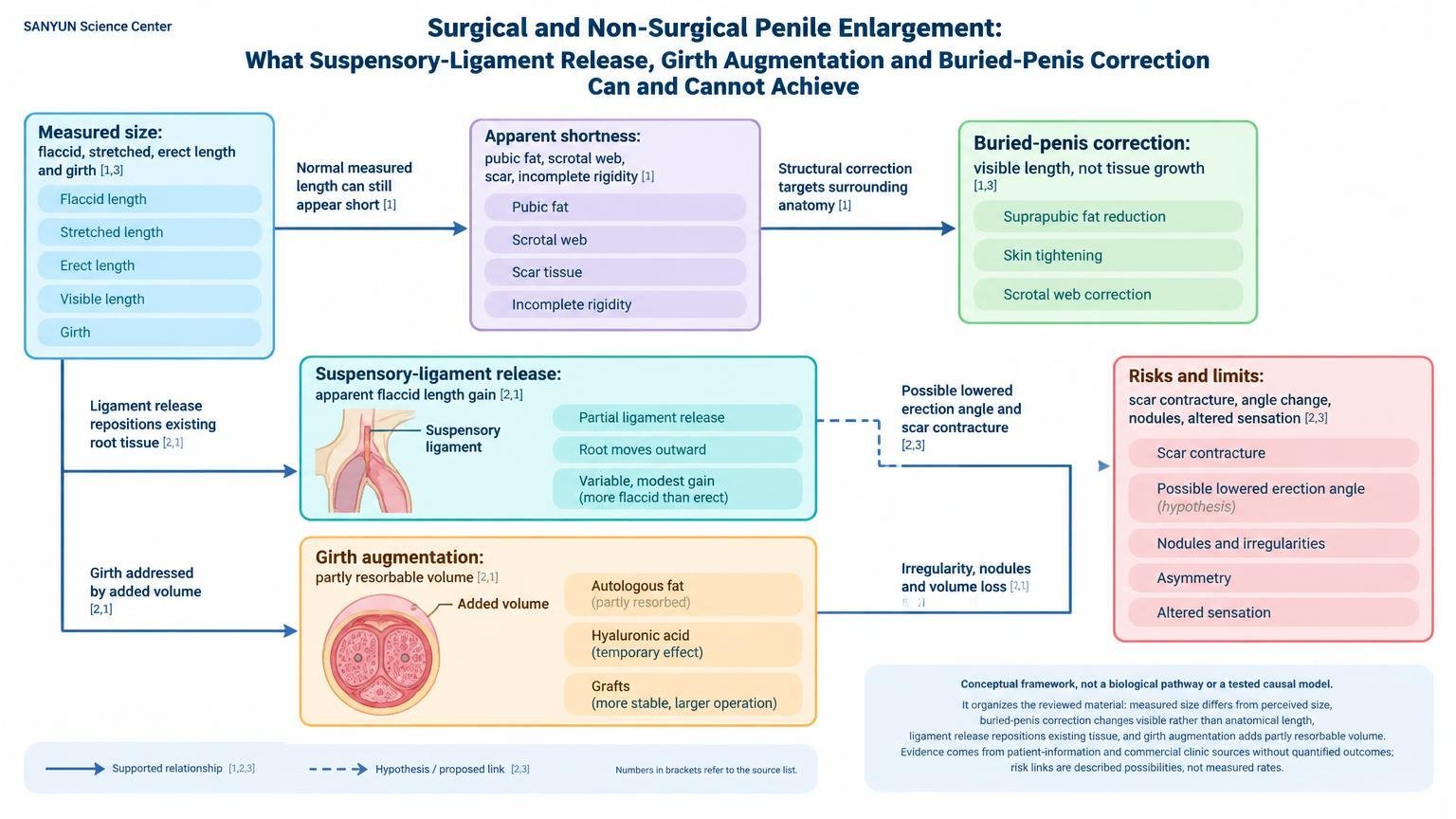
Where surgery is described, its stated aims are modest and largely positional rather than growth-based. The most commonly described lengthening operation partly releases the suspensory ligament so that part of the penile root moves outward, and the reported gain is variable, usually modest, and weighted toward flaccid rather than erect length. Girth augmentation by fat or hyaluronic acid is described as partly resorbable.[2]
The evidence base behind these statements is weak in a specific way that must be stated plainly. The reviewed sources are hospital and commercial clinic patient-information pages, not clinical trials. They describe mechanisms, risk lists and clinical policies, but they report no sample sizes, no measured gains in centimetres, no follow-up durations and no comparison groups. Nothing in this material allows a reader to estimate how much length or girth an individual man would gain, or how often a complication occurs.[3]
The pediatric micropenis literature is informative about principles and uninformative about adult cosmetic outcomes. Its most transferable contributions are definitional rigor, the importance of compressing the suprapubic fat pad during measurement, and the fundamental separation of buried penis from true micropenis. Its surgical techniques, hormone protocols and outcome expectations belong to a different population with a different indication.
Why This Matters
Requests for penile enlargement are common enough that clinics describe many of the men attending consultation as having anatomy within the normal range. When that is true, the operation is being offered for a perception rather than a deficit, and the source material explicitly recommends that information about normal values be part of the consultation itself. It also advises against operating when the request rests on a perception far from reality, when weight loss is the better answer, or when erectile disorder or psychological distress needs other care first.
That advice is not a marketing caveat; it is the most clinically consequential statement in the packet. Cosmetic penile surgery carries a real risk list — hematoma, infection, delayed healing, scar contracture that erodes the gain, nodules and irregularities after volume augmentation, asymmetry, altered sensitivity, a changed erection angle and a result the patient judges insufficient — and none of these risks is quantified in the available sources.
There is also a safety boundary that deserves emphasis. Injection of silicone, paraffin, vaseline or other non-medical substances into the penis is described as capable of causing serious and permanent damage and must not be treated as a safe aesthetic procedure. When a man presents after such injections, the clinical priority shifts from enlargement to assessing damaged tissue and controlling infection or inflammation.
The Measurement Problem: Six Different Things Called Length
Before any discussion of technique, the assessment has to separate the variables. Total anatomical length, visible length, flaccid length, stretched penile length, erect length and girth are distinct, and they behave differently. Flaccid length in particular is described as sensitive to cold, stress, anxiety, ambient temperature, muscle tone and sympathetic activity, so a man may look short when flaccid while his erect length is normal.
Erect length adds another confounder. In men with erectile dysfunction the penis may not rigidify fully and may therefore be perceived as shorter, which means the erectile problem should be evaluated before any size procedure is planned. The pediatric measurement literature makes the same point from the other direction: suprapubic fat must be compressed during measurement, because in children with abundant fat tissue the penis may appear short while true length is within normal limits.
| Variable | What the source says it captures | Why it matters clinically |
|---|---|---|
| Flaccid length | Influenced by cold, stress, anxiety, ambient temperature, muscle tone and sympathetic activity | Can look short while erect length is normal; unreliable as a single basis for surgery |
| Stretched penile length | Measured with gentle traction, with suprapubic fat compressed | Closer to anatomical potential; used in micropenis definitions |
| Erect length | Depends on rigidity; underestimated when erection is incomplete | Erectile dysfunction should be assessed before size surgery is considered |
| Visible length | Portion of the penis not hidden by pubic fat, skin tethering or scrotal web | Can be increased without changing anatomical length |
| Girth | Circumference addressed by volume augmentation | Augmentation is described as partly resorbable and revision-prone |
Suspensory-Ligament Release: Plausible Mechanics, Modest and Unquantified Gains
The suspensory ligament connects the base of the penis to the pubic bone and helps support the erect penis. Partial release allows part of the penile root to move outward, which increases apparent length, mainly in the flaccid state. The stated gain is variable and usually modest, and it concerns flaccid length more than erect length.
This is a repositioning operation, not a tissue-expansion operation. The same logic appears in the pediatric reconstruction literature, where the observation is made that the cavernous bodies themselves cannot be enlarged, so surgery focuses on positioning existing tissue as well as possible. Frame the procedure that way and the honest expectation follows: the visible portion changes, the total amount of erectile tissue does not.
Two costs are attached to the release. Because the ligament contributes to erectile support, dividing it may lower the erection angle, a point the source says should be explained before any decision. And during healing, scar tissue tends to re-shorten the ligament and pull back some of the gained length, which is why technical measures and, in the clinic descriptions, post-operative traction protocols are used to protect the result.
The source material is also explicit that this is not a standard operation for every patient. Erection angle, proximity of vessels and nerves, available skin, scar risk and the patient's expectations all have to be assessed, and the pediatric literature independently notes that gain from ligament release alone is generally limited and that dramatic lengthening is not expected from it in isolation.
Girth Augmentation: Volume That Partly Goes Away
Girth procedures add volume rather than length. The described options include the patient's own fat harvested and re-injected, hyaluronic acid, and grafts, and the sources present them as non-equivalent. Autologous fat is the patient's own material but is partly reabsorbed; hyaluronic acid avoids major surgery but has a temporary effect requiring renewal; grafts offer more stable volume at the cost of a larger operation and its specific risks.
Resorption is the central limitation and it is described as uneven. Some injected fat can break down during the first months, sometimes requiring a touch-up to reach or smooth the result, and because the loss is not uniform across regions it can produce irregular appearance, nodules, asymmetry or volume loss. The penis is mobile and changes shape during erection, which the sources identify as a further reason why symmetry, material placement and long-term appearance are hard to guarantee.
For a reader trying to interpret this, the key point is that none of the reviewed material reports how much girth is typically gained, what proportion of fat survives, or how often nodules occur. These are described possibilities, not measured rates. A clinic page that lists nodules as a risk is telling you the complication exists; it is not telling you its frequency.
Buried Penis and Perceived Shortness: The Most Correctable Category
The clearest clinical distinction in the whole packet is between a buried penis and a genuinely small one. A buried penis can look similar to micropenis but is a fundamentally different condition with an entirely different treatment approach. In buried penis the penis is normal in real length but appears short because of increased pubic fat over the upper penis, skin tethering, or scar tissue after circumcision.
Correction in this category targets the surrounding anatomy rather than the penis. Suprapubic fat reduction frees the penile base and improves visible length without operating on the penis itself, and skin tightening in the pubic region may complement this after major weight loss. Scrotal web correction addresses the skin attachment between the lower penis and scrotum; it does not anatomically lengthen the penis but can improve perceived visible length, which is why the sources insist that patients be told exactly what will and will not change.
The pediatric literature supplies the measurement rule that makes this distinction operational: compress the suprapubic fat, apply gentle traction, and measure from the pubic bone to the glans tip. If the penis reaches a normal stretched length under those conditions, a buried penis is the working explanation and there is no tissue to enlarge.
What the Pediatric Micropenis Literature Does and Does Not Transfer
Micropenis is defined in children by stretched penile length more than 2.5 standard deviations below the mean for age and developmental stage, using a structurally normal penis. Reference values given include a newborn mean stretched length of approximately 3.5 cm, with values below 2 cm flagged as concerning. The underlying mechanism is insufficient androgen stimulation during the second and third trimesters, which can arise from central hypothalamic-pituitary failure, testicular production or response problems, or androgen receptor disorders.
That framework transfers to adult practice as a discipline of assessment: define the condition by measured deviation from age-referenced norms, exclude a buried penis, look for an endocrine explanation, and involve specialist evaluation. What does not transfer is the treatment model. In children, short courses of testosterone are used diagnostically and therapeutically to test tissue responsiveness and improve surgical conditions, under endocrine supervision with monitoring of bone age because uncontrolled or prolonged use can advance bone maturation and cause early pubertal signs.
- Transferable to adults: the definitional threshold logic, the suprapubic fat-compression measurement technique, and the buried-versus-true micropenis distinction.
- Not transferable: pediatric testosterone protocols, pediatric surgical timing, and expectations of growth during puberty, none of which describe adult cosmetic outcomes.
- Transferable as a caution: nerve and vascular preservation matters because sensory change after penile surgery affects sexual function and quality of life, and transient reduction may improve during healing while permanent loss does not.
Interpretation and Limitations
The most important limitation of this review is the nature of its sources. They are patient-facing hospital and clinic pages, including commercial service descriptions, and they synthesize mechanisms, risk lists and clinical policies without citing primary studies or reporting outcome data. Statements such as modest gain, partial resorption or possible lowering of erection angle are therefore best read as consistent clinical descriptions rather than as measured effects.
Several specific gaps follow. There are no effect sizes in centimetres for any technique, no complication rates, no follow-up durations and no patient-reported satisfaction data. There are no controlled comparisons between ligament release, girth augmentation, buried-penis correction and no intervention. There is also no long-term data on how results change with weight fluctuation, ageing or revision surgery, although the sources acknowledge that weight gain can hide the penile base again and that touch-ups may be needed.
A second limitation concerns inference. Much of the mechanistic reasoning is anatomically plausible — a ligament that supports the erect penis will plausibly influence erection angle when divided — but plausibility is not demonstrated causation, and the sources themselves present these as possibilities to be discussed rather than as established outcomes. Readers should also note that the pediatric material describes children, so no finding there should be applied to an adult requesting cosmetic surgery without independent adult evidence.
Research Outlook
The questions that would settle this field are concrete and currently unanswered in the reviewed material. Prospective cohorts reporting standardized stretched and erect length before and after ligament release, with follow-up long enough to capture scar contracture, would convert a plausible mechanism into an estimate. Objective measurement of retained girth after fat transfer, with imaging or standardized circumference at fixed time points, would replace the vague statement that some volume is reabsorbed.
Equally important is a psychosocial arm. Since many men consulting have anatomy within normal range and surgery may be discouraged when perception is far from reality, research that measures satisfaction and body image alongside anatomical change would clarify who actually benefits. Until such data exist, the honest position is that these operations can change appearance in selected patients, that the change is usually modest and partly reversible, and that the most reliable gains come from correcting a buried penis or a misperception rather than from enlarging normal tissue.
Key Takeaways
- Suspensory-ligament release repositions existing tissue to increase apparent flaccid length; gains are described as variable and usually modest, with little or no erect gain, and the erection angle may lower.
- Girth augmentation with fat or hyaluronic acid is partly resorbable, may be uneven, and can require touch-up or renewal; graft-based approaches carry the risks of a larger operation.
- A buried penis is normal in length but hidden by pubic fat, skin tethering or scar; correction targets the surrounding anatomy and improves visible length without enlarging the penis.
- Micropenis is a measured diagnosis — stretched length more than 2.5 standard deviations below the age mean — and its pediatric hormonal and surgical management does not transfer to adult cosmetic practice.
- Non-medical injectable substances such as silicone or paraffin can cause serious permanent damage and are not safe aesthetic procedures.
- Erectile dysfunction, early ejaculation and body-image distress should be assessed before surgery, because an operation that changes appearance will not resolve a functional or psychological problem.
Questions and Answers
What is the difference between a buried penis and a genuinely small penis?
A buried penis is normal in real length but appears short because pubic fat, skin tethering or post-circumcision scar hides the base; a genuinely small penis is structurally short. The distinction is made by compressing the suprapubic fat and measuring stretched length from the pubic bone to the glans tip. Treatment differs entirely: buried penis correction targets surrounding tissue, not penile growth.
How much length does suspensory-ligament release actually add?
The reviewed sources do not provide a measured figure. They describe the gain as variable and usually modest, concentrated in flaccid rather than erect length, because the operation moves part of the penile root outward rather than creating new tissue. Scar contracture during healing can pull back some of the gain, and dividing the ligament may lower the erection angle.
Why does fat injection for penile girth sometimes need a repeat procedure?
Part of the injected fat can be broken down during the first months, and the loss is not uniform across regions, so the result may be irregular, nodular or asymmetric. Touch-up may be needed to reach or smooth the outcome. Hyaluronic acid behaves differently but is also progressively degraded and must be renewed to maintain effect.
How strong is the evidence behind penile enlargement procedures?
Weak in a specific sense. The available material consists of hospital and commercial clinic patient-information pages that describe mechanisms, risk lists and clinical policies without sample sizes, measured gains, follow-up durations, comparison groups or complication rates. The anatomical reasoning is often plausible, but plausibility is not demonstrated effectiveness, and no reviewed source reports quantified outcomes.
Can the pediatric micropenis literature guide adult cosmetic penile surgery?
Only partly. The definitional threshold of stretched length more than 2.5 standard deviations below the age mean, the suprapubic fat-compression measurement and the buried-versus-true-micropenis distinction transfer as assessment principles. Pediatric testosterone protocols, surgical timing and pubertal growth expectations do not transfer, because they describe children with an endocrine or developmental indication rather than adults requesting cosmetic change.
When should a man be advised against penile enlargement surgery?
Sources suggest discouraging surgery when anatomy is within normal range and the request rests on a perception far from reality, when weight loss or another approach is more suitable, or when erectile disorder or psychological distress requires other care first. Erectile dysfunction can make the penis appear shorter, so the functional problem should be evaluated before any size procedure.
Conceptual framework: Conceptual framework, not a biological pathway or a tested causal model. It organizes the reviewed material: measured size differs from perceived size, buried-penis correction changes visible rather than anatomical length, ligament release repositions existing tissue, and girth augmentation adds partly resorbable volume. Evidence comes from patient-information and commercial clinic sources without quantified outcomes; risk links are described possibilities, not measured rates.
Academic References & Evidence
- Erkek Genital Estetik Girne KKTC / Kıbrıs | Doç. Dr. Necmi Bayraktar | ReSurgeClinic.
- Penoplastik in Istanbul — Medespoir.
- Peniz Uzatma ve Peniz Rekonstrüksiyonu (Mikropeniz) • Özel Koru Hastanesi.
SANYUN Science Center explains published research on men's reproductive and sexual health, connecting scientific evidence with everyday questions while making sources and limitations clear.
Disclaimer: This article is for scientific education and research communication only. It does not provide medical advice, diagnosis, or individualized treatment recommendations, and does not endorse any medication, supplement, device, penile enlargement procedure, or other intervention. Decisions about sexual and reproductive health should be made in consultation with a qualified healthcare professional. Do not delay seeking professional care because of information in this article.
Original Content & Copyright Notice
- This article is prepared for SANYUN Science Center, drawing on published research and publicly available academic literature on men’s sexual and reproductive health. Its editorial explanations and presentation are developed for this platform.
- Copyright in the original editorial content, selection, and arrangement is reserved by SANYUN Science Center to the extent protected by applicable law. Referenced research, quotations, and third-party materials remain subject to the rights of their respective owners. This notice does not claim ownership of scientific facts or third-party research.
- Except where permitted by applicable law or an applicable license, prior written permission is required to reproduce, republish, translate, adapt, redistribute, or commercially reuse protected content. Attribution alone does not grant permission for such reuse.
- For permitted quotation or authorized reuse, clearly identify the source and retain a link to the original article.
- Source: SANYUN Science Center
- Original URL: Retain the original article URL on science.san-yun.com.
- Copyright Holder: SANYUN Science Center, for its own protected editorial content.
- Quotation, excerpts, or authorized reuse must not distort the scientific meaning, omit material limitations or disclaimers, or imply unverified medical claims, product efficacy, or endorsement by SANYUN Science Center.



