




Category: Penis Enlargement
Core Research Direction: Evidence-based appraisal of penile enlargement/augmentation procedures (suspensory ligament release, silicone girth implants, fat transfer, fillers, traction) for adult men: what realistic flaccid vs erect gains and satisfaction/complication rates are reported in published series, what normal penile dimensions are, and what the cited literature says about doubtful candidates such as men with normal anatomy or penile dysmorphic disorder.
Search Intent: What can penile enlargement surgery and non-surgical methods realistically add in length or girth, how durable are the results, and what risks and limitations does the published evidence actually document?
Platform: SANYUN Science Center
Evidence reviewed through: 2026-11-16
Executive Summary
Penile enlargement is not a single operation. It is a group of surgical and non-surgical techniques that target different anatomical structures, and their reported results differ enough that they should be assessed separately rather than under one marketing label. The evidence base available for this review is thin: it consists largely of single-surgeon case series, surgeon-authored patient education pages, clinic guides and one secondhand summary of a systematic review, with few long-term controlled studies.[1][2]
The most anchored finding concerns baseline expectations. A pooled analysis of measurements from more than 15,000 men reported an average erect length of about 13.1 cm (5.2 in) and average erect girth of about 11.7 cm (4.6 in), and a cited meta-analysis gives an average flaccid length of 9.16 cm with a range of 6.5 to 11.8 cm. Against those references, 80 to 85 percent of men requesting enlargement in clinical practice are of normal size.
For surgery, the strongest single data point in this packet is a single-surgeon series of 400 patients receiving a silicone girth implant, in which mean mid-shaft girth measured on the flaccid penis increased 56.7 percent and 81 percent of men reported high or very high satisfaction at two to six years. Because the erect shaft starts from a larger baseline, the proportional gain when erect is substantially lower.
Ligament release tells a more cautionary story. One widely cited European series of 42 men reported a mean gain of about 1.3 cm in stretched length, with only about one third satisfied, mainly because expectations had been set too high. Some men who do not use postoperative traction end with no gain, and some end with scarring that leaves them shorter than before.
The central practical conclusion is that the published literature documents modest, technique-specific and variable dimensional change, not dramatic enhancement; that durability depends heavily on maintenance behaviours such as traction; and that men with normal anatomy or penile dysmorphic concerns are the group least likely to benefit and most likely to regret treatment.
Why This Matters: Normal Size, Perceived Size and the Candidate Question
Size concern is common, but the distribution of penile dimensions is narrow, and many men who seek help compare themselves with a distorted reference point rather than with measured population data. The numbers in this packet are worth restating plainly: average erect length about 13.1 cm and average erect girth about 11.7 cm in a pooled analysis of more than 15,000 men, and average flaccid length 9.16 cm in the cited meta-analysis table, with a stated normal range of 6.5 to 11.8 cm.
A working clinical threshold is also given: in adults, micropenis is defined as an erect length below 9.3 cm, and anything above that is medically normal, making treatment a personal choice rather than a medical need. This distinction matters because it separates a functional reconstructive question from a cosmetic one.
The candidate profile reinforces the same point. In clinical practice, 80 to 85 percent of men asking for enlargement are of normal size. Where perceived size diverges markedly from measured size — described here as penile dysmorphic disorder — the recommended first step is sex therapy and, where needed, psychological support, rather than surgery or injections.
This is also where the evidence is most consistent on what does not work. For body dysmorphic disorder or severe concern about a normally sized penis, counselling is described as helping this group while surgery is not. A 2020 systematic review including 1,192 men concerned about penile size, of whom 773 were treated and followed up, concluded that structured counselling should always come first and that several widely marketed techniques have weak or no supporting evidence.
Professional position statements align with this. The American Urological Association's policy on penile augmentation does not regard suspensory ligament division or fat injection as proven safe and effective, and enlargement surgery is not standard urological treatment for a normal-sized penis.
Biological and Anatomical Mechanism: Why Gains Are Flaccid-First
Three structures determine how much shaft is visible: the erectile bodies, the suspensory ligament that anchors the penis to the pubic bone and keeps part of the shaft internal, and the suprapubic fat pad, which can conceal length. Each intervention in this article targets one of these structures, which is why outcomes differ by technique and by measurement state.
Ligament release divides the anchoring ligament so that internal shaft can come forward and hang lower. It changes visible resting anatomy far more than erect length, because the erect penis is already supported by its own rigidity and the ligament's contribution to erect projection is limited. Consistent with this, published series report average gains of about 1-2 cm, erect length rarely changes, and final results depend heavily on regular postoperative traction use.
The traction requirement is a mechanical consequence rather than an optional extra: without it, 30 to 50 percent of the gain can be lost, and some men end with no gain or with net shortening from scarring. A traction device worn 4 to 8 hours a day for 6 to 12 months is described as adding 1 to 2 cm of erect length, with regression possible if use stops.
Girth techniques add volume around the shaft. A soft silicone sleeve is placed beneath the penile skin, adding circumference along the shaft and modestly improving the appearance of flaccid length. Fat transfer and fillers inject volume into subcutaneous tissue, and neither adds length.
Suprapubic liposuction works differently again: it removes fat above the pubic bone to uncover a buried penis, increasing visible length without touching the penis itself, although weight gain can reverse the effect.
What the Evidence Shows, Technique by Technique
The table below summarises the reported dimensional outcomes and the durability caveats that accompany them. It is a comparison of what different sources claim, not a head-to-head trial, and several rows rest on a single series or on surgeon-authored summaries.
| Technique | Reported dimensional change | Measurement state and durability | Evidence caveat |
|---|---|---|---|
| Silicone girth implant (Penuma/Himplant class) | Mean mid-shaft girth +56.7% in a 400-patient series; flaccid length appearance modestly improved | Measured on the flaccid penis; erect percentage gain substantially lower; long-term device considered removable | Single-surgeon series reflecting one highly experienced implanter; 81% high or very high satisfaction at 2-6 years |
| Suspensory ligament release | About 1.3 cm mean stretched-length gain in a 42-man European series; published series range about 1-2 cm | Flaccid/visible length; erect length rarely changes; loss of 30-50% of gain without six months of traction | Only about one third satisfied, attributed mainly to unrealistic expectations |
| Fat transfer | About 1-3 cm initial girth; 20-50% reabsorbed in the first year, or 30-50% in the first six months depending on source | No length gain; top-up sessions often needed | Uneven absorption, cysts or nodules in 5-15% |
| Hyaluronic acid and PMMA fillers | Girth only; no length gain | Hyaluronic acid temporary, PMMA longer-lasting; both avoid stitches | Off-label use for penile girth in many markets; granuloma risk with PMMA |
| Traction device | 1-2 cm erect length over 6-12 months of daily wear | Gains may regress after discontinuation | Adherence of 4-8 hours daily is the limiting factor |
| Suprapubic liposuction | Increases visible length by uncovering a buried penis | Reversible with weight gain | Addresses concealment, not penile tissue |
Read together, these figures show a consistent pattern: the largest documented percentage change is in flaccid girth after sleeve implantation, the most modest is in stretched length after ligament release, and erect length is barely moved by any technique in this packet.
Satisfaction does not track dimensional change in a simple way. The 400-patient implant series reported 81 percent high or very high satisfaction at two to six years, while the 42-man ligament series reported satisfaction in only about one third. The stated explanation for the low figure was expectation mismatch rather than surgical failure, which suggests that counselling quality may influence satisfaction as much as the procedure itself.
The implant evidence also carries a design caveat that deserves emphasis. The girth outcome was measured on the flaccid penis, and because the erect shaft begins from a larger baseline, the percentage gain when erect is substantially lower than 56.7 percent. Men evaluating a sleeve should therefore ask for erect-state data specifically, not simply transfer the headline figure to their own expectations.
Complications: What Is Documented and How Often
Complication reporting in this literature is uneven. Several sources list risks without incidence rates, and one explicitly notes that most complications in published series were minor and managed without loss of results, with only a small proportion of implant patients requiring device removal — while noting that this profile worsens with low-volume surgeons, non-hospital settings and unverifiable devices.
Implant-specific risks include seroma, infection, palpable or visible implant edges, device tilting or migration, and skin erosion in thin tissue. An infected implant generally cannot be salvaged with antibiotics alone, and case reports describe penile shortening and curvature after removal. This is the realistic worst case that should be considered before choosing a device.
Ligament release carries its own trade-offs: a 5 to 15 degree drop in erect angle, four to six weeks without sexual activity, and a limited effect on erect length. Fat transfer is associated with uneven absorption, cysts or nodules in 5 to 15 percent of cases.
One class of risk has no acceptable version. Injecting liquid silicone, paraffin or unknown "permanent fillers" into the penis causes disfiguring granulomas and is described as unacceptable at any cost; silicone oil and other unapproved substances can destroy penile tissue and should never be used. Men considering inexpensive injectable offers should treat this warning as absolute rather than relative.
Operator dependence is widely asserted rather than measured. One source states that most complications depend on who performs the procedure, which is presented as a hypothesis rather than a demonstrated effect in the supplied material, but it is consistent with the contrast drawn between high-volume and low-volume settings.
Interpretation and Limitations
Several constraints limit how far these numbers can be pushed. First, the packet contains no full randomised trial and few long-term controlled studies; the American Urological Association policy cited here does not regard suspensory ligament division or fat injection as proven safe and effective, and long-term controlled data remain scarce.
Second, the sources are predominantly commercial. Most are clinic or surgeon pages describing their own practice and pricing, which introduces selection and reporting incentives. The 400-patient implant series and the 42-man ligament series are single-operator experiences, and the systematic review figures are reported secondhand rather than from the review itself.
Third, the packet contains a genuine conflict about erect length after ligament release. One surgeon summary presents 2 to 4 cm of flaccid and 1 to 2 cm of erect length gain, permanent with traction, whereas the more widely cited European series shows about 1.3 cm mean stretched-length gain and other guides state that erect length rarely changes. Readers should treat the larger figures as a practice-specific claim rather than an established effect.
Fourth, fat reabsorption is quoted inconsistently — 20-50 percent in the first year in one source and 30-50 percent in the first six months in another. This is a range problem rather than a contradiction, but it means any single percentage should be read as an estimate whose exact value depends on technique and individual healing.
Finally, satisfaction figures are not directly comparable across techniques because they come from different populations, follow-up windows and question formats. A two-to-six-year implant satisfaction figure and a short-term ligament-release satisfaction figure describe different things, and neither substitutes for a controlled comparison.
Research Outlook
The most useful studies would be prospective cohorts with standardised measurement protocols that report flaccid, stretched and erect dimensions separately, with adequate follow-up to capture device removal, reabsorption and late satisfaction. The current literature's reliance on flaccid measurements for girth implants is a specific methodological gap, because it systematically overstates the proportional change men will see when erect.
A second priority is the dysmorphic population. The claim that counselling helps men with body dysmorphic disorder or severe concern about a normally sized penis is presented as consistent evidence, but the underlying studies are not detailed in the supplied material. Prospective work comparing psychological intervention with surgery in this group would directly inform the counselling-first recommendation.
Traction is another under-measured variable. Its role in preserving ligament-release gains — with 30 to 50 percent of gain at risk without it — is stated consistently but without a cited series, and adherence of 4 to 8 hours daily for 6 to 12 months is demanding. Studies that record actual wear time rather than prescribed wear time would help clinicians give honest advice about what the operation plus traction package delivers.
Key Takeaways
- Average measured anatomy is modest: about 13.1 cm erect length and 11.7 cm erect girth in a pooled analysis of more than 15,000 men, with average flaccid length 9.16 cm; micropenis is defined as erect length below 9.3 cm.
- Most men seeking enlargement are already normal in size — 80 to 85 percent in clinical practice — and for dysmorphic concern the recommended first step is counselling, not surgery or injections.
- Ligament release adds visible flaccid length in a modest range, with about 1.3 cm mean stretched-length gain in the most-cited series, only about one third satisfied, and loss of 30 to 50 percent of gain without six months of traction.
- A silicone girth implant produced a 56.7 percent flaccid mid-shaft girth increase in a 400-patient single-surgeon series with 81 percent high or very high satisfaction at two to six years, but erect-state percentage gain is substantially lower.
- Fat transfer adds about 1-3 cm of girth initially but loses roughly 20-50 percent in the first year, with cysts or nodules in 5 to 15 percent; fillers add girth only and never length.
- Unapproved permanent injectables such as liquid silicone or paraffin cause disfiguring granulomas and tissue destruction and should never be used.
Questions and Answers
What is the average erect penile length and girth in measured population data?
A pooled analysis of more than 15,000 men reported an average erect length of about 13.1 cm (5.2 in) and average erect girth of about 11.7 cm (4.6 in). The cited meta-analysis table gives an average flaccid length of 9.16 cm, with a stated normal range of 6.5 to 11.8 cm. Adults with erect length below 9.3 cm are classified as having micropenis.
How much length does suspensory ligament release realistically add?
The most-cited European series of 42 men reported a mean gain of about 1.3 cm in stretched length, with only about one third satisfied. Published series broadly report about 1-2 cm, and erect length rarely changes because the operation mainly lets internal shaft hang lower. Without six months of traction, 30 to 50 percent of the gain can be lost, and some men end shorter than before.
How effective are silicone sleeve implants for penile girth, and what are the main risks?
A single-surgeon series of 400 patients reported a 56.7 percent mean increase in mid-shaft girth measured on the flaccid penis, with 81 percent high or very high satisfaction at two to six years. Erect percentage gain is substantially lower. Risks include seroma, infection, visible or palpable edges, tilting or migration, and skin erosion; an infected implant usually requires surgical removal.
Does penile fat transfer or filler give permanent girth without surgery?
No. Fat transfer adds roughly 1-3 cm of girth initially, but 20-50 percent is reabsorbed in the first year, uneven absorption and cysts or nodules occur in 5 to 15 percent, and top-up sessions are often needed. Hyaluronic acid and PMMA fillers add girth but not length; hyaluronic acid is temporary. Permanent unapproved injectables such as liquid silicone cause granulomas and tissue destruction and should never be used.
Why do some surgeons recommend counselling instead of penile enlargement surgery?
In clinical practice, 80 to 85 percent of men requesting enlargement are of normal size, and where perceived size diverges markedly from measured size the recommended first step is sex therapy and psychological support. A 2020 systematic review of 1,192 men concerned about size concluded that structured counselling should always come first and that several widely marketed techniques have weak or no supporting evidence.
How strong is the published evidence behind penile enlargement procedures overall?
It is limited. The packet contains no randomised trials, mostly single-surgeon case series and commercial clinic or surgeon pages, and the systematic review figures are reported secondhand. The American Urological Association policy cited does not regard suspensory ligament division or fat injection as proven safe and effective, and long-term controlled studies remain few, so reported gains should be treated as technique-specific and uncertain.
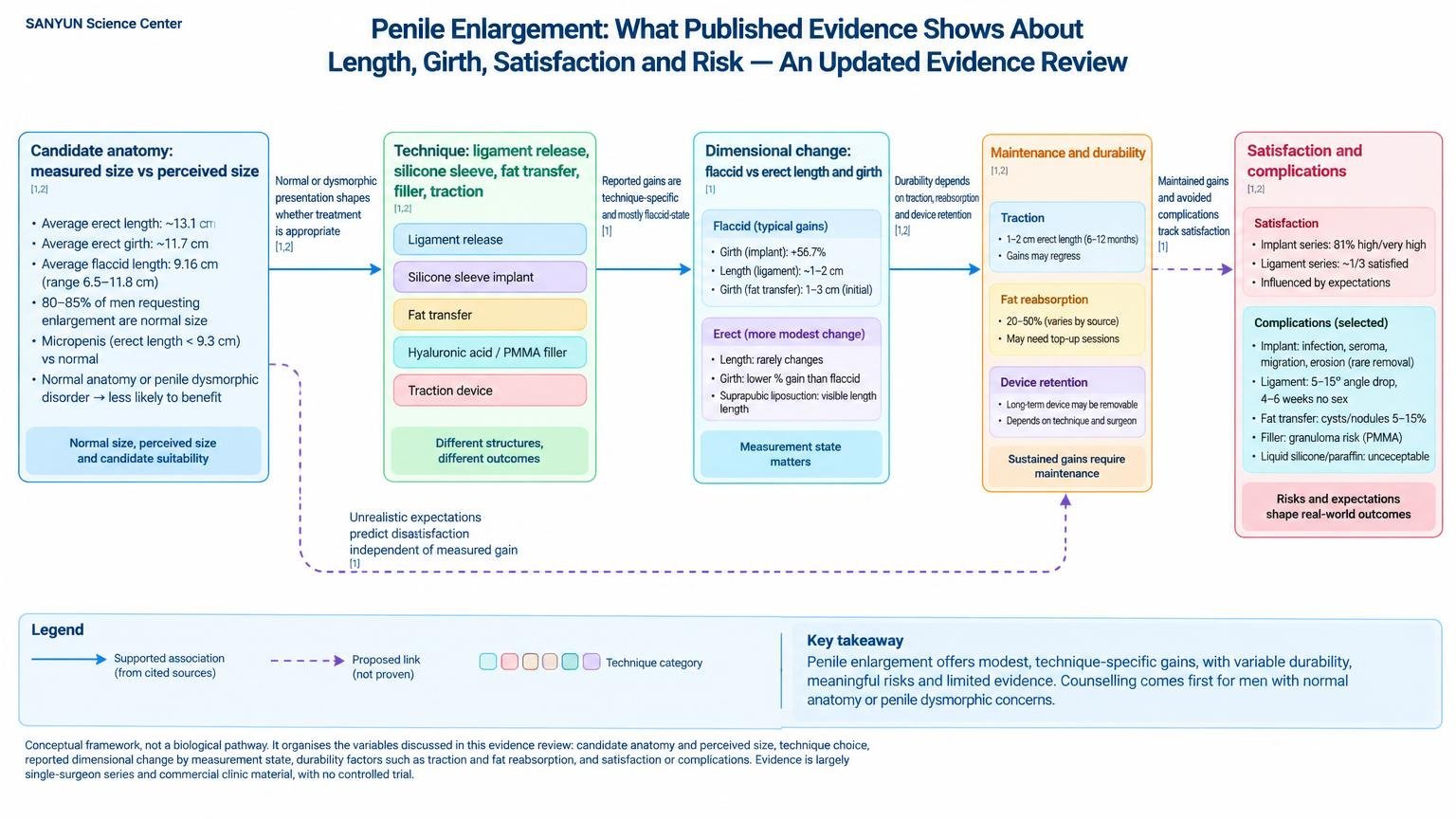
Conceptual framework: Conceptual framework, not a biological pathway. It organises the variables discussed in this evidence review: candidate anatomy and perceived size, technique choice, reported dimensional change by measurement state, durability factors such as traction and fat reabsorption, and satisfaction or complications. Relationships marked as supported reflect associations reported in the cited sources; the links from expectations and from durability to satisfaction are proposed rather than demonstrated. Evidence is largely single-surgeon series and commercial clinic material, with no controlled trial.
Academic References & Evidence
SANYUN Science Center explains published research on men's reproductive and sexual health, connecting scientific evidence with everyday questions while making sources and limitations clear.
Disclaimer: This article is for scientific education and research communication only. It does not provide medical advice, diagnosis, or individualized treatment recommendations, and does not endorse any medication, supplement, device, penile enlargement procedure, or other intervention. Decisions about sexual and reproductive health should be made in consultation with a qualified healthcare professional. Do not delay seeking professional care because of information in this article.
Original Content & Copyright Notice
- This article is prepared for SANYUN Science Center, drawing on published research and publicly available academic literature on men’s sexual and reproductive health. Its editorial explanations and presentation are developed for this platform.
- Copyright in the original editorial content, selection, and arrangement is reserved by SANYUN Science Center to the extent protected by applicable law. Referenced research, quotations, and third-party materials remain subject to the rights of their respective owners. This notice does not claim ownership of scientific facts or third-party research.
- Except where permitted by applicable law or an applicable license, prior written permission is required to reproduce, republish, translate, adapt, redistribute, or commercially reuse protected content. Attribution alone does not grant permission for such reuse.
- For permitted quotation or authorized reuse, clearly identify the source and retain a link to the original article.
- Source: SANYUN Science Center
- Original URL: Retain the original article URL on science.san-yun.com.
- Copyright Holder: SANYUN Science Center, for its own protected editorial content.
- Quotation, excerpts, or authorized reuse must not distort the scientific meaning, omit material limitations or disclaimers, or imply unverified medical claims, product efficacy, or endorsement by SANYUN Science Center.



