




Category: Penile Size
Core Research Direction: Evidence boundaries on penile size: measured norms, what preference and satisfaction studies do and do not establish, and the evidence status of enlargement interventions
Search Intent: What does published research actually show about measured penile size norms, whether size predicts sexual satisfaction, and whether enlargement methods work?
Platform: SANYUN Science Center
Evidence reviewed through: 2026-11-16
Executive Summary
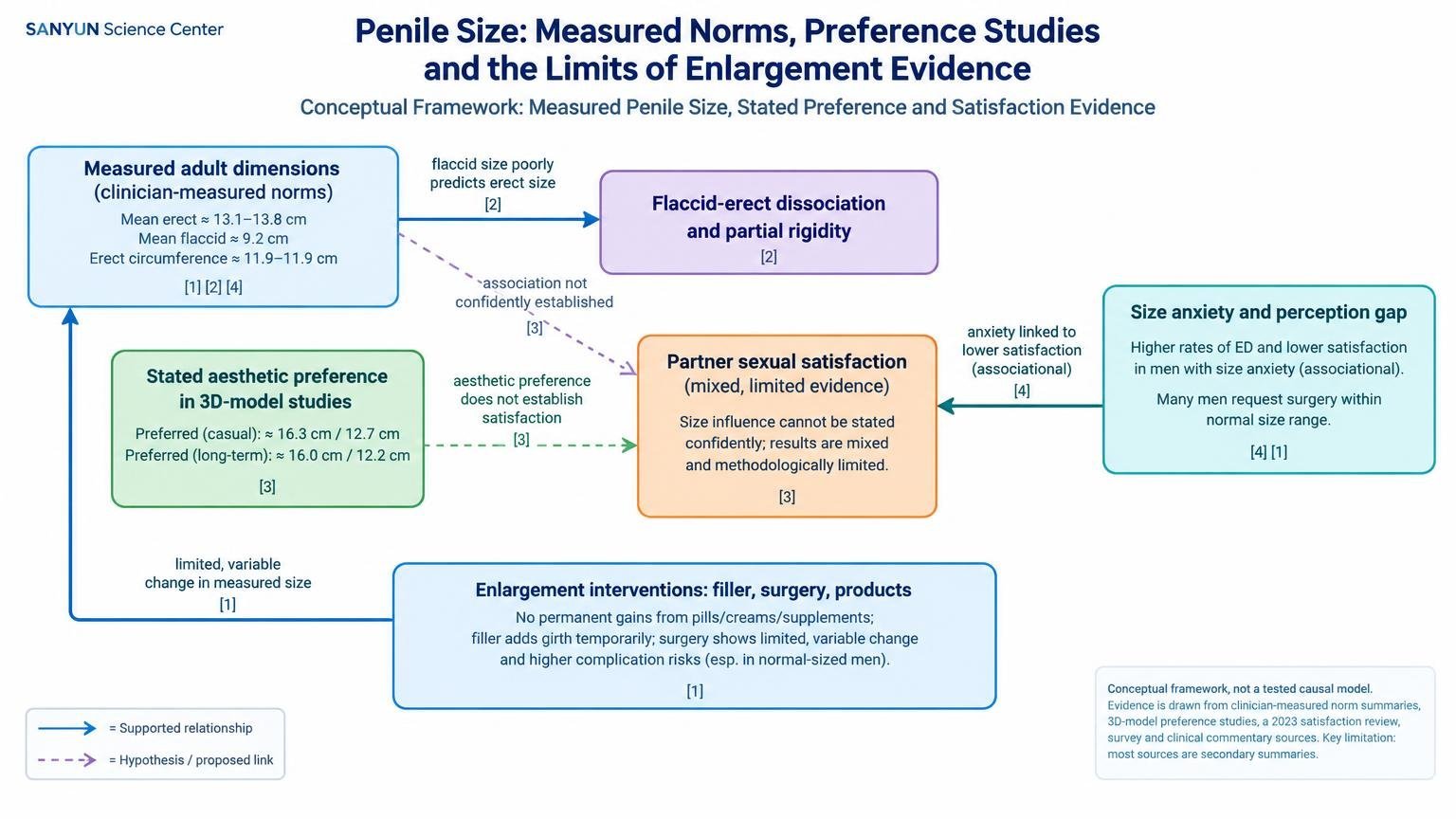
Published clinician-measured data place average adult penile dimensions in a modest range: pooled figures from a systematic review of up to 15,521 men give a mean erect length of roughly 13.1 cm and flaccid length of roughly 9.2 cm, with wide normal limits. A urology commentary citing large clinician-measured studies gives approximate averages of 9 cm flaccid length, 13–14 cm erect length and 11–12 cm erect circumference.[1][2]
Three evidence streams are often conflated. Aesthetic preference experiments using 3D models ask which body looks more attractive. Satisfaction research asks whether size relates to pleasure or relationship outcomes. Intervention research asks whether a procedure produces durable, meaningful change. Each answers a different question, and only the third bears directly on treatment claims.[3]
The 2015 preference study of 75 heterosexual women, using 33 3D erect-penis models, reported stated preferences of about 16.3 cm length and 12.7 cm circumference for casual partners, versus 16.0 cm and 12.2 cm for long-term partners. These are stated ideals from a small sample with visual references, not measurements of what partners experience as satisfying.
A 2026 study using 343 3D male-body figures and more than 800 men and women found that women tended to rate larger-penis figures as more attractive up to a point, that men read larger-penis rivals as more competitive, and that height mattered more than penis size for women's attraction.
A 2023 Journal of Sexual Medicine literature review concluded that it is not possible to state confidently that penis size influences a partner's sexual satisfaction, because results are mixed and methodologically limited: few studies, small samples, self-report bias, and only one study addressing male partners.
On interventions, a clinic guide states that no pill, cream or supplement has evidence of permanent size gains; hyaluronic acid filler adds girth temporarily, typically for about one to two years, without adding length; and a 2020 systematic review concluded that many enlargement procedures in men of normal size carry high complication rates and uncertain satisfaction.
Why This Matters
Size concern is common, but the distribution of measured anatomy and the distribution of worry do not match. A survey of more than 50,000 adults (Lever 2006) found only about half of men were satisfied with their own size, while 85% of women were satisfied with their partner's size. News reporting of similar survey figures gives 85% of women satisfied and 45% of men wishing they were larger.[4]
A certified sex and couples therapist reported that men often believe the true average is much larger, around 16.51–17.78 cm. That belief is a clinical impression from one therapist, not a measured population estimate, but it illustrates a persistent perception gap between assumed and actual norms.
The gap matters clinically because size worry is not merely cosmetic. Men with penile dysmorphic disorder or small penis anxiety are reported to have higher rates of erectile dysfunction and lower intercourse satisfaction than men not overly concerned about size, although the source does not cite a specific underlying study, and the relationship is associative rather than proven causal.
It also matters commercially. Men seeking lengthening surgery frequently measure within the normal range: Mondaini et al. (2002) found most such men were normal-sized, a finding repeated in later work according to a clinic summary. When normal anatomy drives a surgical request, the anatomical premise of the request is already questionable.
Measurement, Definitions and the Normal Range
Comparing size figures across sources requires attention to method. Clinician-performed measurement differs from self-report, and flaccid measurement differs from erect. A review of medical literature reported in news gives clinician-measured means of about 9.22 cm flaccid length and 9.09 cm flaccid circumference, and about 13.84 cm erect length and 11.91 cm erect circumference.
A separate news roundup of 33 medical studies gives mean flaccid length about 3.63 inches (9.2 cm), flaccid circumference 3.58 inches (9.1 cm), erect length about 5.45 inches (13.8 cm) and erect circumference about 4.69 inches (11.9 cm). The centimetre and inch figures converge on the same approximate values, although the pooled sample size and methods are not provided.[5]
Flaccid size is a poor predictor of erect size, which is why locker-room or self-view comparisons carry little information. Partial rigidity can also make a penis appear shorter and narrower than during a full erection, so a perceived size problem may partly reflect erection quality rather than anatomy.
Micropenis is a distinct medical diagnosis, not a synonym for below-average size. It is defined by stretched penile length significantly below the expected range for age and population, generally more than 2.5 standard deviations below the mean, and it is uncommon. Roughly half of all men are below average by definition, which is a statistical fact rather than a pathology.
| Variable | Source-grounded definition | Interpretation |
|---|---|---|
| Mean erect length | About 13.1 cm in a systematic review of clinician measurements from up to 15,521 men; about 13.84 cm in a separate literature summary; about 13–14 cm in a urology commentary | Estimates cluster in the low-to-mid teens of centimetres; ranges differ by pooling method and population |
| Mean flaccid length | About 9.2 cm in the same pooled review; about 9.22 cm in the literature summary; about 9 cm in the commentary | Similar central estimate, but flaccid size varies with temperature and situation and predicts erect size poorly |
| Erect circumference | About 11.91–11.9 cm in news summaries; about 11–12 cm in the commentary | Girth estimates are consistently narrower than length estimates in relative terms |
| Micropenis threshold | Stretched penile length more than about 2.5 standard deviations below the mean for age and population | A diagnostic boundary, not a description of below-average size |
| Stated preferred size, casual partner | About 16.3 cm erect length and 12.7 cm circumference in a 75-woman 3D-model study | Stated aesthetic preference; not a satisfaction threshold or a treatment target |
| Stated preferred size, long-term partner | About 16.0 cm erect length and 12.2 cm circumference in the same study | Slightly smaller than the casual-partner figure; authors framed explanations as hypotheses |
What the Preference Studies Do and Do Not Establish
The 2015 model-based study is often cited as evidence that women prefer larger penises. Its design supports a narrower claim: when 75 heterosexual women chose among 33 3D erect-penis models, their stated choices averaged slightly above measured population means. The sample is small, the stimuli are models rather than partners, and the outcome is preference rather than pleasure, comfort or relationship quality.
The authors proposed comfort and a preference for less masculinity in long-term partners, plus a novelty factor for casual encounters, as possible explanations for the casual-versus-long-term difference. These are hypotheses offered in interpretation, not tested mechanisms, and the small absolute difference between conditions should not be read as a demonstrated partner-type effect.
The 2026 figure study is broader but still an aesthetic-judgment design. Women tended to rate larger-penis figures as more attractive up to a point, men perceived larger-penis rivals as more competitive, and height was more important than penis size for women's attraction. Attractiveness ratings of static figures are not measurements of sexual satisfaction, and the source is a news report with limited methodological detail.
A urology commentary adds a clinical observation that for many partners girth may influence sensation somewhat more than additional length, and that there is no universally ideal penis. This is unreferenced expert commentary rather than primary data, so it is best treated as a plausible clinical impression consistent with the mixed satisfaction literature, not as a quantified finding.
Size and Sexual Satisfaction: A Mixed and Limited Literature
The central satisfaction question is whether measured size predicts partner pleasure or relationship outcomes. The 2023 review concluded that the answer depends on context and that a confident claim of influence cannot be made, because existing results are mixed and methodologically limited. An absence of firm evidence is not proof that size never matters; it means the current literature cannot settle the question.
The methodological problems are specific: few studies, many with small samples, reliance on self-report questionnaires with response bias, and only one study examining male partners. These constraints mean effect estimates that do exist are fragile, and heterogeneity across studies likely reflects differences in how size and satisfaction were defined and measured.
Clinical commentary frames satisfaction as multifactorial, depending on erection quality, sensation, arousal, communication, technique, confidence and relationship factors, with penile length only one variable. That framing is consistent with the review's conclusion and with the observation that treating erectile dysfunction can improve both function and perceived size.
Enlargement Interventions: What Has Evidence and What Does Not
The strongest negative statement concerns oral and topical products: according to a clinic guide, no pill, cream or supplement has evidence of producing permanent size gains. The same guide notes documented harms in this market, including dietary supplements for men found to contain undeclared PDE-5 inhibitor drugs, which can be dangerous for people with heart disease or those using nitrates.
Mechanical approaches split by purpose. Vacuum pumps produce temporary erection and have a role in erectile dysfunction care, but do not produce permanent size increase; excessive pressure risks capillary injury. Traction devices have limited data, with small reported effects requiring many hours of daily use over months, and should be used only under medical guidance according to the clinic guide.
Hyaluronic acid filler temporarily adds girth but not length, with effects typically lasting about one to two years before natural resorption. It is dissolvable if results are unsatisfactory, but carries risks of irregular nodules, filler migration and inflammation. These are stated limitations from a commercial clinic summary rather than comparative trial estimates.
Surgery is the only approach that produces a durable anatomical change, and even that is limited. Published research reports that ligamentolysis increases visible flaccid length by about 1–2 cm on average, with wide individual variation and some men showing almost no change. Fat grafting for girth has unpredictable fat resorption. A 2020 systematic review by Marra et al. concluded that among men of normal size, many enlargement procedures carry high complication rates and uncertain satisfaction.
The most dangerous category is injection of non-medical substances such as liquid silicone or oils by unqualified practitioners, associated with chronic inflammatory masses, tissue necrosis, permanent deformity and major corrective surgery. Any such product or technique claiming guaranteed centimetres or permanent results should be treated as a warning sign rather than a selling point.
Apparent Size, Perceived Size and Confounders
Some size complaints reflect visibility rather than anatomy. Weight reduction can increase visible penile length by reducing tissue concealment without changing anatomical length, and in men with much abdominal fat, fat loss makes more of the penis visible as a visibility effect rather than a size increase. A buried penis and post-surgical or fibrotic changes are separate clinical entities requiring assessment.
Perception is also shaped by viewpoint and comparison. A top-down self-view compresses apparent length, flaccid size varies with temperature and stress, and adult media depict a selected group with favorable angles. These are explanations for systematic misjudgment, not evidence that size is irrelevant to all partners, and they do not substitute for a clinical measurement when a genuine concern exists.
Interpretation and Limitations
This review interprets secondary and tertiary sources: a science news article, two news roundups, a urology clinic commentary and a commercial clinic education guide. None of the underlying primary studies was independently appraised here, and no pooled analysis was performed. Where a source summarizes a named study such as Veale 2015, Mondaini 2002, Marra 2020 or Lever 2006, the figure is reported as summarized rather than re-derived.
Several statements are association or mechanism claims rather than trial results. The link between size anxiety and erectile dysfunction is reported without a specific cited study. The visibility effect of fat loss is mechanistic. The claim that girth matters more than length for sensation is unreferenced expert opinion. The 2026 figure study is known here only through news reporting, so its design details and analysis cannot be verified from the packet.
Statistical and clinical meaning should not be merged. A preference difference of a few millimetres between casual and long-term conditions in a 75-woman study may be statistically detectable yet clinically trivial, and the source does not report effect sizes or uncertainty. Similarly, an average gain of 1–2 cm in visible flaccid length after ligamentolysis does not establish improved satisfaction, and wide individual variation means some men gain little or nothing.
Research Outlook
The most useful next steps are methodological rather than promotional. Satisfaction research needs larger samples, validated and consistent measures of size and satisfaction, inclusion of male partners, and designs that separate aesthetic judgment from lived sexual experience. The 2023 review's finding of only one male-partner study is a clear gap.
Intervention research needs transparent reporting of complication rates, satisfaction outcomes and denominators, particularly in men of normal size, where the 2020 systematic review found high complication rates and uncertain satisfaction. Until such data exist, clinicians are left comparing small, heterogeneous surgical series against a strong placebo and perception effect.
On the perception side, the repeated finding that most men requesting lengthening measure within normal limits suggests that measurement plus counseling may be a more appropriate first step than any procedure. Whether accurate measurement durably reduces anxiety is a plausible but untested proposition in this packet.
Key Takeaways
- Average adult erect length is roughly 13–14 cm and erect circumference roughly 11–12 cm across clinician-measured summaries, with wide normal variation and flaccid size a poor predictor of erect size.
- 3D-model preference studies describe stated aesthetic ideals in small or news-reported samples; they do not measure sexual satisfaction or establish a treatment target.
- A 2023 review found the size-satisfaction literature mixed and limited, with few studies, small samples and self-report bias, and no confident conclusion possible.
- No pill, cream or supplement has evidence of permanent gains; filler adds temporary girth only, and surgery produces limited, variable changes with real risks and uncertain satisfaction.
- Most men seeking lengthening measure within the normal range, and size anxiety is associated with worse erectile function and satisfaction, so assessment and counseling deserve priority over procedures.
Questions and Answers
What is the average erect penile length according to clinician-measured studies?
Pooled clinician measurements from up to 15,521 men give a mean erect length of about 13.1 cm, and other summaries report roughly 13.8 cm or a 13–14 cm range. Normal variation is wide, so an individual measurement below these averages is usually still within the normal range, and flaccid size predicts erect size poorly.
Do 3D-model studies prove that women prefer larger penises?
No. The 2015 study of 75 women using 33 3D models and the 2026 study of 343 figures with more than 800 participants describe stated aesthetic preferences. The 2015 preferences averaged about 16.3 cm length and 12.7 cm circumference for casual partners and 16.0 cm and 12.2 cm for long-term partners, but these are model-based ideals, not satisfaction outcomes.
Does penis size affect a partner's sexual satisfaction?
A 2023 Journal of Sexual Medicine review concluded it is not possible to state confidently that penis size influences a partner's sexual satisfaction. Existing studies are few, often small, rely on self-report questionnaires with response bias, and only one addressed male partners. Mixed results mean the evidence is incomplete rather than proof that size never matters.
Do pills, creams or supplements increase penis size permanently?
According to a clinic guide, no pill, cream or supplement has evidence of producing permanent size gains. Some men's supplements have been found to contain undeclared PDE-5 inhibitor drugs, which can be dangerous for people with heart disease or those using nitrates. Products promising guaranteed centimetres should be treated as a warning sign.
What results and risks do filler and surgery for penile enlargement have?
Hyaluronic acid filler adds girth temporarily but not length, typically lasting about one to two years, with risks of nodules, migration and inflammation. Ligamentolysis reports average visible flaccid gains of about 1–2 cm with wide variation and some men gaining almost nothing. A 2020 systematic review found high complication rates and uncertain satisfaction in normal-sized men.
Why do many men worry about size when their measurements are normal?
Perception gaps are common: a survey of more than 50,000 adults found only about half of men were satisfied with their size versus 85% of women satisfied with their partner's, and men requesting lengthening often measure within normal limits. Self-view angle, flaccid variability, adult media and assumed averages around 16.5–17.8 cm distort appraisal.
Conceptual framework: Conceptual framework, not a tested causal model. Evidence is drawn from clinician-measured norm summaries, 3D-model preference studies, a 2023 satisfaction review, survey and clinical commentary sources. Supported edges reflect reported associations or measured relationships as worded; the dashed conceptual link between stated preference and satisfaction is proposed, not demonstrated. Key limitation: most sources are secondary summaries.
Academic References & Evidence
- เพิ่มขนาดน้องชาย: ขนาดปกติ อะไรได้ผลจริง ความเสี่ยง. 2026
- Does Size Matter?. 2026
- Victor Bianchin. Tamanho é documento? Entenda o que a ciência diz sobre as medidas do pênis. Revista Galileu
- 男性生殖器多長才正常?研究揭平均尺寸 45%男人想再大一點 | 世界新聞網. World Journal
- 男人都在誇大尺寸?研究揭GG平均長度「只有13.8公分」 45%嫌它不夠大→恐釀勃起障礙. Mirror Daily
SANYUN Science Center explains published research on men's reproductive and sexual health, connecting scientific evidence with everyday questions while making sources and limitations clear.
Disclaimer: This article is for scientific education and research communication only. It does not provide medical advice, diagnosis, or individualized treatment recommendations, and does not endorse any medication, supplement, device, penile enlargement procedure, or other intervention. Decisions about sexual and reproductive health should be made in consultation with a qualified healthcare professional. Do not delay seeking professional care because of information in this article.
Original Content & Copyright Notice
- This article is prepared for SANYUN Science Center, drawing on published research and publicly available academic literature on men’s sexual and reproductive health. Its editorial explanations and presentation are developed for this platform.
- Copyright in the original editorial content, selection, and arrangement is reserved by SANYUN Science Center to the extent protected by applicable law. Referenced research, quotations, and third-party materials remain subject to the rights of their respective owners. This notice does not claim ownership of scientific facts or third-party research.
- Except where permitted by applicable law or an applicable license, prior written permission is required to reproduce, republish, translate, adapt, redistribute, or commercially reuse protected content. Attribution alone does not grant permission for such reuse.
- For permitted quotation or authorized reuse, clearly identify the source and retain a link to the original article.
- Source: SANYUN Science Center
- Original URL: Retain the original article URL on science.san-yun.com.
- Copyright Holder: SANYUN Science Center, for its own protected editorial content.
- Quotation, excerpts, or authorized reuse must not distort the scientific meaning, omit material limitations or disclaimers, or imply unverified medical claims, product efficacy, or endorsement by SANYUN Science Center.



