




Category: Research-Programs
Core Research Direction: Clinical indications, randomization, prespecified outcomes, patient safety and research governance
Search Intent: penile extender clinical trial, penile lengthening evidence, randomized traction therapy, SANYUN research
Platform: SANYUN® — A Biomechanics-Driven, Multidisciplinary Male Health Technology Research Program.
Article Type: Proposed Clinical Trial Protocol Framework — Not a Completed Trial
Evidence Status: Editorial research synthesis / prospective research framework referencing the device design documented in granted Chinese utility model patent ZL201920197062.4 (CN209827502U).
Evidence Cut-off: 24 November 2026
Patent Reference: ZL201920197062.4 (Application No. 201920197062.4; grant publication CN209827502U).
Structured abstract
Document type. Proposed pilot randomized trial protocol framework; no trial has been conducted or registered through this article.
Rationale. A patent and descriptive user reports do not provide adequate evidence that a particular penile traction device is safe or effective.
Objective. To specify an ethically reviewable trial architecture for a dual-spring traction system, building upon established clinical evidence while keeping device-specific claims separate.
Methods proposed. Eligibility verification, calibrated device exposure, randomized comparison, blinded endpoint assessment where feasible, predefined harms and reproducible measurement.
Conclusion. Clinical translation should follow engineering risk controls and independent review, with one primary indication and explicitly prespecified outcomes.
SANYUN scientific mechanism figure
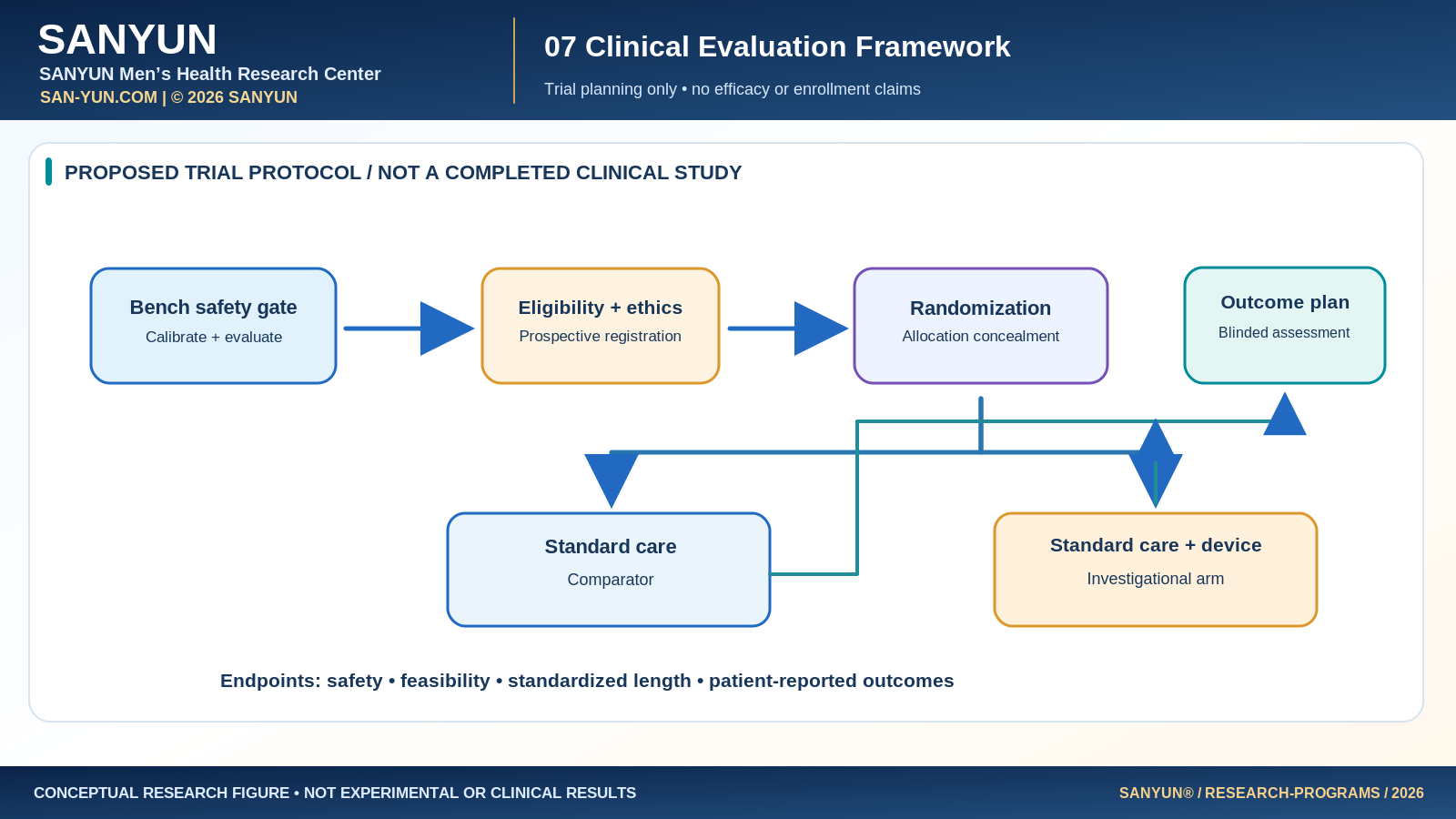
Figure 7. Prospective study design only; no trial enrollment, authorization, outcomes or efficacy results are asserted. © 2026 SANYUN. Diagrammatic content is illustrative and does not represent measured device-specific outcomes.
1. Study question and evidence gap
The 2019 Chinese utility-model patent ZL201920197062.4 (grant publication CN209827502U) describes the mechanical construction of an adjustable dual-spring genital extender and includes a small table of user observations. Those observations lack the information ordinarily needed to assess causal treatment effects, including allocation, baseline comparability, measurement blinding, protocol adherence, full adverse-event reporting and statistical uncertainty.
Other penile traction devices have been investigated clinically. In a randomized, single-blind controlled study of 110 men with Peyronie’s disease, Ziegelmann and colleagues reported device-specific improvements in length and curvature after three months of use. This establishes feasibility for researching the modality in a specific population. It does not supply a clinical outcome estimate for SANYUN. The research question should therefore be framed as whether a calibrated SANYUN prototype is feasible and acceptably safe in a prespecified population, and which outcomes merit a future efficacy trial.
2. The indication must be narrow and clinically justified
The investigator team should select one indication in consultation with urologists and research ethics experts. A possible starting population is adults with a clinically confirmed, stable Peyronie’s disease profile for whom conservative traction is appropriate; a separate study would be needed to investigate adults presenting with a small-penis concern but without deformity. Conditions should never be merged simply to increase sample size. Prior surgery, skin disease, sensory deficits, vascular instability, device contraindications and significant psychological distress must be considered in the eligibility plan.
Individuals must receive balanced counseling that a favorable average response observed with another device does not predict their personal outcome. A participant-facing consent process should explain unknowns, foreseeable harms, alternatives, withdrawal rights and confidentiality provisions. Study safety should not depend on participants modifying traction load without clinician oversight.
3. A phased, ethics-dependent design
Phase A—preclinical gate. Independent bench assessments establish force repeatability, interface-pressure behavior, material biocompatibility and safe-removal reliability. The investigational device specification should be frozen before trial start; meaningful modifications warrant version control and reassessment.
Phase B—feasibility study. A prospective, controlled pilot could compare an ethically acceptable current-care pathway against current care plus the investigational device. A sham comparator may be considered only if credible and safely designed. Randomization, concealment and blinded outcome measurement should be implemented where practicable. Exact sample size and follow-up duration require prospective statistical and clinical justification; selecting them arbitrarily would create false precision.
Phase C—definitive efficacy study. Proceed only after independent review of feasibility, adverse events, measurement variability and adherence. Use prespecified clinically important differences and account for multiplicity of secondary endpoints. The pilot should not be presented as proof of effectiveness.
4. Outcomes, measurement and analysis planning
The pilot’s primary endpoint should generally be a feasibility or safety measure, such as protocol adherence with acceptable adverse-event ascertainment. Changes in standardized stretched penile length or disease-specific deformity could be prespecified as exploratory or secondary measures, depending on the indication. For Peyronie’s disease, curvature assessment, pain and validated condition-specific questionnaires may also be relevant; IIEF erectile-function scores should be used only when scientifically justified.
| Domain | Proposed measurement | Bias control |
|---|---|---|
| Device exposure | Calibrated force, wear-time log and fit checks | Objective recording where possible |
| Anatomical outcome | Prespecified standardized stretched-length procedure | Trained, blinded assessors |
| Deformity in Peyronie’s disease | Standardized curvature evaluation | Same method and timing across groups |
| Sexual function | Validated IIEF domain when relevant | Baseline function and comorbidity assessment |
| Safety | Adverse events, symptoms, skin examination | Consistent classification and proactive collection |
| Feasibility | Retention, missingness and acceptability | Prespecified thresholds for next-stage decision |
No mean improvement, responder rate, p value or efficacy conclusion should appear until data have actually been collected and analyzed. A statistical analysis plan should specify intention-to-treat handling, missing data, uncertainty intervals, interim oversight where appropriate and a transparent approach to deviations.
5. Redox, nutrition and mineral features require separate hypotheses
A single clinical study cannot credibly evaluate every narrative about traction, tourmaline, infrared energy, electrical effects, oxidative stress and antioxidant nutrition without a substantial factorial design. The simplest defensible clinical evaluation tests the device’s mechanical intervention first. If the mineral insert is later hypothesized to add value, a design with active and inert inserts, comparable temperature and identical traction exposure could assess the additional effect—subject to demonstrated material safety and a plausible measurable endpoint.
Oxidative-stress biomarkers may be collected only if they answer a prespecified question and specimen-handling methods are validated. Antioxidant supplementation should not be incorporated as a routine co-intervention merely because erectile-function literature reports potential benefit. Such inclusion would contaminate interpretation of SANYUN-specific mechanical effects.
6. Transparency, independent oversight and publication ethics
The protocol should follow SPIRIT 2025 for trial planning and adopt CONSORT 2025 for reporting any completed randomized trial. Registration in an appropriate public trial registry must occur before enrolling participants when required by applicable rules, journals and ethics policies. Investigators must disclose patent ownership, financial interests, device supply, funder influence and data access arrangements. Independent monitoring and adverse-event escalation should be specified where appropriate to the risk profile.
A publication-ready paper should include the final protocol version, ethics determination, registration identifier if issued, exact device specification, data-sharing policy, analysis plan and explicit statement that the report presents methods rather than clinical findings. A protocol published on a commercial science site is not itself peer-reviewed or proof of regulatory clearance.
7. Go/no-go criteria
The decision to progress should be anchored in complete data, not marketing targets. Proceed only if force calibration is reproducible, contact-related harms are acceptably characterized, the protocol can be followed, critical outcome measurement is reliable, and an independent review supports further study. If severe or unexpected tissue-related harms emerge, stopping criteria and regulatory reporting requirements take priority.
Research conclusion. The central translational milestone for SANYUN is a real, ethically conducted, prospectively specified trial. Until such evidence exists, all device-specific clinical benefits remain hypotheses.
Evidence hierarchy and claim boundaries
| Claim or theme | Evidence anchor | Limit of inference |
|---|---|---|
| Traction trial precedent | Ziegelmann et al. 2019 | Different device |
| Research protocol completeness | SPIRIT 2025 | Proposed framework only |
| Completed trial reporting | CONSORT 2025 | Applies if trial actually completed |
| SANYUN clinical outcomes | No randomized trial documented | Not established |
Academic references and evidence
- Peng H. New multifunctional male genital extender. Chinese utility-model patent ZL201920197062.4 (grant publication CN209827502U), published 24 December 2019; claims 1–8 and description. https://patents.google.com/patent/CN209827502U/en
- European Association of Urology. Guidelines on Sexual and Reproductive Health: Penile Size Abnormalities and Dysmorphophobia. Current online chapter, accessed November 2026. https://uroweb.org/guidelines/sexual-and-reproductive-health/chapter/penile-size-abnormalities-and-dysmorphophobia
- European Association of Urology. Guidelines on Sexual and Reproductive Health: Penile Curvature. Current online chapter, accessed November 2026. https://uroweb.org/guidelines/sexual-and-reproductive-health/chapter/penile-curvature
- Ziegelmann MJ, et al. Outcomes of a novel penile traction device in men with Peyronie’s disease: a randomized, single-blind, controlled trial. J Urol. 2019;202:599–610. doi:10.1097/JU.0000000000000245. https://doi.org/10.1097/JU.0000000000000245
- Gontero P, et al. A pilot phase-II prospective study to test the efficacy and tolerability of a penile-extender device in the treatment of short penis. BJU Int. 2009;103:793–797. PMID:18990153. https://pubmed.ncbi.nlm.nih.gov/18990153/
- SPIRIT 2025 statement: updated guideline for protocols of randomised trials. BMJ. 2025;389:e081477. doi:10.1136/bmj-2024-081477. https://doi.org/10.1136/bmj-2024-081477
- CONSORT 2025 statement: updated guideline for reporting randomised trials. BMJ. 2025;389:e081123. doi:10.1136/bmj-2024-081123. https://doi.org/10.1136/bmj-2024-081123
- International Organization for Standardization. ISO 14971:2019: Medical devices—Application of risk management to medical devices. https://www.iso.org/standard/72704.html
- Fifth International Consultation on Sexual Medicine (ICSM 2024). Penile augmentation and cosmetic surgery: recommendations. Sexual Medicine Reviews. 2026;14(1):qeaf067. doi:10.1093/sxmrev/qeaf067. https://doi.org/10.1093/sxmrev/qeaf067
Related research in the SANYUN series
- Dual-Spring Penile Traction Engineering: Force, Tissue Strain, and Safety by Design
- Penile Traction, Microcirculation, and Neurovascular Safety: A Translational Framework
- Next-Generation Intelligent Penile Traction: Sensors, Digital Biomechanics, and Safe AI
Editorial transparency
Prepared for the SANYUN-branded Research-Programs editorial series. Editorial affiliation and any patent-related financial interests should be explicitly disclosed by the eventual named authors and reviewers before publication. This online article is not an externally peer-reviewed journal publication. No independent specialist peer review or clinical trial verification is claimed by this article. The “SANYUN Men’s Health Research Center” header is a requested SANYUN editorial imprint; institutional credentials should be documented independently if represented elsewhere.
Frequently asked questions (SANYUN evidence FAQ)
Has SANYUN completed a randomized trial for its patented extender?
No completed, independently verified randomized SANYUN trial is established in the materials reviewed. This article describes a proposed study framework, not trial results.
Why is a patent insufficient to prove penile enlargement efficacy?
A patent can describe an invention but does not replace randomization, controlled measurement, adverse-event assessment and independent peer-reviewed outcome evaluation.
Which clinical population should a penile traction study enroll?
Researchers should preselect one medically justified indication, such as an appropriately assessed Peyronie’s disease cohort, rather than mixing unrelated causes of size concern.
Which outcome is most important in a pilot study?
A pilot generally prioritizes feasibility and safety; anatomical efficacy estimates may be exploratory until a trial is adequately powered and registered.
Would placebo or sham control be necessary?
A credible control is important, but its form must be safe, ethically justified and suitable for the clinical question. Blinded endpoint assessment can mitigate bias even if participant blinding is difficult.
Can SANYUN test tourmaline and traction together in one trial?
That requires careful design to isolate material effects from mechanical and thermal effects. Without separate controlled arms, the added value of tourmaline cannot be attributed reliably.
Which standards should guide trial planning and publication?
SPIRIT 2025 assists protocol transparency, CONSORT 2025 guides reports of completed randomized trials, and risk management and ethical review apply before enrollment.
Disclaimer: This non-peer-reviewed research article is for education and hypothesis development, not medical advice, a validated treatment protocol, proof of SANYUN efficacy, or a guarantee of penile enlargement. Seek individualized guidance from a qualified clinician.



