




Category: Premature Ejaculation
Core Research Direction: Comparative efficacy of physiotherapy versus dapoxetine for prolonging intravaginal ejaculatory latency time in men with premature ejaculation, and couple-oriented cognitive-behavioral treatment approaches
Search Intent: How does physiotherapy compare with dapoxetine for prolonging intravaginal ejaculatory latency time in men with premature ejaculation, and what does couple-oriented cognitive-behavioral therapy add?
Platform: SANYUN Science Center
Evidence reviewed through: 2026-11-23
Executive Summary
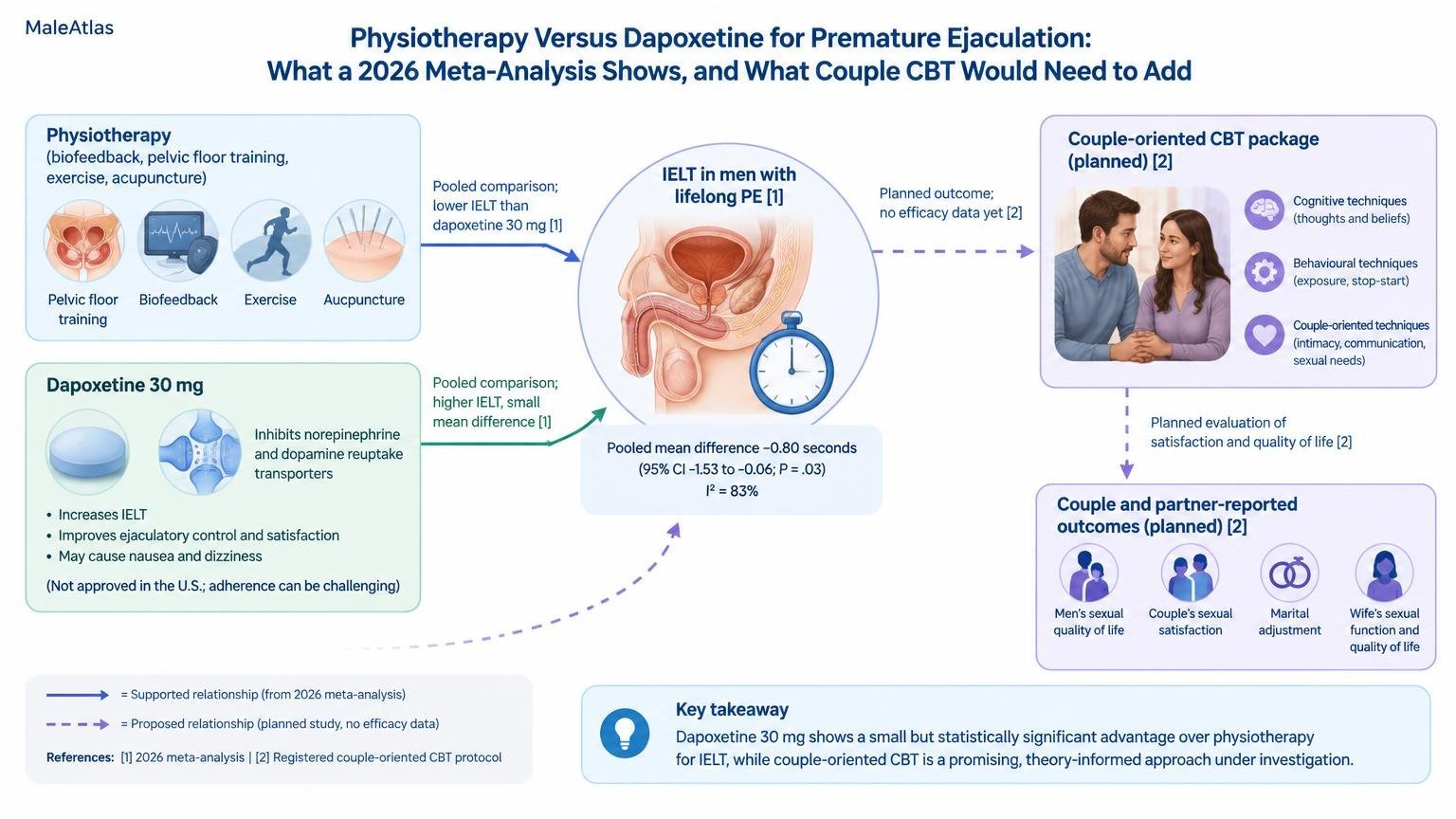
A systematic review and meta-analysis published in the Journal of Sexual Medicine in May 2026 asked whether physiotherapeutic interventions can increase intravaginal ejaculatory latency time (IELT) as effectively as pharmacological treatment in men diagnosed with premature ejaculation (PE). The review identified six clinical trials with a total of 416 participants and pooled the comparison between physiotherapy and dapoxetine 30 mg. The pooled mean difference in IELT was −0.80 seconds (95% confidence interval −1.53 to −0.06; P = .03), a statistically significant result favouring dapoxetine, with high between-study heterogeneity (I2 = 83%). The authors concluded that dapoxetine 30 mg is significantly more effective than physiotherapy for prolonging IELT in men with lifelong PE, while describing physiotherapy as a safe and promising alternative for men who cannot tolerate medication.[1]
The same review cautioned that the scarcity and heterogeneity of the included trials limit definitive conclusions. The point estimate of −0.80 seconds also needs careful reading: it is a pooled average difference, not a claimed average prolongation of 0.8 seconds for every man, and the confidence interval nearly touches zero. The review's qualitative synthesis separately suggested that a combined therapeutic approach yielded the most significant IELT improvements, but this observation was not meta-analysed. No head-to-head outcome data are yet available for couple-oriented cognitive-behavioural treatment (CBT); a registered Iranian protocol plans to test such a package, with recruitment not yet started as of its October 2026 registration.[2]
Why This Matters
Ejaculatory disorders are common and carry a substantial impact on men's quality of life and relationships, according to a consensus review prepared under the Fifth International Consultation on Sexual Medicine. That review states that it aims to present evidence-based recommendations on definition, classification and treatment of premature and delayed ejaculation. The comparison between a low-risk physical intervention and a short-acting drug matters because the two options differ in tolerability, cost, accessibility and the way they fit into a couple's sexual life, not only in how many seconds they add to intercourse.[3]
From a clinical standpoint, the relevant question is not simply which arm produces a higher group mean IELT. It is whether a man and his partner experience more control, less distress and a sexual relationship they can sustain. The 2026 meta-analysis addresses latency only. The planned couple-oriented protocol is designed to evaluate a wider set of outcomes, including men's sexual quality of life, couples' sexual satisfaction and marital adjustment, and wives' sexual function and quality of life. Those outcomes remain unevaluated because the study has not begun recruiting.
Definitions and Measurement: IELT, Lifelong and Acquired PE
IELT is defined as the time elapsed from vaginal intromission to intravaginal ejaculation, and it is used both to diagnose PE and to measure clinical response to treatment. The review describes the International Society for Sexual Medicine classification, which distinguishes lifelong PE (IELT less than 1 minute) from acquired PE (IELT of 3 minutes), with both forms sharing reduced latency, lack of control and/or a subjective perception that ejaculation occurs too soon. These thresholds are diagnostic categories, not targets for individual couples, and the review notes that PE commonly appears between ages 25 and 55 while not being limited to that range.
The review's statement that approximately 75% of men will experience PE at some point in their lives should be treated cautiously. It is presented without methodological detail in the available text, differs from many narrower prevalence estimates in the field, and cannot be independently verified from the excerpt supplied. Readers should not treat it as a settled epidemiological figure.
How Physiotherapy and Dapoxetine Are Proposed to Work
Dapoxetine is a short-acting selective serotonin reuptake inhibitor developed for PE and widely approved in Europe but not in the United States, according to the review. The review describes its action in terms of inhibition of norepinephrine and dopamine reuptake transporters, and reports that SSRIs can increase IELT, improve perceived ejaculatory control and sexual satisfaction, and reduce distress. The same review states that long-term adherence is a major challenge, with cited discontinuation rates of 70.6% to 89.6% after the first year of treatment and adverse effects such as nausea and dizziness. Those discontinuation figures are drawn from other sources within the review rather than from a pooled analysis, so they should be read as contextual rather than as a trial-level estimate.
Physiotherapy in the included trials was not one intervention. It comprised biofeedback, pelvic floor muscle strengthening, physical exercise and acupuncture across different studies. The review's rationale is that pelvic floor muscle weakness and/or hypertonicity may contribute to ejaculatory disorder, and that strengthening or retraining these muscles could increase IELT without drug side effects. Because the modalities, session schedules and delivery formats varied, the pooled comparison should be understood as physiotherapy as a heterogeneous category rather than a single standardised treatment.
The planned couple-oriented CBT package is described differently again. Its protocol combines cognitive techniques for correcting dysfunctional sexual thoughts and beliefs, behavioural techniques including exposure exercises and stop-start, and couple-oriented techniques aimed at increasing intimacy, communication skills and attention to women's sexual needs. This is a psychological and relational intervention, not a pelvic floor programme, and its proposed mechanisms have not yet been tested in the registered trial.
| Comparison | What was studied | Reported result | Key limitation |
|---|---|---|---|
| Physiotherapy versus dapoxetine 30 mg on IELT | Six clinical trials with 416 men with PE; physiotherapy modalities included biofeedback, pelvic floor muscle strengthening, physical exercise and acupuncture | Pooled mean difference −0.80 seconds (95% CI −1.53 to −0.06; P = .03), favouring dapoxetine; I2 = 83% | High heterogeneity, small number of trials, and a confidence interval close to zero |
| SSRI tolerability context | SSRI-treated men, as summarised in the review | Cited discontinuation of 70.6% to 89.6% after the first year; nausea and dizziness reported | Figures cited from other sources, not a pooled estimate; adherence context only |
| Combined therapeutic approach | Qualitative synthesis across the included trials | Suggested to yield the most significant IELT improvements | Qualitative observation, not meta-analysed; no pooled effect estimate |
| Couple-oriented CBT package | Planned single-case multiple-baseline study of 4 couples plus 1 pilot, 10-week intervention with 1.5-month follow-up | No efficacy results yet; recruitment not yet started at registration | Very small sample, no classic control group, no full blinding, self-reported IELT |
What the Evidence Shows: The Meta-Analysis
The review searched PubMed, PEDro, Scopus and Researchgate for clinical trials published within the prior 10 years. Six studies met the inclusion criteria and were analysed, encompassing 416 participants. The authors pooled IELT results for physiotherapy versus dapoxetine 30 mg using a random-effects model. The pooled effect was statistically significant (Z = 2.12; P = .03), with a mean difference in IELT of −0.80 seconds (95% CI −1.53 to −0.06) favouring dapoxetine, and heterogeneity was high (I2 = 83%).
Individual trial results help explain both the direction and the variability. In one trial, dapoxetine 30 mg was associated with IELT rising from a baseline average of 37.2 seconds to 168.2 ± 36.6 seconds at 6 weeks, and dapoxetine 60 mg with a rise to 193.2 ± 43.8 seconds; after 12 weeks, 62.5% of patients in the 30 mg subgroup and 72% in the 60 mg subgroup had an increase greater than 180 seconds. In another trial, at 4 weeks, IELT rose to 127.52 seconds (SD ± 3.9) with dapoxetine 60 mg, 103.21 seconds (SD ± 3.20) with dapoxetine 30 mg and 87.21 seconds (SD ± 15.78) with acupuncture, while the sham acupuncture group did not exceed 63.43 seconds (SD ± 17.74). In a further trial, moderate physical activity was associated with IELT rising from 39.3 seconds (SD ± 8.8) to 188.6 seconds (SD ± 82.9), while dapoxetine rose from 36.8 seconds (SD ± 13.1) to 181.7 seconds (SD ± 88.8). These are single-trial observations with wide variability, not pooled estimates, and they illustrate why an average difference of less than one second across heterogeneous trials is difficult to translate into a clinical recommendation.
The review authors concluded that dapoxetine 30 mg is significantly more effective than physiotherapy for prolonging IELT in men with lifelong PE. They also wrote that physiotherapy can be considered a safe and beneficial intervention, positioning it as a promising alternative for patients intolerant to pharmacological treatment, and that the qualitative review suggested a combined therapeutic approach yields the most significant improvements in IELT. The phrase "qualitative review suggests" is important: it is not a pooled finding, and it does not establish that combining treatments is superior in a controlled comparison.
What the Evidence Does Not Yet Show: Couple-Oriented CBT
The couple-oriented CBT protocol registered in Iran is a four-phase project, of which the efficacy phase uses a single-case multiple-baseline design with no classical control group. The planned sample is 4 couples plus 1 pilot, with each couple serving as their own control, no randomisation of treatment, a 10-week intervention and a 1.5-month follow-up. The primary outcome measures include PE symptom severity by the Premature Ejaculation Diagnostic Tool and IELT measured by couples' self-report, alongside men's sexual quality of life, couples' sexual satisfaction, marital adjustment, and wives' sexual function and quality of life.
As registered on 2026-10-16, recruitment had not yet started, with an expected recruitment start of 2027-02-20. No efficacy data therefore exist for this package. The protocol itself acknowledges that full blinding of participants and therapists is not feasible for a psychological intervention of this kind. Even if the trial is completed as planned, a single-case design with four couples cannot establish generalisable efficacy, and self-reported IELT is subject to recall bias compared with stopwatch measurement. The appropriate current statement is that couple-oriented CBT is a plausible, theory-informed approach under investigation, not an evidence-based treatment with demonstrated effects on IELT.
Interpretation and Limitations
Several features of the meta-analysis constrain its interpretation. The pooled mean difference of −0.80 seconds is statistically significant but very small in absolute terms, and its confidence interval extends to −0.06 seconds, close to no difference. Heterogeneity was high at I2 = 83%, meaning the trials did not agree closely on the size or even the direction of the physiotherapy effect. The review itself notes that the scarcity and heterogeneity of trials comparing physiotherapy with drugs make definitive conclusions difficult. The included studies were few, their sample sizes ranged widely, their physiotherapy modalities differed substantially, and blinding of participants, therapists and assessors was largely absent, which is common in trials of physical interventions.
A methodological inconsistency deserves mention. The review methods describe calculation of mean differences or standardised mean differences, yet the pooled result is reported both as a mean difference and, in the discussion, as a pooled standardised mean difference of −0.80 (95% CI −1.53 to −0.06). A standardised effect size of that magnitude would be considered large by conventional criteria, but it cannot be equated with a one-second change on the IELT scale. Readers should not convert the pooled figure into an expected seconds gain without the original trial-level data. This is a reporting ambiguity in the review, not a finding about treatment effect.
The consensus review from the Fifth International Consultation on Sexual Medicine is available in the supplied material only as an abstract, so its detailed recommendations on dapoxetine, psychotherapy and combination treatment cannot be evaluated here. It is cited for its scope and its general statement that ejaculatory disorders are common and burdensome, not for specific clinical guidance. Similarly, the wider literature on couple involvement is not quantified in the available sources, and no controlled trial of partner-involved CBT with IELT outcomes has been reported in this packet.
Research Outlook
The most informative next step would be adequately powered randomised trials that compare dapoxetine, structured physiotherapy and a combined programme, with stopwatch-measured IELT and validated partner-reported outcomes. The planned Iranian study will not answer that question because of its design and sample size, but it may generate hypotheses about which couple-level processes, such as communication, intimacy and attention to a partner's needs, are worth measuring in a larger trial. Until such data exist, the meta-analysis supports a narrow conclusion: in the trials reviewed, dapoxetine 30 mg produced a statistically greater pooled IELT than heterogeneous physiotherapy, and physiotherapy remains a reasonable option to discuss where medication is ineffective, poorly tolerated or unavailable.
Key Takeaways
- A 2026 systematic review and meta-analysis of six trials with 416 men found a statistically significant pooled IELT difference of −0.80 seconds (95% CI −1.53 to −0.06) favouring dapoxetine 30 mg over physiotherapy in men with lifelong PE.
- Heterogeneity was high (I2 = 83%), the number of trials was small, and the authors cautioned that scarcity and heterogeneity limit definitive conclusions.
- Physiotherapy in the included trials was a heterogeneous category including biofeedback, pelvic floor muscle strengthening, physical exercise and acupuncture; the review described it as safe and promising for men who cannot tolerate medication.
- The qualitative synthesis suggested combined approaches produced the largest IELT improvements, but this was not a pooled or controlled finding.
- A couple-oriented CBT package is planned in a single-case study of 4 couples plus 1 pilot, with recruitment not yet started at its October 2026 registration; no efficacy data exist, and the design cannot establish generalisable efficacy.
- IELT is the time from vaginal intromission to intravaginal ejaculation and is used for diagnosis and outcome measurement; the 1-minute and 3-minute ISSM thresholds describe lifelong and acquired PE categories, not universal targets.
Questions and Answers
What is intravaginal ejaculatory latency time (IELT) and how is it used in premature ejaculation research?
IELT is the time from vaginal intromission to intravaginal ejaculation. Researchers use it to classify premature ejaculation and to measure treatment response. The 2026 meta-analysis used IELT as its primary outcome, with lifelong PE defined as less than 1 minute and acquired PE as about 3 minutes. IELT is a research and diagnostic measure, not a target that every couple should aim for.
Did physiotherapy or dapoxetine 30 mg produce longer IELT in the 2026 meta-analysis?
The pooled result favoured dapoxetine 30 mg. Across six trials with 416 participants, the mean difference in IELT was −0.80 seconds (95% CI −1.53 to −0.06; P = .03), with high heterogeneity (I2 = 83%). The authors concluded dapoxetine was significantly more effective for prolonging IELT in lifelong PE, but the absolute difference was small and the evidence was limited by few heterogeneous trials.
How strong is the evidence that physiotherapy is a safe alternative to medication for premature ejaculation?
The evidence is suggestive but not definitive. The review described physiotherapy as safe and beneficial and a promising option for men intolerant to pharmacotherapy, based on trials of biofeedback, pelvic floor training, exercise and acupuncture. However, those modalities were heterogeneous, blinding was largely absent, and the authors themselves cautioned that scarcity and heterogeneity of trials prevent definitive conclusions. Safety claims rest mainly on the absence of drug side effects rather than on systematic adverse-event reporting.
Is couple-oriented cognitive-behavioural therapy proven to help premature ejaculation?
No. A couple-oriented CBT package has been registered for study in Iran, but as of its October 2026 registration recruitment had not started, so no efficacy results exist. The planned design is a single-case multiple-baseline study of 4 couples plus 1 pilot with a 10-week intervention and 1.5-month follow-up. It cannot establish generalisable efficacy, and full blinding is not feasible. It should be described as under investigation, not proven.
What are the main limitations of the physiotherapy versus dapoxetine meta-analysis?
The review included only six trials with 416 participants, and the physiotherapy interventions varied from pelvic floor training to acupuncture. Heterogeneity was high (I2 = 83%), the confidence interval for the pooled difference came close to zero, and blinding of participants, therapists and assessors was mostly absent. The review also reports its pooled result inconsistently as both a mean difference and a standardised mean difference, so the seconds figure should not be over-interpreted.
How should a clinician discuss treatment options for premature ejaculation with a couple?
Discussion should acknowledge that dapoxetine 30 mg showed a statistically greater pooled IELT than heterogeneous physiotherapy in a 2026 meta-analysis, while physiotherapy remains a reasonable low-risk option where medication is ineffective, poorly tolerated or unavailable. Combining approaches was suggested to produce the largest improvements, but that was a qualitative observation. Couple-oriented CBT is still under study. The conversation should include tolerability, cost, partner involvement and realistic expectations rather than a single latency target.
Conceptual framework: Conceptual framework. The figure summarises the variables discussed in this evidence review: heterogeneous physiotherapy and dapoxetine 30 mg as compared exposures, IELT as the pooled outcome in men with lifelong premature ejaculation, and a planned couple-oriented CBT package with planned couple and partner-reported outcomes. Solid-style links indicate relationships reported in the 2026 meta-analysis; the CBT links are proposed only, because the registered study has not recruited. The framework is an interpretive aid, not a tested causal model.
Academic References & Evidence
- Esther M Medrano-Sánchez; Ana López-del-Castillo; Maud Boisseau; Juan C Fernández-Domínguez; Esther Díaz-Mohedo. Effectiveness of physiotherapy in male premature… : The Journal of Sexual Medicine. The Journal of Sexual Medicine. 2026 23(5) DOI: 10.1093/jsxmed/qdag096.
- zahra khaksari; Seyed Kazem foroutan. Exploring the Lived Experiences of Women with Husbands Suffering from Premature Ejaculation: Improvement, Feasibility, and Efficacy of an Individual Cognitive-Behavioral Treatment Package into a Couple-Oriented Package Based on the Findings of a Qualitative Study. 2026 (protocol)
- Contemporary consensus and emerging directions in premature and delayed ejaculation: recommendations from the 5th International Consultation on Sexual Medicine.. Sexual medicine reviews PMID: 42855438.
SANYUN Science Center explains published research on men's reproductive and sexual health, connecting scientific evidence with everyday questions while making sources and limitations clear.
Disclaimer: This article is for scientific education and research communication only. It does not provide medical advice, diagnosis, or individualized treatment recommendations, and does not endorse any medication, supplement, device, penile enlargement procedure, or other intervention. Decisions about sexual and reproductive health should be made in consultation with a qualified healthcare professional. Do not delay seeking professional care because of information in this article.
Original Content & Copyright Notice
- This article is prepared for SANYUN Science Center, drawing on published research and publicly available academic literature on men’s sexual and reproductive health. Its editorial explanations and presentation are developed for this platform.
- Copyright in the original editorial content, selection, and arrangement is reserved by SANYUN Science Center to the extent protected by applicable law. Referenced research, quotations, and third-party materials remain subject to the rights of their respective owners. This notice does not claim ownership of scientific facts or third-party research.
- Except where permitted by applicable law or an applicable license, prior written permission is required to reproduce, republish, translate, adapt, redistribute, or commercially reuse protected content. Attribution alone does not grant permission for such reuse.
- For permitted quotation or authorized reuse, clearly identify the source and retain a link to the original article.
- Source: SANYUN Science Center
- Original URL: Retain the original article URL on science.san-yun.com.
- Copyright Holder: SANYUN Science Center, for its own protected editorial content.
- Quotation, excerpts, or authorized reuse must not distort the scientific meaning, omit material limitations or disclaimers, or imply unverified medical claims, product efficacy, or endorsement by SANYUN Science Center.



