




Category: Reproductive Care
Core Research Direction: Post-vasectomy semen analysis (PVSA): current clearance criteria, timing, adherence gaps, and the limits of home/mail-in testing in an explainer for adult men considering or recovering from vasectomy
Search Intent: After a vasectomy, when and how is a man confirmed sterile, and why do clearance criteria and follow-up practices vary so much?
Platform: SANYUN Science Center
Evidence reviewed through: 2026-11-24
Executive Summary
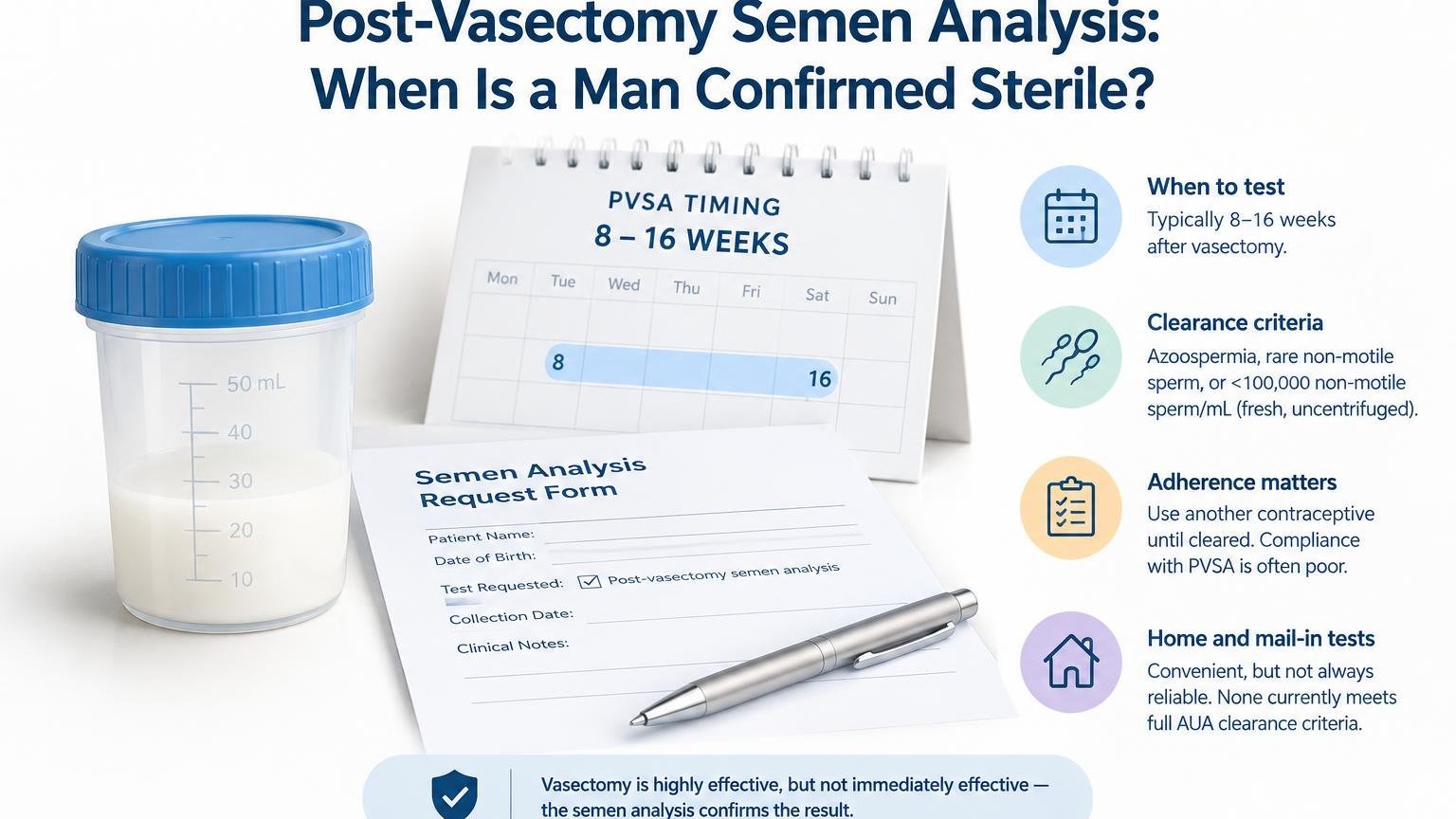
A vasectomy is a highly effective form of permanent contraception, but it does not make a man sterile on the day of the procedure. Both reviewed sources stress that patients must keep using another contraceptive method until a post-vasectomy semen analysis (PVSA) confirms clearance. The test is therefore not a formality: it is the step that converts a surgical procedure into confirmed contraception.[1][2]
Current criteria are broader than many men expect. Clearance can be confirmed when a fresh, uncentrifuged sample shows azoospermia (no sperm), rare non-motile sperm, or fewer than 100,000 non-motile sperm per millilitre. Historically, most physicians required azoospermia, and the 2012 American Urological Association guidelines expanded the definition to include up to 100,000 non-motile sperm. That change reduced the need for repeat testing and raised initial clearance rates, but it has not solved poor compliance with the follow-up test itself.
The practical message for men is simple: use backup contraception until you are cleared, attend the semen check when asked, and understand that home and mail-in kits are convenience tools rather than a proven replacement for guideline-based clearance.
Why This Matters
Vasectomy is often described as a one-time decision, but the evidence reviews frame it as a process with a built-in verification step. The procedure is reported as reliable, with a success rate exceeding 98%. That figure is reassuring at population level, yet it is not a guarantee for an individual couple, and both reviews note that early or late failures can occur. The semen analysis is how those failures are detected before an unintended pregnancy happens.
The stakes of skipping the check are highest in the first months after surgery, when residual sperm can still be present. One review also points to a demographic shift: vasectomy rates have risen, particularly among younger, childless men, driven by changing attitudes toward reproductive autonomy and by political and socioeconomic factors. The same review argues that this shift makes clear counselling about the non-immediate contraceptive effect and better PVSA compliance more important, not less. That argument is interpretive rather than a measured outcome, so it should be read as a reasonable concern rather than proof of cause and effect.
There is also a systems problem. Guidelines emphasize PVSA, but adherence and interpretation vary in actual practice, with significant mismatches between what is recommended and what happens. For a man trying to understand his own follow-up, that means the advice you receive may depend on your surgeon and clinic, and it is worth asking explicitly what your local protocol requires.
Biological and Clinical Mechanism
A vasectomy interrupts the vas deferens, the tube that carries sperm from each testis toward the ejaculate. Sperm continue to be produced in the testes, but they no longer reach the semen in the same way. The catch is timing and anatomy: sperm already stored beyond the blockage can remain in the ejaculatory tract for a while, and the tract is not instantly emptied by surgery. That is why vasectomy does not render a patient sterile immediately and why alternate contraception is needed until clearance is confirmed.
Clearance is judged on what the laboratory actually sees. The criterion depends on a fresh, uncentrifuged sample, because how the sample is handled affects whether sperm are detected and counted. The accepted result can be azoospermia, rare non-motile sperm, or fewer than 100,000 non-motile sperm per millilitre. Motility matters in these criteria: the thresholds refer to non-motile sperm, so a sample with many motile sperm would not meet them.
Two failure patterns are described. Early failure usually reflects sperm still clearing from the tract or a procedure that did not fully occlude it; late failure can reflect recanalization, where the divided ends reconnect over time. The reviews do not quantify these failure rates in the supplied text, so the honest summary is that failure is possible in both windows and that the semen check is the detection tool rather than a guarantee against either.
What the Evidence Shows
On timing, PVSA is typically performed between 8 and 16 weeks after vasectomy, depending on the surgeon's preference. This is a description of typical practice, not a fixed biological deadline, and the range itself explains part of the variation men experience. The interval allows time for sperm to clear while still catching persistent sperm reasonably early.
| Variable | Reported definition or value | Interpretation |
|---|---|---|
| Vasectomy success rate | Exceeding 98%, as summarized in a review | High effectiveness at review level; not an individual guarantee |
| Typical PVSA timing | 8-16 weeks after vasectomy, depending on surgeon preference | Practice-based interval, not a single fixed protocol |
| Historical clearance standard | Most physicians required azoospermia | Strictest criterion; varied widely among providers |
| 2012 AUA clearance threshold | Up to 100,000 non-motile sperm; azoospermia and rare non-motile sperm also acceptable | Broader than azoospermia alone; applies to a fresh, uncentrifuged sample |
| Effect of broadened criteria | Fewer repeat semen analyses and higher initial clearance rates | Fewer men need retesting, but compliance with testing remains poor |
| Home and mail-in testing | Convenient but not always reliable; no current at-home test meets AUA clearance criteria by the review's assessment | Mail-in testing may clear by azoospermia alone; not a proven substitute for full criteria |
On adherence, the picture is less encouraging. Patient compliance with PVSA has been poor, which has motivated research into why men skip the test and how completion can be improved. The reviews do not provide compliance percentages in the supplied text, so the size of the gap cannot be stated precisely from these sources. What can be said is that the gap is treated as a real clinical problem rather than a fringe complaint, because an unconfirmed vasectomy leaves a couple relying on a procedure whose outcome has not been checked.
On alternatives, mail-in and at-home PVSA kits are presented as promising for convenience and privacy, with the potential to reduce embarrassment and improve compliance. That potential is a hypothesis, not a demonstrated effect in the supplied text. More importantly, one review states that no currently available at-home test fulfils AUA clearance criteria, although mail-in testing can be used to clear patients on the basis of azoospermia alone. In other words, the home route can confirm the strictest result but does not yet cover the full range of acceptable clearance outcomes.
Interpretation and Limitations
Both documents are narrative reviews rather than new cohort studies or randomised trials. They summarise guideline positions and clinical experience, and their statements about success rates, timing and compliance are review-level claims. The supplied text does not give denominators, confidence intervals, or study-level effect sizes, so this article cannot tell you how often PVSA is completed, how many men need repeat tests, or how much home testing changes pregnancy risk. Those are exactly the numbers a couple might want, and the reviews themselves call for further research to harmonise protocols.
There is also a definitional limitation worth flagging. The 100,000 non-motile sperm threshold is often quoted without its per-volume basis, and one of the supplied quotes states the guideline threshold without specifying per millilitre. The other source explicitly frames the criterion as fewer than 100,000 non-motile sperm per millilitre on a fresh, uncentrifuged sample. Men comparing clinic letters should therefore check both the number and the units, and ask the laboratory how the sample was handled.
Finally, the evidence on behavioural change is weak in these sources. The claim that younger, childless men are driving vasectomy rates is an interpretive framing, and the suggestion that improved counselling will improve compliance is a recommendation rather than a tested intervention. The mail-in and at-home discussion is similarly provisional: convenience is plausible, but the supplied reviews do not show that it raises completion or lowers unintended pregnancy.
Research Outlook
The research agenda described in these reviews has two strands. The first is harmonisation: because guidelines vary and PVSA outcomes are inconsistent across health systems, there is a call for protocols that are easier to compare and follow. The second is patient-centred: future work should examine strategies to improve PVSA compliance and explore patient preferences and alternative options. Neither review reports a completed trial of a compliance intervention, so these remain directions rather than results.
For now, the most defensible reading of the evidence is conservative. Treat vasectomy as highly effective but not immediately effective; treat the semen check as the step that confirms the outcome; and treat home or mail-in testing as an evolving option whose reliability and coverage are still being assessed. If you are considering or recovering from vasectomy, the useful questions for your clinician are which clearance criteria your clinic uses, when it wants the sample, and what happens if the first result is not clear.
Key Takeaways
- Vasectomy does not sterilise immediately; use another contraceptive method until a post-vasectomy semen analysis confirms clearance.
- Testing is typically done 8-16 weeks after surgery, depending on the surgeon's protocol.
- Acceptable clearance can include azoospermia, rare non-motile sperm, or fewer than 100,000 non-motile sperm per millilitre on a fresh, uncentrifuged sample.
- The 2012 AUA broadening reduced repeat testing and raised initial clearance rates, but compliance with PVSA remains poor.
- At-home tests are convenient but not always reliable; by the review's assessment, none currently meets AUA clearance criteria, and mail-in testing may clear on azoospermia alone.
- The evidence base is narrative review level, so specific completion and failure rates should be sought from local clinic data rather than inferred from these summaries.
Questions and Answers
What is post-vasectomy semen analysis (PVSA) and why is it needed?
PVSA is a semen test performed after vasectomy to confirm that sperm no longer meet the clearance criteria. It is needed because vasectomy does not make a man sterile immediately, and early or late failures are possible. Guidelines emphasize PVSA, and patients should use another contraceptive method until clearance is confirmed.
When should post-vasectomy semen analysis be done?
PVSA is typically performed between 8 and 16 weeks after vasectomy, depending on the surgeon's preference. This is a description of common practice rather than a single fixed deadline, so the exact timing should come from your own clinic's protocol.
What sperm count counts as clear after a vasectomy?
Accepted clearance includes azoospermia, rare non-motile sperm, or fewer than 100,000 non-motile sperm per millilitre on a fresh, uncentrifuged sample. The 2012 AUA guidelines broadened clearance to include up to 100,000 non-motile sperm, which reduced repeat testing and raised initial clearance rates.
How reliable is home or mail-in post-vasectomy semen testing?
Home kits are described as convenient but not always reliable, and one review states that no currently available at-home test fulfils AUA clearance criteria. Mail-in testing can be used to clear patients on the basis of azoospermia alone. The idea that convenience improves compliance is a plausible hypothesis, not a demonstrated result in the supplied reviews.
Why do so many men skip the semen check after a vasectomy?
The reviews report that compliance with PVSA has been poor and call for research into the factors involved and ways to improve completion. They do not give completion percentages in the supplied text, so the exact size of the gap is uncertain. Convenience and reduced embarrassment are proposed reasons that home testing might help.
How strong is the evidence behind current post-vasectomy clearance advice?
The supplied sources are narrative reviews summarising guideline positions and clinical experience, not new cohort studies or trials. They support the general approach but do not provide denominators, confidence intervals, or trial-level data on compliance interventions. Specific local completion and failure rates should be obtained from your clinic rather than inferred from these reviews.
Sources and References
- Post-Vasectomy Semen Analysis: What’s All the Fuss about? – DOAJ. Diagnostics. 2024
- Cahill, Ellen M.; Rabil, Maximilian J.; Rotker, Katherine; Honig, Stanton C.. Post-vasectomy semen analysis: what is the best protocol?. DOI: 10.1038/s41443-025-01052-3. PMID: 40155486.
SANYUN Science Center explains published research on men's reproductive and sexual health, connecting scientific evidence with everyday questions while making sources and limitations clear.
Disclaimer: This article is for scientific education and research communication only. It does not provide medical advice, diagnosis, or individualized treatment recommendations, and does not endorse any medication, supplement, device, penile enlargement procedure, or other intervention. Decisions about sexual and reproductive health should be made in consultation with a qualified healthcare professional. Do not delay seeking professional care because of information in this article.
Original Content & Copyright Notice
- This article is prepared for SANYUN Science Center, drawing on published research and publicly available academic literature on men’s sexual and reproductive health. Its editorial explanations and presentation are developed for this platform.
- Copyright in the original editorial content, selection, and arrangement is reserved by SANYUN Science Center to the extent protected by applicable law. Referenced research, quotations, and third-party materials remain subject to the rights of their respective owners. This notice does not claim ownership of scientific facts or third-party research.
- Except where permitted by applicable law or an applicable license, prior written permission is required to reproduce, republish, translate, adapt, redistribute, or commercially reuse protected content. Attribution alone does not grant permission for such reuse.
- For permitted quotation or authorized reuse, clearly identify the source and retain a link to the original article.
- Source: SANYUN Science Center
- Original URL: Retain the original article URL on science.san-yun.com.
- Copyright Holder: SANYUN Science Center, for its own protected editorial content.
- Quotation, excerpts, or authorized reuse must not distort the scientific meaning, omit material limitations or disclaimers, or imply unverified medical claims, product efficacy, or endorsement by SANYUN Science Center.



