




Category: Reproductive Care
Core Research Direction: Post-vasectomy semen analysis (PVSA): clearance criteria, timing, and compliance as the decisive step before discontinuing contraception
Search Intent: After a vasectomy, when and how should semen be tested before relying on it for contraception—and why do so many men skip the test?
Platform: SANYUN Science Center
Evidence reviewed through: 2026-11-22
Executive Summary
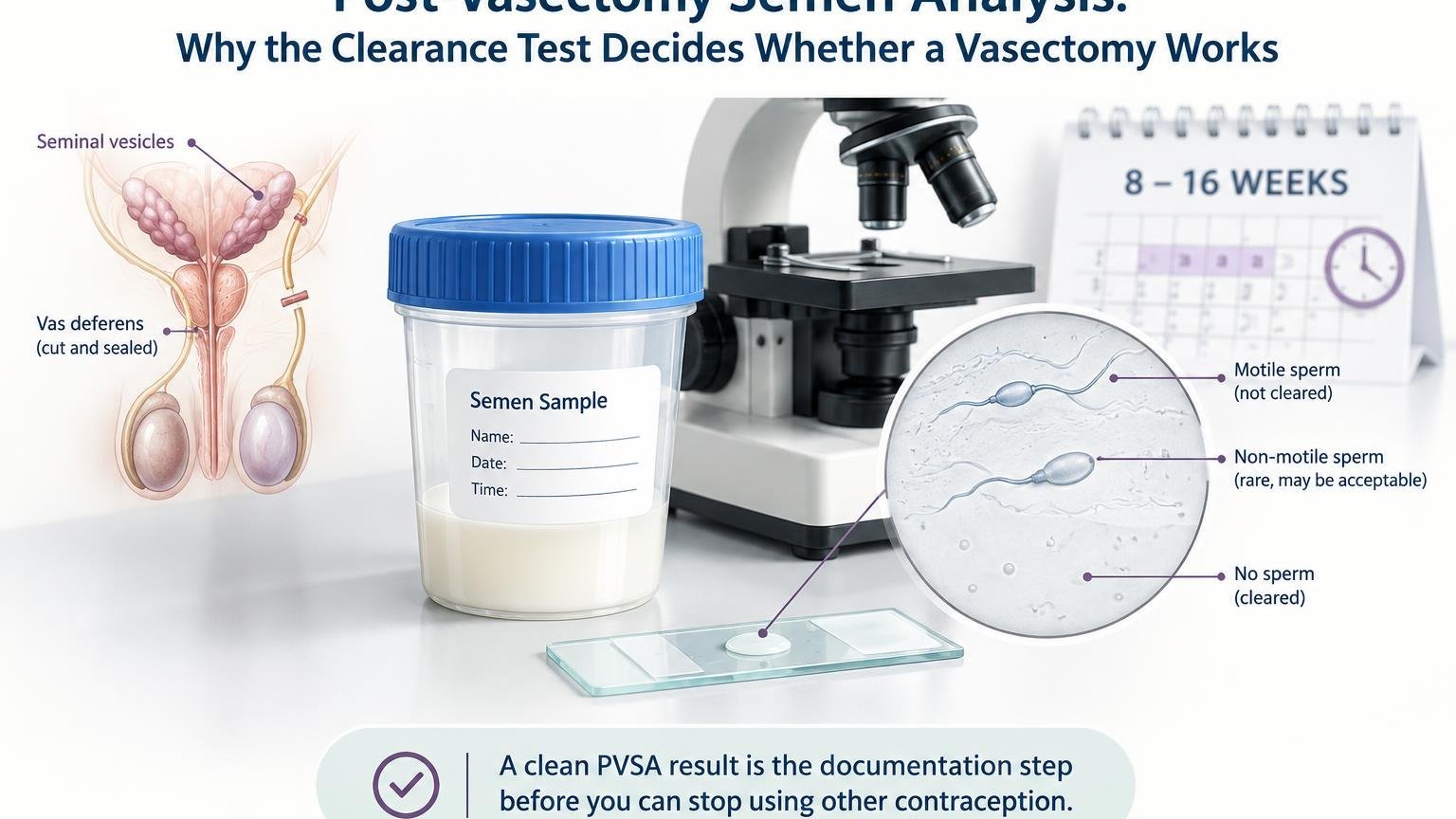
A vasectomy is a safe, quick and highly effective form of permanent sterilization, but it does not make a man sterile immediately. Sperm that were already downstream of the cut at the time of the procedure remain in the seminal vesicles and lower vas, and they must be cleared through ejaculation before the ejaculate becomes sperm-free. Because of this, the post-vasectomy semen analysis (PVSA) is the step that confirms the procedure has worked. Until a clinician documents a satisfactory result, couples are advised to keep using their previous contraception.[1][2]
The PVSA is a laboratory examination of ejaculate under a microscope to confirm the absence of sperm, or the presence of only rare non-motile sperm. The American Urological Association recommends the first test at 8 to 16 weeks after the procedure. A review in the International Journal of Impotence Research notes that compliance with this test is poor, and that mail-in and at-home options are being studied as ways to improve completion. No at-home test currently fulfills AUA clearance criteria, although mail-in testing can clear patients when azoospermia alone is demonstrated.
Why This Matters
The clinical stakes of the PVSA are straightforward: a vasectomy is not effective birth control until a urologist confirms a satisfactory PVSA result in writing. The consumer explainer reviewed here describes skipping the PVSA as the most common reason for unintended pregnancies after vasectomy, and reports that compliance rates in some studies are as low as 50%. The review agrees that patient compliance has been poor, while not citing a specific rate in the supplied excerpt. These compliance claims come from secondary summaries, and the individual studies behind the 50% figure are not named in the source text.
The gap is not caused by unclear science alone. The AUA criteria have been in place since 2012, and the expanded definition including rare non-motile sperm has reduced the need for repeat semen analyses and increased initial clearance rates. Yet compliance remains poor, which suggests the bottleneck is behavioral, logistical and psychological rather than purely biological. Researchers are studying factors associated with compliance and interventions to enhance completion, including patient preferences for alternative testing options.
The Mechanistic Reason for the Wait
The need for a waiting period is anatomical. The vas deferens is cut and sealed, but sperm that were stored downstream of the obstruction—in the seminal vesicles and lower vas—remain in the tract. They are not removed by the procedure itself. Only ejaculation clears the reservoir, and the process takes time. This is why a clean result cannot be assumed on the day of surgery, and why the AUA recommends the first PVSA at 8 to 16 weeks after the procedure.
Some surgeons add a target of roughly 20 ejaculations within that window as a clearance benchmark. The consumer source reviewed here emphasizes that the calendar window and the ejaculation target are independent: a man can reach 8 to 16 weeks without enough ejaculations, or have enough ejaculations before the window has passed. Both factors contribute to clearance, and the ejaculation target is a practice-specific addition rather than a universal guideline requirement.
What the Evidence Shows
Clearance criteria have changed over time. Historically, most physicians required azoospermia—no sperm in the sample—before considering a vasectomy successful, and criteria varied widely among providers. In 2012, the AUA guidelines expanded the definition of post-vasectomy clearance to include up to 100,000 non-motile sperm. The consumer source specifies this as fewer than 100,000 non-motile sperm per milliliter. The review reports that this change decreased the need for subsequent semen analyses and increased initial clearance rates.
What happens after the first test matters too. If motile sperm are seen, the patient is not cleared and needs a repeat test. If sperm persist past 6 months, a workup for vasectomy failure begins. These are clinical decision points rather than self-reported outcomes, and they require a clinician to interpret the result. The consumer source stresses that final clearance to stop using other contraception should come from a urologist after a clinical PVSA or a clinician-reviewed result, not from a screening tool alone.
| Variable | Source-grounded definition | Interpretation |
|---|---|---|
| Post-vasectomy semen analysis (PVSA) | Microscopic examination of ejaculate to confirm no sperm or only rare non-motile sperm after vasectomy | The documentation step that clears a man to stop other contraception |
| Azoospermia | No sperm in the sample | Historically the standard clearance result; still accepted |
| Rare non-motile sperm | Fewer than 100,000 non-motile sperm per milliliter, accepted by the AUA as clearance | The 2012 AUA expansion that increased initial clearance rates |
| Motile sperm on PVSA | Sperm with movement observed in the sample | Not cleared; repeat testing required |
| First PVSA timing | 8 to 16 weeks after the procedure, per AUA Vasectomy Guideline | Allows downstream sperm to clear through ejaculation |
| Ejaculation target | Roughly 20 ejaculations within the clearance window, used by some surgeons | Independent of the calendar window; both contribute to clearance |
| Persistent sperm beyond 6 months | Sperm still present past 6 months post-vasectomy | Triggers a workup for vasectomy failure |
The Compliance Problem
The review describes mail-in and at-home PVSA as having the potential to increase compliance because of convenience and reduced patient embarrassment. That framing is explicitly a hypothesis: the supplied text presents it as potential, not as a demonstrated effect. The consumer source positions at-home testing as a screening and progress-tracking tool only, and states that final clearance should come from a urologist after a clinical PVSA or a clinician-reviewed result. The review adds that no currently at-home test fulfills the AUA guidelines on post-vasectomy clearance, although mail-in testing can be used to clear patients on the basis of azoospermia alone.
This distinction matters for interpreting the evidence. A convenient test that detects persistent sperm is useful for tracking progress through the clearance window, but it is not the same as a test that satisfies the full AUA clearance definition, which includes the rare non-motile sperm category. Men who use at-home or mail-in options still need clinician review before they rely on the result to stop contraception. The review calls for future research on strategies to enhance PVSA compliance, patient preferences and alternative options.
Interpretation and Limitations
The evidence summarized here has important limits. Neither source is a primary study of PVSA outcomes, and the supplied excerpts do not report sample sizes, confidence intervals or the individual studies behind the 50% compliance figure. The 8 to 16 week window and the rare non-motile sperm threshold are relayed from the AUA guideline through secondary sources; the full guideline text was not supplied. The 6-month failure workup threshold and the claim that skipping the PVSA is the most common reason for post-vasectomy pregnancy are editorial statements without cited primary data in the supplied text.
The two sources also serve different purposes. The consumer explainer is written with a commercial at-home testing context and includes practical guidance that is not attributed to a specific study. The journal review is a narrative summary that describes historical variation and the 2012 guideline change but provides no quantitative effect sizes. Neither source supports a claim that a particular testing method is proven to reduce pregnancy rates, and neither should be read as a new experiment or a systematic review.
Research Outlook
The review's research agenda is clear: continued strategies to enhance PVSA compliance, exploration of patient preferences, and evaluation of alternative testing options. The compliance gap is the central problem. Even a well-defined clearance standard cannot prevent unintended pregnancy if men do not complete the test that applies it. Future work will need to show whether convenience-oriented testing models actually increase completion and whether they can be integrated with clinician review without weakening the clearance standard.
Key Takeaways
- A vasectomy is not immediately effective; couples should keep using prior contraception until a clean PVSA is documented.
- The AUA recommends the first PVSA at 8 to 16 weeks after the procedure, because downstream sperm must be cleared by ejaculation.
- Azoospermia is the classic clearance result; since 2012 the AUA also accepts fewer than 100,000 non-motile sperm per milliliter.
- Motile sperm mean the patient is not cleared and needs a repeat test; sperm persisting past 6 months trigger a failure workup.
- PVSA compliance is poor, with some studies reporting rates as low as 50%; the review calls for research on convenience-oriented testing and patient preferences.
- At-home tests are positioned as screening tools; final clearance should come from a urologist after clinical or clinician-reviewed PVSA.
Questions and Answers
What is a post-vasectomy semen analysis (PVSA) and why is it needed?
A PVSA is a microscopic examination of ejaculate to confirm that no sperm, or only rare non-motile sperm, remain after a vasectomy. It is needed because vasectomy does not cause immediate sterility: sperm already downstream of the cut must be cleared through ejaculation. Until a clinician documents a satisfactory PVSA result, the procedure should not be relied on as birth control.
When should the first semen test be done after a vasectomy?
The American Urological Association recommends the first PVSA at 8 to 16 weeks after the procedure. Some surgeons also use a target of roughly 20 ejaculations within that window. The calendar window and the ejaculation target are independent benchmarks; reaching one does not guarantee the other, and both contribute to clearance.
What sperm count counts as clear after a vasectomy?
The classic clearance result is azoospermia, meaning no sperm in the sample. Since the 2012 AUA guidelines, clearance can also include rare non-motile sperm, defined as fewer than 100,000 non-motile sperm per milliliter. If motile sperm are seen, the patient is not cleared and needs a repeat test. Sperm persisting past 6 months trigger a workup for vasectomy failure.
How common is it for men to skip the post-vasectomy semen analysis?
Compliance is poor. A consumer source reports that PVSA is the most commonly skipped step in the vasectomy process, with rates in some studies as low as 50%. A journal review also describes compliance as poor, though it does not cite a specific rate in the supplied excerpt. The individual studies behind the 50% figure are not named in these sources, so the estimate should be treated cautiously.
Are at-home semen tests enough to stop using contraception after a vasectomy?
Not on their own. A review states that no currently at-home test fulfills the AUA guidelines on post-vasectomy clearance, although mail-in testing can clear patients when azoospermia alone is demonstrated. A consumer source positions at-home testing as a screening and progress-tracking tool only. Final clearance to stop other contraception should come from a urologist after a clinical PVSA or a clinician-reviewed result.
What are the main limitations of the evidence on PVSA clearance and compliance?
The evidence summarized here comes from a consumer explainer and a narrative review, not primary studies. Sample sizes, confidence intervals and the individual compliance studies are not reported in the supplied excerpts. The timing window and sperm thresholds are relayed from the AUA guideline through secondary sources, and claims such as the 6-month failure workup and the link between skipped testing and unintended pregnancy are editorial statements without cited primary data.
Sources and References
- Cahill, Ellen M.; Rabil, Maximilian J.; Rotker, Katherine; Honig, Stanton C.. Post-vasectomy semen analysis: what is the best protocol?. DOI: 10.1038/s41443-025-01052-3. PMID: 40155486.
- Mike Sanders. What Is a Post-Vasectomy Semen Analysis (PVSA)?. 2026
SANYUN Science Center explains published research on men's reproductive and sexual health, connecting scientific evidence with everyday questions while making sources and limitations clear.
Disclaimer: This article is for scientific education and research communication only. It does not provide medical advice, diagnosis, or individualized treatment recommendations, and does not endorse any medication, supplement, device, penile enlargement procedure, or other intervention. Decisions about sexual and reproductive health should be made in consultation with a qualified healthcare professional. Do not delay seeking professional care because of information in this article.
Original Content & Copyright Notice
- This article is prepared for SANYUN Science Center, drawing on published research and publicly available academic literature on men’s sexual and reproductive health. Its editorial explanations and presentation are developed for this platform.
- Copyright in the original editorial content, selection, and arrangement is reserved by SANYUN Science Center to the extent protected by applicable law. Referenced research, quotations, and third-party materials remain subject to the rights of their respective owners. This notice does not claim ownership of scientific facts or third-party research.
- Except where permitted by applicable law or an applicable license, prior written permission is required to reproduce, republish, translate, adapt, redistribute, or commercially reuse protected content. Attribution alone does not grant permission for such reuse.
- For permitted quotation or authorized reuse, clearly identify the source and retain a link to the original article.
- Source: SANYUN Science Center
- Original URL: Retain the original article URL on science.san-yun.com.
- Copyright Holder: SANYUN Science Center, for its own protected editorial content.
- Quotation, excerpts, or authorized reuse must not distort the scientific meaning, omit material limitations or disclaimers, or imply unverified medical claims, product efficacy, or endorsement by SANYUN Science Center.



