




Category: Premature Ejaculation
Core Research Direction: Contemporary consensus (5th ICSM) on the definition, classification, evaluation and treatment of premature ejaculation, contrasted with prior exploratory behavioral therapy evidence, PDE5-inhibitor trial results, and epidemiology that depends strongly on the definition used
Search Intent: What does the current international consensus say about how premature ejaculation is defined, subclassified and treated, and how strong is the underlying evidence for pharmacological versus behavioral approaches?
Platform: SANYUN Science Center
Evidence reviewed through: 2026-11-15
Executive Summary
The Fifth International Consultation on Sexual Medicine (5th ICSM) has published a consensus review that sets out definition, classification and treatment recommendations for premature ejaculation and delayed ejaculation. According to a summary of the 2026 consensus, the recommendations were developed with a modified Delphi process and the GRADE system, drawing on recent literature rather than presenting new primary data. The same summary states that premature ejaculation remains the most common male sexual complaint and is divided into lifelong, acquired, variable and subjective subtypes, with treatment including SSRIs, local anesthetics and psychotherapy.[1][2]
The consensus definition is built on three elements rather than a stopwatch alone: time to ejaculation, distress and control. This matters because earlier epidemiology is definition-dependent. A US survey reported a prevalence of 31% among men aged 18–59, whereas a strict definition of ejaculation within one minute has been linked to 2–5% of men, and subtype-based estimates place lifelong premature ejaculation near 3%. The clinical task is therefore not to decide whether a man is fast, but whether the pattern is persistent, poorly controlled and distressing.[3][4][5]
Treatment evidence is uneven. Dapoxetine has the clearest on-demand trial support, with reported IELT increases of 2.5- to 3.0-fold, but it carries dose-dependent nausea, diarrhea, headache and dizziness that often lead to discontinuation. One randomized trial found that sildenafil did not significantly improve IELT despite improving confidence, control and satisfaction. Behavioral therapy has a long clinical tradition but weaker trial support; one expert commentary concluded that more convincing evidence is needed. High long-term discontinuation, including a 90% cumulative rate after two years in one report on combination therapy, is a central and often under-discussed limitation.
Why This Matters
Premature ejaculation is common, but it is not a single biological entity. The distinction between lifelong and acquired forms changes the diagnostic path: lifelong premature ejaculation is usually treated symptomatically, whereas acquired premature ejaculation prompts a search for causes such as erectile dysfunction, prostatitis, thyroid overactivity or relationship strain. When erectile dysfunction and premature ejaculation coexist, one clinical narrative suggests that rushing to finish while the erection holds can mimic premature ejaculation, and that treating the erectile dysfunction first may resolve the apparent ejaculatory problem.
The personal burden is substantial. Men with premature ejaculation are often dissatisfied with their sexual relationship, have difficulties during intercourse and are less often sexually active, and the condition is associated with stress, frustration, anxiety and depression. Yet four out of five men (78%) do not seek professional help, which means the consensus framework reaches only a minority of those affected unless clinicians initiate the conversation.
Defining the Condition: Time, Distress and Control
ICD-11 describes premature ejaculation as ejaculation occurring before or shortly after vaginal penetration over several months, with little or no control over ejaculation and associated distress. The 5th ICSM consensus similarly incorporates time, distress and control criteria. A patient-facing summary of European guidance makes the hierarchy explicit: the time criterion, the loss of control and the distress criterion must all be present, and if distress is absent, no disorder is present even when the time appears short.
The subtype framework adds precision. Lifelong premature ejaculation has been present since the onset of sexual activity and is usually associated with ejaculation within about one minute of vaginal penetration. Acquired premature ejaculation develops later in life and is characterized by a significant shortening of latency to about three minutes or less. Variable premature ejaculation involves strongly fluctuating ejaculation times, and subjective premature ejaculation describes men who perceive ejaculation as too early despite objectively normal intravaginal latency. The 2026 ICSM summary lists lifelong, acquired, variable and subjective subtypes as the current classification.
These thresholds are classification conventions, not measured outcomes, and they should not be read as diagnostic cut-offs for an individual. A man whose latency is four minutes but who reports severe distress and no sense of control fits the definitional spirit more closely than a man at one minute who is untroubled. This is also why self-estimated latency deserves caution: self-estimates may overestimate intravaginal ejaculatory latency time by about one minute, and the mean time between penetration and ejaculation in general samples is around five minutes with very large variance.
Epidemiology Depends Heavily on the Definition
| Definition or classification | Reported prevalence | Population or context | What it tells us |
|---|---|---|---|
| US National Health and Social Life Survey definition | 31% | Men aged 18–59 years | Broad survey-based estimate; definition-dependent |
| Strict criterion: ejaculation within at most one minute after penetration | 2–5% | Men | Narrow threshold yields a much smaller group |
| Waldinger classification, lifelong | About 3% | Men in general | Subtype-specific estimate |
| Waldinger classification, acquired | 4% | Men in general | Subtype-specific estimate |
| Waldinger classification, variable | About 10% | Men in general | Subtype-specific estimate |
| Waldinger classification, subjective | 6% | Men in general | Subtype-specific estimate |
| Self-perceived difficulty lasting long enough | Up to 20–30% | Men | Hedged estimate from a sponsored commentary, not a diagnostic rate |
| General estimate in patient information[6] | About one in four men | Men | Estimate without a stated definition |
The spread is not a contradiction so much as a consequence of what is being counted. A survey question about “ejaculating too quickly” captures dissatisfaction; a strict latency threshold captures a narrow physiological pattern; subtype classification separates lifelong from acquired and situational forms. A sponsored commentary noted that 2–5% may meet a strict one-minute definition while up to 20–30% may feel they cannot last long enough, and a patient-information article estimates that about one in four men is affected without specifying a definition. None of these figures should be treated as interchangeable.
A further limitation is that not all sources agree on age distribution. One patient-information article states that affected men are represented in equal proportions across age groups, but this claim is not supported by cited data in the supplied material, and it sits awkwardly with the distinction between lifelong and acquired forms. The epidemiology of premature ejaculation should be read as definition- and population-sensitive rather than as a fixed prevalence.
Biological and Clinical Mechanism
The causes of premature ejaculation are not fully clarified. A review of pathophysiology suggests that lifelong premature ejaculation may involve penile hypersensitivity, disturbed serotonin regulation in the brain and hormonal imbalance, while acquired premature ejaculation is more often associated with psychological problems, relationship difficulties or traumatic sexual experiences; genetic and epigenetic factors may also contribute. A sponsored commentary describes the causes as unsettled and suggests nervousness, faulty ejaculatory reflex function and certain brain processes as possibilities, with inherited factors as a further hypothesis.
The consensus keyword scope includes penile hypersensitivity and selective serotonin reuptake inhibitors, which reflects the two dominant mechanistic threads: reduced penile sensory threshold and central serotonergic modulation of the ejaculatory reflex. Risk factors reported in a clinical review include physical inactivity, poor general health with overweight and diabetes, prostatitis and thyroid overactivity. These are plausible contributors rather than established causes, and the same review notes that successful treatment of chronic prostatitis can significantly improve ejaculation latency and control.
The erectile dysfunction overlap deserves particular attention. In a patient-facing summary of European guidance, the most frequently overlooked pattern is a man who develops erectile dysfunction and unconsciously rushes intercourse to finish while the erection holds; this looks like premature ejaculation but has a different cause. The practical implication is that when both problems are present, the erectile dysfunction is treated first, and the apparent ejaculatory problem may resolve without specific ejaculatory treatment.
What the Evidence Shows: Pharmacological Treatment
Dapoxetine is a short-acting selective serotonin reuptake inhibitor licensed for on-demand treatment of premature ejaculation. A clinical review reports that it increases IELT by 2.5- to 3.0-fold and works better in patients with intravaginal latency below 30 seconds. The same review notes that nausea, diarrhea, headache and dizziness occur dose-dependently and often lead to treatment discontinuation. These are second-hand summaries of trials, not a pooled analysis, and the review does not provide the underlying trial data or discontinuation percentages.
The PDE5 inhibitor evidence is more ambiguous. In one randomized trial comparing sildenafil with placebo, IELT was not significantly improved, although sildenafil increased self-confidence, ejaculatory control and sexual satisfaction. This dissociation between a physiological endpoint and patient-reported outcomes is important: a drug can change the experience of sex without changing the measured latency, and trials that rely only on IELT may miss what men value. It would be wrong to present PDE5 inhibitors as an established latency-prolonging treatment on the basis of this single trial, and equally wrong to dismiss the patient-reported benefits as noise.
Combination therapy with dapoxetine plus sildenafil has been reported to improve IELT compared with monotherapy, but the same review reports a cumulative discontinuation rate of 90% after two years. The reasons given are adverse effects, subjectively insufficient efficacy, high cost, the recognition that the condition is not cured long-term, and the need to plan intercourse. That figure is a striking reminder that short-term efficacy trials and long-term real-world persistence are different questions; a treatment can work in a trial and still fail in practice.
Topical local anesthetics — lidocaine–prilocaine cream or spray — reduce glans sensitivity and prolong ejaculation latency without abolishing the sensation of ejaculation. A clinical review states that meta-analyses support their efficacy and safety, with no significant adverse events expected in the absence of allergy, but notes the risk of transfer to the partner and vaginal numbness, so condom use is recommended. A separate commentary notes that lidocaine must be applied about 15 minutes before intercourse and that many men dislike this practical requirement. The practical burden of timed application is a real limitation that efficacy data alone do not capture.
Other SSRIs are used off-label, generally with daily dosing and stronger effects, and tramadol is also used off-label in some settings. The consensus keyword scope includes SSRIs and dapoxetine but does not provide comparative effect estimates in the supplied text. Clinicians and patients should therefore treat comparative claims between agents as uncertain rather than established.
What the Evidence Shows: Behavioral and Psychological Treatment
Behavioral approaches include masturbation techniques, stop–start training in which stimulation is interrupted before the point of no return, the squeeze technique applying pressure to the glans, pelvic floor muscle training and couple-focused psychosexual work. The 5th ICSM consensus lists psychotherapy among treatment options, and a clinical review notes that behavioral and psychosexual interventions can be particularly helpful in variable and subjective premature ejaculation and can be combined with other measures. A patient-information article reports that targeted pelvic floor muscle training significantly prolonged time to ejaculation in studies, though it gives no trial details or effect size.
The counterweight is that behavioral therapy has been criticized as often ineffective. A sponsored commentary reported that experts concluded after comparing several studies that behavioral therapy is often not an effective treatment, and quoted study leader Stanley Althof saying that more convincing evidence is needed that it actually works. The same commentary noted that behavioral therapy is not inexpensive and that a treatment period lasts at least two to three months, while other studies suggested the best results come from combining medication with therapy rather than using either alone.
These positions are not fully reconcilable from the supplied material. The negative assessment comes from an old, sponsored news piece that does not present pooled data, while the positive statements come from a clinical review and a patient-information article that also lack trial-level detail. The most defensible reading is that behavioral techniques have a plausible role, particularly for variable and subjective presentations and as an adjunct to medication, but that their independent efficacy is less firmly established than the efficacy of dapoxetine. A stepped approach over some weeks has been proposed as having better prospects, but this remains a clinical recommendation rather than a tested protocol in the supplied sources.
Interpretation and Limitations
The evidence base for premature ejaculation is constrained by several features. First, the 5th ICSM consensus is a consensus review, not a systematic review with meta-analysis; its recommendations carry the strength of expert synthesis and GRADE assessment rather than new experimental data. Second, several of the most specific numbers in this article come from a clinical review and a sponsored commentary that summarize primary trials second-hand, without showing sample sizes, confidence intervals or full trial methods. Third, the behavioral therapy literature is described inconsistently across sources, with one commentary calling it often ineffective and other sources endorsing it.
Fourth, definitions themselves are a source of heterogeneity. Prevalence estimates range from 2–5% under a strict one-minute criterion to 31% in a US survey and about one in four men in patient information, and subtype-specific figures depend on which classification is applied. This makes cross-study comparison unsafe and means that a clinician's impression of how common the condition is will depend heavily on the questions asked. Fifth, many treatment claims concern IELT, which is only one endpoint; patient-reported control, satisfaction and distress are arguably closer to the definition of the disorder but are less consistently measured.
Sixth, the long-term picture is poorly captured. The reported 90% cumulative discontinuation after two years on combination therapy is a reminder that persistence, tolerability and cost are central to real-world effectiveness, yet these are rarely the focus of short-term efficacy trials. The consensus itself calls for stronger evidence-based treatment research in the future, particularly for delayed ejaculation, which is acknowledged to be less well researched and to have limited treatment options. That is a research recommendation, not a finding.
Finally, the diagnostic process is mostly conversational. The diagnosis is based mainly on history, with validated questionnaires such as the Premature Ejaculation Diagnostic Tool available to assess control, satisfaction and interpersonal difficulty, and a combination of IELT with such questionnaires may improve specificity. Routine laboratory or physiological testing is not recommended, although physical examination may be needed to exclude other causes. This is appropriate for a distress-defined condition, but it also means that the quality of care depends on the clinician's willingness to ask and the patient's willingness to disclose.
Research Outlook
The 5th ICSM consensus explicitly calls for stronger evidence-based treatment research in the future, with particular attention to delayed ejaculation, which remains less well studied and has limited treatment options. For premature ejaculation, the most pressing gaps implied by the supplied evidence are head-to-head and combination trials that measure patient-reported outcomes alongside IELT, long-term persistence studies that account for adverse effects, cost and planning burden, and better-defined behavioral therapy trials. The consensus methodology — modified Delphi with GRADE — provides a structured framework for grading future evidence, but it cannot substitute for the trials themselves.
Another open question is how the four-subtype model will perform in practice. Variable and subjective premature ejaculation together account for a substantial share of prevalence estimates in Waldinger's classification — approximately 10% and 6% respectively — yet they are the subtypes for which behavioral and psychosexual interventions are said to be most helpful and for which pharmacological trial evidence is thinnest. Future research that stratifies by subtype rather than treating premature ejaculation as a single condition would be more informative than further unselected trials.
Key Takeaways
- The 5th ICSM consensus defines premature ejaculation using time, distress and control criteria and classifies it into lifelong, acquired, variable and subjective subtypes; it is a consensus review using a modified Delphi process and GRADE, not new primary research.
- Distress is definitional: without it, no disorder is present even if latency is short, and the classification thresholds of about one minute for lifelong and about three minutes for acquired forms are conventions rather than individual diagnostic cut-offs.
- Prevalence estimates range from 2–5% under a strict one-minute criterion to 31% in a US survey and about one in four men in patient information, so figures should never be compared without their definitions.
- Dapoxetine has the clearest trial support, with reported IELT increases of 2.5- to 3.0-fold, but dose-dependent nausea, diarrhea, headache and dizziness often lead to discontinuation.
- Sildenafil did not significantly improve IELT in one randomized trial but improved confidence, control and satisfaction, a dissociation that cautions against judging treatment solely by latency.
- Behavioral therapy is endorsed by consensus and patient guidance but has been criticized as often ineffective, and the evidence is weaker and less consistent than for dapoxetine.
- Long-term persistence is a major limitation: one report describes a 90% cumulative discontinuation rate after two years on dapoxetine plus sildenafil, driven by adverse effects, perceived insufficient efficacy, cost and the need to plan intercourse.
Questions and Answers
How does the 5th ICSM consensus define premature ejaculation?
The 5th ICSM consensus defines premature ejaculation using time, distress and control criteria, and classifies it into lifelong, acquired, variable and subjective subtypes. The recommendations were developed through a modified Delphi process with GRADE. Clinically, the distress criterion is decisive: a short latency alone does not establish the disorder if the man is not bothered by it.
What is the difference between lifelong and acquired premature ejaculation?
Lifelong premature ejaculation has been present since the onset of sexual activity and is usually associated with ejaculation within about one minute of vaginal penetration. Acquired premature ejaculation develops later and is characterized by a significant shortening of latency to about three minutes or less. The distinction matters because acquired cases prompt a search for causes such as erectile dysfunction, prostatitis or thyroid overactivity.
How effective is dapoxetine for premature ejaculation?
A clinical review reports that dapoxetine increases intravaginal ejaculatory latency time by 2.5- to 3.0-fold and works better in men with latency below 30 seconds. However, nausea, diarrhea, headache and dizziness occur dose-dependently and often lead to discontinuation. These are second-hand summaries rather than a pooled analysis, so the precise magnitude of benefit and long-term persistence remain uncertain.
Do PDE5 inhibitors such as sildenafil treat premature ejaculation?
The evidence is mixed. In one randomized trial, sildenafil did not significantly improve IELT compared with placebo, but it increased self-confidence, ejaculatory control and sexual satisfaction. That dissociation means PDE5 inhibitors should not be presented as established latency-prolonging treatments, but the patient-reported benefits are relevant and warrant discussion with a clinician, particularly when erectile dysfunction coexists.
Is behavioral therapy effective for premature ejaculation?
The evidence is inconsistent. The 5th ICSM consensus includes psychotherapy among treatment options, and behavioral techniques are described as particularly helpful for variable and subjective subtypes. Yet a sponsored commentary reported that experts concluded behavioral therapy is often ineffective and that more convincing evidence is needed. Behavioral approaches appear most defensible as part of a combined plan rather than as a guaranteed stand-alone cure.
Why does the reported prevalence of premature ejaculation vary so much?
Prevalence depends on the definition used. A US survey reported 31% among men aged 18–59, a strict criterion of ejaculation within one minute has been linked to 2–5% of men, and subtype-based estimates place lifelong premature ejaculation near 3% and variable premature ejaculation near 10%. Patient information citing about one in four men usually omits the definition. These figures measure different constructs and should not be compared directly.
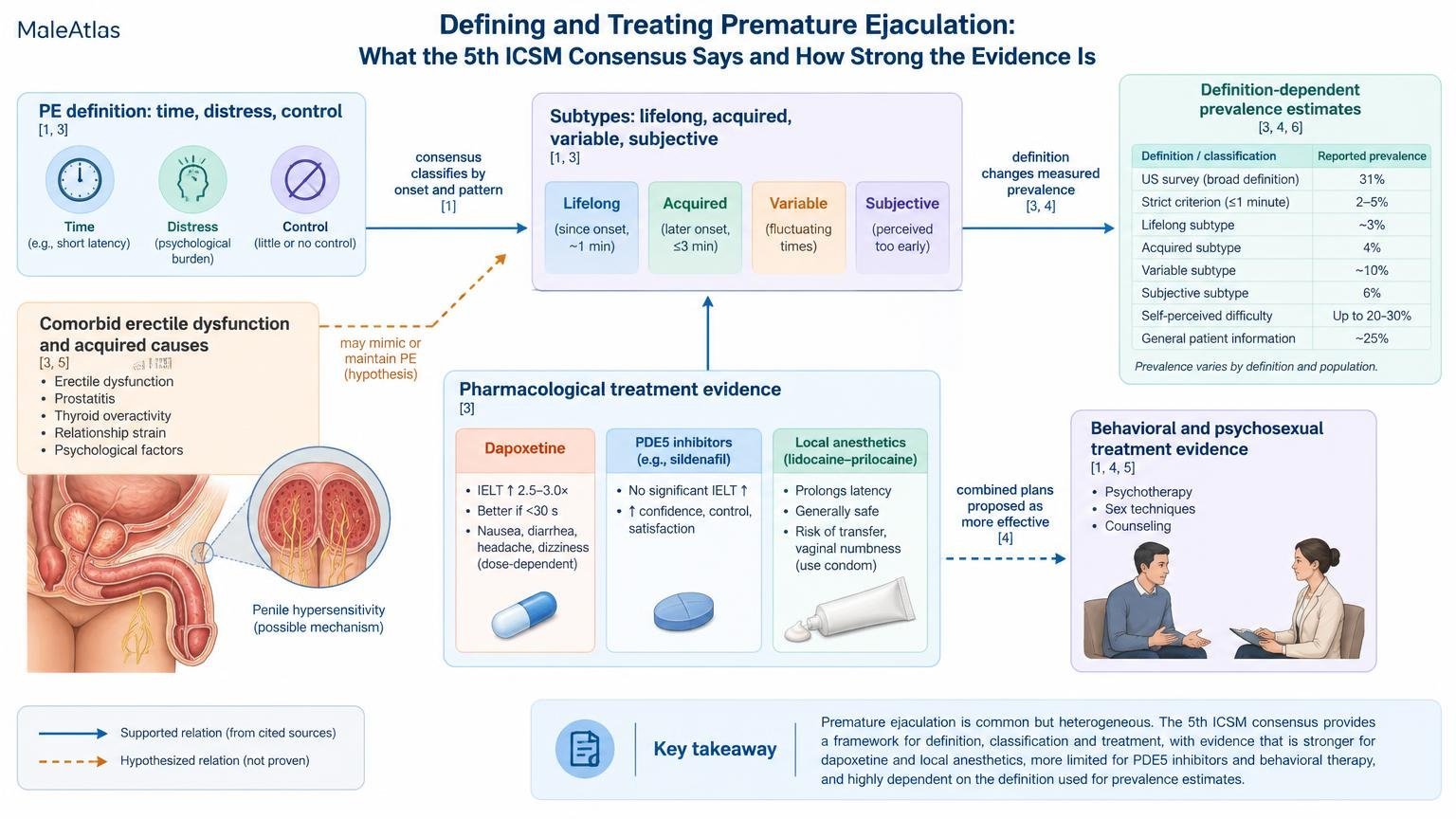
Conceptual framework: Conceptual framework for premature ejaculation evidence. The framework links consensus definition criteria (time, distress, control), the four-subtype classification, definition-dependent prevalence estimates, pharmacological treatment evidence (dapoxetine, PDE5 inhibitors, local anesthetics) and behavioral/psychosexual evidence. Comorbid erectile dysfunction is shown as a proposed contributor to acquired presentations. Solid relations are supported as described by the cited sources; dashed relations are proposed or hypothesis-level. Evidence is a consensus review plus secondary clinical summaries, not a tested causal model.
Academic References & Evidence
- 国际性医学咨询会(ICSM). 2026 ICSM专家共识:早泄和延迟射精的当代共识与新兴方向. Sex Med Rev. 2026 14(4)
- Contemporary consensus and emerging directions in premature and delayed ejaculation: recommendations from the 5th International Consultation on Sexual Medicine.. Sexual medicine reviews PMID: 42855438.
- Dr. Pies. Ejaculatio präcox: Ursachen, Diagnostik und Behandlungsmöglichkeiten. 2023
- PHARMINDEX Online. Nehéz a korai magömlés kezelése | PHARMINDEX Online – hirdetés.
- UroWissen. Vorzeitiger Samenerguss: was wirklich hilft | UroWissen.
- Ejakulationsstörung.
SANYUN Science Center explains published research on men's reproductive and sexual health, connecting scientific evidence with everyday questions while making sources and limitations clear.
Disclaimer: This article is for scientific education and research communication only. It does not provide medical advice, diagnosis, or individualized treatment recommendations, and does not endorse any medication, supplement, device, penile enlargement procedure, or other intervention. Decisions about sexual and reproductive health should be made in consultation with a qualified healthcare professional. Do not delay seeking professional care because of information in this article.
Original Content & Copyright Notice
- This article is prepared for SANYUN Science Center, drawing on published research and publicly available academic literature on men’s sexual and reproductive health. Its editorial explanations and presentation are developed for this platform.
- Copyright in the original editorial content, selection, and arrangement is reserved by SANYUN Science Center to the extent protected by applicable law. Referenced research, quotations, and third-party materials remain subject to the rights of their respective owners. This notice does not claim ownership of scientific facts or third-party research.
- Except where permitted by applicable law or an applicable license, prior written permission is required to reproduce, republish, translate, adapt, redistribute, or commercially reuse protected content. Attribution alone does not grant permission for such reuse.
- For permitted quotation or authorized reuse, clearly identify the source and retain a link to the original article.
- Source: SANYUN Science Center
- Original URL: Retain the original article URL on science.san-yun.com.
- Copyright Holder: SANYUN Science Center, for its own protected editorial content.
- Quotation, excerpts, or authorized reuse must not distort the scientific meaning, omit material limitations or disclaimers, or imply unverified medical claims, product efficacy, or endorsement by SANYUN Science Center.



